
|     |
|
| |

REVIEW / REPORTAcross forms and traditions: Erasing Borders 2026, Day Two- Dr Anita Vallabhe-mail: editor@globalindianartist.com Photos: Nir Arieli Across forms and traditions: Erasing Borders 2026, Day One September 26, 2026 (The article first appeared in Global Indian Artist™ LLC, dated Sept 24, 2026) 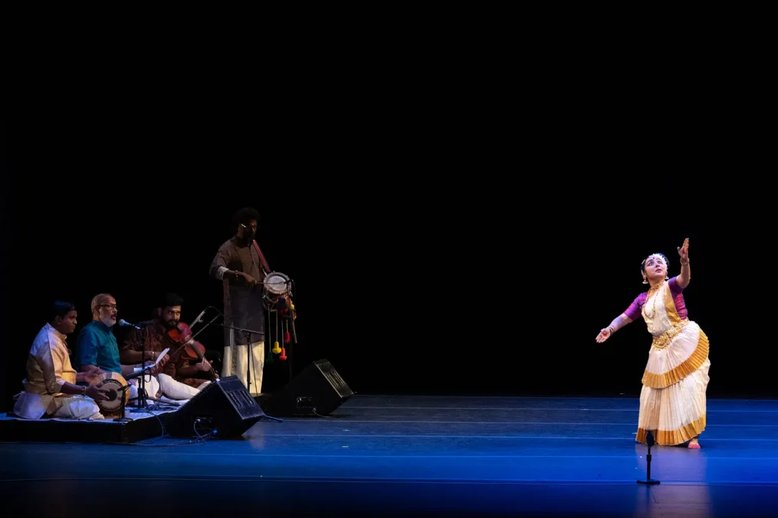 Day 2 commences with Neena Prasad's Śivānubhavam which explores Śiva through the five elements, from water's life-sustaining flow to fire's destructive force, and through the cycles of creation and dissolution. Sound, too, is central to this vision. Neena finds the scale of these ideas in the smallest of gestures. A subtle flutter of her fingers carries expressive weight; in her evocation of the Gaṅgā held in Śiva's matted locks, one senses both the river's flow and the power held within it. Years of practice are written into Neena's movement: each detail arrives with an ease that belies its precision. The live ensemble lends Śivānubhavam gravitas: Changanacherry Madhavan Nampoothiri on vocals, K. P. Ramesh Babu on mridangam, Shyam Kalyan on violin, and Kalamandalam Arundas on edakka. The lighting, too, becomes part of the storytelling. Through Mohiniyattam's fluid grace, Neena makes Śiva's power palpable without sacrificing subtlety. She is an artist at the height of her powers. 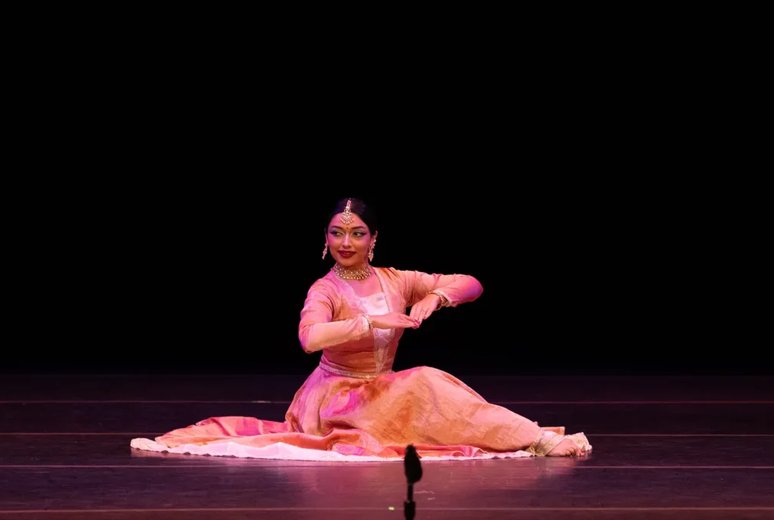 The next presentation opens on a delicate image: Radha Varadan seated beneath a soft spotlight, heightening the impression of a nāyikā in love. Her Kathak rendition of a tarana in Rāga Bhāgeśrī, set to Jhaptāl, is a visual delight, shaped by refined choreographic choices that recall the expressive subtlety reminiscent of the Lucknow gharana. In this choreography, the tarana, traditionally a vehicle for nṛtta without a literal narrative, acquires emotional life within the rāga's melody. Varadan evokes śṛṅgāra through minute expressive details: a sidelong glance, a gentle inclination of the head, a romantic smile, and the familiar act of adorning herself, each intricately laced into the rhythm. These interventions transform a traditionally technical composition into a graceful, flowing aesthetic experience. Varadan's nuanced abhinaya and rhythmic control breathe vibrant life into the choreography of her gurus, Smt. Nirupama Rajendra and Sri T. D. Rajendra. 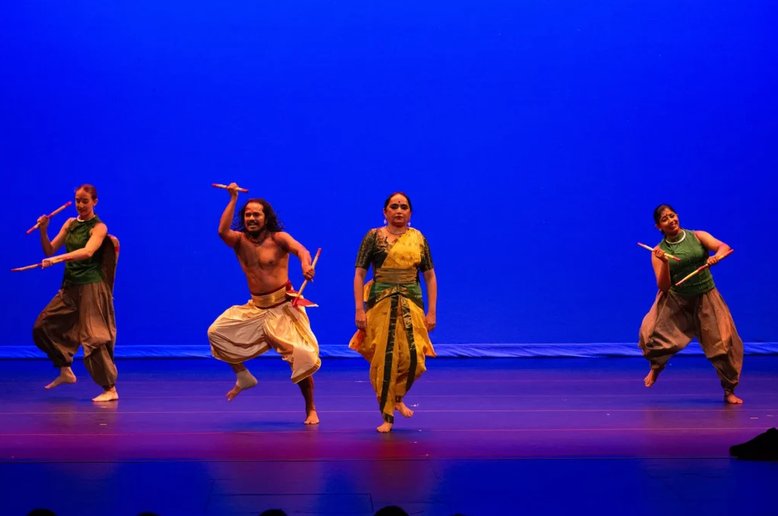 In Aparna Sindhoor and Anil Natyaveda's presentation with Natya-Navarasa, three dancers enter bent forward, winnowing baskets slung across their backs and sticks held low in their outstretched hands.They sing as they work, their unaccompanied voices setting the rhythm of shared labor. The opening is simple and arresting: the baskets place daily life in close relationship with the grain, land, and water that sustain it. Aparna enters singing a folk song, and the narrative shifts from the rhythms of daily work to a community's rightful claim to the land it calls home, a claim threatened by war and sustained by love. Song and verse in different languages carry the work through deforestation, drought, and fire, connecting the struggle of tribal communities in India with those of Indigenous peoples elsewhere. As a God of War figure threatens the forest, the fight becomes one for more than land and water. The people must also defend their songs, dances, and ways of living. The choreography draws on Kalaripayattu, Bharatanatyam, Mallakhamb acrobatics, and theater, giving that resistance a forceful physical language. Black cloth suggests violence and erasure; loose hair, whipped through the air, evokes rebellion spreading like wildfire. The music by award-winning composers Isaac Thomas Kottukapally and George Brooks lifts the narrative without overstating its drama. Earthy and grounded, it stays close to the dancers' physical world. The work is written by S. M. Raju and Aparna Sindhoor, choreographed and directed by Sindhoor and Anil Natyaveda. Raw, urgent, and deeply human, the performance shows the power of art in social and environmental justice. It asks us to rethink what is being taken, empathize with those who resist, and consider what action that understanding demands. 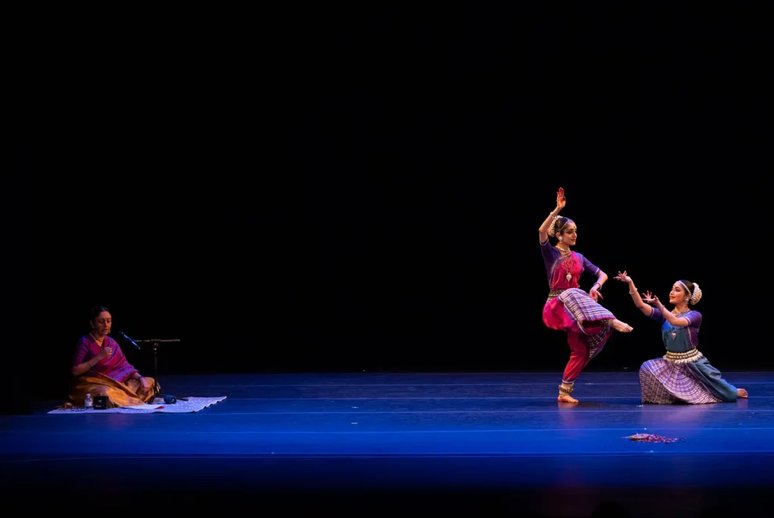 Arushi Mudgal's Athaah is a befitting close to the 18th edition of Erasing Borders Festival, revealing the abundance within classical Odissi. Its five pieces, Pārvatī Lāsyam, Aikya, Chhaliya, Raam Haun, and Aahlad, move through divine encounter, rhythmic play, teasing, grief, and joy. Different musical traditions meet within the form, while two dancers with distinct energies find a shared language onstage. The performance opens with Pārvatī Lāsyam. Arushi and Shalakha Rai stand with their backs turned in a pool of light, their hands moving in alternation to evoke the Gaṅgā flowing from Śiva's matted locks. Their gestures suggest an unbroken current of water and energy before the dancers move into synchrony. They exchange the roles of Śiva and Pārvatī, allowing each to see and embody the other. Gentle heel strokes and delicate mudrās give Pārvatī both serenity and authority; Arushi's whole body comes alive as she evokes Shiva's offering of the ḍamaru. Shalakha's grounded presence is a compelling foil to Arushi's lightness on her feet. Even in unison, each remains unmistakably herself. At moments, the deep curve of the hip and shifts of the spine that give classical Odissi's tribhaṅgī its sculptural force are less pronounced in their dancing. Aikya explores rhythm through a Hindustani tarana and a Kathak tihai woven into Odissi. Chhaliya brings a different playfulness: Krishna's friends tease him about his wan face and see through his denial of love for Radha. Here, too, Arushi and Shalakha exchange roles, each change renewing their relationship to one another and to the music. Throughout Athaah Sawani Mudgal sings live over the recorded music. Her mellifluous voice lends the dancing warmth and intimacy, giving the unfolding stories greater emotional weight. The emotional heart of Athaah is Raam Haun. A fleeting strain of Thumak Chalat Ramchandra recalls Rama walking toward Kaushalya as a child. Now he is a grown man walking away into exile. The child who once rested in her lap is leaving the home filled with memories of him. Arushi's expressions bring these moments together with exquisite restraint, holding Kaushalya's joy in remembrance alongside her grief at the impending separation. Allowing a little more time between these emotional shifts would let both the memory and the approaching loss resonate more fully. The final Aahlad restores the pleasure of pure dance, yet Kaushalya's haunting lament in Raam Haun lingers long after the performance ends. The breadth of the evening also brings into view the considerable work of gathering artists, musicians, and productions with different staging and musical needs onto one stage. Indo-American Arts Council executive director Suman Gollamudi, festival director Deepshikha Chatterjee, and curators Uttara Asha Coorlawala, Sruthi Mohan, Jin Won, Preya Patel, Srinidhi Raghavan, and Dipashreya Sur deserve praise for bringing together such a varied and accomplished array of artists. Throughout the second evening, sound and light shared in the storytelling, shaping the spaces in which these works unfolded and the images that remain with us. 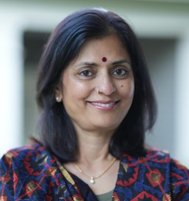 Anita Vallabh, Ph.D, is an author and the Founder and Editorial Curator of Global Indian Artist, based in Boston. |
