
|     |
|
| |

REVIEW / REPORTAcross forms and traditions: Erasing Borders 2026, Day One- Dr Anita Vallabhe-mail: editor@globalindianartist.com Photos: Nir Arieli September 26, 2026 (The article first appeared in Global Indian Artist™ LLC, dated Sept 23, 2026) 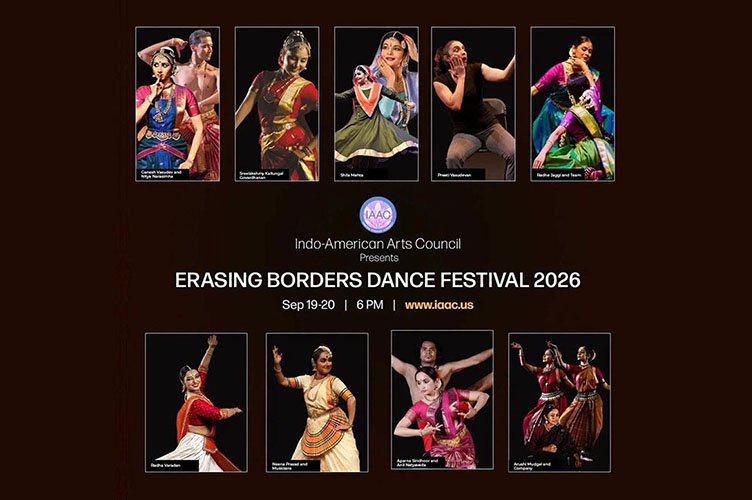 18th Annual Erasing Borders Dance Festival, presented by the Indo-American Arts Council | September 19-20, 2026 | The Kaye Playhouse at Hunter College, NYC The much-awaited 2026 edition of the Erasing Borders Dance Festival opened at The Kaye Playhouse at Hunter College with a wide range of performance traditions, offering audiences a glimpse into the many ways stories are told, and passed across generations and cultures. 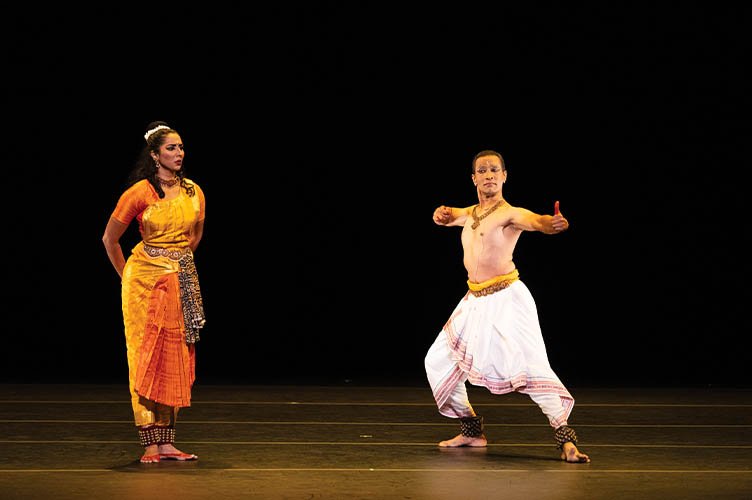 The evening began with Kiraataarjuniyam, performed by Bharatanatyam dancers Ganesh Vasudev and Nitya Narasimhan. Vasudev enters with grace and finely chiseled movement as Arjuna, offering prayers to Lord Śiva against the rhythmic backdrop of a jati. Narasimhan embodies Śiva, who later assumes the guise of the hunter, Kirāta. The use of jatis for Arjuna and svaras for Śiva establishes a clear distinction between the two characters, although the device feels somewhat overemphasized at times. The lighting creates a particularly effective spatial composition: Arjuna occupies a pool of light downstage right, while Śiva, in the guise of Kirāta, stands diagonally opposite him upstage left. This visual distance heightens the sense of an encounter waiting to unfold. Yet when Arjuna and the disguised Śiva finally engage in combat, the choreography does not generate the tension or dramatic urgency the confrontation demands. A more vigorous use of space, sharper rhythmic exchanges, might have given the battle greater physical force and theatrical momentum. Nevertheless, both dancers display assured technique, clarity of line, and finely controlled movement throughout the work. 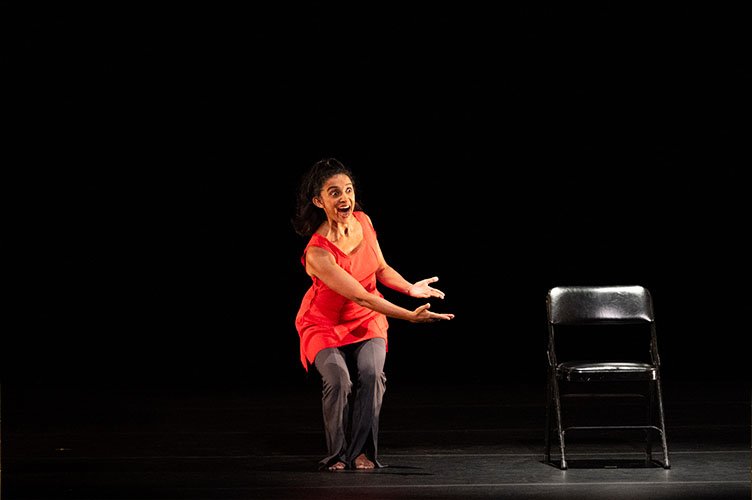 Preeti Vasudevan's Conversations with Cunningham & Cage, created in dialogue with composer Kamala Sankaram, offers a thought-provoking exploration of rasa through the body, space, and time. The work focuses on five of the nine rasas: love, wonder, fear, peace, and anger. Beginning with śṛṅgāra, Vasudevan moves through these emotional textures using spare but precise theatrical means. The use of a chair evokes the experimental world of Cunningham and Cage. In her exploration of adbhuta, wit enters wonder: her mouth opens into an exaggerated "O," holding the body at the edge of astonishment and momentarily suspending time. Her interpretation of śānta is especially compelling. Vasudevan chooses a cross-stage walk, with one hand held in a gesture of peace, suggesting that tranquility is not a state removed from life's turbulence but something continually sought within it. As she crosses the space, śānta exists within constant motion and an unbroken timeline, suggesting peace as an enduring human pursuit. Sankaram's operatic vocal score heightens the distinctive quality of each rasa, giving the work the force of a provocative and sharply conceived inquiry into emotional experience. 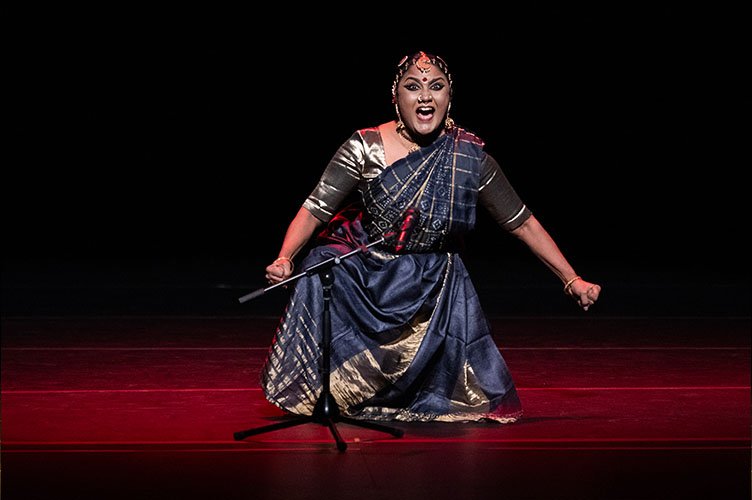 Sreelakshmy Kallungal Govardhanan's Soorpanakha is a masterful display of Kuchipudi's theatrical power. From the moment she begins with vācika abhinaya, a distinctive feature of the Kuchipudi tradition, introducing herself and tracing her life as a queen before Lakṣmaṇa disfigures her, Govardhanan holds the stage with complete authority. When her vengeful rage erupts in the cry "Lakṣmaṇa!" the moment is visceral and dramatically powerful. The shifting emotions as Śūrpaṇakhā is passed between the brothers—Rāma directing her to Lakṣmaṇa, and Lakṣmaṇa rejecting her and sending her back to Rāma—are brilliantly realized, as her hope and desire gradually give way to confusion, humiliation, and rage. In every movement, Govardhanan's narrative remains lucid, her āṅgika, vācika, āhārya, and sāttvika abhinaya coming together with remarkable completeness. The power of this convergence evokes karuṇa for a woman whose "fault" is falling in love and whose desire is answered with humiliation and bodily violence. In restoring voice, dignity, and emotional complexity to Śūrpaṇakhā, Govardhanan delivers a stellar performance: a compelling reminder of Kuchipudi's capacity to make an ancient story immediate, human, and profoundly moving. 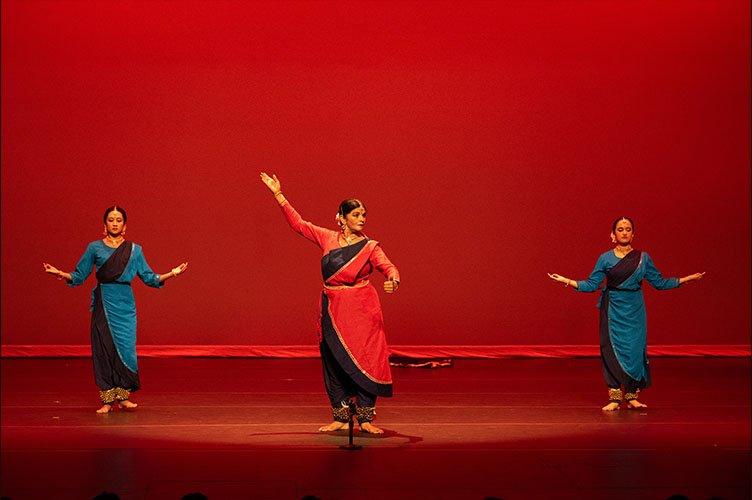 Distinguished Kathak artist and scholar Shila Mehta of the Lucknow gharana, joined by Salonee Satagar and Sanchita Dighe, presents Nimitta (Instrument) using the Kathākār storytelling tradition of vocal narration. Mehta's clear footwork and vācika abhinaya frame the story of Amba, who is reborn as Śikhaṇḍī and ultimately becomes the instrument through which Bhīṣma is defeated. The veil Mehta wears to depict Amba provides a helpful visual marker as the narrative moves between identities. Even so, the work's layered structure shifts among Amba, Śikhaṇḍī, and Bhīṣma, as well as between past and present, and these transitions would benefit from clearer delineation. At times, the narrative becomes difficult to follow. Satagar and Dighe support Mehta's narration with graceful, restrained movements that complement the central performance. A greater infusion of energy at key dramatic moments, however, might have heightened the work's theatrical momentum. Mehta's depiction of the moment when the arrow strikes Bhīṣma is particularly poignant. Standing almost still, she allows her posture to slacken and her head to drop slightly to one side, distilling the warrior's fall into a single, restrained image. 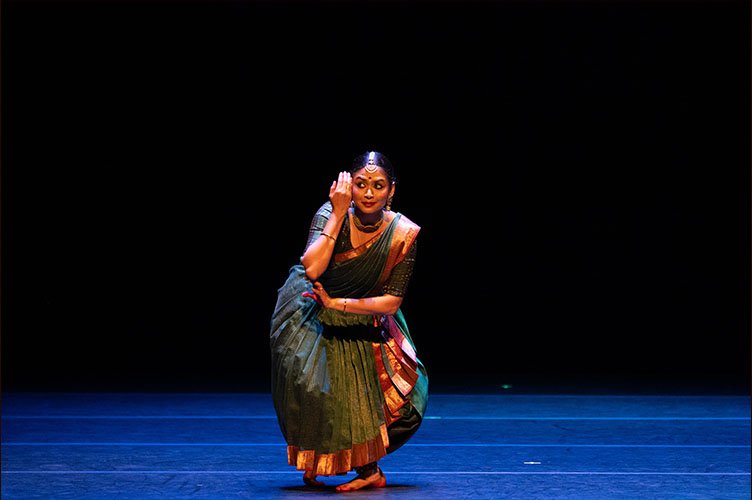 The evening's marquee performer, Radhe Jaggi, presents excerpts from Bhakta, a Bharatanatyam solo exploring the many ways devotion is expressed and experienced through emotion. Beginning with Devi, Radhe embodies the devotee's awe before the Divine Mother, seeking both solace and surrender. Each stanza invokes a different facet of the goddess, moving between her awe-inspiring power and compassionate grace. After every stanza, Radhe returns to the graceful gesture of waving āratī. The contrast is beautiful: her dynamic embodiment of the goddess's formidable energy softens into an offering marked by delicacy and reverence. She has a gentle stage presence, yet she summons the goddess's power without sacrificing the refinement of her movement. In Auchitya, Radhe Jaggi adapts a conversation between two lovers from the Subhāṣitāvali, reimagining it as a dialogue between Rāvaṇa, representing Life, and Death. The work suggests that within every life, death is already present, and within every death, life continues. Like true lovers, life and death share an inseparable bond and an unexpected intimacy. Radhe holds and tells this dialogue with poignancy, revealing the gentleness and love within Death: usually regarded as a terrifying force, Death emerges instead as a compassionate presence that takes life away when its moment comes. In Alakh Niranjan, the music carries the audience into the story of a traveling mendicant whose eyes become the object of another's desire. He offers them freely, hoping that the sacrifice will awaken her inner eye and turn her vision toward what is eternal. Verses drawn from the Kannada epic poem by Pandarinatha Galagali find depth in Ram Miryala's rich, melodic rendering. Across the three excerpts, devotion expressed as awe, surrender, intimacy, and selfless sacrifice is suffused with gentleness and unguardedness, revealing vulnerability itself as a form of spiritual strength. The lighting, however, did not always support the changing dynamics of the storytelling. In Devi, brighter illumination would have brought the goddess's dynamic yet benevolent presence, together with the devotee's awe and surrender, into sharper focus. The interplay of light and shadow can deepen particular moments, but when shadow dominates, the shifts between power, softness, and inwardness become less clearly defined. Overall, Day 1 offered a rich garland of artistic voices. The sound throughout the evening was excellent, allowing vocal narration, music, and rhythmic detail to be heard with clarity. Particularly striking was the curatorial choice to position Preeti Vasudevan's contemporary and unconventional mode of storytelling between two classical dance choreographies. Although the placement may initially seem unexpected, it functions simultaneously as a bridge and a disruption, inviting the audience to consider how classical vocabularies are inherited, transformed, or challenged. In this productive tension, the festival's title, Erasing Borders, finds particular resonance. Across forms and traditions: Erasing Borders 2026, Day Two  Anita Vallabh, Ph.D, is an author and the Founder and Editorial Curator of Global Indian Artist, based in Boston. |
