 |
    |
|
|

PROFILEParwati Dutta's world of Art and the unceasing quest for excellence- Dr Chitra Sharmae-mail: sharmachitra8@gmail.com November 16, 2026 Kathak and Odissi exponent Parwati Dutta is an artiste who envisioned a magnificent dream -- not merely of establishing her own artistic identity, but of nurturing and advancing both these classical dance traditions. Remarkably, she chose to pursue this vision in a place where neither of these dance forms had an established tradition. That place was Sambhajinagar, formerly known as Aurangabad. It was here that Parwati Dutta transformed her grand vision of MAHAGAMI, an institution dedicated to the arts, into a foundation for the propagation and flourishing of dance. The path was arduous, for the region had no existing tradition of these classical dance forms upon which to build. Yet, she drew inspiration from a profound verse of the Rigveda, whose philosophical essence conveys: "A cosmic command emerged, and from the darkness came the luminous birth of Truth. Thereafter arose the waves of the ocean; from those waves emerged Time, the year, followed by night and day, through which even the smallest measure of time -- the blink of an eye -- came to be determined." In essence, the creation of the universe from nothingness unfolded through a gradual and continuous process. 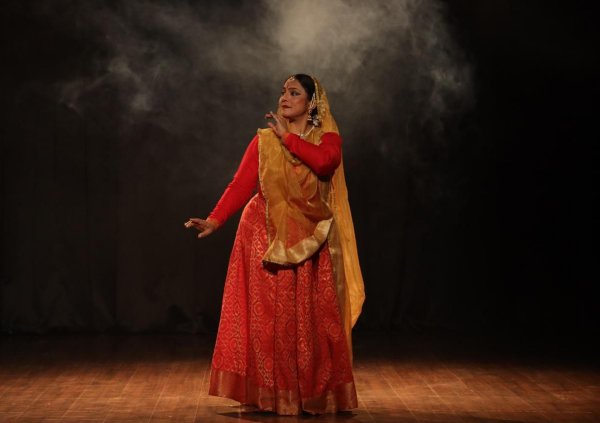 Parwati Dutta The story of MAHAGAMI bears a striking resemblance to this cosmic narrative of creation. Its history is one of perseverance and struggle, of bringing something meaningful into existence upon a seemingly barren landscape. Where once there was nothing, MAHAGAMI stands today -- a serene abode of art existing in harmony with nature. It is the realization of a dream that emerged from the void and gradually took shape as a living, tangible world. MAHAGAMI is not merely an institution devoted to the academic study of dance and music. Through its tireless journey, it has evolved into an almost unparalleled international centre in the independent, non-governmental sphere, dedicated to the promotion, preservation, research, innovation, publication, scholarly inquiry, education, dissemination, workshops, documentation and archival study of Indian classical arts. Indeed, within the framework of the traditional Guru–Shishya Parampara, MAHAGAMI may rightly be regarded as one of the finest centres of artistic learning and cultural transmission. The vision underlying its development reflects a remarkable confluence of tradition and modernity. MAHAGAMI is like a river of art flowing through the heart of time -- remaining connected to its original current while embracing new streams along the way, enriching its course through every stage of its journey. Parwati Dutta received her training in Kathak under maestro Pandit Birju Maharaj and in Odissi under the visionary Guru Kelucharan Mohapatra and the distinguished exponent Madhavi Mudgal. Beyond her formal training, she has dedicated her life to the study of classical treatises, contemplation, research and the artistic assimilation of India's profound cultural and aesthetic heritage. Her intellectual pursuits extend far beyond performance, encompassing the deeper philosophical and scriptural foundations of Indian classical arts. Parwati also initiated a grand festival in memory of Sharangadeva, the celebrated author of the Sangita Ratnakara, one of the most authoritative treatises on Indian music, embracing both the Carnatic and Hindustani traditions. The festival brings together performances, scholarly lectures, presentations of research papers, intellectual discussions and deliberations, thereby creating a meaningful dialogue between artistic practice and academic inquiry. The conceptual structure of MAHAGAMI rests upon four carefully envisioned pillars: Shastra (classical knowledge and theoretical foundations), Prayoga (creative practice and experimentation), Parampara (tradition), and Anusandhana (research and inquiry). Parwati Dutta herself is an artiste of an experimental and innovative temperament. Among her acclaimed creative works is Varnaja, an experimental choreographic composition inspired by the art of calligraphy. To understand the philosophical origins of this innovative work, one must explore the primordial relationship between Nada (sound) and Rupa (form), whose early conceptual foundations may be traced to the Shiva Sutras and the Puranic traditions. According to the narrative, the sage Sanaka once posed a question to Lord Shiva: "If sound were to be given a visible form, what would that form be?" In response, Lord Shiva raised his damaru and sounded it nine and five times in a rhythmic sequence, revealing the answer through a cosmic dance. Panini, who witnessed this divine manifestation, subsequently gave these creative vibrations a structured expression through the aphorisms associated with the Maheshvara Sutras. The documentation and symbolic interpretation of this creative process evoke the concept of Rupa Dhyana Ratnavali, wherein each Akshara, or syllable, is transformed into a manifestation of Akara Devi, the divine embodiment of form. In her artistic interpretation, Parwati Dutta explores the sequential manifestations of Akara Devi, Ukara Devi and Makara Devi, through which sound assumes the sacred form of Om. The narrative further connects this manifestation with Lord Ganesha and the creation of the Ganesha Paran, a traditional rhythmic composition. 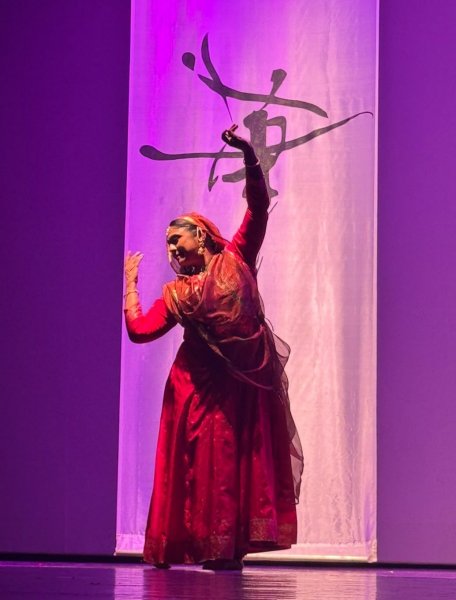 Parwati Dutta Drawing inspiration from this philosophical account, Parwati Dutta gave a tangible visual dimension to the concept of Nada in her calligraphic dance presentation. For this purpose, she used white fabric panels displaying the calligraphic forms of Om, Allah and other sacred expressions. She then recreated corresponding shapes and visual patterns through the gestures, movements and bodily configurations of Kathak. In doing so, she transformed the abstract relationship between sound and form into an innovative choreographic language. This experiment represented a fresh and imaginative expression of creativity within the framework of tradition -- an artistic exploration in which inherited knowledge became the foundation for new possibilities. Another significant creation by Parwati Dutta is Sutra Man, inspired by the philosophy of Mahatma Gandhi. This choreography incorporates Gandhi's fundamental ideals, including love, compassion, non-violence and Satyagraha, giving them expression through the language of classical dance. An especially innovative feature of this work is the use of threads of khadi as a symbolic warp and weft, transforming the fabric of Gandhi's philosophy into a visual and artistic metaphor. Luminous Threads of Gandhi is a choreographic interpretation of the radiant philosophical principles of Mahatma Gandhi, presented through the combined artistic languages of Odissi and Kathak. The composition brings Gandhi's philosophy of life to the stage through the fundamental ideals that guided his thoughts, actions and moral vision. It employs the distinctive elements of both classical dance traditions. From Odissi, it draws upon Chauka, Tribhangi, Mudrabhinaya and the sculptural beauty of its classical body movements. From Kathak, it incorporates Tatkar, Chakkars, Hastakas, Layakari, Gat-Bhav and Abhinaya. Through this creative synthesis, Gandhian thought is presented as a dialogue between two distinct yet deeply interconnected traditions of Indian classical dance. The choreography explores the following foundational principles of Gandhi's philosophy: * Satya -- Truth * Ahimsa -- Nonviolence * Satyagraha -- The steadfast pursuit of truth through nonviolent resistance * Swadeshi -- Self-reliance and commitment to indigenous production * Aparigraha -- Non-possession and freedom from excessive attachment * Brahmacharya -- Self-restraint and disciplined living * Asteya -- Non-stealing * Sarva Dharma Samabhava -- Equal respect for all religions * Opposition to Untouchability -- The rejection of caste-based discrimination and social exclusion * Sarvodaya -- The welfare and upliftment of all The final and culminating principle is Gandhi's immortal declaration:"My life is my message." The concluding section becomes a distilled expression of Gandhi's entire philosophy of life. The movement of the spinning wheel, the symbolism of his long marches on foot, the spirit of prayer and, ultimately, the attainment of peace are woven together through the shared expressive vocabulary of Odissi and Kathak. In the final moments, the convergence of the two dance forms transcends a mere blending of techniques. Their artistic unity becomes a profound symbol of Gandhi's vision - a harmony of thought, action, truth, compassion and universal coexistence. Parwati Dutta's artistic personality embodies an extraordinary range of intellectual and cultural dimensions, including civilization, culture, history, geography, education and classical scholarship. These very elements find expression in the imaginative architectural conception of MAHAGAMI. The institution is, therefore, not simply a physical space devoted to the performing arts. Its architecture, educational philosophy and creative environment together reflect the breadth of Parwati Dutta's artistic imagination. Today, MAHAGAMI stands as a living, vibrant institution, a testament to a remarkable vision that transformed an uncharted landscape into a flourishing world of art, knowledge, tradition and creative exploration. It remains an enduring manifestation of Parwati Dutta's belief that art is not merely something to be learnt or performed, but a continuous journey of discovery, reflection, innovation and cultural renewal. 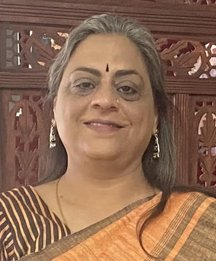 Dr Chitra Sharma is an art critic. She has her own YouTube Channel and a page on Face Book named "Kathak ka soundarya." She is working with CBC, information and broadcasting ministry as an assistant director (programmes). Post your comments Please provide your name along with your comment. All appropriate comments posted with name in the blog will also be featured in the site. |
