 |
    |
|
|

OBIT / TRIBUTETeejan Bai: Folk Theatre artist from the Pardhi Margins to the Throne of the Mahabharata- Dr Navina Jafae-mail: navina.jafa@gmail.com July 9, 2026 The stage did not tremble when Teejan Bai stepped on it; it remembered how to tremble. The Pardhi folk artist who chose Kapalik, became Bhima, and turned the Mahabharata into a tribunal died on 5 July 2026. 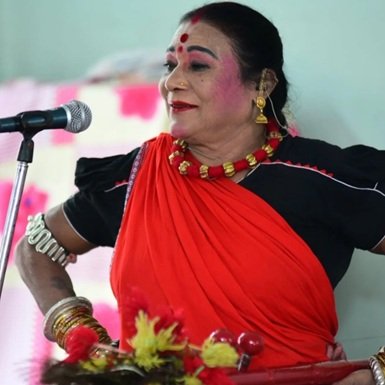 The stage did not tremble when Teejan Bai stepped on it; it remembered how to tremble. Teejan Bai, the great teller of the Pandavas, died on 5 July 2026 at the age of 70. She was born into the Pardhi community, a denotified tribe in Chhattisgarh that had been unjustly branded as criminal and pushed to the margins, and was told early that women in her world were not meant to speak for gods. She did not learn to obey. She learned to sing the Mahabharata aloud, on her own feet, and in her own voice. Pandavani is the oral epic ballad tradition of central India, a solo singing performance in which the artist becomes the whole war and its witnesses. The word itself means "songs of the Pandavas" - the five brothers, Judhisthira, Bhima, Arjuna, Nakula, and Sahadeva, whose destiny and ruin animate the epic. In Chhattisgarh, where Teejan Bai lived, spoke, and performed, Pandavani is not museum folklore; it is a living argument about justice, power, gender, and the price of dharma. Two styles prevailed: Vedamati, seated, text-led, tempered; and Kapalik, standing, dramatic, muscular, and for a long time guarded for men. Teejan Bai chose Kapalik. She became, by force of presence and refusal, the first woman to command it in public. The forehead that carried the war: Kapalik, Bhairava, and Teejan Bai The Kapalik style of Pandavani carries a name that echoes the tantric Kāpālika ascetics, the "skull-men" of Bhairava Shaivism, a fierce, non-Puranic Shaiva movement that flourished between the 8th and 13th centuries. Bhairava, a terrifying form of Shiva, was their central deity; they wore bone ornaments, smeared their bodies with ashes from cremation grounds, and carried a skull-topped staff (khaṭvāṅga) and a human skull (kapāla) as a begging bowl. Their practice was a radical declaration that purity and impurity are human lies, and that power arises from transgressing those lies. There is no historical claim that Teejan Bai belonged to that lineage; she was not a tantric priest, nor did she perform tantric rites. Yet the resonance is not accidental. Both the tantric Kāpālika and the Kapalik Pandavani draw on the same root, kapāla, skull and forehead, the locus of fire, authority, and the third eye. In the tantric tradition, kapāla is the skull that holds the drink of transformation, the vessel that turns blood into power. In the Kapalik Pandavani, kapāla becomes the forehead that carries the weight of the epic, the head that bears the whole war as if it lived inside the performer. Teejan Bai's Kapalik performance was not ritual arson but theatrical. She did not ask the gods to descend; she made them descend by becoming the body through which they moved. Her stage was not a cremation ground, but Chhattisgarh itself, the land that had watched Partition, caste violence, and the slow erosion of the poor. She carried the epic not as inheritance but as accusation. Bhima's Gada, Today's Holy Men: Teejan Bai's Story of Justice in a Republic of Rapists The Republic of Holy Men In a country where the accused of sexual violence are washed clean by garlands and spectacle, folded back into the public square as teachers, saints, custodians of dharma, Teejan Bai's death cuts like a wound that will not be stitched. The republic has learned to launder power with ritual language: the predator as holy man, the abuser as elder, the partisan as guardian of morality. Against that pandancing, her art stood as an accusation. Her most searing act was Draupadi's Cheerharan, the disrobing, and within it, the lightning was Bhima, the strongest of the Pandavas, stepping in to kill Dushasana and drink his blood to honour Draupadi's vow. Each time she became that Bhima avenging Draupadi, she stripped the lie of a moral order that lectures women on modesty while crowning male violence with sanctity. She did not preach; she enacted. She made the epic a mirror in which the court could not look without seeing its own rot. Her body was the text. She moved across the stage like a storm that had been told to sit down and refused. Sometimes she was a spear: arm raised, shoulder forward, the whole of her charging the air as if the audience were the Kaurava army. Sometimes she was a wall: feet planted, spine straight, the gada held like a judgment that would not be moved. She was restrained, but the restraint was not meekness; it was the tension of a bowstring before the arrow. Her voice was not a single tone but a war orchestra. It moved from the low, grounded rumble of the village square to the high, piercing cry of the wounded goddess. She did not simply recite the Mahabharata; she weaponised its vocabulary, turning the ancient words into modern shrapnel. In her mouth, the old stories stopped being comforting folklore and started being evidence. She sang of duty while the nation performed it; she sang of justice while the courts suspended it. Her tonal range was a political act, a refusal to let the epic be a lullaby for the powerful. She made the language sweat, bleed, and stand up. She did not inherit the text; she colonised it. And in that colonisation, she turned the stage into a courtroom where the only verdict was guilt. 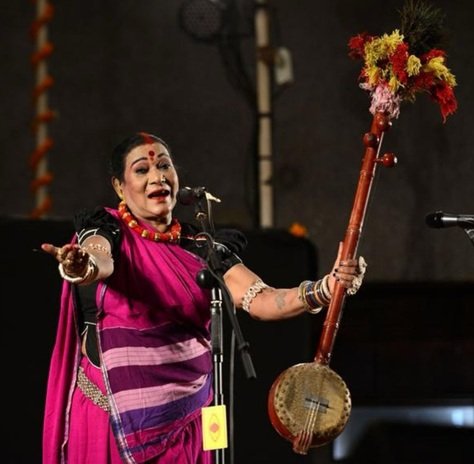 Red Bindi, Manly Figure, Maha Goddess To see her on stage was to remember: high-tied sari, the body drawn like a spear, tambura turning into Bhima's gada, round face lit by a red bindi that burned like a promise. She fused male and female energies until the word "gender" no longer fit the instrument she played; what the audience met was not a woman in a role, but authority itself. She did not ask to sit inside a man's form; she enlarged the form until "male" looked too small to hold her. It reminded one of what the 13th century Sufi Saint Hazrat Nizamuddin Auliya said of his contemporary female saint Bibi Fatima Sam that "when a lion comes out of the forest, nobody asks whether it is male or female," he was not speaking of a saint alone; he was speaking of her. She appeared with what so many women in India are denied: not visibility, but sanctioned force. Teejan Bai said Bhima was her favourite because of his strength and anger, and his killing of Dushasana became her most fabled feat. Her Dushasana Vadh, echoing Draupadi Cheerharan, turned the stage into a tribunal: what name do we give a moral order in which a woman is violated in public and the elders say nothing? In her hands, Bhima's violence was not bloodlust but retribution for a court that had collapsed under procedure, watching abuse and choosing silence. Her performance was read not as a recital but as a feminist revision: Draupadi, no longer a ceremonial victim for pity, became the axis on which ethical reckoning turned. The fall of Dushasana was not just a death; it was the destruction of patriarchal impunity. The Epic she recited, the Epic she became Teejan Bai did more than transform her own career. She built an independent teaching practice, trained roughly 200 students, many of them young women, and helped carry Pandavani beyond its regional base into new languages, venues, and publics. She turned a village-rooted oral form into a national and international performance language without surrendering its Chhattisgarhi pulse. But she was also the epic she recited. She was the widow who turned into a queen of fire. She was the woman who stepped from the denotified margins into the centre of the stage and refused to be silenced. She was the Kapalik poet who carried the war on her forehead and wore the red bindi like a wound that would not be closed by holy men. Remembering her only as an award-winning folk icon would be too small. She was a woman in whose body different times collapsed: epic time, village time, feminist time, the time of injury, and the time after fear. She rose in a red bindi and a so-called manly figure, carrying the epic not as inheritance alone but as a weapon, a witness, and a warning. She did more than any man around her thought a woman should do, and then she made that excess look natural. That is why Teejan Bai will remain not merely remembered, but necessary. 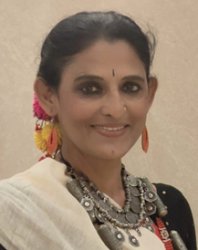 Dr Navina Jafa is an Indian classical dancer, dance scholar, and cultural heritage expert, known for her expertise in Kathak and contributions to tourism. Post your comments Please provide your name along with your comment. All appropriate comments posted with name in the blog will also be featured in the site. |
