 |
    |
|
|

 Indian dance in France: Jean-Paul Montanari- Sonya Wynne Singhe-mail: sonya.s.wynne@gmail.com April 25, 2026 Around this time last year, I was working on the 25th edition of attenDance, the only yearbook on dance published by Ashish Khokar. Specifically, I had just completed my text on Jean-Paul Montanari, the director of the Montpellier Danse Festival, who had done so much to introduce the world's dance traditions to a French and Western audience. Little did I know that this text would take the form of an obituary. On the 25th of April 2025, dance lost one of its greatest stalwarts - someone with a profound and instinctive understanding of the arts. I thought back on our meeting, just a few weeks prior organised by Elisabeth Petit, and realised it was perhaps the last recorded interview of him while in office. It was Jean-Paul Montanari's last day as director for Montpellier Danse, as he was retiring. What was supposed to be a brief interview went for over an hour, during which he spoke at length about his life, his deep love for dance and the small moments of pure pleasure when he listened to Vilayat Khan. 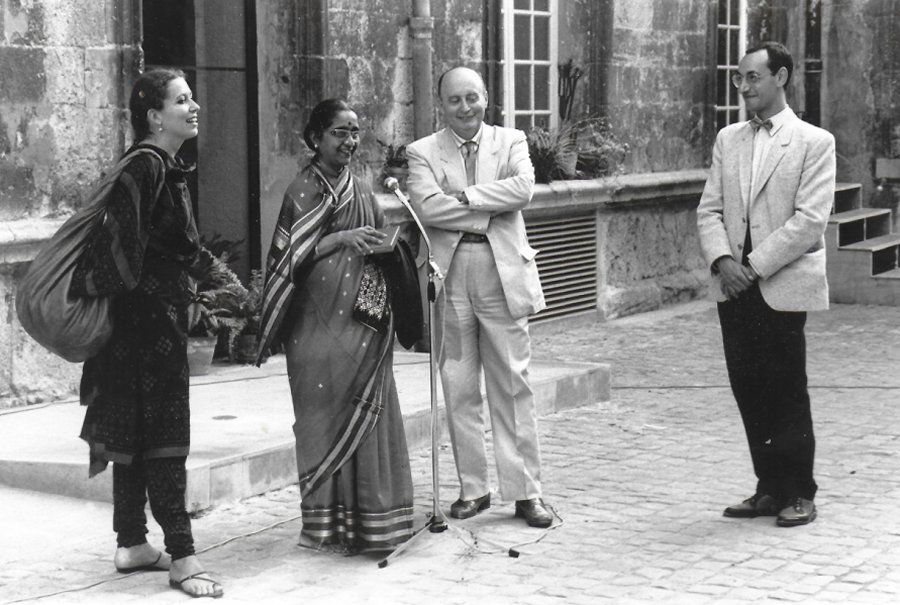 Jean-Paul Montanari, Elisabeth Petit with Kalanidhi Narayanan receiving the Citoyen d' Honneur in 1984 Photo credit: Bresson Iacoponelli A year later, while going through my notes and recordings of our conversation, I was struck by a strong feeling -- that very few in India truly knew of Jean-Paul Montanari's contribution. He had not only showcased the rich diversity of Indian dance forms at the Festival, but had also cultivated an educated, appreciative audience for them. Thanks to him, many Indian and French artistes performed at the Festivals. In the 1984 edition, Kalanidhi Narayanan captured the hearts of Montpellier's audiences with her remarkable performances of abhinaya accompanied by thoughtful French translations of the danced poems. She was honoured with the title of Citoyen d'honneur (Citizen of Honour) of the city. Audiences discovered Odissi through the very talented Malavika Sarukkai and French dancer Maitreyi graced the stage with Bharatanatyam. Guru Govindan Kutti Nair, accompanied by his students and Cecily Gordon, thrilled the public with Kalaripayattu in 1985. In 1988, the spotlight turned to the renowned Kerala Kalamandalam, and by 1990, the Festival dedicated an entire week to Bharatanatyam. This edition featured conferences by Saskia C. Kersenboom, V.R. Devika, and Laurent Louppe, and became a landmark occasion as Guru V.S. Muthuswamy Pillai was awarded the Chevalier des Arts et Lettres, France's highest honour in the cultural arts. Padmini Chettur and Sharmila Mukherjee performed in 1996, followed by a return to Bharatanatyam in 2004 with the performances of Priyadarsini Govind and Elisabeth Petit. None of this would or could have happened without Jean-Paul Montanari's tireless efforts and passion. 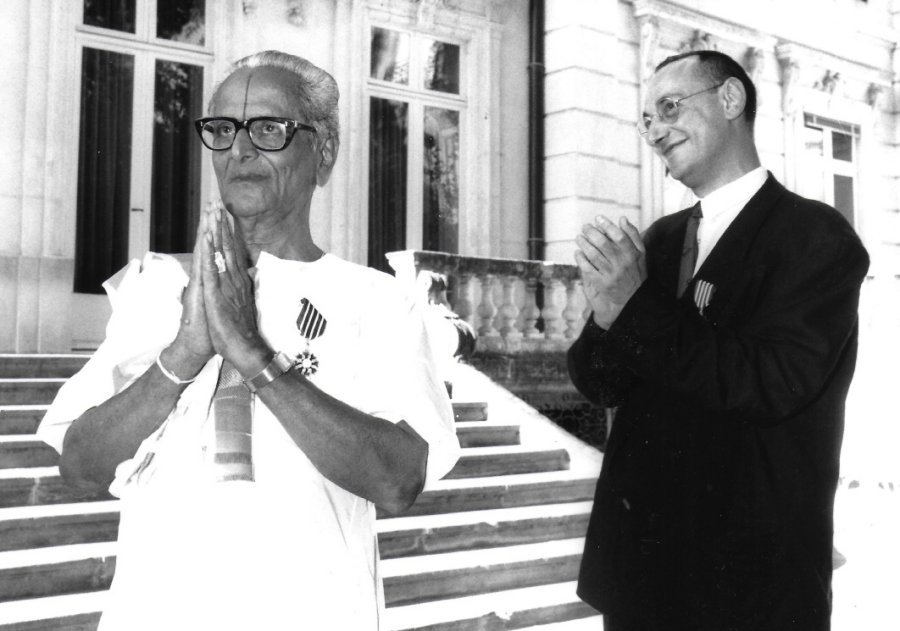 Jean-Paul Montanari with Guru V.S. Muthuswamy at the award ceremony of Chevaliers des Arts et des Lettres in 1990. Photo courtesy: Elisabeth Petit Jean-Paul Montanari equally encouraged talented French dancers who were experimenting with cultural crossovers. Artistes such as Annette Leday, Maitreyi, Elisabeth Petit, Cecily Gordon, and Michel Lestrehan to name a few, performed at the Festival. This inclusive approach was central to his vision for the arts and the Festival. What follows is the article I wrote for attenDance - though I will always feel no one can truly do justice to this larger-than-life figure who dominated the world of dance. Since the 1980s, the city Montpellier in Southern France has seen an amazing diversity of dance performances from all over the world, thanks to the now famous Montpellier Danse Festival, and the tireless efforts of its director, Jean-Paul Montanari, who was also instrumental in bringing classical Indian dance to the fore. Born in Algiers in 1947, Jean-Paul Montanari's journey into the world of dance and culture has been nothing short of extraordinary. At just 15, he moved to Lyon in 1962, where he discovered his lifelong passions: cinema, theatre and dance. His path into the world of dance officially began in 1975, when he joined the Centre Dramatique National de Lyon, overseeing public relations and laying the foundation for his future role as a cultural architect. His meeting with Indian "culture" happened in 1967. Just 20 years old, he saw Maurice Béjart's piece, Bhakti, at the Avignon Festival, and he was overwhelmed by it. What really stayed with him was the music, which touched him deeply and with which he felt an odd sense of familiarity; till the end, Indian music remained something he could listen to for hours. Like so many European youth of the time, he became fascinated by the Orient in general and India in particular. In 1980, Montanari moved to Montpellier, where he took charge of the press relations at the Centre Chorégraphique of Dominique Bagouet. This was the start of a transformative period in his career. In 1981, he became Bagouet's assistant at the prestigious Festival International Montpellier Danse. Within just two years, Montanari took on the role of Director General, and under his leadership, the festival flourished and became an international reference for contemporary dance and a showcase for dance cultures of the whole world, a testament to his vision and tireless dedication. He visited India twice, in 1983 and 1989. Reflecting on those days, Jean-Paul Montanari stated that the 1980s and early 1990s were, from a European point of view, a true moment of "discovering" India, which was still mysterious in many ways. That is no longer the case and for today's youth, India is already well known. Bollywood and globalization have done much for this, though Jean-Paul Montanari noted the ambivalence - on the one hand, popularizing and showcasing India, on the other hand, somewhat diminishing the tradition for the sake of the global market. He also pointed out that this was not a uniquely Indian phenomenon: world dance cultures were and are slowly being replaced by a uniform dance style promoted through social media. India was however, just one of many cultures that interested him and that he presented at Montpellier Danse, being equally enamoured of Chinese, African, South American and Mediterranean dance traditions. Jean-Paul Montanari's impact went beyond the art world. Along with his commendable efforts for raising awareness for AIDS, he invested himself in the cultural evolution of his adopted city. Working with Georges Frêche (the emblematic mayor of Montpellier from 1977 to 2004) he played a pivotal role in the city's creative and intellectual development. From 1993 to 1995, Jean-Paul Montanari served as its cultural affairs director, driving initiatives that would shape Montpellier's future as a vibrant cultural hub. His extraordinary contributions to the arts have earned him France's highest recognitions: he was made a Chevalier de l'Ordre national du Mérite in 1998, Chevalier de la Légion d'Honneur in 2010 and Commandeur de l'ordre des Arts et des Lettres in 2023 - the latter two being the highest civil and artistic distinctions in the country. Jean-Paul Montanari passed away on April 25th, 2025, in the city that he helped transform, leaving behind an incredible legacy and a lasting message: that all dance cultures of the world have something deep to share with each other. Courtesy: Ashish Khokar's AttenDance 2025 - Indian Dance in France, guest edited by Sonya Wynne Singh.  Sonya Wynne Singh is a senior talent in art books publishing from 1980s and recently guest- edited ‘Indian Dance in France' for attenDance 2025. She lives and reports for various publications from France. Post your comments Please provide your name along with your comment. All appropriate comments posted with name in the blog will also be featured in the site. |
