 |
    |
|
|

 Remembering and reflecting on my first dance teacher and idol- Uma Palam Pulendrane-mail: umapalam@hotmail.com Photos courtesy: Uma Palam Pulendran September 25, 2025 When I came to know that Ms. Vijayambigai Indrakumar (Nee Ramasamy) had passed away recently, I was shocked and deeply saddened. The last time I spoke to her was sometime in 2020 during the COVID-19 pandemic, followed by a few text exchanges. In the last couple of years, I tried to reach her several times, but to no avail. I wish I had reached out sooner. I felt a deep sense of grief and regret. As the news sank in, memories steadily came flooding back - from my last conversation to my earliest memories of her and our special teacher-student relationship. She was my first Bharatanatyam teacher. More importantly, she was my first "idol of dance" - my diva dancer. I used to address her as "Vijayambigai Ms.". We addressed our teachers as either "Akka" (informal) or "Ms." (formal). They did not become our "aunties" as we know them today. Now, referring to her as "Vijayambigai Ms." feels too formal and odd! She lived in an apartment far away and was looking for a place in our neighborhood in Colombo (Sri Lanka) to conduct classes. My mother eagerly offered our home and provided our living room/hall as the space for dance classes. My mother, who loved to dance but had to quit at the age of twelve, was eager to see her daughters learn dance. That is how I got to observe dance classes as a little three-year-old. At first, I would sit next to her on a little bamboo chair, keenly watching every step and move of the dance during class. Gradually, I began picking up steps, and before long, I could do most of them. I was encouraged to join at the back of the class. I learned all the steps and Alarippu (the first item in the repertoire) entirely by observation. She never corrected my step, my technique, or scolded me! She allowed me to learn organically without formal training or pressure. I absorbed as much as I could, like a sponge, even parts of other items in the repertoire, by watching the older students. I can still see the images of each student learning their item, like flashcards shuffling in front of my eyes. 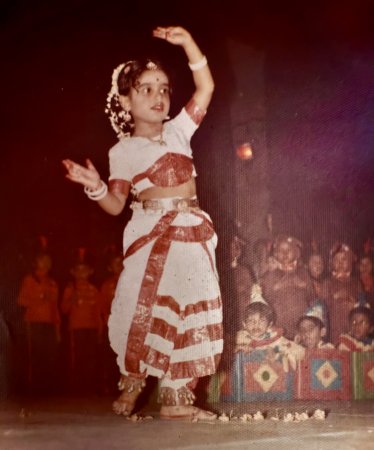 Uma in 'Toy Maker's Dream' at age 5 I must have been around four when she gave me my first opportunity to perform on stage - a short invocatory item along with my sisters (who were much older!). The following year, she guided me to perform as an "Indian dancing doll" in the play 'Toy Maker's Dream' at my Montessori school. With no recorded music those days (even a cassette player was uncommon), and to have a five-year-old me perform a solo without mistakes, she cleverly strung steps from first Naattadavu to fifth Korvai Adavu in a sequence (like a simple Korvai) to her voice reciting the jathi with the sounds of cymbals. I don't remember making any mistakes in the sequence! The school management was so impressed with the simple yet meticulous performance that they wanted "Uma's dance teacher" to direct the school's annual program the following year. She choreographed various catchy pieces suited for little kids who were from diverse communities, most of whom had no prior dance experience or exposure. I also had the opportunity to participate in her well-received dance drama, Chandalika by Rabindranath Tagore. At that time, my second sister helped me put together a Bharatanatyam scrapbook filled with dancers and Nattuvanars (cuttings from Tamizh magazines such as Kalki / Kalaimagal / Ananda Vikatan, etc.) from across generations, which is one of my treasured possessions. A few of the scanned images of Ms. Vijayambigai that I share here are from a brochure tucked into its pages. 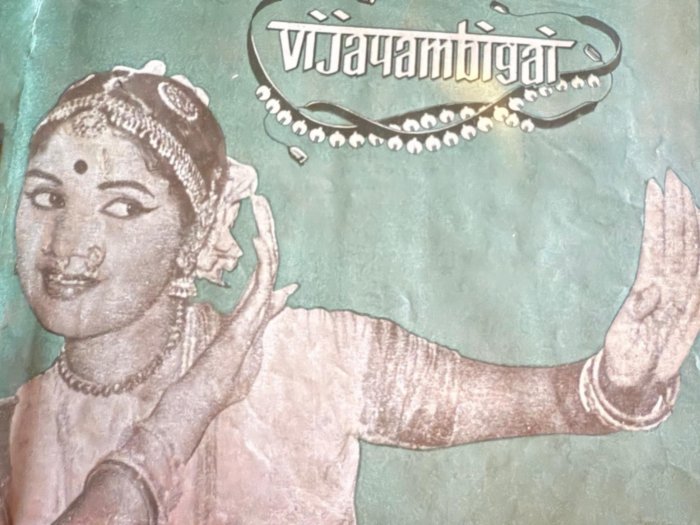 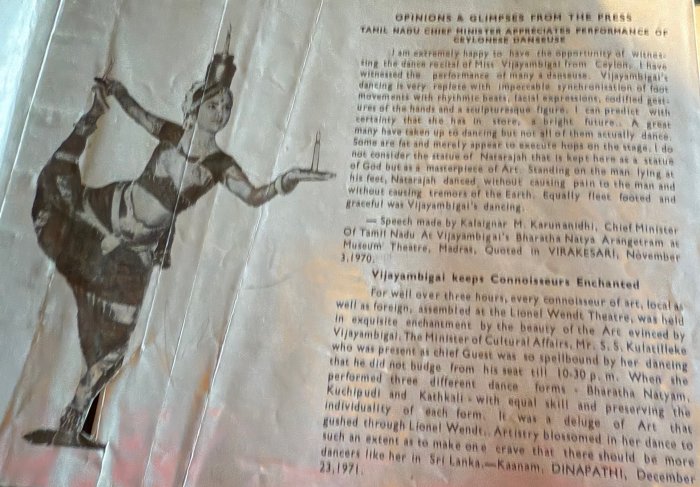 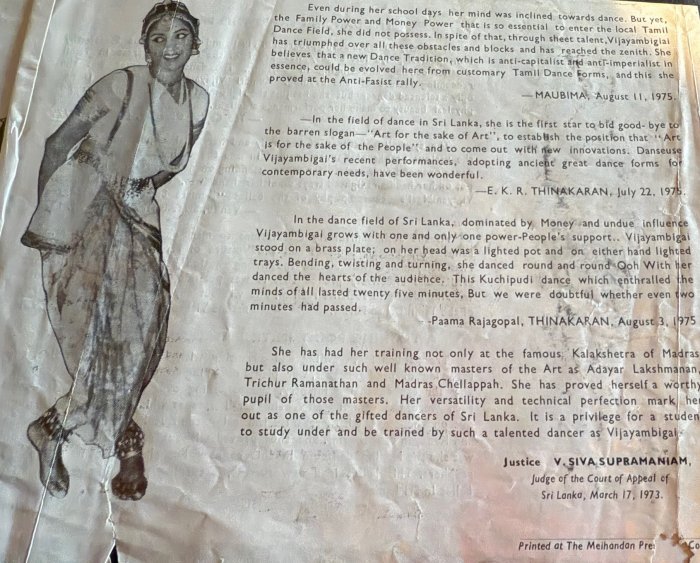 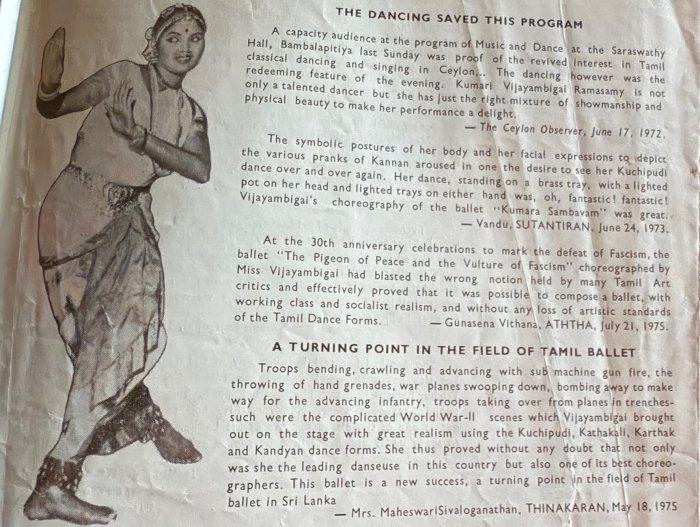 Scanned images from brochure from Uma's dance scrap book created when she was 5 or 6 Although my time with her was about three or four years during my early childhood, those memories remain vivid. I must say I was quite possessive of Ms. Vijayambigai. The bamboo chair (mentioned earlier) had a dedicated spot right next to her during class, and it was my spot and my chair. To me, she was a dance goddess - radiant, always dressed in gorgeous, bright-colored sarees with kanakambaram flowers adorning her hair, Mangai malai - mango-shaped gold beads strung on a black string, painted nails, and matching bangles - she had an aura. She was the first dancer I had met, and I imagined that every dancer looked and dressed like her. I had a kind of heroine worship. I would often run to the entrance of our lane to shower her with flowers from our garden and welcome her. I would pick up the Thattukazhi or the cymbals without asking her permission and do nattuvangam when she danced. In those days, teachers were often feared. But I had no fear of her. While favoritism is still common in many South Asian learning environments, she was the only teacher to show such favoritism toward me. Once, instead of correcting me for doing the Kudhitthu Mettadavu incorrectly, she asked others to do it the way I did! I didn't even realize that I was doing it wrong until my sister scolded me. 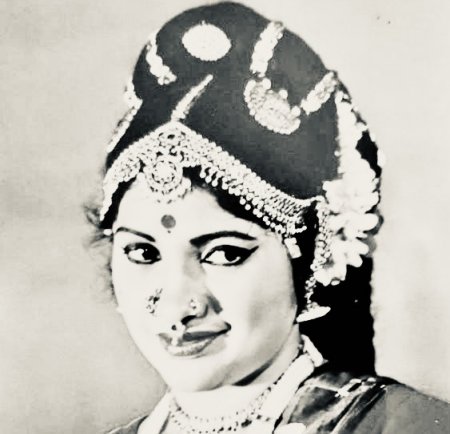 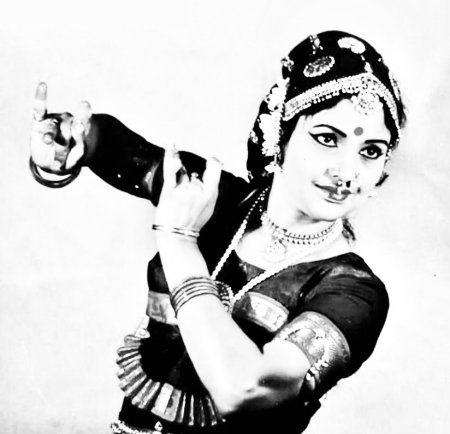 After a few years, she moved her classes to her own place, which was farther away, and wanted to focus on her own performances. My mother, wanting us to continue our dance training, found another teacher. (Also trained at Kalakshetra, she provided me with structured training, laying a strong foundation in the Bharatanatyam technique). I was disappointed by the change. I was so emotionally attached to Vijayambigai Ms. that it took me some time to adjust, though I eventually did. Over the years, we occasionally crossed paths at dance events. But she often avoided eye contact. I was still too young to understand the reason. About five years later, my mother met her mother, who was also extremely supportive of me. She revealed that Ms. Vijayambigai had been deeply hurt when my mother "took me away from her". She had not forgiven her. Only then did I understand the depth of the emotional bond. Those words stayed with me. I never fully appreciated the special emotional bond between an acharya (teacher) and sishya (student), especially in the Indian traditional arts - until I became a teacher myself. Following the ethnic conflict, we moved to India, and she moved to the UK. We lost touch. Many years later, I happened to run into her at a wedding in Chennai. As soon as she saw me, she exclaimed, "Oh my! That very fair little kid (Vellai Kutty) has become so darkened!" and hugged me warmly and tightly. I felt more relieved than happy. Relieved that she had forgiven us and perhaps healed from the past. We couldn't exchange phone numbers or emails like we do now at the instance of meeting someone. Back in those days, even landlines were rare; we didn't have cell phones or email, just "airmail". Finally, after many decades, we connected via Facebook. She had founded Vijaya Narthanalayaa and had a successful dance career in the UK. She was planning to celebrate her Golden Jubilee year of dancing with a new production and wanted all her students from around the globe to perform. She wanted me to be part of it. Unfortunately, the pandemic took over the world for the next two years, and the program could not take place as planned. In the following years, her physical and cognitive health had declined. That explained why I couldn't reach her in the end. 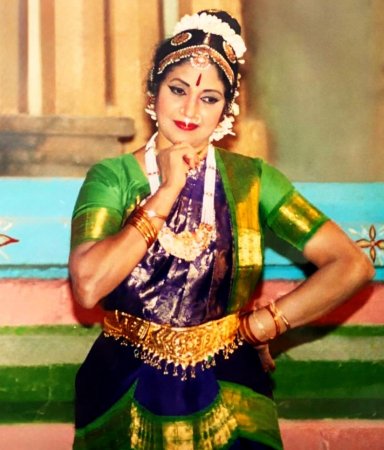 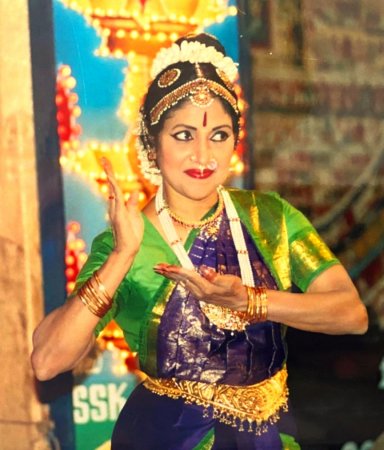 Ms. Vijayambigai was trained at Kalakshetra and later under Adyar K. Lakshmanan, having earlier studied with Thanjavur Govindaraju Pillai. She was a fabulous dancer with an incredible stage presence. Highly creative, she had choreographed over 15 dance productions, including Kumara Sambhavam, Tagore's Chandalika, Tchaikovsky's Swan Lake, Pigeon of Peace and the Vulture of Fascism (to mark the 30th anniversary of World War II), and many other unique works that blended multi-disciplinary choreography, imaginative costumes, lighting, music, and creative script. In Sri Lanka, until the 1980s, most dancers transitioned into full-time teaching after marriage. But not her. She defied those norms - continuing to perform, act in theatre productions, and even take on cameo film roles. She received numerous noteworthy appreciations, titles, and awards in India and Sri Lanka. From the mid-1970s to the mid-1980s, she was considered Sri Lanka's foremost Bharatanatyam performing artist. Looking back, my time with her was short - just a few childhood years. Yet it was one of the most cherished teacher-student relationships and memories of my life. Those memories are still fresh like newly blossomed flowers. Later in Chennai, I had the great fortune to come under the tutelage of one of Bharatanatyam's greats. During my teenage and early adult years, I had many dance idols or divas, but Ms. Vijayambigai was and is my first idol and diva dancer. She ignited in me a passion for dance that made me want to dance wherever and whenever - even in our narrow street - so long as no one was watching! She was my first inspiration for dance, which only grew over a period, and led me to become a professional dancer. Sadly, I don't have a single photo of us together. But I carry a lifetime of memories. Disclaimer: Words/views expressed in this article are my own. Narthaki is not responsible for the words/views expressed in this article. 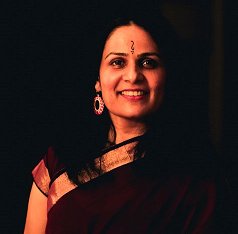 Uma Palam Pulendran is a Bharatanatyam dancer, PH Program Professional, and democratic activist based in the USA. Response * Beautifully written! I could almost 'see' the little child sitting beside the teacher and observing her (and her students') every move. And, I could feel the relief when they met again after several years and the teacher hugged the student. Teachers live for ever in their students! - Valmiki Raghunathan (Sept 26, 2025) Post your comments Please provide your name and email id along with your comment. All appropriate comments posted with name and email id in the blog will also be featured in the site. |
