
|     |
|
| |

 e-mail: janakipatrik@gmail.com Mozartayana December 3, 2025 The title of India's great epic RAMAYANA includes the Sanskrit suffix -ayana. Literally translated, "Ayana" (अयन) refers to time periods -- the passage of the sun through the zodiac. Therefore, loosely translated, Ramayana means "The travels of Ram [through] time." Linguistically improvising on the Sanskrit root "Ayana", I created the title MOZARTAYANA - The Travels of Mozart. It premiered on 28 July 2012 at the City University of New York, Baruch College, Manhattan campus. The title refers to Wolfgang Amadeus Mozart's travels. During his tragically short lifetime (1756 to 1791), Mozart traveled extensively in Europe, concertizing, playing his own and others' compositions, improvising and composing masterpieces. My family traveled a great deal during my childhood - from Jersey City, New Jersey TO Summit, New Jersey, TO Rock Hill, South Carolina, TO Forest Hills, Queens, New York, TO Chicago, Illinois, TO Terre Haute, Indiana, TO Potsdam, New York. I'm familiar with the traveling life and what music means to the traveler. Music played a sustaining role in my life. On the first day in a new school, I might not know a single person in a sea of strangers. But I could sit down in the concert band and immediately have a place where I fit into the group. Playing music was my security blanket. My childhood travels in music included a demanding piano teacher on the faculty of Winthrop College in Rock Hill, South Carolina. When I was eleven years old, she took me through Mozart's variations on what was for me a childhood ditty - "Twinkle twinkle little star". In fact she was introducing me to the concept of improvisation in the guise of "theme and variations" -- Mozart's composition, "Twelve Variations on Ah vous dirai-je, Maman, K. 265". Later travels took me to inner city Chicago and Morgan Park High School. The flute teacher who came to the school weekly to teach private lessons happened to be the wife of Donald Peck, first chair flute of the Chicago Symphony. When Mrs. Peck decided that she had nothing more to teach me, she passed me to her illustrious husband. And so I received my final, eleventh year of flute instruction from a great performer and teacher, whose lessons included many flute compositions by Mozart. My mind and ears are full of Mozart's music. It is not a stretch of my imagination to hear Mozart in Lucknow. and see Kathak in Vienna. In my mind's ear and eye, I visualize Mozart's melodies and compositional structures as synchronizing perfectly with Lucknow Kathak's courtly elegance and sophisticated complexity. Paying tribute to Mozart's universality, genius and versatility, I included a moment of stillness at 6 minutes and 11 seconds, seen in the recording of MOZARTAYANA posted on YouTube and in Hemant Sethi's photograph which accompanies this text. The dancers sink to the ground and bow their heads. 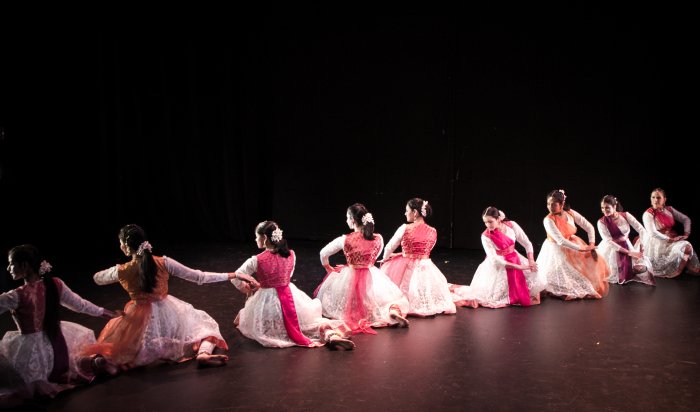 Kathak (Photo: Hemant Sethi) If the title of George Balanchine's ballet MOZARTIANA comes to mind when you encounter the title of my choreography - MOZARTAYANA -- you are not mistaken in making this connection. The inspiration of Mozart's music is of course a common element. The great 20th century ballet choreographer George Balanchine choreographed MOZARTIANA on Suite No. 4, Tchaikovsky's arrangement and orchestration of several short works by Mozart. I choreographed MOZARTAYANA on the 4th movement - molto allegro -- of Mozart's 41st Symphony. 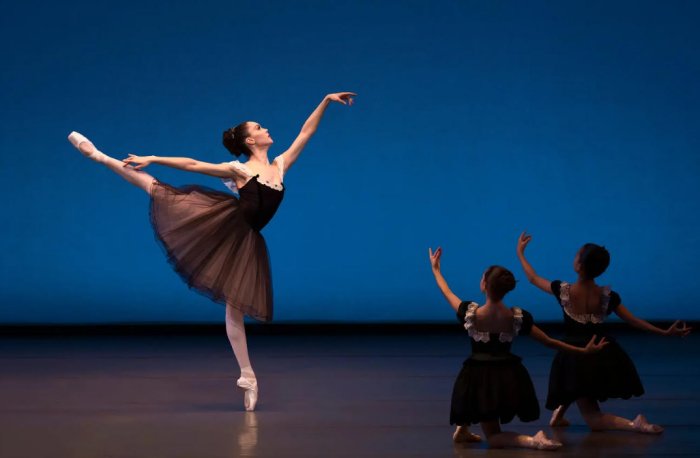 Mira Nadon with 2 young students from the NYC Ballet's School of American Ballet in Mozartiana 2024 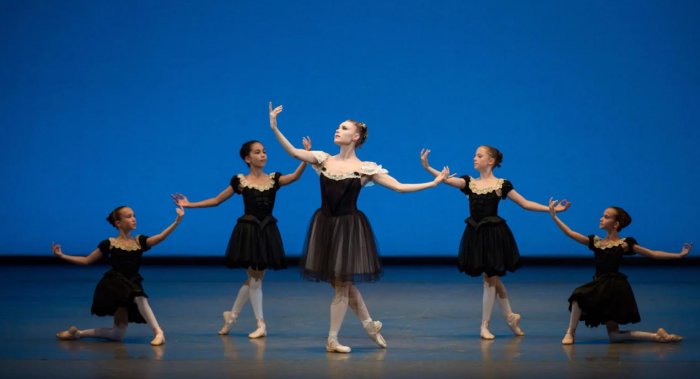 Sara Mearns in Mozartiana with 4 young students at the School of American Ballet I consider George Balanchine to be one of my choreographic mentors. Balanchine's modern ballet technique was distilled from traditional ballet technique. In this transformative process Balanchine left mythical subjects behind and based many ballets on modern rhythms, modern movement and modern or abstract themes. AGON is based on 20th century iconoclast Stravinsky's music; EPISODES is set to the music of Anton Webern, whose radical extension of the 12-tone row compositional method produced music many considered inaccessible, except when visualized under the deft choreographic hand of Balanchine; WESTERN SYMPHONY blends classical steps with American folk dance; WHO CARES is a ballet set to the music of popular songwriter George Gershwin ..... Balanchine's choreography indirectly gave me permission to create my own style, and it provided an example of how a modern technique can be embedded in and born from, a traditional technique. 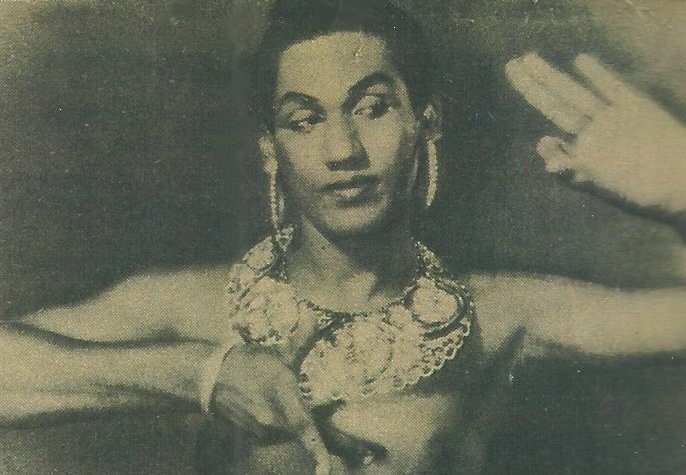 Sukhendu Dutt (photographer unknown) I am also reminded of the comments my Bengali friend Sukhendu Dutt made after Maharaji's 1974 performance at Carnegie Hall. Within an hour of the conclusion of Maharaji's Carnegie Hall performance, Sukhendu phoned me and said with outrage in his voice, "Your guru is not dancing Kathak." (Sukhendu had studied Kathak with Maharaji's father, Achhan Maharaj.) Half an hour later, having calmed down and reconsidered his vitriolic outburst, Sukhendu called me again and said reflectively, "I was wrong. Your guru is a genius. He has taken Kathak to the modern stage." And I replied analytically, "Yes, Maharaji is dancing on diagonals and curves, using a large proscenium stage to present his art from all angles and for all people, not with a frontal focus for the king or emperor alone." From the perspective of studying with and observing Maharaji over the course of almost 50 years - in classes at Kathak Kendra, New Delhi and in American workshops and performances, I have observed that his technique and choreography align the torso and arms on diagonals. Thereby the torso, viewed from many angles, does not form an impenetrable mass, blocking observation of emotional expressions in the chest rising and falling with each breath. Moreover, the alignment of the head in relation to the diagonal torso gives either a profile or partial or full-on view of the face's emotional expressivity. In addition, a choreographic device in many of Maharaji's nritta compositions ("pure, abstract" compositions) is based on the tihai pattern, which repeats rhythms and movement three times - on the R side, L side, and front. In my teaching of Lucknow gharana Kathak and in my non-narrative Kathak choreography, I have likewise moved the choreography along diagonal pathways. 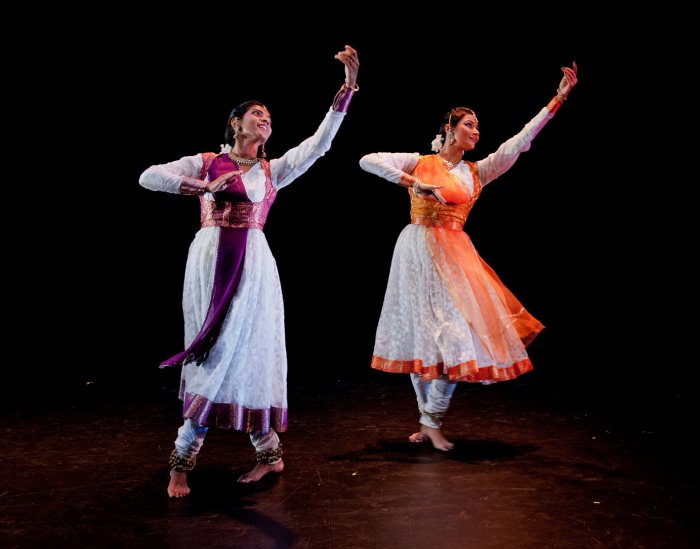 Neha Kulkarni and Sowmya Viswanath in MOZARTAYANA 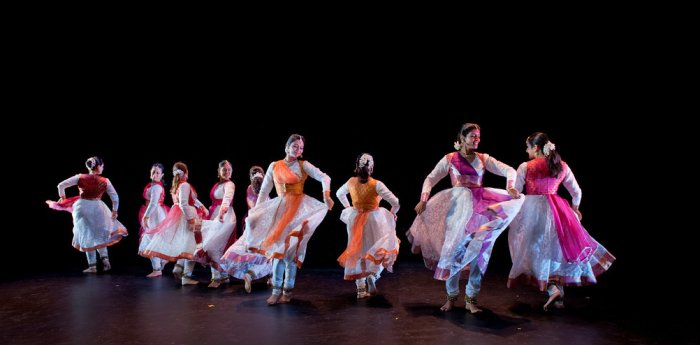 Taal se Taal, MOZARTAYANA (Photos: Michael J. Palma) Reminiscent of Balanchine's re-imagining of ballet technique, Maharaji's teaching and choreography transferred his hereditary Kathak legacy onto modern bodies, presenting it in modern venues and translating traditional stories and storytelling vocabularies with a combination of abbreviated narration from the stage and modern imagery. For example, to illustrate the thrice-repeated rhythmic pattern of a tihai, Maharaji made the gestures of dialing a rotary phone - the same number once ... twice ... and finally - connect / HELLO. Using modern movement and choreographic structures, Maharaji remained squarely within traditional Kathak while creating with a modern sensibility. The choreography of MOZARTAYANA reflects my years of training in Maharaji's modernized Kathak technique and in Merce Cunningham's modern dance techniques. But it also reflects my years of watching and listening to modern ballet, modern dance and world dance, and to classical, modern and world music and theater. What I retained was never the steps but the approach to tradition and modernity. Mozart continues to travel throughout the world with his music. The Kathak Ensemble & Friends will contribute to the timelessness of Mozart's legacy by re-mounting MOZARTAYANA in 2028, celebrating the 50th anniversary of the founding of The Kathak Ensemble & Friends. Kathak lives. Kathak lives because it changes. 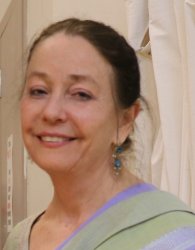 Trained in both classical Kathak dance (Pt. Birju Maharaj, beginning 1967) and Merce Cunningham modern dance technique (1971 to 1978), Janaki Patrik has choreographed thirty full-evening productions and numerous shorter works exploring an eclectic range of poetry, mythic storytelling and music. She is the Artistic Director and Founder (1978) of The Kathak Ensemble & Friends / CARAVAN, NYC. A dedicated teacher, Janaki has trained dancers to perform an extensive repertoire of classical Kathak, as well as her new choreography. Teaching and performing in inner-city schools through Urban Gateways / Chicago and Young Audiences / New York for forty years, Janaki has embodied the power of dance and music to communicate the interconnections of all cultures. Post your comments Please provide your name along with your comment. All appropriate comments posted with name in the blog will also be featured in the site. |
