
|
    |
|
|
|

ARTICLEVedānta LaharīWeaving philosophical inquiry through Nāṭya- Rohit Viswanathe-mail: natyashastra.gurukulam@gmail.com November 18, 2026 At the conclusion of the Vedānta Laharī programme at the India Habitat Centre, New Delhi, on the evening of 21 October 2026, Professor Bharat Gupt reflected on an important artistic challenge. Nāṭya has drawn extensively upon narratives from the Purāṇas and the Itihāsas, as well as stories of kings and queens, whose dramatic possibilities have long nourished the classical arts. The attempt to explore philosophical ideas more directly through performance, he observed, is comparatively less common. One of the particular challenges in presenting such ideas lies in finding ways to embody them through performance and evoke Rasa. How, then, might abstract philosophical inquiry find expression through Nāṭya, not merely as an idea to be understood, but as an experience to be encountered? This question lay at the heart of Vedānta Laharī. Bringing together six presentations across Bharatanaṭyam, Odissi, Mohiniaṭṭam and Kuchipuḍi, the programme sought to explore whether aesthetic experience could offer a glimpse of spiritual transcendence through Rasāsvāda. Its successive dance presentations approached this aspiration through different philosophical sources, devotional orientations and artistic vocabularies. The question was not whether narrative could convey philosophy. The great narrative traditions of India are themselves repositories of philosophical insight. Rather, it was whether philosophical inquiry could become an organising impulse of performance, allowing movement, gesture, music, rhythm and stillness to make a Tattva available through aesthetic experience without reducing it to verbal explanation. Establishing the frame The evening opened with the recitation of a Nāndī śloka from Kālidāsa’s Abhijñānaśākuntalam by the Sūtradhāra, before Professor Gupt and the participating dancers were invited for dīpa prajvālanam. The invocation situated the programme within the inheritance of classical Sanskrit theatre before the evening turned to its particular philosophical concerns. The opening reflections sought to establish a point of entry into the programme through the relationship between the many forms through which reality is apprehended and the underlying unity contemplated in Vedāntic thought. The image of a wave and the ocean offered one way of approaching this relationship. A wave possesses a recognisable form and a momentary individuality, yet cannot be separated from the waters of which it is composed. The image was not intended to collapse the distinctions between Vedānta, Śaivism and Sāṃkhya into a single doctrine. Rather, it offered a contemplative point of departure for an evening in which different philosophical ideas would find expression through different artistic forms. The programme's coherence lay not in assigning a common philosophical label to every presentation, but in allowing distinct works to contribute to a larger inquiry. Six artistic approaches 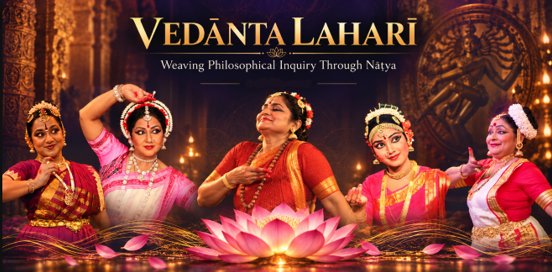 Dr. Padmaja Suresh’s Bharatanaṭyam presentation, Aṅgayarkkaṇṇi, explored Mīnākṣī through the devotional and aesthetic dimensions of dance. Its conception brought Bhakti into dialogue with Rasa Sādhanā, seeking to explore how an immersive aesthetic experience might offer a glimpse of spiritual transcendence, opening a space for contemplation beyond narrative and representation. Music, movement and jathis formed an integral part of this exploration. Dr. Padmaja drew attention to the coming together of Akṣara and Nāda in the jathis, pointing towards a relationship between syllable, sound and movement. Sound is contemplated not merely as something heard, but also in relation to manifestation itself. The interplay of rhythmic syllables, music and movement thus offered a way to consider how philosophical associations might be explored through the formal elements of a composition, without depending entirely on verbal explanation. The presentation also brought into view a question central to the aesthetics of Nāṭya: how might the experience of Rasa move beyond an individual's immediate, personal associations? Abhinavagupta's reflections on Sādhāraṇīkaraṇa offer a framework for considering how the particular circumstances represented in performance may become available to the spectator in a more universalised aesthetic experience. The relationship between Rasāsvāda and spiritual insight, including the place of Śānta within this inquiry, remains a subject for reflection rather than an outcome that can be assumed of any performance. Dr. Jyoti Srivastava’s Odissi presentation, Mahākāli Dhyan, turned towards the formidable presence of Mahākālī. Jayaprabha Menon’s Mohiniaṭṭam interpretation of Bhaja Govindam brought the question of delusion and spiritual discernment into the realm of embodied expression. Meenu Thakur’s Kuchipuḍi presentation, Rāmāyaṇa Sāram, approached the epic through its distilled significance, while Dr. Kanaka Sudhakar’s Bharatanaṭyam explored the Bhagavad Gītā’s distinction between Kṣetra, the field, and Kṣetrajña, the knower of the field. Finally, Dr. Suresh returned to the stage with selected verses from Śaṅkara’s Vivekacūḍāmaṇi, set to original music and choreography by Dr. Padma Subrahmanyam. The presentations differed in their sources, philosophical emphases and modes of expression. Their succession brought questions of manifestation, delusion, dharma, discernment and self-knowledge into a shared artistic space. Each contributed to the programme's broader inquiry into whether philosophical reflection might, through the distinctive resources of each dance tradition, become an occasion for aesthetic and spiritual contemplation. The Sūtradhāra and the space between works The role of the Sūtradhāra was to establish a thread connecting the presentations while leaving each work free to unfold on its own terms. The task extended beyond announcing the artistes or explaining their philosophical sources. It involved providing enough context to orient the audience, while allowing the dance to remain the principal medium of expression. An introduction may offer a philosophical distinction, a textual reference or a question to carry into a performance. It cannot determine what the audience will perceive, however, or prescribe the aesthetic experience that will follow. The dancer's abhinaya, movement, musicality and rhythmic organisation must be allowed to speak for themselves. The introduction prepares an encounter; it cannot replace it. The demands of live performance also required adjustments as the evening progressed. The introductions to the final presentations had to be shortened to preserve the programme's momentum. This brought into sharper relief a practical dimension of the Sūtradhāra's role: philosophical context must be sufficient to orient the audience, but not so extensive that the spoken word competes with the art. The task is to sustain continuity without imposing uniformity, and to allow the transitions between works to carry a question forward without pre-empting what the next artiste might express. From Tattva to Rasa The deeper challenge lies beyond the architecture of the programme. How does a philosophical idea become an aesthetic experience, and how might that experience open towards spiritual insight? A proposition may be intellectually clear without becoming experientially immediate. The meaning of a verse can be explained, its philosophical implications elaborated, and its place within a tradition established. Yet encountering that idea through Nāṭya involves something more: its embodiment through the expressive resources of the performer and the spectator's attentive engagement with them. Rasa cannot be reduced to the communication of a predetermined emotion. Nor can it be guaranteed by the choreographer's intention, the dancer's virtuosity or the eloquence of an introduction. The artistic process can create conditions for aesthetic experience, but what unfolds in the encounter cannot simply be commanded. In Vedānta Laharī, the spoken framing and the dance presentations occupied different but complementary places in this process. The Sūtradhāra's words sought to orient the audience towards the ideas being explored; the performers gave those ideas their own embodied expression. The transitions helped sustain a thread of inquiry across the programme, while the performances remained the principal sites of artistic encounter. The aspiration was not simply to communicate philosophical propositions through dance, but to explore whether their aesthetic apprehension might become an occasion for contemplation. The question of spiritual transcendence must nevertheless remain open. The intention to evoke Rasa does not establish what each spectator experienced, nor can an account of the programme determine whether a particular aesthetic or contemplative state was attained. The significance of the undertaking lies in exploring the possibilities of that encounter rather than claiming a prescribed result. What remains after the performance? Vedānta Laharī did not settle the question of how philosophical inquiry might be embodied through Nāṭya, nor could one evening resolve so substantial a challenge. It brought the question into a shared artistic space, where philosophical texts, embodied expression and attentive spectatorship could meet. Perhaps the more fruitful question is not whether dance can illustrate philosophy, but how Nāṭya might enable philosophical inquiry to be encountered through the integrated resources of the art. The wave does not explain the ocean. It makes something of the ocean perceptible in a particular form, without exhausting what the ocean is. In a different register, a performance may offer an encounter with a philosophical question without claiming to contain its full meaning. (Editorial note: The author served as Sūtradhāra for Vedānta Laharī. This account is a participant's reflection on the programme and its artistic questions.) 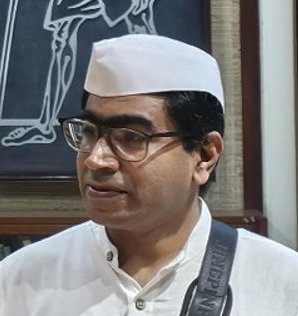 Rohit Viswanath is Yajamāna and Yojaka of Nāṭyaśāstra Gurukulam: A Centre for Civilisational Statecraft in Navi Mumbai. His work explores the relationship between Nāṭya, Dharma, human formation, governance and civilisational renewal. He is the author of The Dhārmic Theory of Human Flourishing and The Dhārmic Theory of Climate Management. His work brings together civilisational thought, artistic practice and contemporary questions of governance and public responsibility. Post your comments Pl provide your name along with your comment. All appropriate comments posted with name in the blog will also be featured in the site. |
