|
    |
|
|
|

ARTICLEArts Management 101- Sankriti Krishnane-mail: sankriti.krishnan@gmail.com November 10, 2026 (The article was first published on d'Artagnan) 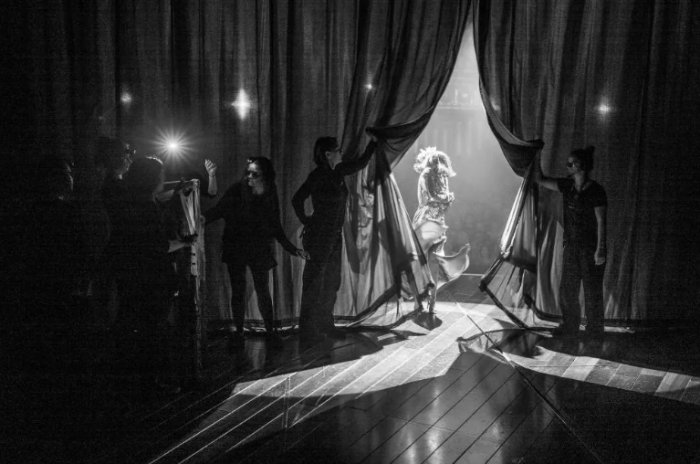 Quick Change - Gypsy, Savoy Theatre | Photograph by Matt Humphrey When I tell people that I work in arts management, a pause usually follows. Sometimes that comes from curiosity and sometimes from people stumbling over the term "arts manager" itself. "An arts manager? What exactly does an arts manager do?" That surprised curiosity is not entirely unfounded. For many, the job title is still quite new to hear and the field of work behind it even more so. Take a play or a theatre production you've seen. As the audience, we see the actors, the sets, the lights, the costumes and the story unfolding onstage. What we don't necessarily see is the work that made the production possible - securing a venue, bringing together the cast and crew, coordinating rehearsals, raising funds and securing sponsorships, managing budgets and contracts, working with creative and technical teams, promoting the production and bringing an audience into the room. Long before the curtain rises and even after it falls, there is an entire framework of people, planning and resources, working behind the scenes to support what happens onstage. This is where arts management comes in. In textbook terms, arts management is defined as a branch of management that focuses on applying business and management principles to the arts and cultural sector and its development. The field is also referred to as arts administration and those working within it may be known as arts managers or arts administrators, although their responsibilities vary widely. While that definition is a useful starting point, I tend to strip away the jargon and describe an arts manager as someone like a management consultant, but for the arts and cultural sector. We arts managers work with artists and cultural organisations to help put the people, plans and resources in place for artistic and cultural work to happen. It is as much a strategic role as it is a creative one. Depending on what an artist, organisation or project needs, an arts manager could help shape strategy, curate or programme work, manage projects and productions, raise funds, build partnerships, reach audiences or handle marketing and promotion. This is usually where my favourite follow up question arrives. "So, is it like event management?" The short answer is yes and no. Yes, because arts managers may manage events and both fields draw on many of the same skills such as planning, budgeting, logistics, marketing and coordinating people. And no, because these skills are being used towards different ends. In arts management, these skills support the development and sustainability of artistic work and the artists or organisations behind it. An event may be one outcome of a much longer term engagement involving strategy, funding, partnerships, audiences and evaluation. In event management, the event itself is the primary focus and decisions regarding strategy, logistics, budgeting and guest management are all directed towards delivering it successfully. So, while there is some overlap in terms of how these fields operate, arts management and event management are not the same. "Is that a real job? Do artists or creative people really require a 'manager'? Do they actually have that much work?" This is probably the question that stumps me the most, because it contains a very real world tension. Do artists need managerial support? Often, yes. Can they afford to bring another person into their practice? Not necessarily. Many artists work with limited or uncertain incomes and paying another person to manage the work around their creative practice can seem like an additional expense. However, the need for an arts manager becomes apparent when you think about everything that artists must do not only to create, but to keep making work and earn a living. For a long time and still today, many artists have had to be their own manager, strategist, producer, fundraiser, marketer and administrator alongside creating the work that audiences eventually get to see. For some, art is their primary source of income. Others balance their artistic practice with another full-time profession because their creative career alone may not pay enough to sustain them. In either case, the artistic practice continues and so does the work around it. Whether or not an arts manager is hired, the administrative nitty gritty remains. And as long as that exists, so does the need for arts management. An arts manager typically functions like a bridge between the artist (or organisation) and the creative idea and takes on the brunt of the administration, coordination and planning around the work, giving the artist more time and space to focus on their creative practice. I've come to understand the relationship between the artist, arts manager and creative idea from two sides. As a performing artist, I understand what it means to be immersed in creating and presenting artistic work. As an arts manager, I see the planning, people, processes and systems required to make that work possible. Now is when people normally go, "Aha! You must be in this line of work because you're a dancer." Truth be told, being an artist certainly has its advantages when working in arts management. You have an insider's understanding of timelines, creative processes, people, venues and organisations. While being an artist is not a prerequisite for becoming an arts manager, a genuine interest in and appreciation for the arts goes a long way - only because working in a niche sector is far more bearable when you actually like what it is built around! Jokes aside and more importantly, this appreciation helps an arts manager understand that creative processes are not always linear nor do they fit neatly into established administrative systems. It helps us recognise when structure is useful and when it needs to remain flexible. There is a misconception and a silent expectation within the sector, that arts managers must extend this flexibility not only to how they work, but also to the conditions under which they work. The irony is that we function within the same under resourced cultural ecosystem as the artists and organisations we work with. We may be hired only for the duration of a project, expected to juggle several responsibilities under one blanket job title or paid less than the breadth of our work warrants. While artistic insight, empathy and an appreciation for arts and culture can make the work meaningful, they shouldn't be treated as substitutes for fair pay. Better funded, larger cultural institutions may have the capacity for well defined arts management roles, while smaller organisations and independent artists often rely on freelance, part time or informally shared administrative support. Even a formally acknowledged job title doesn't necessarily mean that the compensation accurately reflects the work involved. This is where I find it (technically) safe to say that recognising arts management as a profession goes beyond simply naming the role. It also means budgeting realistically for it, offering fair contracts and creating viable career paths for the people doing the work in the sector. Given how broad and yet niche the field is, what an arts manager actually does can vary significantly across art forms. In the performing arts, an arts manager can help take an idea to the stage, coordinate performers, rehearsals and venues while also working on fundraising, touring and technical production. In the visual arts, the role may involve artist representation, exhibition planning, sales, gallery or museum management and public programming. Beyond working with individual artists, arts managers also work within arts organisations, cultural institutions, non-profit organisations and foundations on festivals, performances, exhibitions, workshops, standalone programmes and events. Some roles overlap with adjacent practices like curation and arts writing, while arts managers may also specialise in areas such as arts marketing and communications, fundraising, partnerships or audience development. Just as the responsibilities of an arts manager vary across art forms, the way the profession is recognised and understood, and the frameworks within which it operates, can vary across countries. Having studied and worked in the UK, I encountered arts management as a more established professional field with specialised degrees, clearly defined roles and formally recognised professional networks to connect with practitioners, academics and leaders in the field. Back home, the work itself is far from new. Artists, patrons and cultural organisations have long undertaken the planning, fundraising, programming and administration needed to sustain artistic practice. India has no shortage of art, artists or audiences. What is relatively new is the recognition of arts management as a distinct profession, with its own skills, systems and practitioners, while the access to formal training and dedicated managerial support is still uneven. Recognition is slowly beginning to take shape through a mixture of postgraduate qualifications, online courses and practitioner led programmes. These range from the PG Diploma in Cultural Management offered by the Indira Gandhi National Centre for the Arts (IGNCA) and online courses from IIM Bangalore and Università Bocconi to capacity building programmes such as the ones offered by ARThinkSouthAsia. While these initiatives are encouraging, they do not yet form one clear or standardised route into the profession. In fact, many arts managers enter the field having no prior, formal qualification in arts management. They may begin as artists, producers, administrators or creative practitioners, notice a gap around the work and simply start filling it. They learn on the job and build a practice over time, before they necessarily acquire or even encounter the title "arts manager." That does not make their experience any less valid. If anything, it reflects how the profession itself has developed in India; the work came first, the terminology followed and the training is now beginning to catch up. Formal education can offer shared language, frameworks and networks, but it is not the only route into the field. The next step then, is not to introduce management into a sector where it never existed, but to recognise, formalise and value the work that is already being done. As the cultural sector continues to grow and it undoubtedly will in an artistically rich country like ours, artists and organisations should not have to carry all of that often invisible labour alone. This brings me back to that one recurring question that I've been asked throughout my professional life, "So what exactly does an arts manager do?" My answer as an arts manager? It depends. It will look different depending on the artist, organisation, project or art form. My answer as the person wearing that hat everyday? I could take you through a whole spiel about helping take a creative idea from concept to the stage, the gallery or wherever it is meant to live. But at the heart of what I do is the less glamorous, arguably all consuming heavy lifting around the art, so that the fun part - the art itself, has room to happen. So, the next time I say I'm an arts manager, perhaps the pause that follows will finally be, just a tad bit shorter.  Sankriti Krishnan is an arts manager with a background in engineering and a Master's in Arts and Cultural Management from King's College London. She has worked across cultural programming and arts administration in India and the UK, spanning the visual and performing arts. Alongside her independent practice, she writes on arts and culture, travel and other interests. She is also a Bharatanatyam dancer and teacher at Chidambaram Academy of Performing Arts, Chennai (CAPA), where she trains under Guru Chitra Visweswaran and Acharya Sukanya Ravindhar. Post your comments Pl provide your name along with your comment. All appropriate comments posted with name in the blog will also be featured in the site. |
