|
    |
|
|
|

ARTICLEWhen Ghungroos rang at Disney World- Samyuktha Gopiraje-mail: samugopi28@gmail.com November 8, 2026 I have performed on many stages - school auditoriums, community centers, temple halls. But nothing prepares you for the moment you stand inside the Theater in the Wild at Disney's Animal Kingdom - a 1,500-seat venue that normally houses Finding Nemo: The Big Blue... and beyond! and realize that the next seven minutes belong to you, your art, and your community. And nothing prepares you for the day before that, when you dance down Main Street, U.S.A. with Cinderella Castle behind you and thousands of strangers cheering you on. Ghungroo Dance School Inc., a small studio from Santa Clarita, California, was one of 25 companies selected from over 600 applicants worldwide to perform at the Diwali Dance Fest 2026 at Walt Disney World Resort. Organized by Jashn Productions, the fourth annual festival brought together more than 500 dancers from four continents for a four-day celebration of South Asian dance and culture (October 22-25), with over 1,100 participants and guests. Ghungroo performed in both the Grand Parade and the International Dance Showcase. I was one of those dancers. This is what it felt like. Three days, Three Parks The festival unfolded across Walt Disney World - each day with its own character, each park offering a different stage. October 22 - Diwali Mela, EPCOT. The celebrations opened with the Jashn-E-Magic Diwali Mela at EPCOT's World Showplace Pavilion - a first-time venue for the festival. Live DJs, mehndi art, cultural activities, dinner. Mickey and Minnie joined in kurta and sari. This was the gathering, the community breathing together before the performances began. October 23 - Diwali Grand Parade, Magic Kingdom. Over 500 dancers in Indian costume moved down Main Street, U.S.A. as a special pre-parade ahead of the Festival of Fantasy, with Cinderella Castle as their backdrop. Thousands of park goers lined the route - American families, international tourists, children in Mickey ears - most encountering Indian dance for the very first time. This was spectacle on the grandest scale: Indian dance not as a side note in a multicultural programme, but as the event that stopped Main Street. October 24 - International Dance Showcase, Disney's Animal Kingdom. The 25 selected studios performed their individual pieces inside the Theater in the Wild, the 1,500-seat venue in the DinoLand U.S.A. area. This was not a parade. This was theater - a professional stage with full lighting and sound, where each company had its own set to showcase their artistry. For dancers accustomed to community halls and temple stages, the shift was profound. Two performances. Two entirely different contexts. The parade was about collective spectacle - 500 dancers, one celebration, the sheer visual impact of Indian dance in the most American of spaces. The showcase was about craft - seven minutes on a professional stage where every tatkar, every transition, every formation had to hold up under theatrical scrutiny. Ghungroo did both. The space between Sabhas and Spectacle What struck me across both performances was the audience. This is not a sabha. There is no kutcheri protocol, no rasikas settling into seats with knowing eyes. At Magic Kingdom, thousands watched from the sidewalks but at Animal Kingdom, it was a full theater. When Indian dance steps out of its familiar contexts and into spaces where it must speak through pure movement - no programme notes, no cultural shorthand - it reveals what is universal in our tradition: rhythm, emotion, the human body in communion with music. That is what inclusion looks like. Not a token gesture, but Indian heritage commanding one of the most iconic entertainment platforms on earth, witnessed by thousands who may never visit India but who, for those minutes, felt its pulse. Seven minutes at the Theater in the Wild: Kathak, Bhangra, Bollywood Our showcase piece was seven minutes long. Seven minutes to carry an audience from the courts of Mughal India to the harvest fields of Punjab to the Technicolor dreamscapes of Bollywood. Seven minutes in which every dancer - from the youngest to the most advanced - had a part to shine. 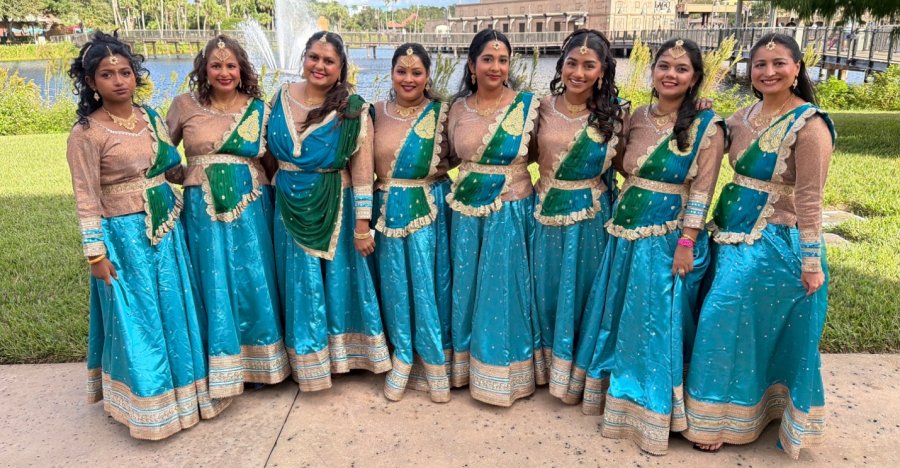 The piece opened with Kathak. A deliberate and brave choice. In a theater that normally hosts underwater puppetry and Disney spectacle, the instinct might be to open with maximum energy. Instead, our choreography chose restraint. The Kathak opening commanded attention through precision - the articulation of tatkar, controlled chakkars, the expressive abhinaya that drew the audience inward before the energy expanded. It was a statement of origin: we begin where our art begins, in the classical tradition, in the discipline of the gharana, in the language of rhythm and storytelling passed down through generations. For a Disney audience encountering Kathak for the first time, the effect was striking. Stillness before spectacle. Discipline before abandon. The theater's acoustics carried every footfall, every ghungroo, into the farthest seats. 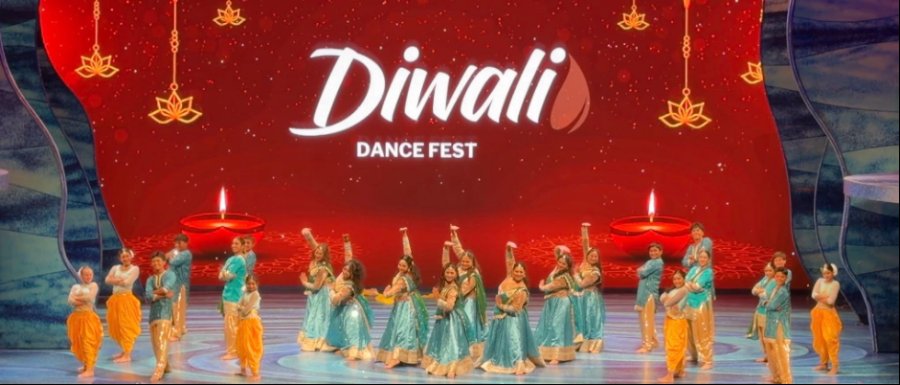 The transition to Bhangra was electric. Where Kathak held the audience in its palm, Bhangra detonated. Athletic leaps, powerful shoulder work, the infectious pulse of Punjab's harvest dance. The shift was a choreographic conversation - classical and folk, restrained and unrestrained, existing not in opposition but in dialogue. This is the breadth of Indian dance: that it can contain both the meditative grace of a Kathak tukda and the joyful detonation of a Bhangra sequence, and that both are authentic, both are necessary. 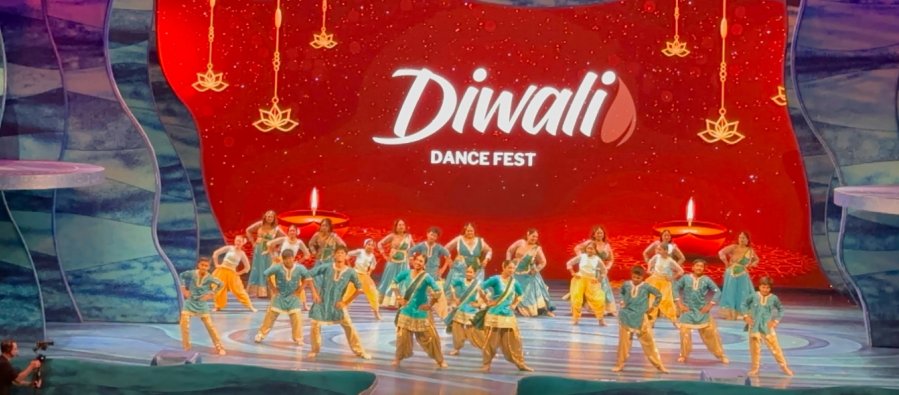 The finale was Bollywood - the great unifier. The full company came together. Every dancer had their moment. Bollywood's genius has always been its ability to synthesize: classical vocabulary, folk energy, contemporary movement, cinematic emotion. Accessible without being shallow. Spectacle with soul. When the final beat landed, I looked out past the stage lights and saw something I will not forget: a Disney audience - from everywhere - cheering, clapping, some dancing in their seats. Seven minutes. That was all it took. The women behind Ghungroo Ghungroo is led by two women whose backgrounds are as distinctive as the school itself. Jini Valiaveettil, the school's founder and director, began teaching dance at 16. She built Ghungroo between the demands of her career as a travel nurse and raising her family - driven by the conviction that Indian American children deserve a space where heritage is celebrated Karthika Ashok, the school's Program Manager, brings an unusual dual expertise. Trained in physical therapy and sports medicine, she understands the body's mechanics and the physical demands placed on young dancers with clinical precision. She is also a trained dancer in Bharatanatyam and Mohiniyattam. Together with Jini, she led the program management effort - coordinating rehearsals, travel logistics, and the organizational complexity of taking 25-plus performers and their families across the country. 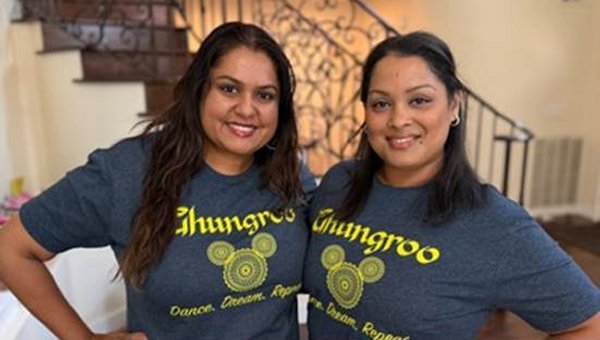 Jini Valiaveettil and Karthika Ashok What Bharatanatyam teaches beyond the stage I should confess: I am a Bharatanatyam dancer performing with a school that specializes in semi-classical styles, Bhangra, and Bollywood. But classical training does not stay in its lane. It seeps into everything. My Bharatanatyam training has helped me with geometry - understanding angles, spatial patterns, and the symmetry of formations on stage. It has sharpened my rhythmic expressions, teaching me to internalize complex tala structures and translate mathematical precision into movement. And the eye and hand coordination that Bharatanatyam demands - where your eyes follow your fingertips, where every mudra must align with every glance - that carries into everything I do, from academics to the formations I held at the Theater in the Wild. Classical dance does not just train your body. It trains your mind. This is why classical dance education matters for young people in the diaspora. It is not a relic. It is a technology of the self - ancient, rigorous, and startlingly relevant. Coda There is a moment after a performance when the music stops but the energy has not yet dissipated. You are still in it - the rhythm is still in your feet, the formation is still in your body, the audience is still cheering but you cannot quite hear them because something inside you is louder. That is what I felt twice at Disney World - once on Main Street with Cinderella Castle behind me, and once inside the Theater in the Wild with a standing ovation filling 1,500 seats. Not triumph, exactly. Something quieter. The feeling that our traditions - Kathak's storytelling, Bhangra's joy, Bollywood's spectacle, Bharatanatyam's precision - had traveled across an ocean, across generations, across the vast distance between a temple in Tamil Nadu and a theme park in Florida, and arrived intact. Alive. Celebrated. Dreams are built on passion, perseverance, and community support. They are also built on ghungroos. And on this October weekend, those ghungroos rang loud enough for the world to hear.  Samyuktha Gopiraj is a Bharatanatyam dancer, member of Ghungroo Dance School's Student Leadership Team, and a contributor to Narthaki. She is a high school junior at The Buckley School in Los Angeles. Post your comments Pl provide your name along with your comment. All appropriate comments posted with name in the blog will also be featured in the site. |
