
|
    |
|
|
|

ARTICLECharukesi: The bittersweet ocean of love to pure Krishna consciousnessA perspective on music, movement, and the mind- Bana Shastri Ramanathe-mail: natyanjali@hotmail.com November 3, 2026 In search of meaning Life is often likened to a journey of highs and lows, roses and thorns, and bittersweet moments. As we age, memories may fade, yet the sensations of pain and pleasure can remain, leaving fossil-like impressions within us. Perhaps this is why older faces sometimes carry fleeting, childlike smiles touched with melancholy, as emotions pass effortlessly and involuntarily across them like images appearing on a screen. Is the mind quietly revisiting a lifetime of triumphs, disappointments, joys, and sorrows? I often wondered about this while watching my parents, both of whom lived to nearly 100. These reflections returned as I prepared for a dance performance. I searched for a song gentle enough for my injured knees, yet powerful enough to stir my consciousness and convey love, joy, melancholy, and warmth. I also wanted the music to evoke the painless healing I have occasionally experienced during and after my performances. When mind, body, and feelings move in harmony, merging as one with the music, I have experienced that the mind can become so absorbed in the process that pain seems to dissolve, for a time. Those experiences have inspired me to explore and share how music and dance can transform a lifetime of mixed memories into a more peaceful, expansive form of love through artistic expression, a moving meditation. Culture, Philosophy, and Artistic Expression India's vast tradition of compositions by saints, scholars, and musicians is rich in philosophy, spirituality, and insight into human emotion. Foundational works on dance, drama, and music likewise explore how disciplined artistic practice can unite physical technique, expressive feeling, and spiritual understanding. Among the works and composers that have shaped my perspective are: Charukesi Our experiences, upbringing, and emotions shape the associations through which we understand music and memory. When we examine those impressions and listen to the heart's whisper, even painful associations can become a path from bitterness toward selfless, peaceful love. I began looking inward, searching for the right melody that would move me profoundly. Many ragas, lyrical compositions, and arrangements express love, pain, resentment, anger, and devotion beautifully. Yet I wanted something more intense: music that touched my core, awakened memories flowing through my veins, and evoked natural, spontaneous feelings and expressions. I kept returning to one of my favorite ragas, Charukesi, which has long lingered in my psyche. Its bittersweet depth can stir the mind's deepest thoughts of bittersweet moments and the longing for a dear friend, a mentor, or a soulmate. Charukesi is the 26th raga in the Carnatic Melakarta system. Like other ragas, it is built on all seven musical notes that brilliantly mirror the dichotomy of the human psyche, blending sorrow, intense love, disappointment, uplifting joy, devotion, and peace. It can evoke and express melancholy, devotional love, the joy of romantic longing, and the pain of heartbreak in one song. My affinity for this raga, Charukesi, emerged from exposure to Indian classical music, dance, religious stories, life experiences, and imagination. Magic of Krishna Music affects each person differently, shaped by temperament, physical response, and inner spirit. It speaks to the soul and lingers not only in conscious memory but also in the body's deeper memory of experience. It can bring tears and smiles, a sense of floating without sinking, or of merging with subtle, transformative energy. Within the devotional tradition that shaped my artistic imagination, related stories, narrations, and musical compositions connect this transformative energy with Krishna, the beloved charioteer who revealed his divine form in the Indian epic Mahabharata. Krishna's personality is popularly associated with the radiance of love, playfulness, hope, beauty, music, dance, and strength - qualities that can bring joy and ease human struggle. Indian classical compositions often imagine and mention him arriving to rescue and protect, sometimes through no more than a gentle breath of energy that transforms a challenging situation. Pure Krishna consciousness through music, dance, and devotion 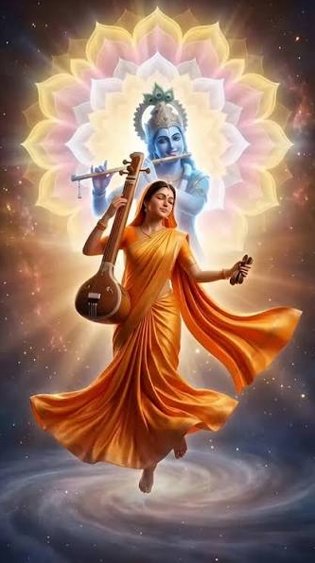 My emotional compass led me to a Charukesi composition about a young maiden longing to meet playful Krishna on the banks of the River Jamuna. His presence is like an ocean into which rain, rivers, and all other waters flow, transforming every emotion into divine love through the discipline of devotion (Bhakti Yoga). Many composers and devotees describe this state of being fully immersed in the spiritual realm as Krishna consciousness: a quiet harmony of mind and heart, in which love is experienced freely, without fear or restraint. Saint Meera Bai exemplifies this devotional path; she sang and danced in praise of Krishna, immersing herself fully in Krishna consciousness. Like Meera Bai, devotees imagine and express Krishna appearing in times of need to help and offer love and joy. In such moments, the human soul is immersed in seeking attention, friendship, love, and compassion - and to find them through Krishna consciousness, or what Yoga philosophy calls pure consciousness. This ancient vision also parallels Buddhist meditation and contemplation, as well as modern psychology's Empty Chair Technique, a therapeutic practice used to release emotional burdens. The Empty Chair as a healing practice In Yogya Kalra's article "Healing with the Empty Chair Method," published on MentalHealth.com, the Empty Chair Technique is described as a Gestalt therapy role-play exercise. A person sits across from an empty chair and speaks to either an imagined individual - such as a parent, partner, friend, or deceased relative - or an internal aspect of the self, such as an inner critic. By giving unresolved emotions a voice, practice can help a person process them and move toward closure. For me, this offers a beautiful parallel to the inward work of music and devotion: each creates an imagined space where emotional burdens can be acknowledged, rationalized, and gradually released. From bitterness to love The power of Charukesi, like that of other deeply expressive melodies, seems to rise from an ocean of love and bitterness. Expressive music, when engaged with the mind, emotions, and rhythmic movement, can confront and transform life's bitterness: Charukesi is not merely a raga to understand; it is one to feel and express. Through melody, lyrics, and movement, raga Charukesi can transform pain and disappointment into devotion and guide the restless mind toward a more expansive experience of peaceful love. I hear and feel the magic of Charukesi bringing lyrics, melody, and movement together as a path through which the mind travels the shared ocean of pure Krishna consciousness.  Bana Shastri Ramanath is the Director, Natyanjali Austin - San Antonio. Post your comments Pl provide your name along with your comment. All appropriate comments posted with name in the blog will also be featured in the site. |
