
|
    |
|
|
|

ARTICLEWhen AI can perform, what remains to be cultivated in the artist?- Rohit Viswanathe-mail: natyashastra.gurukulam@gmail.com October 28, 2026 Author's Note This essay draws upon the writings of Dr. Padmaja Suresh, Ācārya for Nāṭya Pedagogy at Nāṭyaśāstra Gurukulam, on the philosophical, aesthetic and spiritual dimensions of Nāṭya, and the guidance of Dr. M. B. Athreya, the Gurukulam's Marga Darshak, on human development, institutional responsibility and Dhārmic statecraft. These perspectives inform the essay's engagement with AI, artistic judgement and self-governance. 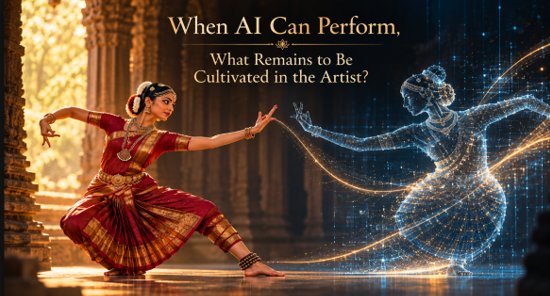 A movement can be recorded, its geometry analysed, its execution compared against a reference, and a sequence of gestures generated through computational systems. Yet the cultivation of an artist entails a question of a different order. What happens to the person who practises? How are the body, perception, affect, imagination and judgement progressively refined through engagement with an art? And what distinguishes the possession of a repertoire from the cultivated capacity to interpret, embody and bring it to life? These questions acquire particular significance when approached through Naṭya. Within the tradition of the Nāṭyaśāstra, performance is not merely an external arrangement of movements, gestures and expressions. Its constituent elements are brought into an expressive whole through abhinaya, while the relationship between Bhava and Rasa directs attention towards the aesthetic experience that performance makes possible for the cultivated spectator. The dancer's formation, therefore, cannot be understood solely through the movements mastered or the performances accomplished. It must also be considered in relation to the capacities developed through disciplined practice: embodied awareness, expressive discrimination, sensitivity to context and the ability to apprehend relationships that cannot be understood by examining the components of a performance in isolation. This distinction does not require us to assume that artificial intelligence can produce only superficial imitations, or that technological assistance necessarily diminishes artistic integrity. AI may support movement analysis, documentation, choreographic experimentation and the transmission of instructional material. The more consequential question is whether the ability to generate or reproduce aspects of performance is accompanied by the cultivation of judgement required to interpret, evaluate and take responsibility for them. The production of an artistic output and the formation of an artist are related, but they are not identical processes. Recent developments make this question increasingly pertinent. A 2024 study demonstrated a computational approach to identifying Bharatanatyam poses and reconstructing them in three dimensions, drawing upon representations of the 108 Karaṇas associated with the Nāṭyaśāstra. [1] A subsequent study examined professional dancers collaborating with ChatGPT in choreographic experimentation. [2] These projects illustrate how AI can contribute to the analysis, representation and generation of dance material, opening possibilities for documentation, creative exploration and cultural preservation. The question is not whether such capabilities should be admitted into the studio. It is what their use means for the cultivation of the artist. Approached as Sādhanā, Natya directs attention beyond the production of performative form towards the formation of the practitioner: the refinement of perception, the cultivation of Viveka and the capacity to exercise informed artistic judgement. This also raises a wider responsibility. How might the practice and transmission of Naṭya contribute not only to the formation of individual artists, but also to the human capacities upon which meaningful self-governance depends? From Rūpa to Abhinaya The Nāṭyaśāstra approaches performance as an integrated discipline rather than an arrangement of isolated movements. Its fourfold account of abhinaya, comprising Āṅgika (bodily expression), Vācika (verbal and vocal expression), Āhārya (costume and external presentation) and Sāttvika (expressive manifestations associated with inner states), provides a vocabulary for understanding the multiple dimensions of performance. [3] The expressive body, as explored in Dr. Padmaja Suresh's writings, is not merely a vehicle for producing visible forms. She examines the symbolic and ritual dimensions of gesture, placing the dancer's hand within a wider field of meaning that includes iconography, sacred symbolism and the interpretive grammar of the tradition. Her reflections invite us to consider the hasta not merely as a configuration of the fingers, but as an expressive form whose significance emerges through context, convention and the practitioner's understanding. [4] This distinction matters when computational systems analyse bodily configurations, classify gestures or generate movement possibilities. Such capabilities can assist documentation and learning, but the identification of a form does not, by itself, establish its appropriateness within a particular composition, character or dramatic situation. The task of the practitioner is to bring form and meaning into an appropriate relationship through knowledge of the tradition and informed artistic judgement. The issue is not whether a computationally generated movement is necessarily deficient, but whether the production of Rūpa, the perceptible form, is accompanied by the discernment required to interpret and employ it meaningfully. The question is therefore not simply whether AI can produce a plausible Abhinaya, but how the artist develops the Viveka to discern what a particular dramatic and aesthetic context calls for, which expressive choices serve it, and when a choice must be modified or rejected. Nāṭya as Sādhanā When artistic practice is understood as Sādhanā, its significance extends beyond the performance eventually produced. The practice itself matters: repetition, correction, attention, the refinement of movement, and the progressive integration of bodily discipline with expressive understanding. A dancer does not merely accumulate movements. Through sustained practice, the relationship between body, rhythm, gesture and intention becomes increasingly refined. Technology can support this cultivation in several ways. Movement analysis can help students identify technical inconsistencies; digital archives can preserve material that might otherwise become difficult to access; and generative systems can offer choreographers new possibilities for compositional exploration. The concern arises when assistance displaces the very practice through which discernment develops. If a system continually supplies solutions, the practitioner may have fewer opportunities to exercise the judgement needed to evaluate them. This is not an inevitable consequence of AI use, but a pedagogical risk worth recognising. The distinction is between technology that supports Sādhanā and technology that progressively substitutes for the exercise of the capacities Sādhanā is intended to cultivate. Bhāva, Rasa and the Sahṛdaya The aesthetic theory associated with Bharata Muni and elaborated by Abhinavagupta offers a further dimension to this inquiry. The relationship between Bhāva and Rasa concerns more than the outward representation of emotion. It directs attention to how the elements of performance are organised and how aesthetic experience becomes possible for the cultivated appreciator, the Sahṛdaya. [5] This framework cautions against equating the convincing appearance of an emotion with the full aesthetic achievement of a performance. Aesthetic significance depends upon the expressive elements' place within the artistic whole and the conditions through which they are apprehended. Can AI generate material that occasions Rasa? That question deserves serious artistic and philosophical investigation. It would be premature to assume that computational involvement automatically invalidates aesthetic experience. Equally, the technical plausibility of an output does not establish its aesthetic efficacy. For the practitioner, the more immediate question concerns cultivation: what enables an artist to understand the relationship between expressive means and aesthetic ends? What enables a spectator to apprehend more than the surface of a performance? The Sahṛdaya is not simply a spectator who enjoys a performance. The concept points towards a cultivated receptivity through which the aesthetic significance of performance can be apprehended. Such receptivity cannot be inferred from the mere availability of content, just as the artist's formation cannot be inferred from the successful reproduction of a movement. The cultivation of aesthetic discernment, however, should not be equated with the cultivation of ethical responsibility. Although the capacity to apprehend experience with greater depth may enrich the conditions for judgement, it does not determine how that capacity will be exercised. The transition from aesthetic apprehension to responsible action requires further normative orientation. Dharma provides that orientation by directing attention to the purposes for which knowledge and capability are exercised, the responsibilities they entail, and the consequences of their use. Guru-Śiṣya Paramparā: From Access to Vidyā These distinctions become consequential in the transmission of artistic knowledge. Digital repositories and online instruction have widened access to performances, demonstrations and teaching materials. AI-assisted systems may offer additional explanations, movement comparisons and practice resources. For many learners, these can be valuable supplements. Yet access to a demonstration is not identical to the acquisition of Vidyā. A recording may show a gesture, but learning involves discovering how that gesture functions within a composition, how it must be refined for a particular student, and how it relates to the wider grammar and expressive demands of the art. The guru-śiṣya relationship matters not because technology must be excluded, but because artistic understanding develops through sustained engagement: demonstration, correction, interpretation, questioning and the gradual assumption of responsibility by the student. Dr. Suresh's reflections on Paramparā illuminate this formative dimension of transmission. She interprets the invocation to the guru as expressing a shared endeavour between teacher and student, directed towards the cultivation of understanding, clarity of intellect and the removal of misunderstanding. Read alongside her reflections on Rasa, this perspective suggests that artistic transmission involves more than the acquisition of a repertoire. [6] The guru's responsibility extends beyond the transmission of technique to the cultivation of the śiṣya's capacity to understand, discriminate, interpret and exercise independent artistic judgement. The objective is neither perpetual dependence upon the teacher nor the mere acquisition of a repertoire, but the progressive formation of a practitioner capable of taking responsibility for the tradition. As technological systems increasingly supply demonstrations, explanations and feedback, their value must therefore be assessed in relation to whether they strengthen or displace the student's developing discernment. This formative responsibility extends beyond the individual student. A pedagogical tradition helps shape the capacities through which its students subsequently engage with the world. By cultivating discernment alongside technique, it can contribute to the formation of individuals capable of exercising responsibility rather than merely following directions. A 2025 article in Narthaki.com, 'Can YouTube Be Your Guru?', considers the opportunities offered by digital platforms while raising questions about what access to dance material can provide in the absence of sustained guidance. [7] This distinction becomes increasingly pertinent as AI systems begin to generate personalised instructions and evaluate aspects of performance. The Institution's Responsibility Dance institutions face a corresponding challenge. AI may assist with administration, archival cataloguing, documentation, publicity, movement analysis and selected pedagogical tasks. Such uses can free practitioners to devote greater attention to artistic work. But an institution must distinguish between delegating a task and relinquishing the capability to evaluate it. Can its teachers assess AI-generated instructional material? Can its practitioners identify when a computational representation omits an important feature of a tradition? Can the institution continue teaching and interpreting its art if a technological service becomes unavailable or unsuitable? These are questions of institutional continuity and self-governance. This concern also connects with a broader principle of technological governance articulated in a recent working paper from Nāṭyaśāstra Gurukulam, The Dhārmic Theory of AI Management: the delegation of capability must remain proportionate to the responsibility involved, with sufficient human competence retained to evaluate, question and, where necessary, override the system. Applied to the arts, this means distinguishing between using AI to assist artistic practice and surrendering the capacities through which artistic choices are interpreted, evaluated and made accountable. Routine administrative functions may be delegated more readily; decisions central to artistic interpretation, pedagogy and cultural transmission require sufficient retained competence to question, correct or replace the system. [8] The human-AI co-dancing project offers a pertinent example. The project translates principles of traditional Thai dance into interactive computational models, enabling human dancers and virtual characters to engage in choreographic exchange. It explores how technology might support not merely the recording of cultural heritage but its further development. [9] In her reflections on AI and Bharatanatyam, Dr. Anita Ratnam raises questions about AI-generated dance and its implications for artists, audiences and presenters. Her perspective underscores the need to engage with emerging technological possibilities while remaining attentive to their implications for artistic practice. [10] Such experimentation need not be opposed to tradition. Yet the continuity of a living tradition depends on more than the preservation of its external forms. It also depends on practitioners and communities who can interpret, renew and take responsibility for what is transmitted. A digital model may preserve a representation without, by that fact alone, ensuring the continuity of the Paramparā through which its significance is understood. Svarājya: From the Artist to Society The deeper question is one of Svarājya: Self-governance. In the context of artistic practice, it means retaining the capacity to exercise informed judgement and assume responsibility, rather than allowing the availability of a technological solution to determine the direction of one's work. For the individual artist, this entails evaluating an AI-generated suggestion, recognising its limitations and remaining accountable for the artistic decision. For the guru, it means using technological resources without allowing the cultivation of the student's discernment to become secondary. For the institution, it means retaining the competence to govern the processes it delegates. The responsibility of Naṭya practitioners extends beyond personal cultivation and the preservation of artistic form. Dr. Suresh's reflections on the wider significance of Naṭya situate the art within a larger conception of human development rather than limiting its purpose to performance or entertainment. [11] This perspective invites us to consider not only what an artist accomplishes, but also what is cultivated through practice and transmitted through teaching, performance and institutional stewardship. Such a contribution must be understood carefully. Aesthetic discernment does not automatically produce ethical conduct, and Naṭya practitioners cannot, by themselves, secure a Self-governing society. Yet meaningful collective Self-governance depends, in part, upon people capable of examining circumstances, exercising judgement and accepting responsibility for their actions. Artistic practice can contribute to these human capacities when its pedagogy and institutions deliberately cultivate them. The issue becomes especially significant when technological systems increasingly mediate what people attend to, learn and create. Dependence is not inherently a loss of freedom: artistic traditions themselves depend upon teachers, communities and inherited knowledge. The question is whether a particular relationship of dependence strengthens the capacity to understand and act, or progressively weakens it. Svarājya therefore requires not independence from every source of assistance, but the continuing capacity to exercise judgement and responsibility within relationships of dependence. When AI can perform, the responsibility of the artist is not to prove that human beings can accomplish every task more effectively than machines. It is to cultivate the Viveka, embodied understanding and responsibility through which artistic capability acquires direction and meaning. Approached as Sādhanā, Naṭya offers a way to engage technological change without either rejecting it or confusing technological proficiency with artistic formation. The future of the tradition will depend not only on what can be recorded, generated or performed, but also on whether the human capacities through which it is understood, renewed and transmitted continue to flourish. The practitioner's responsibility is therefore both inward and outward: to cultivate the Self and, through that cultivation, contribute to a society capable of governing itself. References 1. J. Jayanthi and P. Uma Maheswari, "AI and Augmented Reality for 3D Indian Dance Pose Reconstruction Cultural Revival," Scientific Reports 14 (2024): article 7906. 2. "Artificial Intelligence in Dance Choreography: A Practice-as-Research Exploration of Human-AI Co-Creation Using ChatGPT-4," International Journal of Performance Arts and Digital Media 21, no. 2 (2025). 3.Bharata Muni, The Nāṭyaśāstra, trans. Manomohan Ghosh, 2 vols. (Calcutta: Asiatic Society, 1951-1961). 4. Padmaja Suresh, "Language the Hands Speak," The Hindu, July 19, 2018. 5. Raniero Gnoli, The Aesthetic Experience According to Abhinavagupta, 2nd ed. (Varanasi: Chowkhamba Sanskrit Series, 1968). 6. Padmaja Suresh, "Reciting this Prayer for Knowledge," The Hindu, November 8, 2018. 7. Anannya Mahanta, "Can YouTube Be Your Guru?," Narthaki, November 8, 2025. 8. Rohit Viswanath, The Dhārmic Theory of AI Management: Delegated Human Power, Self-Governance and the Ordering of Technological Freedom (Navi Mumbai: Nāṭyaśāstra Gurukulam, 2026). 9. MIT Media Lab, "Cyber Subin: Human-AI Co-Dancing," accessed October 25, 2026. 10. Anita R. Ratnam, "Anita Says... April 2025," Narthaki.com, April 1, 2025, section "AI & Bharatanatyam". 11. Padmaja Suresh, "Relevance of Nāṭya Veda," The Hindu, October 26, 2018. 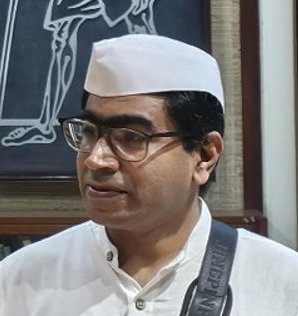 Rohit Viswanath is Yajamāna and Yojaka of Nāṭyaśāstra Gurukulam: A Centre for Civilisational Statecraft in Navi Mumbai. His work explores the relationship between Nāṭya, Dharma, human formation, governance and civilisational renewal. He is the author of The Dhārmic Theory of Human Flourishing and The Dhārmic Theory of Climate Management. His work brings together civilisational thought, artistic practice and contemporary questions of governance and public responsibility. Post your comments Pl provide your name along with your comment. All appropriate comments posted with name in the blog will also be featured in the site. |
