|
    |
|
|
|

ARTICLEThe invisible labor of being an artist online- Dr. Anita Vallabhe-mail: editor@globalindianartist.com October 15, 2026 (The article first appeared in Global Indian Artist™ LLC, dated Oct 14, 2026) 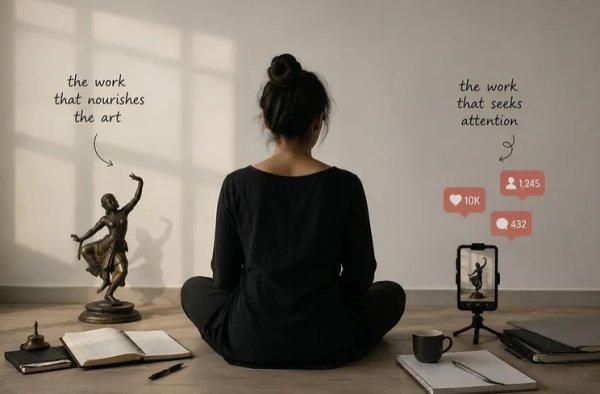 If you are not online, it feels like you simply do not exist in today's artistic ecosystem. To ignore the power and presence of digital marketing is to do so at your own artistic peril. Nowadays, Instagram seems to be the go-to platform for Indian artists, announcing everything from collaborations and performances to events they attend. The boundaries between the personal and the professional have become increasingly blurred. Come to think of it, where does one end and the other begin anyway? Instagram affects people differently. Within my circle of friends, I see three broad responses. Some genuinely enjoy it. They are the enthusiasts - artists who embrace the platform as a space for creativity, connection, and self-expression. Others dislike social media altogether. They are the dissenters, preferring to devote their time and attention to their practice rather than the demands of an online presence. Then there are the reluctant-s: artists who remain on Instagram not because they enjoy it, but because they feel they have little choice. It is where audiences, presenters, collaborators, and professional opportunities now seem to converge. For them, Instagram is less a creative outlet than an indispensable part of the job. I belong to the last category. My reluctance has little to do with the platform itself and everything to do with the time and attention it demands. I often appear to be an extrovert online, yet by temperament I am happiest working in silence - reading, practicing, thinking, and writing. Setting up a shot, finding the right light and camera angle, recording the same few lines repeatedly, editing reels, writing captions, monitoring engagement, and responding to comments all sustain an artist's public presence. Yet these tasks are rarely recognized as labor in their own right. This is what I mean by the invisible labor of being an artist today. I understand why it matters, but it does not nourish me. By invisible labor, I mean the multitude of tasks that sustain an artist's public presence but are rarely recognized as part of artistic practice itself: photographing, filming, editing, posting, monitoring engagement, responding to audiences, and continually maintaining one's visibility. Perhaps every vocation contains aspects we do not particularly enjoy. The Bhagavad Gītā reminds us that every undertaking has its unavoidable accompaniments, just as fire is accompanied by smoke. A writer must proofread. A dancer must travel. A teacher must complete administrative paperwork. Artists today are no different. We are expected to become photographers, videographers, editors, marketers, and publicists. None of these roles is inherently undesirable, but together they occupy time and mental space that might otherwise be devoted to the work itself. This is the tension I continue to wrestle with. Social media has expanded opportunities for artists to be seen, build communities across continents, and speak directly to audiences. I am grateful for these possibilities. Yet I cannot help wondering whether the hours spent learning to communicate our work are replacing the hours spent deepening it. Jenny Odell's How to Do Nothing offers a useful way to understand this tension. She examines how the attention economy draws us away from sustained engagement with the world around us. For artists, this raises a question about the conditions our work requires. Reading, practicing, observing, and allowing an idea to develop take time and concentration. When that attention is repeatedly drawn toward posting, checking responses, and maintaining visibility, what happens to the patience and depth the work needs? The choice, then, becomes ours. We can occasionally unplug, invest in meaningful relationships, and build artistic communities grounded in trust rather than metrics. When we watch a performance, we are invited into an artist's world. We appreciate the years of practice, discipline, and imagination that made that experience possible. Yet if our attention remains caught in the optics of social media, our thoughts may drift toward the photographs we will take, the moments we will post, and how many likes they might receive. The influence of social media may therefore extend beyond the promotion of art to the making of it. Are we simply documenting performances for social media, or are we beginning to create performances with social media already in mind? When choreography is designed to produce memorable clips, immediate applause, or moments that perform well online, artistic decisions can begin to serve the platform as much as the performance itself. Audiences soon come to expect those moments, and artists, consciously or unconsciously, may feel compelled to reproduce them. The danger is not applause itself, nor the popularity of a compelling performance, but allowing the demands of visibility to shape artistic choices that should instead emerge from the integrity of the work. None of this is to suggest that artists should withdraw from the digital world. Social media has democratized visibility, fostered communities across continents, and enabled artists to speak directly to audiences in ways that were unimaginable a generation ago. These are gains worth celebrating. The more difficult question is whether artistic practice has gradually expanded to include visibility, branding, documentation, audience engagement, and emotional labor, or whether these are adjacent skills that increasingly compete with the time, patience, and sustained attention from which artistic excellence emerges. Every generation of artists has adapted to new technologies. Ours is no different. The challenge is not to reject these tools but to ensure they remain in service of the work. The purpose of visibility is to serve the art - not to replace the time required to make it. How do you manage the demands of an online presence while protecting the time and attention your artistic practice needs? 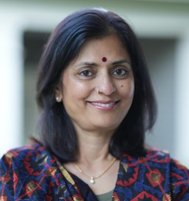 Anita Vallabh, Ph.D, is an author and the Founder and Editorial Curator of Global Indian Artist, based in Boston. Post your comments Pl provide your name along with your comment. All appropriate comments posted with name in the blog will also be featured in the site. |
