
|
    |
|
|
|

ARTICLEThe Instagramization of Indian classical dance- Dr. Rohini Dandavatee-mail: dandavate2@gmail.com October 6, 2026 Social media has given Indian classical dance something previous generations never had: an immediate, global, and largely uncontrolled platform for visibility. A dancer in Bhubaneswar, Mumbai, Chennai, New York, or California can now reach thousands of people without waiting for a festival, Sabha, or institution to provide a stage. This became particularly evident during the pandemic years, when social media became an important means of maintaining visibility, communicating with audiences, and continuing artistic engagement. Since then, its role in the dance world has only continued to grow, bringing enormous opportunities for artists. As someone who has spent several decades learning, performing, teaching, and choreographing within the Odissi tradition, I find this development both exciting and worthy of reflection. I have seen how access to dance has expanded through the screen. Artists who might once have remained known only within a particular geographical or cultural community can now be discovered by audiences across the world. At the same time, I have begun to wonder what happens to a form whose richness often lies in its gradual unfolding when it enters a medium designed for speed. Every medium has its own visual grammar. Instagram and short-form video reward immediacy, visual impact, repetition, novelty, and compressed viewing. Classical dance, on the other hand, often requires time for development - a repertoire that unfolds gradually, a musical structure that opens incrementally, with subtlety and anticipation, and a relationship between the dancer and live audience that develops over time. This makes me think about what can become "Instagrammable" in Indian classical dance. Certain aspects lend themselves naturally to the medium: a sculptural bhangi, a striking expression, intricate footwork, a burst of rhythmic movement, or a beautifully held pose. These moments can be captivating, and there is nothing inherently wrong with sharing them. The concern arises when these moments begin to represent the dance in its entirety. I often think about this in relation to abhinaya. Consider a passage portraying Radha waiting for Krishna. A three-second excerpt in which she hears the sound of his flute, turns, and her face suddenly lights up with anticipation can be visually compelling and immediately understandable. It may make an effective reel. But the three-minute unfolding of the abhinaya may include her waiting, remembering, wondering, experiencing doubt or disappointment, and gradually responding to the sound that announces his presence. The emotional power of that final glance lies in everything that has preceded it. 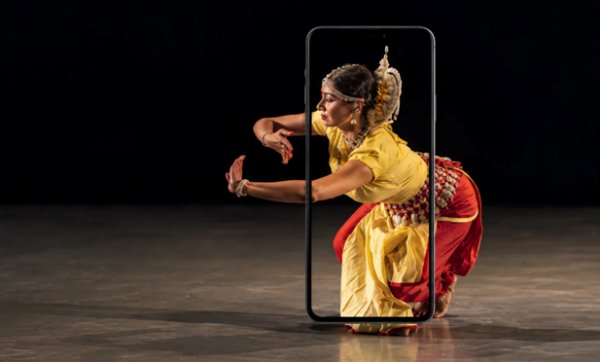 If we extract only the three-second moment, we preserve the expression but lose the context that gives the expression its meaning. I see something similar in a Pallavi. A rapid footwork sequence or a sculptural final pose may be thrilling when isolated in a short video, but the viewer misses the musical buildup, rhythmic development, transitions, repetition, variation, and resolution that make the climax meaningful. The problem, then, is not that the short video fails to show beautiful dancing. It is that it can present the climax without allowing the viewer to experience how it has been developed. Perhaps this points to a larger change in the way stories are told and audiences experience them. In theatre, the audience encounters the whole stage at once. The shared space, the continuity of the performance, and the relationship between the performers allow viewers to direct their own attention. What is not explicitly shown can be completed through imagination. Cinema changed this relationship. The camera can move closer or farther away, shift perspective, isolate a face or gesture, move between locations, and compress or expand time. Through framing and editing, the creator determines not only what the audience sees, but when and how it sees it. The camera therefore becomes part of the storytelling process, directing attention while also expanding the creator's possibilities. Instagram takes this further into a continuous stream of images, sounds, ideas, advertisements, performances, and fragments. The viewer encounters one reel, then another, then something entirely unrelated. This is not simply a question of shorter attention spans. It represents a different framework of attention - one shaped by rapid selection, visual recognition, and movement between fragments. Heavy users of the medium become accustomed to quickly identifying what is being presented, what is striking, and whether something merits continued attention. Understanding can therefore happen differently. One reel may offer an idea, another an image, another an explanation, and another a performance. We retain pieces, revisit them, and sometimes assemble them into a larger understanding. I think of this as a kind of quilting of understanding, where a larger picture emerges through partial encounters rather than through one sustained experience. Classical dance operates under different conditions. A Pallavi develops through repetition and variation. Abhinaya allows emotion and character to deepen over time. A choreographic idea may not reveal its significance immediately. Social media does not make such experiences impossible, but it changes the conditions under which they are encountered. The opening image, gesture, expression, rhythmic passage, or visual composition may determine whether a viewer continues watching. That reality can, in turn, influence how dance is presented and even how it is choreographed. This is where I begin to see a subtle shift in what gets noticed and valued. Spectacle can easily overshadow substance. Spins, jumps, dramatic poses, elaborate costumes, and visually appealing synchronized formations immediately catch the eye. Yet classical choreography also lives in its opening, its progression of an idea, the development of a narrative, the transitions, and the eventual climax. These elements may not always produce the most spectacular three-second clip, but they are often what give the complete work its depth. Classical choreography is capable of drawing viewers into the dancer's world of imagination and, ultimately, evoking rasa, which lies at the heart of Indian aesthetics. The dancer inhabits the music and brings an idea, emotion, or story alive rather than simply presenting a succession of impressive images. When choreography begins to be shaped around a series of moments that can be extracted and shared, the integrity of the larger composition can become secondary. A memorable moment is not necessarily a memorable composition. I have also become increasingly aware of how differently a dance is experienced through a camera. In a live performance, I see the dancer's entire body in relation to the space, the other performers, the music, and the composition as it unfolds. As a choreographer, I am conscious of how a formation develops across the stage and how one movement leads the audience's eye toward another. The audience is free to take in the larger visual and spatial field and decide where to place its attention. A camera makes different choices for us. It may move closer to a face, isolate a hand gesture, capture a particular angle, or focus on one dancer within a larger composition. The framing, close-ups, camera movement, and editing create an experience quite different from that of a live performance. I have noticed this distinction in my own group Odissi composition on Tagore's Bichitro Anondo. The strength of a formation may lie in the relationship between the dancers in the ensemble and in the way an image gradually unfolds across the stage. Yet a camera may isolate one dancer's bhangi, a facial expression, or a hand gesture because that particular moment is more visually striking within the small frame of a reel. The close-up can certainly be beautiful, but it can also shift our attention from the larger choreographic idea to the individual image. If choreographers begin designing primarily for such moments, the camera is no longer merely documenting the dance; it begins to participate in shaping its visual language. This is not necessarily wrong. Artists have always adapted their work to different spaces and audiences. What concerns me is the possibility that the medium may gradually begin to dictate the choreography rather than providing another way of presenting it. There is another, more physical dimension to this change: the vertical screen itself. The stage is horizontal, expansive, and three-dimensional, while the phone screen is usually vertical and confined to a much smaller frame. A group formation that appears powerful from the auditorium may look flat or even confusing on a phone. Conversely, a tightly framed face, upper-body gesture, or particular movement can become extraordinarily powerful on a small screen. Over time, this may encourage tighter formations, greater emphasis on upper-body movement, gestures designed for close-up, repeated dramatic poses, deliberate moments created for the camera, or even dancers directing their gaze into the lens. None of these choices are inherently problematic. Together, however, they suggest the emergence of a new choreographic vocabulary shaped, at least in part, by technology. This brings me back to something fundamental about Indian classical dance: its capacity to communicate through more than what is immediately visible. In Indian classical dance and theatre, the four modes of abhinaya (Chaturvidha Abhinaya) are Āṅgika, Vācika, Āhārya, and Sāttvika. Āṅgika is expression through the body; Vācika through speech, singing, and sound; Āhārya through costume, makeup, ornaments, props, and other external visual elements; and Sāttvika through the inner emotional experience expressed by the performer. On social media, the camera naturally privileges certain dimensions. Āṅgika - the body, gesture, facial expression, and movement - and Āhārya - the costume, makeup, ornamentation, and other visual elements - are immediately visible. The subtler dimension of Sāttvika may be harder to communicate through a brief visual excerpt. For me, abhinaya has always been about an unfolding. A thought emerges. An emotion develops. A character comes alive. A relationship changes. It is not simply a facial expression or a recognizable emotional gesture; it is the gradual deepening of meaning through performance and the audience's experience of it. Short-form video can certainly capture extraordinary abhinaya. But when the excerpt becomes the primary encounter with the work, there is a risk that the expressive moment will be valued more than the emotional depth that produced it. Indian classical dance has always valued beauty. The beauty of the body, the gesture, the costume, the sculpture-like pose, the rhythmic structure, and the relationship between movement and music are all integral to its aesthetic. The concern, therefore, is not with beauty itself, but with what happens when visual attractiveness becomes the primary measure of artistic value. This is also where the language of social media metrics enters the conversation. Views, likes, shares, and followers provide something that artistic experience traditionally does not: immediate and visible validation. A reel may go viral because the costume is spectacular, the movement is unusual, the music is immediately appealing, the dancer is charismatic, or the video is beautifully edited. None of these, by itself, tells us about the dancer's depth of training, understanding of the form, interpretive maturity, or choreographic imagination. I find it important, particularly as an educator, to distinguish visibility from impact. Social media can tell us how many people saw something. It cannot necessarily tell us what they experienced, understood, remembered, or carried away with them. This distinction becomes especially significant for young dancers. They are growing up in an environment where external validation is immediate and measurable - followers, likes, views, shares, and comments. Classical training asks for almost the opposite qualities: patience, repetition, discipline, inwardness, and delayed gratification. A dancer may work for years before developing the maturity to communicate a single gesture with depth. That growth is rarely visible to an algorithm. The danger is that the measurable can begin to appear more valuable than the intangible. Artistic growth is often slow and invisible; social-media response is immediate and public. If a young dancer begins to judge her progress primarily through the response to what she posts, the values of the medium can gradually begin to influence the values of the practice. And yet, I would not want this essay to become an argument against social media. I have witnessed too many positive possibilities to dismiss it. The medium has opened doors that were difficult to imagine a generation ago. It has allowed artists to reach audiences beyond geographical and institutional boundaries, introduced younger generations to classical forms they might otherwise never encounter, and created opportunities for dancers to share their artistic journeys beyond the stage. For younger dancers especially, Instagram is not necessarily experienced simply as a marketing tool. It is a space where they communicate, discover artists, learn, build communities, and develop an artistic identity. Their relationship with the medium is therefore very different from that of many of us who entered the dance world before these platforms existed. Perhaps the question is no longer whether classical dancers should use social media. That question has already become irrelevant. The more meaningful question, to me, is how we can use a contemporary medium without allowing the medium to dictate the art. I believe one possibility lies in using social media not merely as a platform for promotion, but as a form of audience education. As an educator, I have often felt that audiences can be taught not only about dance but also how to watch dance. A short video could invite the viewer to focus on the feet, observe the eyes, notice how the meaning of a gesture changes when the dancer changes her gaze, listen to the music before watching the movement, or consider how the same gesture changes meaning depending on the character. These small invitations can change the way someone encounters a dance. A short video can explain a mudra, demonstrate a rhythmic pattern, explore the poetry behind an abhinaya, or show the relationship between a dancer's movement and a sculptural form. Instead of simply giving the viewer something to consume, it can give the viewer something to notice. The viewer begins to learn how to observe. Social media can also reveal something that audiences rarely see in a traditional performance: the creative process. A choreographer can share research, experimentation, failure, revision, rehearsal, and performance. Such glimpses remind us that choreography does not simply appear fully formed on stage. For classical dance, I find this particularly valuable because it challenges the perception that tradition is merely something to be reproduced. Audiences can begin to see the choices behind the work. How does a dancer interpret a text? Why is one movement retained while another is discarded? How does music influence choreography? How does an idea gradually become movement? In this sense, social media can move from promotion to participation. It can invite audiences into the artistic process rather than simply displaying the finished product. Perhaps this is where the medium offers its greatest possibility. A thirty-second excerpt does not have to pretend to be the whole experience. It can be a doorway to the larger work. It can create curiosity, encourage questions, and lead the viewer toward a fuller engagement with the dance. The challenge before us, then, is not to resist the medium but to understand it. Every generation of artists has encountered new technologies and new ways of reaching audiences. The responsibility of the artist is to engage with these possibilities without losing sight of what the art itself asks of us. For me, the enduring value of Indian classical dance lies in its ability to make us pause, observe, feel, imagine, and enter a world that cannot be reduced to a succession of attractive images. Social media can certainly bring that world to more people. But perhaps our greater responsibility is to ensure that, once we have caught their attention, we give them reasons to look beyond the image. Perhaps the success of classical dance on social media should not be measured only by how many people watch, but by whether those who watch begin to see more deeply.  Dr. Rohini Dandavate is an Odissi dance practitioner, educator, choreographer, and scholar with an interdisciplinary background in dance, cultural policy, arts administration, and education. She earned her doctorate in Cultural Policy and Arts Administration from The Ohio State University. Born and raised in Cuttack, Odisha, she received her foundational training in Odissi at Kala Vikash Kendra and subsequently studied under eminent Gurus, including Dr. Menaka Thakkar, Guru Raghunath Dutta, Guru Ramani Ranjan Jena, and Guru Kelucharan Mohapatra. Her professional work focuses on creating meaningful connections between traditional arts, education, and diverse communities. She develops workshops and curricula for educational institutions and community organizations that encourage cultural understanding through experiential engagement with traditional arts. Her work integrates practice, pedagogy, scholarship, and community engagement, creating opportunities to explore Odissi as both an evolving artistic practice and a vital expression of cultural heritage. Response * Quite a long, learned and lovely discourse! Dr Dandavate treats the issue at hand in a very insightful, deep and comprehensive way. I feel what is talked about choreography vis-a-vis instagrammability so beautifully, is, in a way, symptomatic of classical ( performing) arts vis-a-vis quick and quilted electronic frames. The latter triggers interest, disseminates information, expands attention, captures a few instances or moments acutely, but can't have real development of understanding, appreciation, and impact, which comes with patience, the passage of time, unfolding of a process, seasoning of an art and perception of its depth and width of canvas with context and hence the impact. Technology has to serve the arts and may be able to modify the formats and forms to an extent. But basically, technical and digital media is in the nature of an accessory and abettor rather than being the zing thing of choreography or any classical arts. Excellent ink. - Sankar Narayan Mallick (Oct 7, 2026) Post your comments Pl provide your name along with your comment. All appropriate comments posted with name in the blog will also be featured in the site. |
