
|
    |
|
|
|

 From Abhinaya to ResponsibilityNāṭya, Human Formation and the Ecological World- Rohit Viswanathe-mail: natyashastra.gurukulam@gmail.com September 18, 2026 Author's note The discussion of Nāṭya, Abhinaya, Rasa, Sādhanā, and related dimensions of practice in this essay draws substantially upon the writings and reflections of Dr. Padmaja Suresh, whose work has explored the philosophical, aesthetic and spiritual dimensions of Nāṭya. Her contribution is especially relevant here because of her association with Nāṭyaśāstra Gurukulam, where she has contributed to its pedagogical and aesthetic direction. The extensive engagement with her work reflects both its direct relevance to the argument and its place within the intellectual and pedagogical context from which this essay emerges. 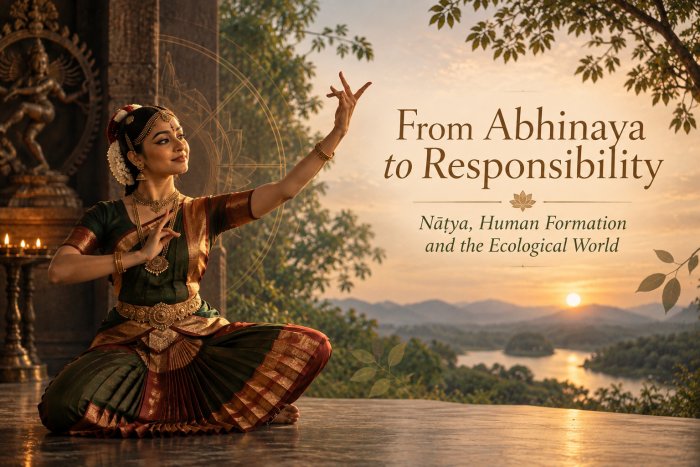 The human foundations of climate responsibility Before movement becomes expression, it must become intentional. The dancer does not simply move the body. Through Sādhanā, attention is gathered, perception refined, gesture given meaning, and what is inwardly apprehended made capable of outward expression. Nāṭya therefore raises a question that extends beyond performance: how does something understood within the human being become embodied in conduct? That question has an unexpected urgency in the context of the climate crisis. Climate management is ordinarily understood through emissions, energy, technology, ecosystems, institutions and public policy. Climate science establishes physical conditions and risks; technology expands our capacity to respond; institutions organise collective action. All of these are indispensable. Yet the persistence of the crisis suggests that knowledge does not automatically become conduct, nor does capacity by itself establish responsibility. The difficulty therefore lies partly in the movement from knowing to doing. It is also a question of the human being who must make that movement possible. Humanity does not suffer from a lack of climate knowledge. We increasingly understand ecological disruption, yet knowledge does not automatically become conduct. We recognise ecological limits and continue to consume beyond them. Institutions acknowledge long-term risks while remaining governed by short-term incentives. Technology enlarges what we can do without determining what we ought to do. The difficulty therefore lies partly in the movement from knowing to doing. This points toward human formation. The Dhārmic Theory of Human Flourishing (DTHF), developed by Nāṭyaśāstra Gurukulam, understands flourishing as a civilisational process of human formation in which ethical, psychological, relational, institutional and civilisational orders are cultivated and aligned. Artistic traditions and educational institutions are consequently among the means through which such formation is cultivated, sustained and transmitted. [1] The Dhārmic Theory of Climate Management (DTCM) extends this insight into the climate domain. Climate management requires not only material infrastructure, but also dispositional infrastructure: practices and institutions through which human beings develop the capacities to exercise desire, power, technology and freedom responsibly. [2] It is here that Nāṭya enters the climate conversation. Not because dance by itself can solve climate change, but because a civilisation seeking to govern its relationship with the natural world responsibly must also ask how it forms the human beings who exercise that power. From order to responsibility The question begins with order. The Vedic conception of Ṛta expresses an understanding of reality as ordered and patterned, within which human life participates rather than standing wholly apart from it. Its relevance to ecological thought must be stated carefully. It would be anachronistic to claim that Vedic thought anticipated modern climate science. Its significance lies instead in the civilisational intuition that human action occurs within an order larger than human preference. The development of Dharma brings this recognition into conduct. As P. V. Kane's History of Dharmaśāstra demonstrates, the Dhārmic tradition developed an extensive vocabulary concerning duty, conduct, restraint, social obligation and order. [3] Dharma is therefore not merely a catalogue of rules. It concerns the appropriate ordering of conduct in relation to persons, circumstances, relationships and the larger purposes of life. Recognising consequence does not, by itself, establish responsibility. Science can establish physical consequences, but it cannot by itself determine whether an action ought to be undertaken, at what scale, for whose benefit, or within what limits. Those are questions of Dharma. And if responsibility is to become conduct, it must become more than an external rule. It must become disposition. Why Nāṭya? For the Nāṭya practitioner, this is familiar territory. Knowledge is not simply accumulated. It is practised. A hasta is repeated until it becomes precise; dṛṣṭi is trained; laya is internalised; bhāva is cultivated; correction is received and incorporated. Through Sādhanā, what begins as instruction can become embodied capacity. The Nāṭyaśāstra presents Nāṭya as a comprehensive field of representation, action, emotion, expression and aesthetic experience. Its significance therefore exceeds entertainment. It provides a mode through which human experience can be represented, contemplated and transformed. Dr. Padmaja Suresh's writings illuminate this formative dimension from within practice. In 'Nāṭya Yoga,' she describes Nāṭya as a means to 'spread knowledge, educate and enlighten,' while relating the practice to representation, music, rhythm, dance and drama.[4] In her discussion of Bhakti Bhāva and Prema Bhāva, she describes the dancer's movement from personal identity into the characters represented, and ultimately toward a loosening of the limitations of individual personality. [5] The significance for climate management is not that artistic practice directly produces ecological behaviour. It is that human beings do not act from propositions alone. Attention, habit, emotional orientation, self-restraint and embodied memory influence how principles become action. Nāṭya works upon precisely this interior territory. At its centre stands Abhinaya. Abhinaya: When understanding becomes embodied Abhinaya is often translated as expression, but its significance lies deeper than the communication of an already completed idea. In performance, meaning must become embodied. The Abhinaya Darpaṇa expresses this integration in its celebrated sequence: yato hastastato dṛṣṭiryato dṛṣṭistato manaḥ | yato manastato bhāvo yato bhāvastato rasaḥ || (Where the hand goes, the gaze follows; where the gaze goes, the mind follows; where the mind is, bhāva arises; and from bhāva, rasa becomes possible.[6]) The sequence captures something central to practice: body, attention, mind and feeling are not separate compartments. Dr. Padmaja Suresh's 'For a Taste of that Aesthetic Joy' and 'Language the Hands Speak' similarly approach Abhinaya as a movement through understanding, visualisation, gesture and expressive realisation. [7] Here lies a suggestive parallel with the climate problem. A person may know that excessive consumption contributes to ecological degradation and yet continue to consume without altering habits. Knowledge has been received but not embodied. The dancer encounters this problem directly. A gesture cannot remain an idea. It must be inhabited. Abhinaya therefore suggests a movement from understanding to embodiment and expression. DTCM asks whether climate responsibility requires a comparable movement from knowledge to orientation, practice, disposition and conduct. This is why Abhinaya becomes the hinge between knowing and doing. The climate question is not merely whether we know what is happening to the natural world, but whether that knowledge has entered the formation of the kartā, the agent who acts. When the world becomes more than an object If meaning becomes embodied in the performer, what happens to the person who receives that embodied meaning? This is where Rasa enters. Bharata Muni establishes the foundations of Rasa theory, while Abhinavagupta's Abhinavabhāratī, particularly in its commentary on the sixth chapter of the Nāṭyaśāstra, develops the nature of aesthetic relish and the conditions of aesthetic experience.[8] The sahṛdaya, the responsive spectator, is not merely a consumer of performance. Aesthetic experience depends upon a capacity to receive and participate. The sahṛdaya, the responsive spectator, is therefore not merely a consumer of performance. The spectator participates in the aesthetic experience through a cultivated capacity to receive, recognise and respond. Nāṭya can consequently become formative not only through what the practitioner learns to embody, but through what the spectator learns to perceive and feel. A forest can be represented as timber, a river as extractable water, soil as an agricultural input, a species as a metric and a landscape as an asset. Such representations are not necessarily false. They are incomplete. They apprehend the natural world primarily through what it can provide. A cultivated aesthetic sensibility introduces another possibility: the capacity to behold before possessing. Adbhuta can interrupt an exclusively instrumental gaze. The river becomes something to behold before it becomes something to use. From perception, relationship becomes possible. What is merely useful can be discarded; what is recognised as related begins to command another kind of attention. Where relationship is recognised, vulnerability becomes visible. Karuṇā can bring suffering, displacement and ecological loss into the field of concern. Bhayānaka can deepen recognition of consequence, not as panic but as awareness of what present action may set in motion. Sensitivity, however, must become discernment. Raudra can become the moral energy of refusal: the recognition that certain forms of destruction and indifference ought not merely to be observed. From refusal comes Vīra, the courage to alter conduct, accept necessary restraint and exercise responsibility even at a cost. Yet courage too requires measure. Without composure, action can become another form of excess. The movement therefore returns toward Śānta, where action can be accompanied by restraint and proportion. This is not an ecological taxonomy of the Rasas, nor a claim that the Nāṭyaśāstra anticipated contemporary environmental ethics. It is a contemporary Dhārmic interpretation of how aesthetic experience may illuminate the movement from perception to feeling, from feeling to orientation, and from orientation toward responsible action. The practitioner is not merely being told to care about the natural world. The practitioner is being invited to see differently. The transformation, however, need not end with the practitioner. The sahṛdaya too may be invited to see differently. What the performer embodies can become an experience for the spectator; what is experienced can refine perception; and what is repeatedly perceived and felt can, over time, influence disposition and conduct. The Performer, the Role, and the Self Another transformation is required before feeling can become responsible action. It is the transformation of the agent. The performer enters a pātra deeply enough for the character to become credible and alive, yet is never wholly reducible to the character. Dr. Padmaja Suresh's discussion of Kṛṣṇa as the 'Perfect Play-Actor' explores this paradox of participation without loss of the larger standpoint.[9] Her reflection on 'Who Am I? The Big Question' similarly brings empirical identity into relation with the deeper Self.[10] The practitioner therefore encounters an important distinction in the experience of role. One can inhabit a role without becoming imprisoned by it. Human beings likewise inhabit necessary roles: consumer, professional, executive, investor, administrator, citizen, producer and leader. These roles carry legitimate functions, but they can begin to dominate identity. The consumer begins to experience consumption as identity; the executive may experience institutional power as personal entitlement. The performer's discipline suggests another possibility: participation without captivity. Climate responsibility does not require withdrawal from economic or institutional life. It requires participation without allowing the interests associated with one's role to become absolute. The question therefore reaches beyond the roles themselves to the kartā, the agent who exercises choice and bears responsibility for its consequences. Climate responsibility ultimately depends not only upon what a person is empowered to do, but upon the capacity to exercise that power with discernment and restraint. Rhythm, Measure, and the Ethics of Enough The Nāṭya practitioner also knows through the body that movement derives meaning from measure. Tāla and laya establish temporal conditions within which movement remains coherent. What is technically possible is not necessarily appropriate at every moment or in every measure. The ecological analogy must remain modest, but the experiential lesson is important: timing, proportion and relationship matter. Human civilisation faces a corresponding challenge in the climate crisis. Technology can expand what human beings can do without determining what they ought to do. Economic systems can increase material availability without determining when enough is enough. Institutions can exercise authority without every use of that authority being justified. Capacity does not establish legitimacy. The Dhārmic question is whether action remains within Maryādā, within legitimate measure. How much may be taken? At what rate? For whose benefit? With what consequences? And within what limits? The dancer learns measure through the body. Climate responsibility asks civilisation to learn it through conduct. Sādhanā and Dispositional Infrastructure Measure cannot be sustained by intellectual recognition alone. It must become disposition through practice. Dr. Padmaja Suresh's writings repeatedly return to disciplined practice, Paramparā, and the transmission of knowledge. Her discussion of Tantra and Nāṭya explicitly connects Sādhanā, Guru–śiṣya Paramparā, Abhinaya, Rasa and the Sahṛdaya. Her later writing on Nṛtta similarly treats disciplined practice, tāla, laya and inward concentration as integral to the practitioner's journey toward Śānta. [12] The Gurukulam embodies this logic of formation. Study, observation, correction, repetition and relationship become an integrated environment in which competence and character can develop together. These are not climate policies. They are capacities relevant to the human beings who design and enact climate policy, make economic choices and exercise technological power. This is why DTCM distinguishes material infrastructure from dispositional infrastructure. Laws, technologies, markets and institutions enable responsible action. Educational environments, artistic traditions, cultural lineages and disciplined communities help form the people capable of exercising those systems responsibly. [13] An ecological civilisation requires both. From Embodied Practice to Ecological Responsibility Climate management requires science, technology, finance, regulation and international cooperation. Yet all of these operate through human beings. The deeper question is therefore whether human beings can cultivate the dispositions required to exercise these capacities responsibly. Nāṭya offers a distinctive civilisational resource because it works upon precisely those dimensions of the human being that lie between knowledge and conduct, shaping both the practitioner who embodies meaning and the sahṛdaya who receives and participates in that experience. Through Abhinaya, meaning becomes embodied; through Rasa, perception becomes lived experience; through the sahṛdaya, that experience becomes participatory; through Sādhanā, repeated practice can become disposition; through Dharma, disposition can find ethical direction; and through Maryādā, conduct can acquire measure. For the Nāṭya practitioner, therefore, the climate question need not begin with a demand to become an environmental activist. It can begin with a question closer to the discipline already familiar in practice: Can the discipline I cultivate upon the stage become a discipline of how I inhabit the world? Such a question shifts the climate conversation from information toward formation, from awareness toward disposition, and from disposition toward conduct. The climate crisis is not only a problem of what human beings know, nor only of what they build. It is also a problem of what human beings have become capable of desiring, perceiving, embodying and doing. The movement from Nāṭya to climate responsibility is therefore not a movement from dance toward environmentalism. It is a movement from human formation toward responsible agency. What is cultivated in practice acquires significance beyond the stage when it begins to shape how the practitioner perceives consequence, exercises choice, inhabits roles and responds to the conditions that sustain life. In this sense, Nāṭya does not manage the climate. Its contribution lies elsewhere. It may help cultivate the human capacities through which climate responsibility becomes more than knowledge or intention, becoming instead a disposition expressed through conduct. The discipline of embodying meaning upon the stage may thus acquire another significance. It can become a discipline not only for the practitioner, but for a shared culture of seeing, feeling and inhabiting the world with greater awareness, responsibility and measure. References 1 Rohit Viswanath, The Dhārmic Theory of Human Flourishing (Navi Mumbai: Nāṭyaśāstra Gurukulam, 2026) 2 Rohit Viswanath, The Dhārmic Theory of Climate Management (Navi Mumbai: Nāṭyaśāstra Gurukulam, 2026) 3 P. V. Kane, History of Dharmaśāstra, 5 vols. (Poona: Bhandarkar Oriental Research Institute, 1930-1962). 4 Padmaja Suresh, "Nāṭya Yoga," Narthaki, March 4, 2009. 5 Padmaja Suresh, "The Role of Bhakti Bhava and Prema Bhava in Dance: A Dancer's Quest," Narthaki, February 16, 2007. 6 Nandikeśvara, Abhinaya Darpaṇa, verse 247. 7 Padmaja Suresh, "For a Taste of that Aesthetic Joy," The Hindu, August 16, 2018; Padmaja Suresh, "Language the Hands Speak," The Hindu, July 19, 2018. 8 Abhinavagupta, Abhinavabhāratī, commentary on Bharata's Nāṭyaśāstra, chap. 6. For the present argument, the relevant discussion concerns the rasa-sūtra and the nature of aesthetic relish. 9 Padmaja Suresh, "Kṛṣṇa, the Perfect Play-Actor," The Hindu, March 21, 2019. 10 Padmaja Suresh, "Who Am I? The Big Question," The Hindu, May 3, 2019. 11 Padmaja Suresh, "Natya's co-relation with the esoteric discipline of Tantra," Narthaki, December 20, 2007. 12 Padmaja Suresh, "Nritta: The journey into Shanta rasa," Narthaki, May 4, 2014. 13 Viswanath, The Dhārmic Theory of Climate Management 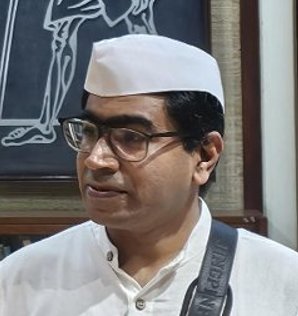 Rohit Viswanath is Yajamāna and Yojaka of Nāṭyaśāstra Gurukulam: A Centre for Civilisational Statecraft in Navi Mumbai. His work explores the relationship between Nāṭya, Dharma, human formation, governance and civilisational renewal. He is the author of The Dhārmic Theory of Human Flourishing and The Dhārmic Theory of Climate Management. His work brings together civilisational thought, artistic practice and contemporary questions of governance and public responsibility. Post your comments Pl provide your name along with your comment. All appropriate comments posted with name in the blog will also be featured in the site. |
