|
    |
|
|
|

ARTICLEBeyond Familiarity: Authenticity, Adaptation, and the Odissi Experience- Dr. Rohini Dandavatee-mail: dandavate2@gmail.com September 5, 2026 Ever since I migrated to the U.S., I have sought to remain rooted in the authenticity and integrity of the Odissi style while finding ways to connect with audiences unfamiliar with its traditions, aesthetics, and cultural contexts. For me, the tension between authenticity and adaptation has never been about choosing one over the other. Rather, it has been a continuing process of understanding what must remain rooted in the tradition and what can evolve so that Odissi can speak meaningfully within the multicultural context of my adopted home. Authenticity, as I understand it, cannot be static. Odissi itself has evolved through many historical transitions - from temple traditions and Mahari and Gotipua practices to its modern reconstruction and codification. Authenticity, therefore, is not the preservation of a frozen historical moment, but an ongoing relationship with tradition. My challenge has been to translate the form without losing its grammar, integrity, or cultural memory, while making it possible for audiences to encounter Odissi without first needing to understand all that lies behind it. My experiments in translation began almost a month after my arrival in Ohio. In one of my earliest presentations, for a class of kindergarteners, I quickly learned from these five-year-olds that I needed to begin with stories and images familiar to them. Their response prompted me to think, learn, and discover new ways of presenting Odissi that could create curiosity about a movement language they had never encountered. Over the years, performances, lecture-demonstrations, workshops, collaborations, and writing became different avenues through which I explored this question. As an artist in the Arts Learning Program of the Ohio Arts Council, and through Days of Creation, an organization of artists who travelled to schools in Ohio to share their artistic practices, I introduced Odissi to schoolchildren through performances and hands-on workshops. Summer programs provided further opportunities to engage with diverse groups of young audiences and to experiment with ways of presenting the form according to their ages, interests, and levels of familiarity. 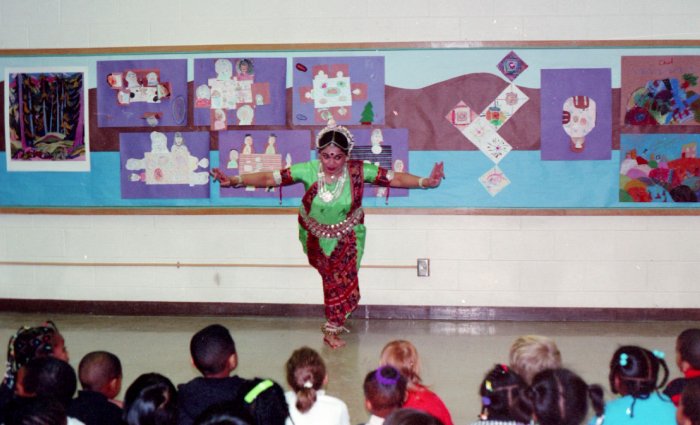 Collaborations with artists from other genres and cultural backgrounds added another dimension to this exploration. These encounters placed Odissi in dialogue with other artistic languages and made me more aware of both what was particular to the form and what could be shared across artistic and cultural boundaries. 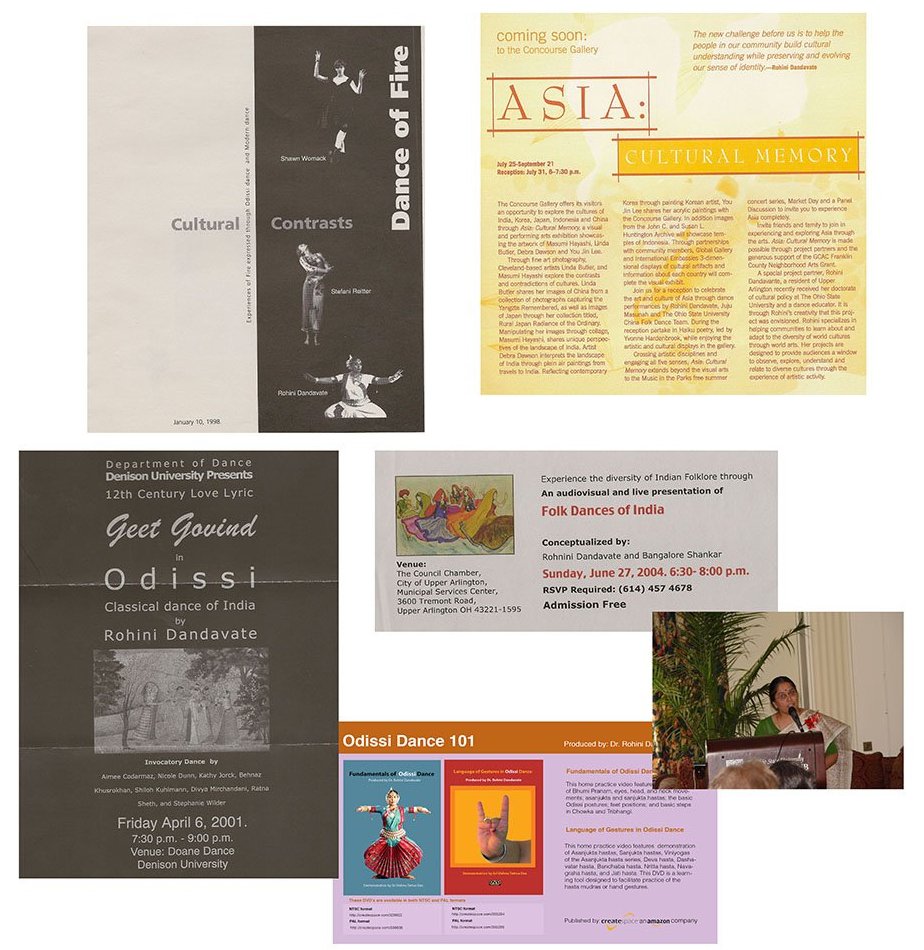 Graduate study, research, and writing extended this engagement beyond the performance space. Reading scholarship, writing about Odissi and cultural understanding, and reflecting on the place of Indian dance in contemporary contexts allowed me to articulate ideas that complemented the experience of performance. Teaching, performing, collaborating, and writing became interconnected ways of engaging with Odissi - through both experience and reflection. From this continuing process, several principles gradually emerged. Authenticity as a Living Relationship My first realization was that authenticity cannot be separated from change. A tradition survives not because every generation reproduces it identically, but because practitioners understand what gives it its identity and find ways to carry that understanding forward. For me, this begins with knowing the form from within. Knowing the form from within A lifelong engagement with Odissi - through rigorous training, sustained practice, performance, and participation in the tradition under the guidance of legendary Gurus - has allowed me to experience the form not merely as a collection of movements, but as a deeply integrated system of knowledge, movement, storytelling, and meaning. I have had the opportunity to observe how my Gurus understood why a movement exists, what it communicates, and how it derives meaning within the larger grammar of the form. 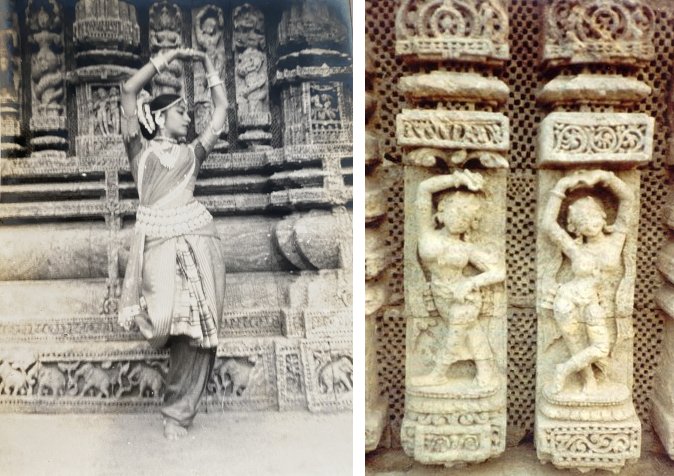 Bhangis sculpted on the walls of the Sun Temple in Konark Odissi's development itself reflects this relationship between movement, storytelling, and meaning. Its reconstructed vocabulary drew extensively from the sculptural postures and visual language of temple architecture, while its narratives were rooted in mythology, sacred texts, and observations of human life. These movements were not simply abstract physical forms; they became vehicles for conveying stories, emotions, values, and ideas. As Odissi moved into the proscenium stage, the Gurus built upon inherited vocabulary, adapting it to a new performance environment while retaining its expressive purpose. Their imagination came not only from inherited knowledge, but also from lived experience and acute observation. The traditional repertoire developed a rich vocabulary through its innumerable bhangis and postures. A bhangi is more than a sculptural stance; it can reflect how living beings move, perform everyday tasks, adorn themselves, stand, sit, or walk. When individual bhangis are connected through movement, they create complete visual and narrative imagery. Observations of nature, human behavior, and everyday life thus become transformed into an expressive movement language. Torso movements provide flow and continuity, connecting one posture or bhangi to another rather than treating each position as an isolated form. Rhythm provides another structural foundation. Movements are organized within cycles of beats, with rhythmic patterns articulated through meters of four, three, five, seven, and nine beats. Rhythm is therefore not an accompaniment added to movement; it determines structure, timing, pace, accents, and flow. Similarly, abhinaya emerges from the meaning and emotional content of the narrative. Facial expressions, gestures, movement sequences, and postures work together to communicate the text and its emotional world. Expression is not simply added after the movement has been created; the narrative itself informs how the body, face, gesture, and movement are shaped. This understanding is important to my choreographic process because it changes what adaptation can mean. A movement cannot be separated from the intention, context, rhythm, and meaning that give rise to it. Knowing the form from within allows me to make creative choices without reducing Odissi to its most recognizable external features. I have therefore tried to resist reducing Odissi to an aesthetic of sculptural poses, decorative hand gestures, beautiful costumes, or recognizable visual imagery. What matters is not only what the audience sees, but the knowledge embedded within the movement language and the relationships that allow that language to communicate. Perhaps this is also why the choreographic works created by the great Gurus continue to be performed, interpreted, and transmitted across generations. Their enduring quality lies not simply in the beauty of their movements, but in the depth of knowledge, structure, intention, rhythm, and artistic understanding embedded within them. Knowing this internal logic creates the foundation from which adaptation becomes possible. Distinguish between Grammar and Vocabulary With an understanding of the foundational grammar of Odissi - movement sequences in tribhangi and chowka, torso movements, chauka-and tribhangi-based spatiality, mudras, rhythmic structures, and the principles of abhinaya - I have consciously sought to retain these essential elements in my work. They are not merely visual markers of Odissi; they constitute the internal language through which the form communicates and creates meaning. At the same time, a language can express new ideas without changing its fundamental grammar. My adaptations have therefore occurred primarily within the possibilities of that grammar - in the choice of themes and narratives, sequencing of movement, spatial design, dramaturgy, and ways of responding to contemporary experiences. One example is my choreography of Tagore's Bichitro Anondo. Using the Sabhinaya Pallavi structure and setting the work to raga Misra Sarang, I explored the kaleidoscope of joyful and painful emotions embedded in Tagore's philosophical reflections on life. The choreography retained the formal and rhythmic framework of Odissi while extending the narrative beyond the immediate poetic imagery into contemporary experience. The first stanza brings together images of nature - the dancing peacock, flights of birds, meandering streams, and the fragrance of flowers - with the sorrow of a world experiencing the devastation of Covid. Tagore's poetic contrast of timir-jyoti, darkness and light, became an opportunity to juxtapose regeneration and loss: growing vegetation, blooming flowers, buzzing bees, and the brightness of day alongside dark skies, returning birds, and people retreating into their homes. 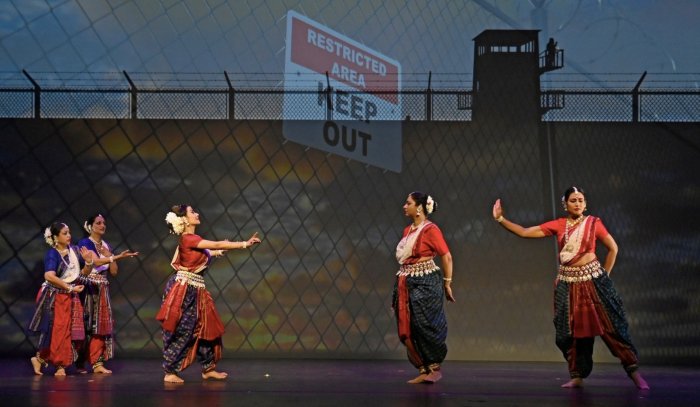 Ensemble from the dance Bichitro Anondo Similarly, the theme of milana-bichheda, union and separation, provided a way to bring a traditional emotional concept into a contemporary social reality. Rather than limiting separation to the emotional or devotional relationships traditionally explored through abhinaya, I interpreted it through the experience of families divided at the Mexican border. The separation of parents and children gave bichheda a contemporary resonance, connecting an established emotional vocabulary of Odissi with the lived experience of displacement and migration. Here, the contemporary subject entered through imagery, narrative, emotional interpretation, and dramaturgy, rather than by replacing the Odissi movement language. The movement continued to draw upon its established grammar, while its expressive possibilities were directed toward new images and experiences. This experience showed me that adaptation does not necessarily require abandoning traditional language. It can instead allow us to discover new meanings within that language. The question then becomes: if the movement language remains rooted in the form, how does an audience unfamiliar with that language find its way into the work? Find points of emotional entry One way I have sought to connect with audiences unfamiliar with the cultural and aesthetic context of Odissi is by finding universal emotional entry points. While the stories, poetry, mythology, and devotional traditions that inform Odissi may be unfamiliar to many audiences, the experiences within them are deeply human - love, longing, separation, conflict, resilience, loss, transformation, and the search for identity and belonging. I began exploring this approach quite early in my journey in the United States. One of my first productions, Cultural Contrasts, was a collaboration with two modern dancers around the theme of Fire. We approached the subject from different cultural, artistic, and scientific perspectives, allowing each of us to interpret it through our own movement language. The two modern dancers explored combustion and fire within the human experience, while my Odissi presentation examined the constructive and destructive dimensions of fire. I explored fire as a life-giving and sustaining force, as well as a destructive force, particularly through the devastation of wildfires in California and the consequences of human intervention and greed. The three interpretations remained distinct in their movement languages. My section drew upon the grammar and vocabulary of Odissi, while the other two artists approached fire through modern dance and a theatrical-modern dance vocabulary. Rather than merging the three forms, we allowed each to retain its distinctive physicality and way of seeing. The contrast itself became part of the artistic dialogue. An accompanying exhibit in the lobby, featuring the various uses and meanings of fire in Indian culture and in different parts of the world, further prepared the audience for the performance. The visual and textual material sparked curiosity and provided a context for approaching the subject. The collaboration taught me that I did not need to make Odissi resemble the other movement languages for audiences to connect with it. The shared subject provided the bridge, while each movement language retained its distinctive identity. Dance of Fire, as a solo presentation, was later presented in San Francisco, Cuttack (Odisha), and Mumbai. The responses in these different settings reinforced for me the ability of a human experience to transcend cultural boundaries. In Mumbai, one audience member was visibly moved while watching the interpretation of loss and destruction in the fire sequence. Her niece had lost her home in the California wildfires, making the imagery deeply personal for her. In San Francisco, another audience member walked away with tears in her eyes, similarly connecting with the feelings of loss and pain evoked by the dance. These responses were particularly meaningful to me. They demonstrated that audiences did not need to share the same cultural background or be familiar with the vocabulary of Odissi to enter the work emotionally. The experience of loss became the point of connection. This was an important early experiment in understanding how Odissi could enter into dialogue with other forms and ways of seeing. It encouraged me to look beyond simply explaining cultural references and instead ask: What is the human experience at the heart of the work? That question has remained important to me. It does not require removing cultural specificity. Rather, it creates a doorway through which audiences can encounter that specificity with curiosity. Translate rather than dilute The question of accessibility eventually led me to another distinction: translation is not the same as simplification. Working with audiences who had little or no prior familiarity with Odissi made me conscious of the temptation to simplify its movement, music, narratives, or cultural references in order to make them immediately accessible. I gradually realized, however, that excessive simplification could compromise the very qualities that give the form its identity. The challenge became: How can I make the work legible without making it generic? As a choreographer working across cultures, I began to see my role as negotiating between the knowledge embedded within the tradition and the experiences of the contemporary viewer. This meant discerning what was essential to the form and what could be reinterpreted, reframed, or contextualized. I found possibilities for adaptation in the narrative, structure, sequencing, spatial relationships, use of text, dramaturgy, and, at times, technology and media. One example came from a workshop I conducted for children, in which I used a folk tale from southern India centered on the idea of giving and sharing. Rather than presenting the story in its original linguistic and cultural context, it was narrated and sung in English, with illustrations accompanying the story. The familiar language and visual storytelling gave the children an immediate point of entry into the narrative. Yet the dance itself remained grounded in the grammar and aesthetic principles of Odissi. I did not simplify the movement vocabulary to make it resemble something the children already knew. Instead, I adapted the surrounding context - the language, imagery, and mode of storytelling - so that they could enter the world of the dance. This experience reinforced for me that translation can take place around the form without necessarily altering the form itself. Context, framing, narrative, and presentation can shift while the movement language retains its integrity. My aim, therefore, has been to open a door rather than remove the walls. I want audiences unfamiliar with Odissi to feel welcomed into the work while still encountering something distinctive, layered, and perhaps even unfamiliar. Rather than positioning the audience as outsiders who need to be educated, I want the performance to create an experiential pathway through rhythm, image, emotion, musicality, and narrative. The early experience with kindergarteners taught me to begin with what the audience could recognize. The Fire collaboration taught me that a shared human experience could create connection without requiring the movement languages to merge. The children's workshop taught me that language and presentation could be adapted without simplifying the dance itself. Together, these experiences gradually shaped my understanding of cultural translation. Beyond familiarity My journey in the United States has taught me that cultural translation does not require making the unfamiliar familiar. It requires creating pathways through which audiences can encounter the unfamiliar with curiosity, openness, and respect. For me, authenticity is therefore not about protecting Odissi from change, nor is adaptation about changing Odissi to suit the audience. Authenticity is not the absence of change; it is the presence of integrity within change. It is about knowing the form deeply enough to understand what can move, what must remain rooted, and where new possibilities can emerge. The tradition gives me the grammar. Experience, imagination, and contemporary life give me questions. Choreography becomes the space in which the two meet. I have come to see unfamiliarity not as a barrier that must be eliminated, but as an invitation to curiosity and discovery. The goal is not to make Odissi resemble something an audience already knows. Nor is it to overwhelm the audience with explanations of everything they do not know. It is to create an opening through which they can encounter the form on its own terms. Adaptation, for me, does not mean altering the grammar of Odissi to make it more familiar; it means finding new ways for that grammar to speak. This is what it means to go beyond familiarity: not to make Odissi something else for the audience, but to invite the audience into its world - to encounter its beauty, complexity, and cultural memory while finding their own points of connection within it. Perhaps the most meaningful form of cultural translation is not when the unfamiliar becomes familiar, but when the unfamiliar remains fully itself and when we learn how to enter it. 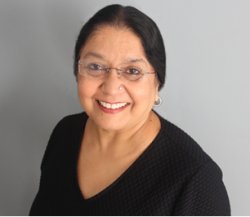 Dr. Rohini Dandavate is an Odissi dance practitioner, educator, choreographer, and scholar with an interdisciplinary background in dance, cultural policy, arts administration, and education. She earned her doctorate in Cultural Policy and Arts Administration from The Ohio State University. Born and raised in Cuttack, Odisha, she received her foundational training in Odissi at Kala Vikash Kendra and subsequently studied under eminent Gurus, including Dr. Menaka Thakkar, Guru Raghunath Dutta, Guru Ramani Ranjan Jena, and Guru Kelucharan Mohapatra. Her professional work focuses on creating meaningful connections between traditional arts, education, and diverse communities. She develops workshops and curricula for educational institutions and community organizations that encourage cultural understanding through experiential engagement with traditional arts. Her work integrates practice, pedagogy, scholarship, and community engagement, creating opportunities to explore Odissi as both an evolving artistic practice and a vital expression of cultural heritage. Post your comments Pl provide your name along with your comment. All appropriate comments posted with name in the blog will also be featured in the site. |
