
|
    |
|
|
|

 From Entitlement to EmbodimentA Nāṭyaśāstra Reflection on Desire, Dharma, and Śṛṅgāra- Rohit Viswanathe-mail: natyashastra.gurukulam@gmail.com June 17, 2026 The internet is a storm chamber. One wrong gust and a petty quarrel becomes a cyclone. The recent dating refund controversy is one such micro-storm: a man treats the cost of a shared meal as an investment that ought to yield a return, and the court of public opinion quickly divides into camps. Some argue for splitting the bill; others condemn the attitude as a red flag or a violation of consent. These are necessary, defensive arguments. They tell us what not to do. They do not tell us how to rise. 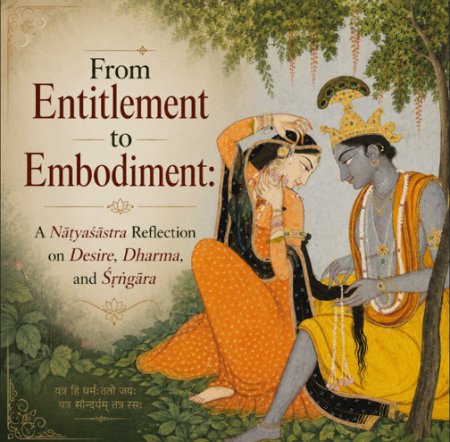 To understand the poverty of this encounter, we must move beyond the mechanics of modern dating and recover a neglected civilisational dimension. Śṛṅgāra is the classical Indian aesthetic of cultivated desire, revered in Bharata Muni's Nāṭyaśāstra as the Rasarāja, the sovereign among rasas. Viewed through this lens, the controversy is not merely a matter of poor manners or questionable etiquette. It reveals a deeper aesthetic failure: the reduction of the unpredictable mystery of human relationship to the rigid arithmetic of a ledger. For us as Nāṭya practitioners, however, the question runs deeper still. The inquiry is not simply what this episode reveals about modern courtship. The inquiry is what it reveals about the formation, or deformation, of the human being. What kind of person was present in that encounter? What qualities had been cultivated? What rasas had become habitual? The significance of the controversy lies not in the money involved, but in the subtle habits of consciousness from which such attitudes and actions emerge. The datified marketplace of modern courtship Dating today is filtered through what sociologists call the 'datified life', where courtship is outsourced to interfaces optimised for swiping, filtering, and superficial curation. Matching becomes market mechanics. Individuals invest time, emotional labor, and financial capital with an explicit expectation of yield. Intimacy is then spoken in a sterile economic vocabulary. We hear talk of emotional ROI, the amortisation of affection, and transactional intimacy. The shared meal is no longer an exercise in mutual hospitality or spontaneous connection. It is reframed as a commercial expenditure. Consequently, the other person is subtly cast as a service provider. If the anticipated service, sustained attention, chemistry, or physical intimacy, is not rendered, the consumer feels defrauded. Empirical studies confirm that when romantic exchanges are framed as market transactions, with profiles as products and filters as pricing, relational satisfaction drops and cynicism rises. Śṛṅgāra: The aestheticisation of desire Classical Indian aesthetics offers a radically different premise. It invites a shift from critical cynicism to a lyrical, grounded philosophy of desire. In the Nāṭyaśāstra, Śṛṅgāra is distinct from raw, untamed appetite, which is kāma in its unrefined form. It is desire filtered through culture, art, discipline, and emotional maturity. The modern dater focuses on outward curation. He polishes a profile to capture an audience. The classical ideal demands that the locus of effort remain firmly on the self. One does not seek to acquire desirability from another. One seeks to transform oneself into a worthy vessel of beauty, dignity, and grace. In this sense, Śṛṅgāra begins with adornment, not as mere decoration for another's gaze, but as the cultivation of those qualities through which beauty becomes embodied. Beauty here is expansive and multidimensional. Speech is cultivated through truthfulness and refinement. The body is maintained through cleanliness and deliberate presentation. The mind is expanded through continuous learning. Emotions are tempered through self-command and restraint. Relationships are approached through generosity and grace. Classical literature celebrates guṇa, the inner excellence of character, long before external attractiveness. Unlike glamour, which may be acquired and displayed, guṇa is an inner harmony of body, mind, and spirit that naturally evokes affection rather than demanding it. Classical thought also recognised the principle of adhikāra, the idea that certain experiences become available only through preparation and qualification. One does not become entitled to knowledge merely by desiring it; one cultivates the capacity to receive it. The same principle applies to human relationships. Affection, trust, intimacy, and companionship are not commodities to be purchased or entitlements to be claimed. They are gifts that arise through the qualities that make such experiences possible. The crisis revealed by the controversy is therefore deeper than transactional dating. It is the expectation of reward without self-transformation. Śṛṅgāra offers an alternative vision in which fulfilment arises not from entitlement but from cultivation. Kāma is not rejected by the Indian tradition. It is aestheticised. Through discipline, culture, and emotional refinement, desire becomes capable of generating rasa rather than merely seeking gratification. Śṛṅgāra is therefore not the denial of desire but its elevation into a form that can be shared, contemplated, and relished. In Bharata's language, raw desire is not itself Śṛṅgāra. Rather, rati serves as the sthāyibhāva from which Śṛṅgāra rasa emerges through aesthetic cultivation. Here lies the deeper alchemy. The Indian tradition does not reject desire; it refines it. Raw kāma seeks immediate gratification and remains centred upon acquisition. When guided and illuminated by dharma, it becomes capable of generating meaning, refinement, and aesthetic experience rather than merely pursuing satisfaction. In the Nāṭyaśāstra, desire is transformed into rasa, an experience that is relished, shared, and contemplated rather than consumed. This insight bears a striking resemblance to what Sigmund Freud would later call sublimation: the redirection of instinctual energies into culturally and creatively productive forms. Yet the Indian aesthetic tradition frames the process less as redirection than as refinement. The energy of desire does not disappear; it is elevated and given form. Poetry, music, dance, literature, and devotion emerge not from the denial of desire but from its refinement. Śṛṅgāra marks the first movement in this transformation. Desire learns to pause, attend, listen, and become receptive. The impulse to possess is gradually transmuted into the capacity to appreciate. Attraction becomes aesthetic experience; longing becomes poetry; passion becomes dance. In this sense, Śṛṅgāra represents the beginning of a civilisational process through which instinct is refined into culture and appetite into beauty. The present controversy serves as a reminder of what occurs when kāma becomes detached from its dhārmic and aesthetic foundations. Desire ceases to be a source of beauty and becomes instead a mechanism of expectation, calculation, and entitlement. What remains may be appetite, frustration, or transaction, but it no longer possesses the qualities through which rasa can emerge. The distinction is not merely moral. It is aesthetic, psychological, and civilisational. The question for the Nāṭya practitioner, however, is how such refinement is cultivated and transmitted. The Nāṭyaśāstra's answer lies not primarily in ideas or arguments, but in disciplined embodiment. If desire is to become rasa, it must first become character, gesture, voice, and presence. The body as a vessel of Rasa For the Nāṭya practitioner, the central insight is simple: rasa is not primarily an idea but an embodied experience. A Bharatanaṭyam dancer cannot portray longing through argument, nor can an Odissi performer evoke devotion through opinion. The body itself must become the vessel through which rasa is transmitted. If Śṛṅgāra is embodied, so too is entitlement. It appears in posture, gaze, speech, rhythm, and movement. The controversy then ceases to be about reimbursement. It becomes a question of embodiment. The actor trains the voice, the dancer the gaze, the musician the ear, and the practitioner attention itself. Over time, the inner instrument is refined. The controversy can therefore be understood as a symptom of desire deprived of aesthetic education. Śṛṅgāra as a discipline of presence The Nāṭyaśāstra tradition never treats Śṛṅgāra as an isolated rasa. It emerges within a larger ecology of emotional life. Desire that is not balanced by Śānta becomes restless. Attraction that is not tempered by dharma becomes possessive. Aspiration that is not moderated by self-awareness becomes entitlement. The task of training is therefore not the amplification of emotion but its harmonisation. A mature practitioner learns not merely how to express desire but how to hold it without being consumed by it. Śṛṅgāra is sustained attention. Śṛṅgāra requires receptivity. Śṛṅgāra requires freedom. Śṛṅgāra cannot coexist with compulsion. Śṛṅgāra emerges through mutual recognition. Entitlement destroys each of these conditions. When desire morphs into demand, attention collapses. When attraction becomes tied to economic entitlement, receptivity evaporates. When another human being is treated as an object of acquisition, freedom is denied. The entire aesthetic field is destroyed. What remains in the room may be a primal appetite, but it has ceased to be Śṛṅgāra. Consent remains a non-negotiable legal and moral boundary. The concern of the Nāṭyaśāstra extends beyond that discussion, asking not merely whether freedom has been respected but whether the conditions for Śṛṅgāra are present. Śṛṅgāra arises only through freedom, reciprocity, attentiveness, and mutual recognition. The possibility of refusal is not an obstacle to rasa but one of its preconditions. Human attraction unfolds through a subtle interplay of gesture, attention, responsiveness, and emotional attunement, yet the essential principle remains simple: beauty cannot be compelled. The moment desire seeks to demand rather than invite, entitlement replaces receptivity and the aesthetic experience dissolves. What does a student of nāṭya learn from Śṛṅgāra? Not how to seduce. Not how to attract. Not how to obtain. Rather: how to attend, how to listen, how to become receptive, how to cultivate presence, how to hold longing without grasping. A performer who has truly worked with Śṛṅgāra knows that rasa disappears the moment one attempts to possess it. It flourishes only in openness, receptivity, and grace. From seeking to becoming: The practitioner's lesson The modern imagination treats desire as acquisitive. It asks whom one can attract, obtain, persuade, or retain. The Śṛṅgāra tradition begins elsewhere. Its first movement is inward. The task is not to secure another's affection but to develop within oneself those qualities that make affection possible. These qualities are grace in speech, steadiness in conduct, generosity in relationship, and beauty in character. Śṛṅgāra begins not with seeking but with becoming. The most meaningful experiences of life require preparation. They ask not merely what one desires, but what one has become capable of receiving. Modern culture teaches us to find someone desirable. Śṛṅgāra teaches us to become desirable. Not through manipulation. Not through display. Not through expenditure. But through the cultivation of guṇa. For the student of nāṭya, the lesson of the controversy lies not in judging the participants but in recognising a condition within oneself. Every practitioner must ask: Where has desire become demand? Where has appreciation become possession? Where has longing become entitlement? The work of sādhanā is to transform these impulses before they crystallise into action. The performer who trains in Śṛṅgāra is not merely learning to depict beauty on stage. Through practice, they refine perception, attention, and presence. In this sense, Śṛṅgāra is not simply a rasa to be performed. It is a mode of being embodied. The ultimate purpose of the art is not representation but transformation. Civilisations historically created institutions through which such refinement could occur. These included poetry, music, dance, ritual, courtship conventions, and systems of ethical formation. Such institutions taught individuals how to desire beautifully rather than merely intensely. Many of these formative structures have weakened in contemporary society. Whether contemporary society can create new institutions capable of fostering emotional maturity, aesthetic sensitivity, and relational responsibility within a digital age remains one of the defining questions of our time. Ultimately, the lesson of the recent controversy is not puritanical. It is not that desire is flawed, nor that partners must suspect one another. The civilisational insight is subtler. Societies flourish when they teach individuals to cultivate the qualities that make fulfilment possible. The highest form of human attraction is never the transactional power to possess, control, or purchase another person. It is the lifelong capacity to cultivate oneself so deeply that one's very presence becomes an organic source of beauty, dignity, and joy. The tragedy of the modern dating apparatus is not the loss of currency but a profound poverty of the imagination. It is a collective forgetfulness of how to court, how to yearn, and how to be still. From the standpoint of classical aesthetics, our internal inquiry must change directions. Abandon the market question: 'What am I owed because I spent money?' Instead, ask the Śṛṅgāra question: 'What beauty have I embodied that another might freely respond to?' That remains the enduring difference between a culture of transaction and a culture of rasa. For the student of the Nāṭyaśāstra, this question extends far beyond courtship. Every rasa ultimately asks what kind of human being one is becoming. Śṛṅgāra teaches that beauty is not something one extracts from the world but something one learns to embody. The task of the practitioner is therefore not merely to perform rasa but to become a vessel through which rasa may be transmitted into the world. In that sense, the true stage is not the theatre alone. Every human encounter becomes a site of practice, and life itself the stage upon which rasa is realised. The journey from entitlement to embodiment is therefore not merely a lesson in courtship. It is a lesson in becoming human.  Rohit Viswanath works at the intersection of classical arts, institutional design, and civilisational thought. He is associated with the Nāṭyaśāstra Gurukulam and engages with questions of cultural sustainability and governance within the performing arts ecosystem. Response * Very interesting and illuminating piece. I think the way the issue has been discussed widely is an issue in social ethics - the treatment and objectification of women in modern society. That is not incorrect but another way would be from the viewpoint of individual development (as cultivation) to see how a person should sensitize himself/herself to other people so that Sringara can mean something more than raw kama. I think it opens up a valuable link between artistic expression and personal conduct based on dharmic principles. That last aspect could do with more exploration. - Prof MK Raghavendra (July 7, 2026) Post your comments Pl provide your name along with your comment. All appropriate comments posted with name in the blog will also be featured in the site. |
