
|
    |
|
|
|

ARTICLEThe silent cry of the Gungroo - Mutation and monetization of classical dance- Dr. Lata Surendrae-mail: kalashrilata29@gmail.com June 8, 2026 For generations, classical art was not merely performed; its sacredness was preserved as its strength. It lived as a sacred trust, passed from breath to breath, born of a quiet reverence for the unseen and the eternal. Today, that protective shield has shattered. Be it the lucrative choreographers or the masses who lap it all up, we are stretching the crazy urge inside in seeking to impress more than express to extreme limits. Ananya Panday's viral Chand Mera Dil controversy is the living embodiment of a tragedy that laments the death of a sacred art form - with Bollywood just staging the execution to create an uproar all around. Panday's viral "fusion" dance was labeled a "catastrophic misunderstanding" of Bharatanatyam by eminent dancer Anita R. Ratnam. Even committed performers all over the world and critics have watched Panday's performance and watched aghast at a centuries-old spiritual discipline being reduced to aggressive, soulless modern gymnastics. Panday's team defended the act as a "creative experiment," proving the point that today you have systems that prioritize cheap entertainment over cultural guardianship. Today's artistes view themselves merely as entertainers rather than guardians of a sacred heritage. Fearing the verdict of a profit-driven industry where artistic compromise is the price of survival, few dare to champion the true system. We watch with quiet grief as pure folk and classical traditions are butchered on the altar of reality television, reduced to mere instruments of shock value. Manmade monstrosities like "Disco Dandiya" are paraded about, stripping away the spiritual sanctity of our roots. Worse still, the very choreographers and mentors entrusted with our lineage seem to have lost their way. They orchestrate a scenario where mere acrobatics soar above the depth of performing arts. We are left to witness the sorrow of Bharatanatyam twisted to Bollywood beats, where immortal melodies like "Raina Beeti Jai" and others are jarringly reimagined as cinematic 'padams'. Even festivals are curated with cinematic songs to draw the crowd and cremate the sanctity of the art, drowning and calling for help in a tide of commercialism. Oh, yes - how deeply we yearn for the golden eras of classical grace! We remember the master choreographers and the luminous, lotus like grace of Kamala, Padmini, Ragini, Dr. Vyjayantimala Bali, and Gopi Krishna. Through their devotion, forms like Kathak and Bharatanatyam transcended the boundaries of tradition to become a cultural craze even within the concrete jungle of Mumbai. In those days, young and eager souls lined up to enroll, hungry to imbibe a chosen style under the watchful, uncompromising eye of a committed Guru. Actors today view themselves as entertainers, not cultural guardians, and they rarely fight the system because doing so risks career suicide in an industry that prioritizes survival and profit over artistic purity. But then what about the so-called stream of dancers, choreographers, and mentors themselves creating a scenario with acrobatics soaring over performing arts and Bharatanatyam with Bollywood songs? We had the legendary Pandit Lachhu Maharaj who debuted as a choreographer in Indian cinema and shaped the performances of Bollywood's greatest leading ladies. Recognized globally as a Kathak maestro, maestro Pandit Birju Maharaj (also from the Lucknow Gharana) composed and choreographed for highly acclaimed Indian films. The legendary Guru Vazhuvoor Ramiah Pillai taught and showcased star silver-screen dancers like Kumari Kamala, Vyjayantimala, and the Travancore Sisters (Lalitha, Padmini, and Ragini) in several blockbuster films. Today, a sacred, centuries-old art form like Bharatanatyam and other classical and folk forms are being stripped of their spiritual depth just for cheap entertainment value. The beauty of the adavus is now replaced with body techniques and calculated drills, without realizing that these adavus accord self-control more than physical control. Each thick-skinned youngster today taking up teaching has one aim, which is to create a package to push into educational systems, to market it into curriculums, and gather systems to imbibe these easily. The imaginative, financially well-off, and respected mentors also join the race to promote drills and tools as part of classical dance training, all in the name of body control. The sudden influx of gym drills, resistance bands, yoga blocks, and biomechanical tools under the guise of "body conditioning" and "injury prevention" is fundamentally altering how classical dance is taught. When gurus and mentors jump onto this trend, it often masks a deeper failure in traditional teaching methods, creating several distinct points of friction within the parampara (tradition). You have the redundant replacement of traditional conditioning with the irony of "Body Control." Classical Indian dance forms are entirely self-contained, rigorous physical conditioning systems. For generations, perfect body control, core stability, and lower-body endurance were built through the repetitive, grueling practice of basic adavus (steps) held in a perfect Araimandi (half-squat). Mentors frequently use resistance bands or ankle weights because they provide a visible, quick shortcut to muscle activation instead of building the long-term, specialized muscle memory that comes from hours of pure dance practice. Students are given gym drills that train muscles for linear movement rather than the complex, multidimensional geometry of Bharatanatyam. Monetization and content creation have taken over mentorship. In an overcrowded digital space, many modern mentors use fitness tools to make their teaching look "scientific," modern, and premium. It allows them to package standard dance training into trendy "conditioning workshops" or "bootcamps" that can be easily monetized online. You have today the aesthetics of the drill. It is far easier to market a "30-day ankle-strengthening drill" than it is to explain the spiritual and physical endurance required to master a single Varnam over the course of a year. Just look at the disconnect from geometric grace, muscle hypertrophy vs. fluidity! Gym exercises focus heavily on muscle contraction and hypertrophy (building mass). While cross-training is beneficial for stamina, over-indexing on standard gym drills can make a dancer's body rigid and cause it to lose its aesthetic lines. The classical dance forms of India rely heavily on the fluid flow of the grammar of the dance form, effortless extensions, and statuesque framing. When the body is trained primarily to fight resistance (like gym tools), the subtle, fluid transitions between movements become blocky, aggressive, and athletic rather than artistic. This athletic obsession shifts the ultimate goal of classical dance. The stage is no longer a sacred space to evoke bhava (emotion) and rasa (sentiment) in the audience; it becomes an arena to show off physical feats - how high a leg can lift, or how many spins can be executed. When mentors focus heavily on the mechanics of the tool, they treat the student's body like a machine to be optimized rather than an instrument of spiritual storytelling. While supplemental sports medicine has a valid place in helping professional dancers recover from injuries, incorporating gym culture directly into the daily fabric of classical dance classrooms risks erasing the unique, organic physical culture of the dance itself. Ultimately, we cannot simply dismantle a system we have quietly allowed to reshape us into passive receptors - a compliant flock chasing the hollow currency of metrics, audiences, and algorithmic applause. Instead, the duty falls upon each of us to fiercely safeguard our own unique cultural identity. If art is to truly survive, it needs to be carried on the shoulders of those quiet, dedicated mentors - the hidden jewels scattered across the globe who understand that innovation is inevitable but it is not the enemy of tradition, but its very breath to ensure continuity. Mentors who remind us that creativity must adapt its innate grammar to changing times without severing its core. Tradition is the foundation and innovations are its branches reinforcing its very essence through adapting its innate grammar to an ever-changing life always. Realization of it is knowing that we only touch the heavens by anchoring ourselves firmly on earth. Like the grandest tree reaching for the stars or the wildest bird soaring out of sight, our greatest heights are forever anchored to the home that birthed us. 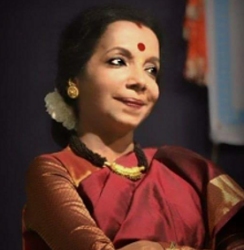 Dr. Lata Surendra is a performer, mentor, an imaginative choreographer, a sought after curator, a dance journalist, a committed independent researcher, a sensitive poet and in the field of dance for over six decades. Response * When grief becomes argument: A response to "The Silent Cry of the Gungroo" Dr. Lata Surendra's essay, published on June 8, 2026, arrives with genuine feeling. The grief is real. The concern - that classical Indian dance is being hollowed out by commercialisation, that depth is being traded for visibility, that the guru-shishya parampara is eroding under market pressure - is one that many serious practitioners share. I share parts of it myself. But grief, however sincere, is not analysis. And when grief is dressed as argument without doing argument's work, it risks doing the very thing it laments: reducing something complex to something consumable. The essay opens with the Ananya Panday controversy and Dr. Anita Ratnam's reported response, using a celebrity flashpoint as evidence of civilisational decline. This is a rhetorical move, not a critical one. The relationship between classical form and popular culture has never been clean. It has always been negotiated, contested, and - this is the part the essay quietly erases - mutually constitutive. The same Bollywood that is cast here as executioner was, for much of the twentieth century, the primary vehicle through which classical forms reached mass audiences. The essay then invokes Kamala, Padmini, Vyjayantimala, and Birju Maharaj as exemplars of an uncorrupted classical tradition. These were film dancers. Birju Maharaj choreographed for commercial Hindi cinema. The essay holds up as paragons the very bridge it claims to mourn. That contradiction is not minor - it is structural. The section on gym conditioning and biomechanical tools makes a point worth taking seriously: that adavus are a self-contained conditioning system, that the form's physical demands are intrinsic to the form, not separable from it. This is a legitimate pedagogical argument. But the essay doesn't make it as an argument - it makes it as an accusation. It asserts that resistance bands and conditioning workshops are "fundamentally altering" classical training without demonstrating this, without engaging with the documented injury rates among classical dancers trained without cross-conditioning, and without distinguishing between practitioners who use supplemental tools carelessly and those who use them thoughtfully. Dismissing injury prevention as monetisation in disguise is not rigorous. It is suspicion dressed as insight. What troubles me most, however, is the essay's relationship to history. The "purity" being mourned was never a stable, uninterrupted inheritance. The twentieth-century revival of Bharatanatyam - to take the most obvious example - involved significant reconstruction, institutionalisation, and in places, reinvention. What we now call tradition was itself the outcome of negotiation, of choices made by people who were also navigating changing times. To speak of a pre-commercial golden age is to speak of something that is, at best, partial memory and, at worst, mythology. Nostalgia is not evidence. None of this means the concerns are wrong. The velocity-over-depth problem is real. The flattening of rigorous, years-long practice into marketable modules is real. The pressure on young practitioners to perform accessibility before they have built interiority is real and worth serious attention. These deserve more precise diagnosis than they receive here. The essay ends with a gesture toward balance - "innovation is not the enemy of tradition, but its very breath" - that sits uneasily after pages of lamentation in which almost every form of change is figured as corruption. If that final line is true, and I think it is, then the essay needed to do the harder work: not just mourning what is being lost, but asking where the line is. What distinguishes adaptation from erasure? What does legitimate innovation look like, and who gets to determine it? These are the questions the tradition actually needs its practitioners and thinkers to wrestle with - carefully, with evidence, without retreating into elegy. Grief for what is genuinely precious is worth honouring. But the art form deserves more than grief. It deserves rigour. - Masoom Parmar (June 13, 2026) Post your comments Pl provide your name along with your comment. All appropriate comments posted with name in the blog will also be featured in the site. |
