
|
    |
|
|
|

ARTICLEFrom a museum artifact to a living traditionThe revival of 'Pavakathakali' in India- Vinod Gopalakrishnane-mail: vinod64@gmail.com June 3, 2026 Dakshinachitra, founded as an institution of preservation, has carried a deep commitment to nurturing and sustaining India's diverse traditional Arts and crafts with a special sensitivity toward forms that survive at the margins of society and are often vulnerable to disappearance. Over the years, the museum has built a meaningful legacy not only as a custodian of living cultures, but also as an active cultural institution that recognizes 'living communities' and the artists who keep these fragile traditions alive. Through its annual Dakshinachitra 'Virudhu' citation and Prize, the institution has consistently acknowledged individuals and groups whose lifelong dedication have strengthened the continuity of folk and traditional arts across India. 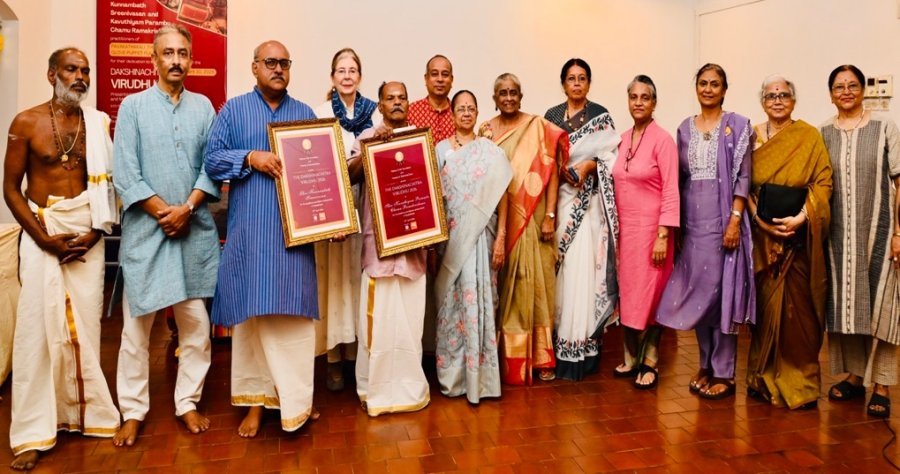 In 2026, this honor was bestowed upon the Pavakathakali performing team leaders of the Natanakairali ensemble from Kerala. Kunnambath Sreenivasan and Kauthiyam Parambu Ramakrishnan were nurtured under the guidance of Guru G. Venu - the visionary Kudiyattam artiste and Navarasa Sadhana Guru whose dedicated pioneering work in reviving endangered performance traditions is extraordinary. Art forms rarely disappear in a flash of light! They fade when the delicate ecosystem that sustains them begins to erode. The most common cause is the loss of patronage. When courts, temples, or community sponsors withdraw support, artists are left without economic security, forcing younger generations to seek more stable livelihoods. Closely linked to this is the break in transmission - when rigorous, time-intensive training no longer seems viable, the lineage quietly thins and starts to erode. Changing social tastes also play a role. As audiences gravitate toward faster, and more accessible forms of entertainment, slower tradition-bound arts struggle to hold attention. Urbanization and migration further disrupt the intimate community contexts in which many art forms once thrived. There are also subtle forces at work. Rigidity within the tradition that resists adaptation, or conversely, excessive dilution that erodes its identity. At times, institutional neglect, lack of documentation, and absence of meaningful platforms accelerate the decline. Yet, perhaps the most intangible reason is the fading of belief in the cultural and emotional connection that once made the art necessary rather than optional. When that shared sense of value diminishes, an art form does not merely lose practitioners - it loses its place in the living rhythm of society. Across the world, puppetry has served as a powerful storytelling medium, blending craft, performance, and imagination into a living art. From the refined shadow theatre of Indonesia's 'Wayang Kulit' with roots in ancient Javanese ritual, to Japan's highly sophisticated 'Bunraku', where large puppets are animated by visible puppeteers, and Europe's marionette traditions that flourished in Italy, France, and Central Europe, puppetry has evolved in diverse cultural contexts. In China, shadow puppetry dates back over two millennia, while in Turkey and Greece, forms like 'Karagoz' developed as popular folk theatre. India, too, possesses a rich and varied puppetry heritage - 'Tholu Bommalata' of Andhra Pradesh and Telangana, 'Togalu Gombeyaata' of Karnataka, and 'Ravana Chhaya' of Odisha represent shadow puppetry traditions with ancient ritualistic links, while string puppetry traditions such as 'Kathputli' of Rajasthan and rod puppetry like 'Putul Nach' of Bengal have entertained communities for centuries. It is within this vibrant constellation of forms that Kerala's unique 'Pavakathakali' emerged. In all, a distinctive synthesis of puppetry and classical dance-drama. 'Pavakathakali' quite literally means 'puppet Kathakali'. It is one of Kerala's most enchanting yet fragile performance traditions, and it is a miniature echo of the grandeur of Kathakali rendered through carved wood and costume attired puppets. The origins of the art can be traced back to the 18th and 19th centuries in the Palakkad and Thrissur regions of Kerala, where it developed as a social art, often performed in the precincts of Subramanian and Bhagavathy temples. Crafted from wood and cloth, the puppets were exquisitely painted and articulated, and their movements closely mirrored the stylized gestures, costumes, and dramatic vocabulary of Kathakali. Episodes from the Ramayana and Mahabharata formed the narrative core, accompanied by the traditional 'Chenda' drum, along with the vocal musical rendition of the story unfolding on stage very similar to the spectacular art in its traditional performance on stage. 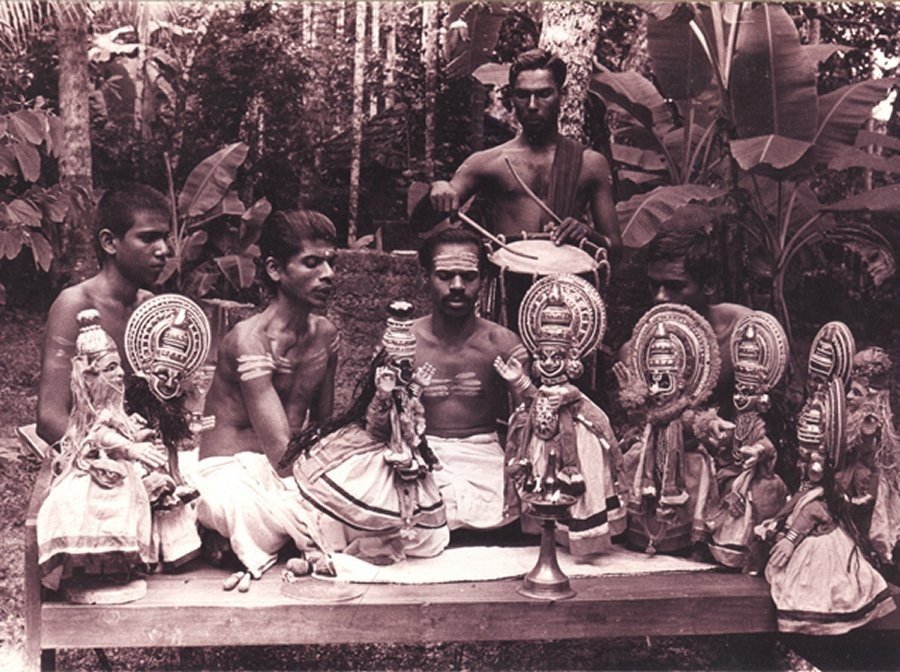 A scene from 'Uttara Swayamvaram' Pavakathakali directed by G. Venu in 1985 K. V. Ramakrishnan, K. C. Ramakrishnan, Ravi Gopalan Nair and V.Thankappan are the puppeteers. The term 'Pandaram' in the South Indian context has historically referred to a range of temple-serving and mendicant communities, often associated with Shaiva traditions and itinerant religious service. Over the course of the 18th and 19th centuries, groups identified as 'Pandarams' are believed to have moved gradually from parts of present- day Andhra and Tamil regions into Kerala, following older routes of pilgrimage, trade, and temple networks. These movements were rarely a single, documented migration, rather, they unfolded in small waves, shaped by the search for livelihood, patronage, and ritual roles within temple economies. When these communities settled in regions such as Palakkad and parts of central Kerala, they found themselves at cultural crossroads. They adapted with notable flexibility to local artistic and ritual practices. It was within this context that some Pandaram families became closely associated with Pavakathakali. As temple-linked performers and service providers, they found in this delicate puppetry tradition, both a livelihood and a means of cultural integration. The performance of Pavakathakali during temple festivals, aligned well with their roles within the ritual sphere. 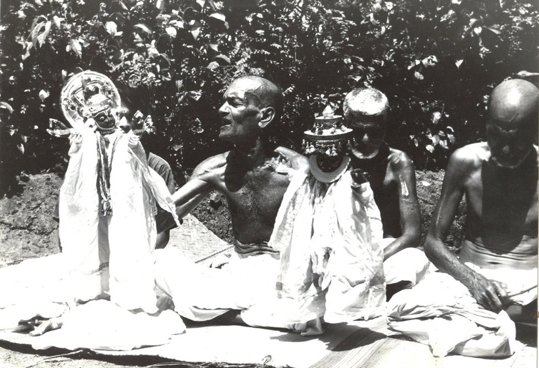 Chamu Pandaram and troupe The contribution of the 'Pandaram' community was not merely custodial but also interpretive. These families learned the complex grammar of Kathakali. They understood its language of gestures, character types, and musical structure. Over years, they translated it into the intimate scale of puppetry. They maintained and transmitted the skills of puppet-making, voice modulation, and rhythmic coordination across generations, often within tightly knit hereditary lineages. Crucially, their continued engagement with Pavakathakali depended on systems of local patronage - temples, landlords, and community sponsors who commissioned performances during festivals and seasonal observances. However, as these patronage networks weakened in the late 19th and early 20th centuries, the economic foundation that sustained both the Pandaram performers and the art form itself began to erode. Many families were compelled to seek alternative livelihoods, and the continuity of Pavakathakali was severely threatened. Yet, the legacy of these communities endures in the fragments they preserved. The repertoire, the techniques, and the memory of a living tradition carried across regions and generations, sustained for as long as patronage and devotion allowed. Much alike many traditional arts across our historical context, Pavakathakali suffered a steep decline during the late 19th and early 20th centuries. The erosion of royal patronage, changing social structures, and the growing popularity of modern entertainment forms led to its marginalization. By the mid-20th century, the art stood on the brink of disappearance, sustained only by a few hereditary families such as those of Chamu Pandaram and their extended families. They kept the flame alive in their memory and their struggle and commitment despite the lack of support or assistance over decades in itself, can be viewed as an artform revived almost from the very brink of a void! The revival of Pavakathakali in independent India owes much to the visionary cultural activism of Kamaladevi Chattopadhyay. A pioneering force behind India's handicrafts and performing arts renaissance, Kamaladevi recognized the profound cultural value embedded in fragile, localized traditions like Pavakathakali. 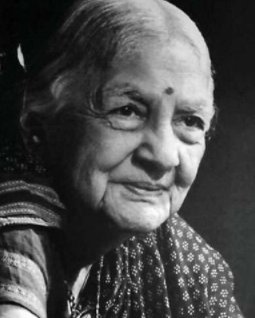 Kamaladevi Chattopadhyaya 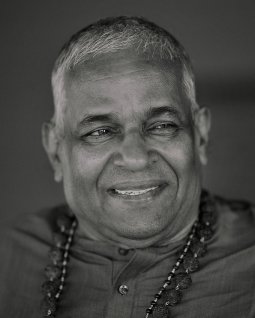 G.Venu A telling moment in the modern history of Pavakathakali can be traced to Kamaladevi Chattopadhyay's visit to the museum at Thrissur in the early 1980's. Amid the quiet displays, her attention was drawn to two small Kathakali puppets - delicately crafted, richly painted, and yet strangely still, as though severed from the life they once embodied. For Kamaladevi, whose eyes were trained to recognize not just objects but the traditions behind them, these were not mere curiosities - they were fragments of a fading performance lineage. She is said to have been struck by the question of how an art so closely aligned with the grandeur of Kathakali could have slipped into near obscurity, surviving only as museum pieces. That moment of encounter sparked a deeper inquiry - into the communities that had sustained the form, the reasons for its decline, and the possibilities of its revival. Fortunately, she had known Guru G. Venu during his time in Delhi and reached out to him immediately. What followed was the quest that set Guru Venu on a path that resonates to this day. True to her lifelong commitment to India's traditional arts, Kamaladevi did not allow this effort to remain a passing curiosity. She began to advocate for the rediscovery and revitalization of Pavakathakali, encouraging documentation, research, and direct engagement with the remaining practitioners. Through institutions such as the Sangeet Natak Akademi and the Crafts Council of India, Kamaladevi advocated for documentation, financial support, and wider platforms for traditional artists. Her efforts along with Guru G. Venu's perseverance, helped bring national attention to the endangered puppetry tradition encouraging research, workshops, and performances beyond the geography of Kerala. Through Kamaladevi's influence within national cultural institutions, and the dedicated contribution of Guru G. Venu, they helped bring attention and support to this nearly forgotten form, ensuring that it could move out of static display cases and return, however modestly, to the living stage. In this way, a quiet museum encounter became the seed for a larger cultural recovery and is an instance of how attentive observation and a dedicated pursuance guided by conviction, can help restore voice and movement to an art on the verge of silence. Building on this foundation, Guru G.Venu played a crucial role in breathing new life into the art of Pavakathakali. He recognized the importance of the cause and his deep respect and reverence for Kamaladevi's vision propelled his relentless effort. Assisted by Ravi Gopalan Nair and later by Kunnambath Srinivasan, Guru G. Venu worked closely with Thottassery Narayanan Namboodiri who committed himself to redesign and subsequently produce real Kathakali performance attire costumes for each of the puppets. 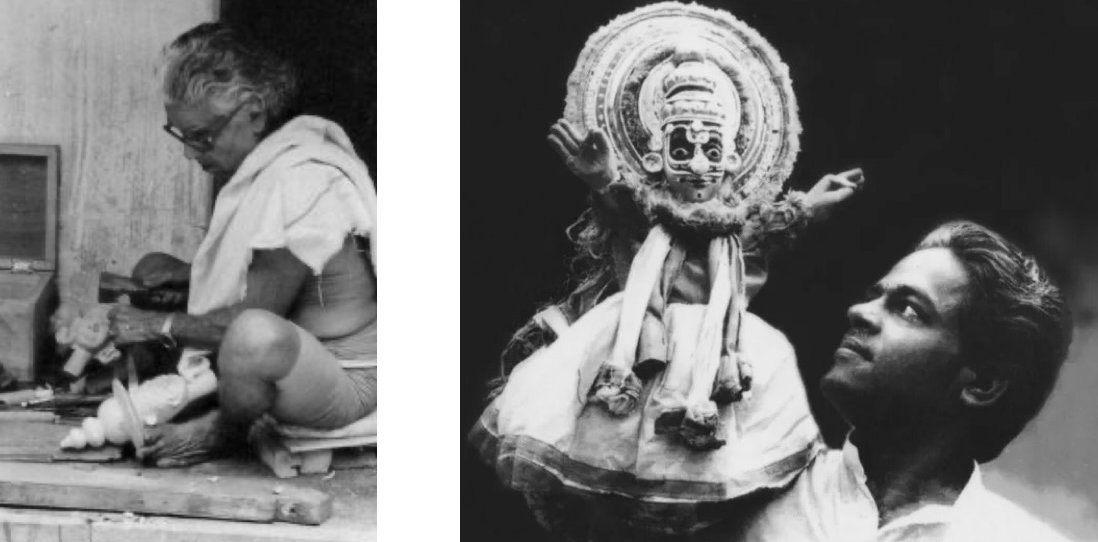 Thottassery Narayanan Namboothiri and G. Venu in the early 1980's These sincere contributions and with the few 'out of work' surviving puppeteer families, they organized a sincere support plan towards the transmission of skills to younger generations while also adapting the art for modern audiences. 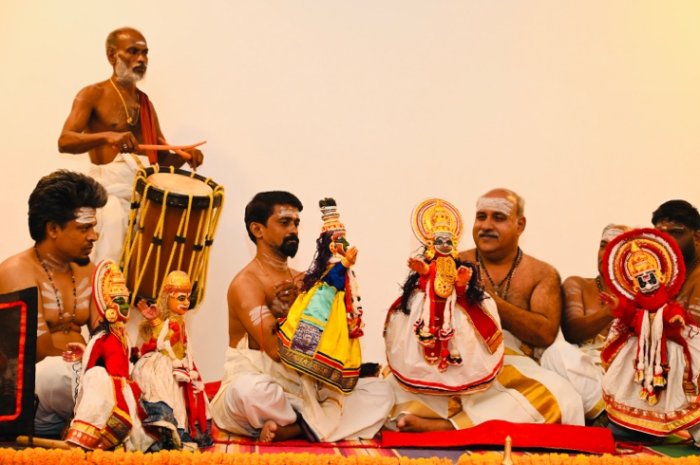 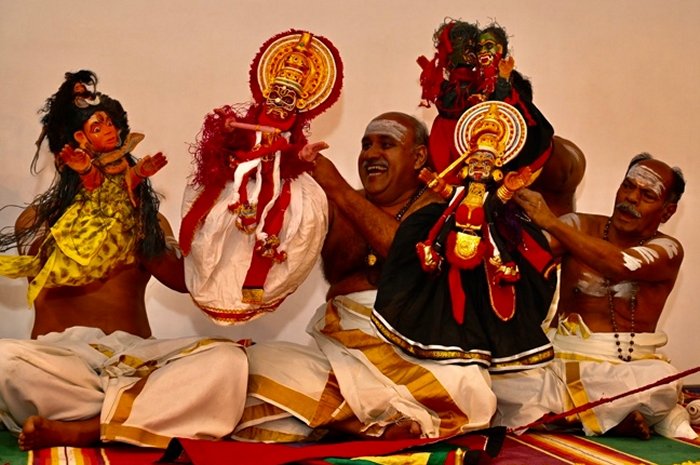 The Natanakairali 'Pavakathakali' ensemble perform at Dakshinachitra - April 2026 Their initiatives have since curated performances, lecture-demonstrations, and over time, the inclusion of Pavakathakali into Indian and International cultural festivals. By refining stage presentation, improving puppet craftsmanship, and contextualizing narratives for contemporary viewers, Guru G. Venu has helped bridge the gap between tradition and modernity. Though the light of Kalamadevi Chattopadhyaya passed on into the heavens at the end of the 1980's, 'Pavakathakali' survives as a testament to resilience. After the visionary's era and her initiation, the relentless work of Guru G. Venu, Kerala's puppet art form's continued presence on cultural stages reflects the enduring impact of revival efforts. Their work reminds us that survival of such art forms depend not only on preservation, but also on a sincere, thoughtful, and sustained commitment to renewal efforts - where heritage is not merely remembered, but reimagined for the future. Vinod Gopalakrishnan is a Trustee and Board Member at the Dakshinachitra Museum in Chennai. He regularly writes and speaks about early pioneers of the many fascinating worlds of Performing Arts, the necessary reality of Cultural Preservation, and the importance of preserving Libraries, Art Repositories and their critical contribution to society. Post your comments Pl provide your name along with your comment. All appropriate comments posted with name in the blog will also be featured in the site. |
