
|
    |
|
|
|

ARTICLEWhy Dance?- Dr. Rohini Dandavatee-mail: dandavate2@gmail.com May 21, 2026 Often, parents and young students wonder whether they or their children should pursue dance education. I would like to reflect on this question through the lens of my lifelong journey with Odissi, a pursuit that began in early childhood and continues to shape my life even today. Through years of performance, arts administration, and arts education, I have gradually come to understand not only what dance demands of us, but also what it gives back in return. The discipline, resilience, sensitivity, and joy I have gained through this quest are reflections I wish to share here. I distinctly remember being asked, sometimes mockingly, "So, are you going to become a professional dancer?" I would simply smile and walk away without answering. Looking back now, I realize I did not need an answer then, because the value of dance extends far beyond professional ambition. I remain deeply grateful to my parents and family for their unwavering support and for encouraging me to remain steadfast on this path. My understanding of dance was deeply shaped by the environment in which I grew up. In Odisha, where I was born, tradition breathes through movement. Dance, music, sculpture, painting, poetry, and ritual are not separate strands of life; they flow together seamlessly, shaping everyday experience and cultural identity. From the intricate carvings of dancers adorning the ancient temples of Bhubaneswar, Puri and Konark to the rhythms of the mardala resonating through festivals and celebrations, art is woven into the very fabric of society. Growing up in such an environment, Odissi felt less like an extracurricular activity or a distant classical form preserved only for the stage. It felt alive - present in stories narrated by elders, in devotional practices, in seasonal festivities, and in the quiet reverence with which beauty and discipline were regarded. As a child, I may not have fully understood the historical and spiritual depth of the tradition, but with passage of time I recognized that dance carried memory, philosophy, and emotion across generations. I began to realize that Odissi was shaping not only my artistic abilities, but also my understanding of identity and cultural continuity. In Odissi, the body becomes a vessel through which tradition is carried forward. Every posture, gesture, and expression is rooted in centuries of artistic refinement, yet each dancer must rediscover and embody them anew. Learning dance, therefore, became for me more than the acquisition of technique; it evolved into a way of understanding where I came from and how tradition can remain dynamic and relevant in contemporary life. Dance became a way of seeing, feeling, and connecting with the world. This realization profoundly shaped my journey and deepened my commitment to the arts. As life gradually carried me beyond Odisha, I discovered another important truth: Odissi lives wherever one carries it. Moving through different parts of India and eventually to the United States taught me that Odissi is not confined to temples, stages, or even geography. Its spirit survives through the sincerity and integrity of the dancer. When practiced with understanding and authenticity, Odissi has the power to connect with audiences across cultures and generations. In this way, dance revealed to me that art becomes universal when its emotional truth remains genuine. This realization also transformed the way I approached learning and performing. Dance performances, scholarly exchanges through paper presentations, and the writing of articles, lectures, and research papers gradually revealed to me the profound philosophy, history, poetry, and devotion embedded within the form. Odissi is not merely a sequence of movements; it is an artistic language shaped by centuries of spiritual thought, literary richness, and cultural memory. The deeper I delved into its mythology, music, language, literature, and symbolism, the more meaningful each performance became, regardless of where it was presented. Whether on a prestigious stage, in an academic setting, or before an intimate community gathering, I began to understand that the true power of dance lies not only in technical execution, but in the depth of understanding and sincerity that animate it. Gradually, I realized that learning dance was also an education in history, aesthetics, philosophy, and human emotion. Every composition became an invitation to study, reflect, and connect more deeply with both tradition and self. In many ways, I came to understand that I was carrying my culture within me. Learning Odissi reinforced the idea that cultural identity is not a limitation, but a foundation. In an increasingly globalized world, being rooted in one's traditions cultivates confidence, individuality, and artistic depth. Odissi became an anchor in my life. By embracing my cultural roots, I developed a stronger sense of self and found meaningful ways to contribute to the preservation of collective memory through performance and practice. At the same time, my own educational background gave me another perspective on tradition. Having studied in a Catholic missionary school, friends and extended family in India sometimes assumed that my understanding of traditions and rituals lacked depth because I was not deeply involved in their daily practice. Yet through dance, tradition found its voice. Odissi became far more than choreography; it became a form of communication - a way of inhabiting and expressing inherited knowledge, devotion, and emotion. This understanding fundamentally changed the way I viewed performance itself. A true performer does not dance merely for an audience, but with them, creating a shared emotional and spiritual experience. Training in Odissi developed in me a sensitivity to expression (abhinaya), storytelling, rhythm, and audience engagement. Through this process, I learned empathy, emotional intelligence, and the ability to communicate beyond words. Tradition speaks through the artist, but only when the artist first learns to listen deeply. Listening deeply also meant learning beyond the stage. Odissi education extended far beyond technical performance. Understanding the meaning behind gestures, compositions, mythology, and aesthetics transformed dance from physical execution into an intellectual and spiritual practice. I came to understand that the "why" behind every movement matters. Studying theory, literature, history, and philosophy enriched not only the quality of performance, but also my personal growth. With deeper knowledge, I found myself able to engage in meaningful dialogue in classrooms, community platforms, and conversations across generations through the language of dance. Over time, this led me to another insight: dialogue strengthens tradition. Tradition does not weaken through interaction; rather, it evolves through meaningful exchange. Odissi possesses the strength to converse with contemporary ideas, global audiences, and interdisciplinary collaborations without losing its essence. 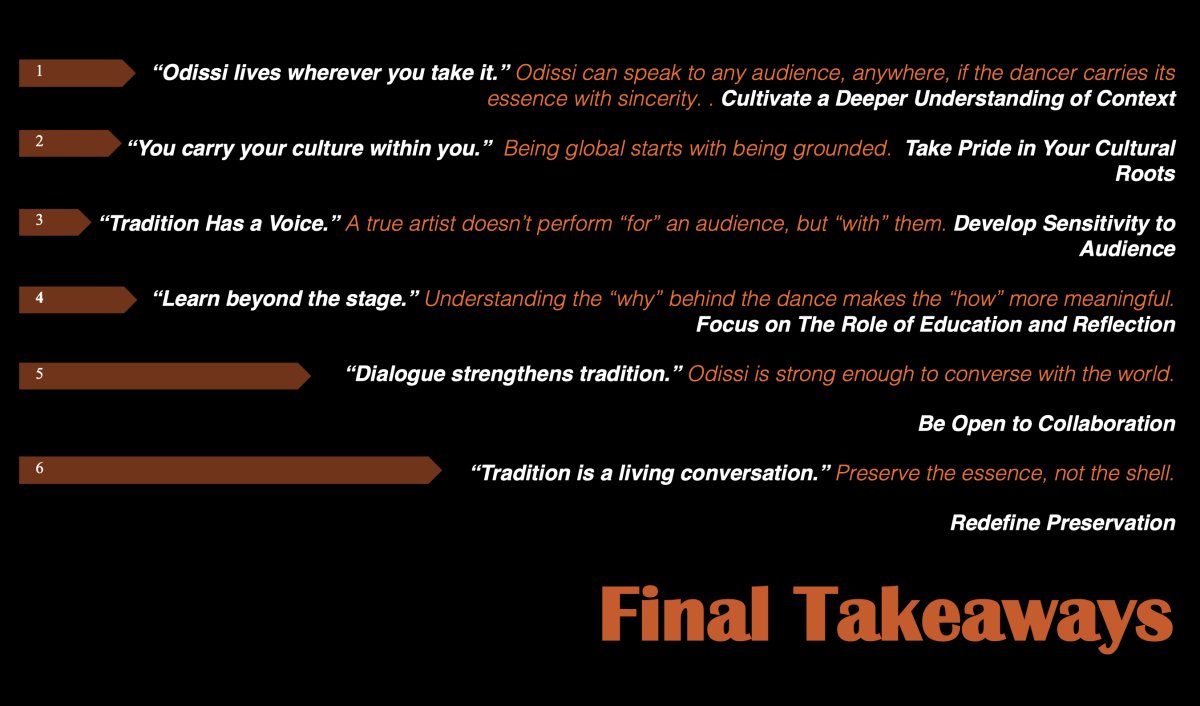 I remember that during one of my early lecture-demonstrations for kindergarten students, a child asked if I could perform Cinderella in the Odissi style. The question stayed with me. I realized that to build curiosity and dialogue around my tradition, I also needed to understand the interests and imaginations of my audience. That openness gradually led me toward collaboration - with other dance forms, music traditions, theatre, and contemporary platforms - as a way of keeping the tradition accessible and relevant. That childhood question eventually inspired new choreographic explorations. I collaborated with two leading modern dancers to explore the meaning of fire in different cultures. One of my projects, TAPA, emerged through another cross-cultural collaboration with Brazilian dancers and musicians. The work was inspired by my concerns about violence in contemporary society, including rising school shootings and immigration struggles along the Mexican border. Similarly, the most recent presentation of my choreographies at Kala Vikash Kendra in Cuttack included a dance based on the poem An Unstuck Feature, exploring the human yearning for freedom, and another work, Vihang Gati, inspired by Jonathan Livingston Seagull by Richard Bach. Through such creative explorations, I came to understand that tradition is not a static inheritance, but a living conversation - one that continually evolves through dialogue with contemporary experiences, ideas, and emotions. Preservation, therefore, is not about rigidly protecting the outer shell of tradition; it is about safeguarding its core values and spirit. Odissi survives because each generation reinterprets and re-experiences it anew. A dancer's responsibility is not only to inherit tradition, but also to nurture it thoughtfully for the future. True preservation balances continuity with adaptation. By understanding the essence rather than imitating mechanically, practitioners help keep the art form alive, dynamic, and meaningful. Ultimately, pursuing Odissi is not simply about learning a classical dance form - it is entering a lifelong journey of discipline, identity, expression, reflection, and cultural dialogue. The training shapes not only the dancer's body and artistry, but also their worldview, teaching them how tradition can remain deeply rooted while still engaging openly with the modern world. With this sharing, I hope I have been able to offer at least one response to the question, "Why dance?" Dance is valuable not only because it creates performers, but because it nurtures thoughtful, sensitive, disciplined, and culturally grounded human beings. It teaches patience, humility, concentration, empathy, and the ability to listen - both to oneself and to others. For young students, especially, the arts cultivate qualities that continue to enrich life far beyond the stage. Not every student who learns dance will become a professional performer, nor should that be the sole measure of its worth. The true value of dance lies in the way it shapes character, deepens cultural understanding, and creates meaningful connections across generations and communities. For me, Odissi has been not merely an art form to practice, but a lifelong companion - one that continues to guide my understanding of tradition, creativity, and humanity itself. In reflecting upon this journey, I remain deeply grateful to my mother, whose unwavering encouragement and faith allowed me to pursue this path with conviction and joy.  Dr. Rohini Dandavate is an Odissi dancer, choreographer, and educator with over six decades of experience across India, Europe, and the U.S. Trained at Kala Vikash Kendra under Gurus Kelucharan Mohapatra, Raghunath Dutta, Ramani Ranjan Jena and Dr. Menaka Thakkar, she brings a strong classical foundation to her work in performance, pedagogy, and intercultural dialogue. She holds a Ph.D. in Cultural Policy and Arts Administration from The Ohio State University, where her research focused on understanding the impact of the arts through cultural exchange. Her writings on dance education and cultural policy appear in Nartanam, Angarag, Ohio Dance Newsletter, and other Journals. A recipient of fellowships from the Ohio Arts Council, Ohio Humanities Council, Asian Cultural Council, New York, and India's Department of Culture, Dr. Dandavate continues to perform, publish, and collaborate-exploring new possibilities in Odissi through both creative and academic practice. Post your comments Pl provide your name along with your comment. All appropriate comments posted with name in the blog will also be featured in the site. |
