
|
    |
|
|
|

 Growing into your own sealA journey from the collective to the individual- Dr. Lata Surendrae-mail: kalashrilata29@gmail.com April 13, 2026 Growing into one's own signature as an artist is not a frantic search for a unique style, but rather a quiet, reflective process of recognizing one's authentic voice, that tends to be hidden within gestures, choices, and a way of seeing the world through another's eyes. It is a journey from imitation to internalization, transforming raw emotion and technique into a consistent, personal "fingerprint" that resonates with both the creator and the viewer. An artistic signature is not created; it is recognized over time. It is the rhythm of color, the movement, and the emotional touch that remains constant even as subject matter shifts. The signature in fact is a soul mark - an extension of the artist's personality--whether harsh or gentle, bold or whispering--acting as punctuation at the end of a personal, creative monologue happening through an evolution over a period of time gathering in depth, performance after performance. It is vital for this growth within to have us pause at times and look back at early pieces to find the common threads--the "fingerprint"--that appear subconsciously. Sometimes to limit an external influence one needs to practice "incubation" by reducing, for a time, the intake of art from others if only to allow one's own internal voice to surface. An artist absolutely needs to develop a deep self-awareness, allowing a performance to become a natural, sincere extension of life experiences to transform them to a journey from the particular to the universal, the tangible to the intangible. Using art as a "secret language" one needs to seek more than see, listen as one hears, feel as one is touched by the unfolding flux of life to reveal that inner world and translate complex emotional landscapes into tangible visual forms. In the tapestry of the sacred WORD, a signature - a 'Mudra' is never a seal of ownership, but a humble surrender to the Source. For the saints and rishis, etching a name into a composition, is the final act of dissolving the self into the Infinite. It is the mark of a witness, not an author--a fierce declaration that the individual soul has been consumed by the divine flame. They signed their verses to anchor the celestial in the earthly, proving that a mere human vessel can resonate with the heartbeat of God. Their names are not monuments to their ego, but footprints left on the path of ecstasy, signaling to all seekers that the bridge to the Divine is open, intimate, and eternally real. It is the mark of a witness, not an author--a fierce declaration that the individual soul has been consumed by the divine flame. They possessively endorse their verses to anchor the celestial in the earthly, proving that a mere human vessel can resonate with the heartbeat of God. Their names thus motivate and transform as footprints left on the path of ecstasy, signaling to all seekers that the bridge to the Divine is open, intimate, one to one and eternally real. In Indian classical music and devotional poetry, a Mudra (Sanskrit for 'sign' or 'symbol') is a composer's signature or pseudonym embedded within the sahitya (lyrics) of a composition (e.g., Kritis, Padams, Bhajans). These signatures are usually found towards the end of the Kriti, typically in the charanam (final stanza) or madhyamakala (the medium-tempo speed in Carnatic music) portion so as to blend naturally with the lyrical flow. They help us to identify authorship and reflect the composer's devotion, lineage, or philosophical stance. Composers have used different types of mudras to sign their works, ranging from their own names to philosophical concepts. For instance: Personal Names - Swanaama Mudras - (Vaggeyakara Mudra) Composers often used their own names to sign, commonly used in South Indian Carnatic music. Tyagaraja: Used 'Tyagaraja' Syama Sastri: Used 'Shyamakrishna' Purandara Dasa: Used 'Purandara Vittala' Mysore Vasudevachar: Used 'Vasudeva' Mirabai: Often used 'Mira ke Prabhu' Tulsidas: Used 'Tulsidas' Deities or Philosophical Mudras Many saint-poets did not use their own names, but rather the name of their patron deity or a philosophical concept, reflecting humility. Muthuswami Dikshitar: Used 'Guruguha' (referring to Lord Subrahmanya / Kartikeya),symbolising the guru within Swathi Thirunal: Used 'Padmanabha' (presiding deity of Thiruvananthapuram) Sadashiva Brahmendra: Used 'Paramahamsa' Papanasam Sivan: 'Ramadasan' Koteeswara Iyer: 'Kavi Kunjara Dasan' (honoring his guru) In Hindustani music, particularly within the Dhrupad and Khayal traditions, mudras often represent the composer's "Gharana" or poetic pseudonym, frequently using "-rang" or "-piya" endings. Sadarang - Niyamat Khan (18th-century dhrupadiya) Adarang - Firoz Khan Gunidas - Jagannathbuwa Purohit Pranpiya - Vilayat Hussain Khan Man-rang - Bhupat Khan Chatur Pandit -Vishnu Narayan Bhatkhande Some composers even incorporated the name of the raga into the lyric as a signature. Thus, we see that a mudra is not merely a signature but a "living declaration of faith" acting as a tool to preserve authorship in oral traditions, distinguishing a composer's work and grounding the composition in a particular tradition or school (parampara). Whenever saint-composers, or Rishis, poets attach their mudra or signature to their deity - Andal - (Kōtai), Sadguru Sri Tyāgarāja Swāmi - (Tyagaraja), Shri Purandaradasa - (Purandara Vittala) Daasashreshta Kanakadasa - (Kaginele Adikeshava), Shri Muthuswamy Dikshithar - (Guruguha), Shri Jayadeva - (Jayadeva), Guru Nanak Granth Sahib - (Nanak), Sant Kabir – (Kabir or sometimes Kabira), Meera - (Meera ke prabhu), Sri Swathi Thirunal Rama Varma - (Padmanabha) or the never ending garland of composers, it is not their voice that echoes through the halls, rather it is their signature that transforms as a bridge with an urgent plea to drown the 'I' in the vast sea of 'Thee.' It is never an assertion of ego, but a stamp of authenticity - a declaration that the song belongs to the Beloved, and the poet penning lines is the bridge - the instrument. This sensitive thread endorsing one to one has us perennially see a perspective of the universal through a deep sensitivity individually perceived by the creator of the composition and when it comes to dance the creator of the choreographed work. It is vital in this world of 'Ch'orographers more than choreographers to comprehend this absolutely as much as it is equally important to all in social media groups to awaken to an inherent manipulative lobby with an agenda to crush and silence the individual thinking to a passive silent presence of 'not being there' and yet there. The Collective mind is a crazy despot seeking to nullify the essential individuality accorded by Providence - that Master Creator who has touched each creation as a 'boutique' piece absolutely one in a million and second to none! Take a look around, no corporate edifice today likes the individual to surpass its own defining stand as an edifice or a brand. The minute the individual is the charisma drawing attention from all - then all focus is aimed at crushing that individual collectively. This can happen or one sees it happen especially in a social media group where many are 'absent in their presence' and are glorified neutral shadows - an illusion unto their very self! These have lost what is most individual to them - their voice, their choice and their taste! You will find these shadowed operators almost everywhere and many may enter your network curious not 'concerned'. They wish to be with you in 'collaborations' but they bypass you - your signature, your presence at the first opportunity. Today, the connotations of dance has definitely grown and a lot is done to have young artistic hearts to imbibe it with universities of dance enlarging it as a comprehensive study through a planned syllabus common to all. Although there may be those with aptitude and talent who have been initiated under Gurus and who having gathered an experience through the years under their mentor, shine through performances; for many who come out into this wider world dance exists on paper more than presence with exams and certificates as the final goal. We had Gurus who created a unique choreography taking stock of a given mould's limitations. The Guru knew 'when' to give what and to whom' and 'where and how' a composition needed to be presented - to which audience taking into account each disciple as distinct. Today one festival will have many dancers use the same 'YouTube to mp3' downloaded audios and reach out with the same choreography in costumed synchronized movements with smoke to camouflage the lack of technical virtuosity. The aim is to create a loud monitored impact to impress more than express. The current Contemporary trends, with rapid digitalization, have repositioned classical dance forms toward spectator driven competitions. Perhaps the pressure to succeed in competitions has led to the homogenization of styles, forcing dancers to adhere to a more "marketable" format rather than developing their own spiritual or artistic voice. In fact, in trying to be the other, we have clones rather than the one emerging performer who could take dance to the next level! The accent on high-speed nritta (pure dance) has diminished the importance of Satvika Abhinaya (emotional depth and spiritual awareness), reducing the dance today to mere gymnastics. The traditional, long-term training system that imparted spiritual values alongside technical expertise is facing challenges, as students often prioritize short-term competition success over long-term artistic, spiritual, and moral development. In an era dominated by the "influenced mind of the collective"--where trends, algorithms, and social conformity often blur the lines of personal identity--the threads of a journey from a 'mere performer to a true artist' defined by the conscious, painfully gathered awareness of individuality has become an entangled knot to surf across into the bandwagon of the collective. Let us understand that while the collective demands harmony and imitation, art demands the unique, "stamp of one's own signature". The group will necessarily need to fade if one seeks growth as a performer to an artist to reckon with amidst the sea of human faces! The journey is always 'one to one' with the signature of the one Guru endorsing and monitoring the growth of the Shishyas or disciples ever so distinctly. But today what one sees is a collective pot-pourie in the execution. The 'workshop-Guru imbibed choreography' goes at loggerheads with the 'Guru-imbibed ' choreography. Some teachers encourage learning under established, seasoned performers hoping to make a gateway into the dance scene and seasons in various states. We talk of loftiness but let us soul search and ask whether we are genuinely true artists and if custodians - of which Guru's great legacy? Is it the YouTube Guru, the 'Initiator Guru' or 'Workshop Guru' or 'Parallel Gurus'? Minus the one to one connect with the divine, transforming dance from mime to a spontaneous delineation of powerful feelings, this art will taper out as 'costumed groups in smoke' dancing to sacred chants and fusion music and arrangements gathered in bits and parts and a crazy audience to accord claps and orchestrated standing ovation. The danger that is obvious is having the individual losing out to the crowd, producing works that seems technically sound but emotionally sterile. It will be ever so late when one wakes up to the fact that the world of Art is about the bonding connect between the orchestral support – Sangat and the performer .The many hands coming together for the one visual 'satsang' coming to life in that centre-stage and sculpting a cosmos pulsating in its realization of divine consciousness! Individuality is not about being self-centered or 'selfie–centered'; it is a vital act of resistance against homogenization. The artist, having separated the mind from the collective, accords fresh perspectives that, paradoxically, enrich the collective. While the collective voice is often loud but hollow, the voice of a true artist is ever so distinct, offering a new way of seeing the world. The journey from performer to artist then becomes an act of reclaiming one's autonomy from the collective. It needs strength of mind and faith in oneself, to stand out, to leave a unique mark, and to say, "I am here, and this is my truth," rather than simply, "I am here, and I fit in." The true artist knows that when the "stamp" is purely their own, it ultimately becomes a valuable, irreplaceable contribution to the world. To move beyond mere performance, one needs to cultivate the courage to trust the internal compass over the external noise of the crowd. This "stamp of one's own signature" is not merely about being different for the sake of novelty; it is the honest expression of a perspective that only you as an individual can possess. By honoring one's own specific lived experience and intuition, we contribute something irreplaceable to the world, transforming a practiced craft into a legacy in time for all times. 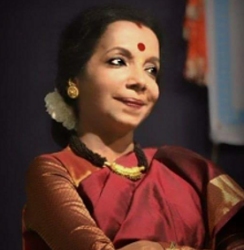 Dr. Lata Surendra is a performer, mentor, an imaginative choreographer, a sought after curator, a dance journalist, a committed independent researcher, a sensitive poet and in the field of dance for over six decades. Post your comments Pl provide your name along with your comment. All appropriate comments posted with name in the blog will also be featured in the site. |
