
|
    |
|
|
|

 The city stands tall- Yazhini SPe-mail: yazhini.2009@gmail.com March 28, 2026 What kind of people make sense in stories? I wish to show the ideologies that dominate this purely aesthetic question, show rasa itself as complicit, and argue for the stage as a place exempt from such governance, where people and their interiority are valued as material, risk is valued as an aesthetic event, and unmediated audience perception is valued as the foundational condition of art. What kinds of people "make sense" in stories? Here is a movie song "sonnathu nee thana" from 1962. I provide a rough translation here. Was it you who spoke this? Tell me. You agree to this, you say? Why? In another's hands, who? Me? Did you forget me? Why, my love? The sacred garland, kunkumam - you were the one you gave all this. It was you who thought of the bride as the goddess. In my heart, you joined your heart. "Till the end, I will be there", it was you who said this. And today, was it you who spoke these words? Tell me, my love. [beautiful sitar music] The garland that adorned the chest of god - can it fall on the street? And if it falls on the street, can another's hands touch it? In a single creeper, this flower blooms only once - is that not so? In a single heart, this relationship grows only once - is that not so? This is not a song of circumstance. It is a song of civilization. In the middle of all that tragic music, it lays down the law of the land. What kind of women make sense in stories? One love, one man. If he dies, I die. I am the garland on your chest. I am also the garland of this civilization. Without me, my tentative fluttering in shringara, my noble suffering in grief, we lose both honor and meaning. I belong to the city of monocultural aesthetics. This city was not created yesterday. From where did Kannagi acquire the power to burn the whole of Madurai? From this city. Over here, even our evil is obedient. It is to satisfy this city that Kambar's Ravanan carefully lifted only the ground on which Sita stood. The city is ancient and kind, but very fashionable. It is intimately aware of status, and the changing fashions of status, and updates itself at all times, for status is its beating heart. Status is the grace it bestows upon what resembles itself, and withholds from what doesn't. The city is the reason why idai vida is performed today with righteous anger. If a man is unfaithful, what is a woman to do? Be angry and pained. As she should be. Anger and pain are aesthetically obedient emotions. They threaten nobody. They obey the script of civilization. The man acts, the woman is injured. Contempt, amusement, boredom, cunningness, cruelty - these emotions are not obedient. Nor are the women who display them. A woman who is amused instead of broken is not properly disciplined by love. By all accounts, the inspiration of Smarasundaranguni was a formidable woman, intolerant of superficiality. Then why is it performed today with a shy, embarrassed nayika, giggling at her own playing of the veena? Why genuflect so much? Cui bono? These things, the city loves. It is a sponge of monoculture. It absorbs everything and paints it white, which is its color. The city is not patriarchy. It uses patriarchy as one of its arms. Another arm is moral virtue. Take this Bharatiyar song and my rough translation, offered with apology: The boons I want, I will sing, listen Ganapathi. Without disturbance in heart, without darkness in mind, The silent state of mind must come to me, as soon as I think of it - you must make sure of it! Wealth and a hundred years of life - these also you must give me. Oh no, this uncommon poet who defined the meaning of risk in modern Tamil poetry - he is praying for wealth? The horror. How do we interpret it in abhinaya? Let's make him give it away. He just wanted wealth so he can be generous and upstanding. Here is yet another arm. This song is Taruniro punya paapamu tana cetidi, by Kshetrayya. The nayika says: O woman, punyam and paapam are both in one's own hands, tell this to Muvvagopala, the supreme soul. If he draws me close, it is fine. It is fine if he holds my hand, if he rebukes, if he exhausts me, If he cherishes me, if he embraces me. If you plead in this way, it will be good. If I hear the mocking words of friends, it's fine. If he calls me his own or speaks sweet words, it's fine. This body is for him - whatever he may do. Only you can convey this. If he summons me through friends, it's fine. If he approaches me with affection as before, it's fine. My friend, if he breaks my heart - what more is there to say? Go and plead with our Muvvagopala. Who is this woman? Did she weigh these insults to the precision of a needle, and watch the scale tip away from them? The song makes you wonder, right? In the abhinaya interpretation, we see staircases going up and down, reflecting life's ups and downs. Cows being herded by Krishna (cow = nayika, presumably). A string puppet being pulled. A content smile. Self-satisfied abandon. Not patriarchy this time, but bhakti. Poetry, after all, relies on details for force production. Its strength is its weakness. If you delete the details, any poem can be subjugated. This nayika's performative self-erasure is not investigated, but removed from its arithmetic of dignity and choice, love and its price, and placed at the feet of god, where there is no danger, and which is where the poet really should have placed it, if he knew what was good for him. It's tough to paint this particular nayika with feminism, so she's painted with bhakti, which has, for now, an inviolable status. A morally superior interpretation, in abhinaya, can destroy the potential of a song. Moral categories are not aesthetic categories. Morality, patriarchy, feminism, bhakti, ancient theory, modern therapy, and whatever other thing the wind dragged to our front door - these things are material for the stage, not its jurisdiction. But who benefits from this? Who benefits if Kshetrayya was really Meera in disguise? If everything is pure artistic license, why does the compass always point to the city? One man. One love. One supreme consciousness. One culture. One people. One art. One way of life. To shore this up, we invoke rasa. But rasa, supposedly the ultimate arbiter of the stage, is vulnerable to meddling by the city. The dancer's craft requires the viewer's permission to work. But the sahrdaya depends on the city for his supply of status. He complies with that which elevates his status, and demotes that which confuses his status. Rasa, far from being an ideologically neutral state of bliss, is voluntary. I would like to propose an opposite to rasa. But unlike rasa, it is easily verifiable, involuntary, bodily felt, invulnerable to pre-program notes and interviews, and the various forces of ideological dominance that seek to mediate the sacred channel between performer and audience: risk. Risk happens when the audience is suddenly unsure of the ground. When there's an interpretation that suddenly shows the audience to be wrong, because the nayika's stakes are deeper, or you sense her strategy, or she's more three dimensional than you expected, or you empathize with that which you disagree with, and the audience must emotionally recalibrate. It is this recalibration, the sense that perhaps you don't have the measure of the song or the nayika or the situation, or one's own self, that creates performative risk. I've always found that the audience might miss several things in dance, but never an earring that is dropped by mistake. It is immediately noticed, because it marks risk, although a risk outside performance. Risk within performance is also not missed, but it's so rare. Risk is felt, I believe, because it is the shadow of the city. They exist in balance, as a threat to each other. That is why we are ever alert to it. In the darkness of the auditorium, we do not love the city. The auditorium is exempt. Once, not so long ago, there was a kind of poetry that contained abundant, performative risk. People called it "dance poetry". It was not textually poetic. It did not distill universal human life into a single startling moment, like we expect poetry to do. Its identifying quality was that it surrendered power and ceded the right to make meaning, to dance. It did not say "Dhīra samīre tīre vana-mālī vasati vane". "There's a gentle breeze on the river-bank, and the forest-garlanded one dwells in the forest." It said "adhi okka yugamu vére janmamippuḍu". "It was another era. This is a different birth." Both are poetry, but in one of them, the dancer decorates the meaning generated by the poet. In the other, the dancer must generate the meaning. Central to this poetry, weaving in and out of its songs, performing another performance within the performance, managing the unmanageable, advancing agendas, inventing narratives, handling with bottomless skill the sari pallu, jewelry, paan, mirrors, men, pride, grief and betrayal, was the samanya nayika. The surprising thing is that she existed at all, when the city looms so large. Or perhaps it is only surprising to us, who look back from a time and a place, where not only are the people of the padams missing, but their very existence has been erased from cultural memory. We have lost - by an accident of time or by a precise and fierce intention - almost all reference points to an alternate aesthetic, alternate morality, alternate categories of life and art. But then, in a bard's words, in the armour of fate, there is ever a rift. In the walls of doom, a breach. The samanya nayika - by a stroke of luck, or by another precise, fierce intention, held quietly and secretly - she survives in our poetry. Away from the police city. In “Intamoham,” the woman's beloved has briefly returned to her, although his heart is still with the other woman. "Is she really more beautiful than everyone else?" she says. "Is that why you're so infatuated?" Her eyes are dry and clear. "Is she more beautiful than that woman over there? More than that other one?" She smiles. "More than me?" Gives him a long look. "I want to know everything", she says. "How does she embrace you?" And then, after every insult and every shade of pain has been consumed, she sends him off to the other woman. The wind changes, after all. People change. And if they don't, there's memory. After all this ends, when he remembers her, who would he recall? How do you define the long game? In “Kuvalayashiro,” we see the woman wringing a wet cloth dry. "These drops", she says lightly to her friend who has brought the news that her beloved was seen with other women, "are what the others are getting." This is the samanya nayika. Her love doesn't reduce her. Love, for her, is also an economy. A performance with an agenda. And sometimes a game in passing. Because of this, some people say that she and her songs are a relic of the past. Period pieces. Bound to another context. They also say Andal is totally not, because they said so. The samanya nayika does not lend herself to be co-opted for purposes grander than a single song. Longing can fit neatly into pretty much any story. Mockery... doesn't. It just sits there like an unadopted orphan. No religion wants it. No philosophy has use for it. The only place it has any emotional charge is between people, in lived life. That is not to say that only improvisational abhinaya of a samanya can produce risk. My claim is that this setup lends itself to continuous recalibrations by the audience, and is therefore hard to compete with. But are people more interesting material than ideas? Ideas, rivers and trees tend to be smooth and shiny, without contradictions, like beautiful closed systems. But people are so open-ended and annoying. Why bother with them in art? We may not be samanyas, but all of us do this. We pretend, we bargain, we try to find out what everyone else is up to, plan our words, plan our actions. We act out of hope, out of fear, out of pettiness. Sometimes we get hurt. Walls close upon us and our entire life is lost and wasted. Then we spring out of it and get drawn into the next bit of drama. But our lives happen in... reality, with all its mundane smallness. The nayikas are larger than life. They are conduits. They say this emotion is okay. Yes, someone else felt it too. This situation is okay. Yes, it happened once before too. Did you not know, my child? Did you think the world came into existence on the day you were born? This is how this woman bore her humiliation. This is what this girl thought of seduction. This is how the mother chided the daughter. This is what this woman said in the face of betrayal. This is also what pride looks like. This is also what grief looks like. Did you not know? Art cannot tell us what is right. We have friends, family and complete strangers for that. But art helps us make sense of our lives, in some way that's twisted, inscrutable, eternally human, and makes no sense when it is laid bare. How lucky are we who get to perform these women? 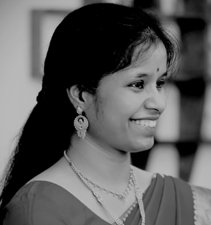 Yazhini SP is a Bharatanatyam dancer based in Bangalore. Post your comments Pl provide your name along with your comment. All appropriate comments posted with name in the blog will also be featured in the site. |
