
|
    |
|
|
|

 Democracy as Naṭya: Toward civilisational renewal- Rohit Viswanathe-mail: natyashastra.gurukulam@gmail.com January 15, 2026 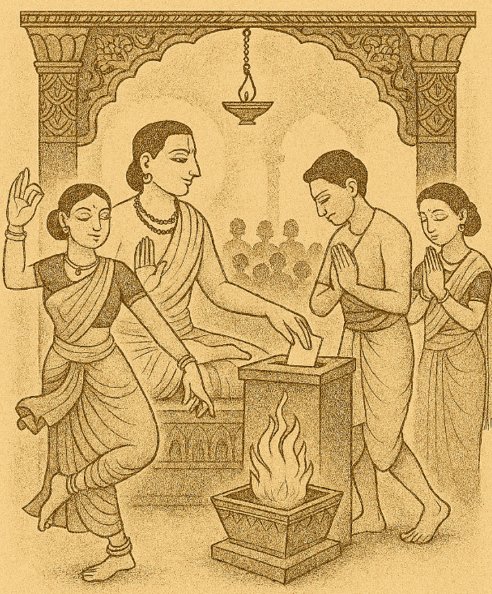 INTRODUCTION: DEMOCRACY'S OUTER RITUAL, INNER VOID Democracy today is outwardly ritualised, yet inwardly hollow. When seen only as procedure, Democracy risks becoming a Nāṭya without rasa. Yet Bharata's Nāṭyaśāstra reminds us that Nāṭya is not mere spectacle but a mirror of life, a fifth Veda meant to harmonise society through Dharma and aesthetic experience. If politics is reframed as poetry, and governance as dramaturgy, then citizenship itself becomes a sādhanā: a disciplined participation in the cosmic drama. In this vision, the sabhā of world affairs is not a battleground of interests, but a stage where harmony, wisdom, and responsibility are enacted as Dhārmic roles. RASA AND ABHINAYA IN DEMOCRATIC LIFE In the Nāṭyaśāstra, Bharata teaches that society is harmonised through the evocation of rasa. Just as the stage cultivates śānta - tranquility that tempers conflict - and vīra - heroism that inspires courage - so too must democracy nurture these rasas in its citizens. Śānta becomes the civic disposition of restraint, patience, and dialogue, while vīra manifests as principled action and fearless accountability. Without karuṇā, compassion, governance risks becoming mechanical; without hāsya, humour, public life risks becoming brittle. In this way, the sabhā itself is a dramaturgical space, where leaders and citizens alike enact roles guided not by ego but by rasa, ensuring that politics remains a Dhārmic performance - a cosmic drama in service of harmony. Just as the Nāṭyaśāstra teaches that abhinaya - the art of expression - conveys the inner bhāva to the audience, so too must diplomacy and governance embody clarity of gesture and sincerity of intent. In the sabhā of world affairs, treaties and negotiations are not mere documents but performances of vācika abhinaya, speech whose tone and cadence shape trust. Policy itself becomes āṅgika abhinaya, bodily action visible in the conduct of institutions and leaders. When guided by Dharma, these expressions transmit sāttvika bhāva - the inner states of compassion, courage, and restraint - ensuring that governance is not manipulation but transparent enactment of harmony. In this way, international relations can be reframed as a dramaturgy of truth, where nations perform roles not for dominance but for balance, echoing Bharata's vision of Nāṭya as a mirror of life and a vehicle for wisdom. LIBERALISM'S UNFINISHED ARC From body to mind, but not yet spirit. The philosophical trajectory of liberalism may be likened to the ascending limbs of Yoga. Classical liberalism (Hobbes, Locke) secured the śarīra through law, order, and property. Modern liberalism (Mill, Rawls) elevated the manas, centring autonomy, reason, and procedural justice. Yet the Ātman remains unacknowledged - freedom without transcendence is liberty without rasa. Mill warned that liberty without cultivated character risks conformity. Rawls admitted fairness is fragile without communal grounding. Abraham Maslow's later work pointed toward self-transcendence - a horizon beyond ego, toward service, reverence, and moral depth. Liberal democracies, having secured the lower rungs of Maslow's hierarchy, must now confront a higher calling: how might freedom mature into devotion, and choice into conscience? THE MAHATMA'S COMPLETION OF LIBERAL DEMOCRACY Svarāj as inner sovereignty, not mere political autonomy. Mahatma Gandhi did not reject liberal democracy; he sought to complete it. His concept of svarāj transcended political sovereignty to affirm self-rule grounded in ethical service and disciplined character. Autonomy was not severance but attunement; freedom was not indulgence but restraint. Rights flourished only through responsibility. Dharma, in this view, was not religion but civic rhythm. Gandhi reframes agency: the individual matters, but only in relationship. His vision completes liberalism's arc - democracy as Nāṭya, where outer ritual reflects inner sovereignty. Yet liberal democracies, failing to embody this completion, now show signs of fatigue. INDIA'S OFFERING: RHYTHMIC CITIZENSHIP Civilisational renewal through Dharma and Rasa. India need not mimic Western fatigue nor retreat into brittle nationalism. Its offering lies in synthesis: · Families as spaces of care, not control. · Institutions prioritising dignity over dominance. · Education cultivating character before competence. Gandhi's village sabhā, the neighbourhood temple, the seminar room, and the municipal chamber together compose a living maṇḍala - a choreography of citizenship where representation is sustained by responsibility, and freedom seasoned by restraint. TOWARD DEMOCRATIC RENEWAL Completing liberalism with Dharma. · From rights alone → rights with responsibility. · From choice alone → choice with conscience. · From transactional work → vocation as sevā. Institutions re-ritualised, not as spectacle but as solemn remembrance of purpose. Democracy matures when citizens ask not merely what they are owed, but what they are called to consecrate. CONCLUSION: PURPOSE AS THE MISSING GRAMMAR The liberal order secured life and liberated the mind, but now faces a crisis of puruṣārtha. Democracy must reorient toward transcendence - lived rhythm, shared responsibility, Dharma as civic vocation. The matadāna (vote) must become not a surrender of judgment, but the outer sign of inner sovereignty. Through the Nāṭyaśāstra lens, democracy recovers its soul - no longer mechanism, but sādhanā of harmony. The evocation of rasa in citizenship and the enactment of abhinaya in governance remind us that politics itself is a Dhārmic performance - a cosmic drama where each role is consecrated by responsibility and wisdom. 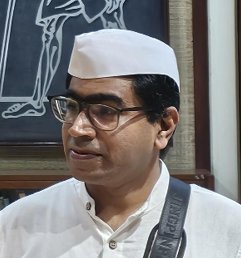 Rohit Viswanath serves as a humble custodian in the lineage of Dr. M.B. Athreya, Dr. Padmaja Suresh, and K.V. Subrahmonyan. He is entrusted with carrying forward the Nāṭyaśāstra Gurukulam's mission of Dhārmic transformation, shaping its spiritual, aesthetic, and institutional vision. Post your comments Pl provide your name along with your comment. All appropriate comments posted with name in the blog will also be featured in the site. |
