
|
    |
|
|
|

 Finding Shiva: A process of rebuilding my own truth- Arnav Ajanae-mail: arnav.ajana16185@dpsiedge.edu.in January 10, 2026 The stone amphitheatre in Old Nessebar keeps the day’s heat like a held note. The sea sits behind the stage as a dark, patient backdrop, and the audience arrives in layers: faces, silhouettes, then the soft static of anticipation. I step into the light with the kind of caution that is really concentration. My feet test the surface, my ribs find the first inhale, and then the body begins its argument with gravity. The turn that follows is not upright. It is angled, airborne for a breath, and it lands slightly before I feel ready. From my experiences representing India in the International Children's Dance and Music Festival and performing with an ensemble in Bulgaria, the medal mattered far less than the question that brought me there: how does a hip hop body learn an Indian vocabulary without turning it into a costume? Taking my learnings from Bulgaria with me after the XXIII International Children’s Festival “Sun, Joy, Beauty” in Nessebar (14–19 June 2025), where we won first prize in the International Folk Dance category, I set out with my choreographer to create a new solo piece called ‘Finding Shiva’.My IB education trained me to value ‘process over product’, to treat the final performance as evidence of thinking, not proof of worth. The IB calls it a cycle of inquiry, action and reflection, and I carried that cycle into every rehearsal for this solo. This piece is my way of finding myself again through discipline, not drama. It is about rebuilding trust with my body, one decision at a time. It is about power that learns precision, then learns honesty. It is also about attention, the kind that stays when things get hard. If you watch closely, you will see effort becoming language. What should you expect as an audience already fluent in Indian forms? Not explanations. Not reverence for technique. Expect friction. The solo moves through Kalari’s heat, Kathakali’s chiselled clarity, and Mayurbhanj Chhau’s attack and elevation, then lets my original training interrupt them. Chhau is not “borrowed” here as a flavour. It has its own lineage, tied to martial practice and regional festival performance, and it demands that the body commit fully. The work was choreographed by Vaishak Raj, and one of the hardest lessons for me was accepting that my job was not to decorate his vision with my strengths. My job was to align my body to his logic. In a short, intense window of training, he taught me fundamentals fast enough that I could stop chasing steps and start chasing clarity. That speed forced a different kind of humility: listening before performing, asking what a movement is doing, not how impressive it looks. Alongside him, Aamrapali Bhandari, brilliant and quietly kind, asked questions that sharpened my choices. She did not “add” choreography. She applied pressure to meaning. Why this rhythm here? Why this stillness now? If the body is lying, the audience will know. Her dramaturgy turned rehearsal into editing, and editing into ethics. I think of our process as an inverted triangle. Mr. Vaishak brought structure and form. Ms. Aamrapali brought narrative consequence. I stood at the bottom point, where structure and consequence had to become a single readable act. If the point is blunt, the work blurs. If it is too sharp, it cuts the audience out. My task was to make it sharp enough to be clear, and warm enough to be human. The costume became its own rehearsal score. I used AI as a generator, feeding it references and constraints until it produced designs that looked exciting on screen but failed the movement test in real life. Then I iterated. I adjusted silhouettes to protect my range of motion. I tested how fabric behaved in turns and landings. I chased a certain “energy” in the costume, and whenever the costume refused to sit right, I changed the build instead of blaming my body. Working with costume designer Anju Dhawan, every small alteration became a negotiation between image and function, and the final look carried the marks of that negotiation. 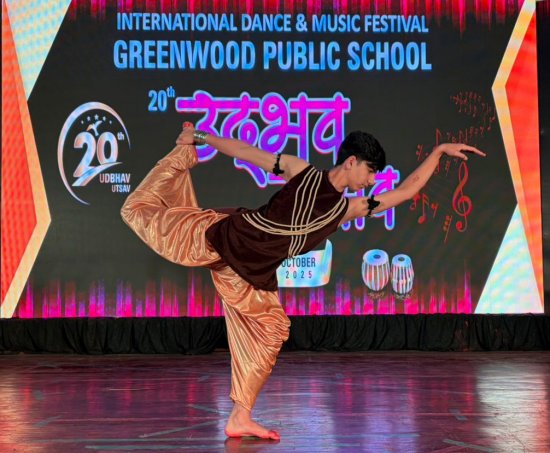 In this solo, Shiva is not a character I perform but a concept I return to when language fails. My family’s close ties to priestly lineage gives me permission to read the icons as lived instruction rather than museum captions. Nataraja’s lifted foot, as I understand it, points toward infinity, toward what has no edge and no end, and that single image becomes a rehearsal note: keep moving, but do not lose the centre. The Damru is the other note. Its beat is not background music, it is nada, the first pulse, the rhythm that makes creation intelligible and makes dissolution bearable; it holds duality in one object, Purusha and Prakriti, birth and death, manifest and unmanifest, and for a dancer it is a reminder that rhythm is not only count, it is cosmology. The trishul completes the triad of meaning: three prongs as time, as the gunas, as creation-preservation-destruction, a weapon only in the shallow reading, but in practice a tool that pierces confusion and cuts through the inner noise that ruins a performance. Ardhanarishvara then makes the entire idea unavoidable, not balance as compromise, but wholeness as inseparability, Shiva and Shakti as one reality, so that force and softness stop being personalities and start being one system. Together these symbols explain what the solo tried to do: rebuild a self that could hold power without hardness, stillness without collapse, and intensity without losing my own truth. A few weeks before this process began, dengue stripped me down to something I did not recognise. I was weak enough that walking felt like choreography. In bed, I practised only the hands, not for aesthetics, but to keep a connection alive. When I could finally move again, hope arrived too early. On my fifth day of walking and running, I started training and collapsed during the Kalari warm up. For a minute, my mind became loud and childish: you cannot do this. Then it went quiet. I sat with it. I breathed. I started again. The technical mountain in this solo was not one step. It was stamina plus accuracy plus fear, all at once. Kalari, Kathakali and Chhau demand energy that is not decorative. They demand heat that stays organised. The palta became my recurring test because it exposes everything: timing, alignment, commitment, and the honesty of the landing. In Mayurbhanj Chhau training, paltas are described as core turning actions, including variations like sidha palta and ada palta, and they require the body to turn with intention rather than spin for spectacle. This is where my “thinking through action” actually became visible. I stopped treating stamina as a personality trait and started treating it as design. I mapped where I was wasting breath. I tracked which moments needed oxygen and which moments needed quiet. Research on breathing interventions in endurance athletes suggests that breath training can affect breathing characteristics and reduce overall breathing work during exercise, delaying fatigue. That is sports science, not dance poetry, but it gave me a framework: breath is not background. Breath is strategy. Breath also became the bridge between forms that felt worlds apart. When my training shifted from “bigger” to “clearer”, breath turned into a metronome inside the ribs. It told me when a jump was truly ready, and when it was panic disguised as an attack. Some days I felt I could dance for twenty four hours if I used breath wisely. That was not bravado. It was a discovery: the body has more endurance than the mind allows, if the mind stops stealing oxygen with unnecessary tension. 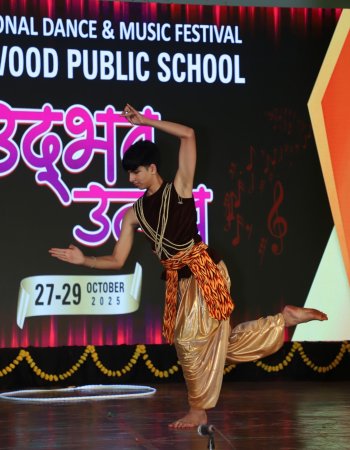 Two days before the performance, I used a ritual my mentor taught me: intense Kapalabhati (a breathing technique used in yoga) to create readiness inside the body, especially under anxiety. I will not pretend I can prove the biochemistry in a studio, but research does show that Kapalabhati can create marked autonomic shifts during practice, including increased sympathetic activity, which matches the sensation of a sharpened, alert body. On the day, while my thoughts ran ahead, my breath stayed underneath them for thirty minutes, steady, repetitive, and strangely calming. When I was in Varna (a city in Bulgaria), watching the Carmen ballet internally I had recalibrated my standards for storytelling. The dancers there spoke without speech, and the clarity of their choices made the stage feel inevitable. It seeded in me a future plan: I want to collaborate professionally with a light designer and a rehearsal director, not for gloss exactly, but to add the rigour it could bring to a future performance. This is my opportunity to bring it into action, if I expand this solo into a thirty minute work, this plan is exactly what I would go through with in order to reach the next level in my career as a dance student. When I performed at the 20th International Dance Festival - Udbhav Utsav in Gwalior (an UNESCO heritage city in India), the result was a first prize in the semi classical solo category giving me a chance now to represent India as a soloist in the International Dance Festivals abroad. I remember the win less as a trophy moment and more as a quiet confirmation that a process, honestly lived, can produce a product worthy of an audience. If there is one principle I will keep as this solo grows, it is this: be honest to your audience. Honesty is not confession. It is like precision. It is letting the viewer feel what is at stake in the body, even when the body is trained to hide effort. In the end, that is what I wanted Gwalior to witness. Not an “achievement”, but a mind at work inside a moving body, rebuilding itself in public. 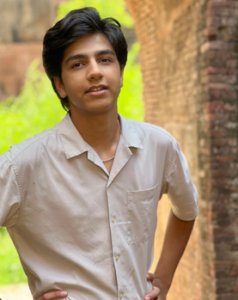 Arnav Ajana is an IB MYP student with a deep interest in the art of performance, particularly dance as a form of expression and storytelling. He is currently a student at DPS International, Gurgaon, where he continues to learn dance as a specialized portfolio based subject deepening his explorations and skills as a performer and experimental choreographer. He has represented India in the XXIII International Children’s Festival “Sun, Joy, Beauty” in Bulgaria, Udbhav Utsav, Gwalior and has created dance on films. As an artiste, he views both the east and the west through a modern Asian lens - rooted in tradition and contemporary in its approach. He is also an actor and has worked in several leading advertisements, which has allowed him to explore performance in front of the camera and understand the discipline, collaboration, and professionalism required in the creative industry. Responses * Very articulate and beautifully expressed. The detailing about the whole thinking process to the costume flow is commendable. Congratulations to you and Vaishak ji. - Rashmi Uppal (Jan 12, 2026) * Arnav, your article so beautifully captures the trials, tribulations and triumphs of your journey as a dancer. We are proud witnesses of your journey and evolution and hope to see many more performances that refine and define you. Great going! - Seema Kaushal (Jan 11, 2026) Post your comments Pl provide your name along with your comment. All appropriate comments posted with name in the blog will also be featured in the site. |
