
|     |
|
| |

Theatre ReviewAll About Natak Fest 2026 - 'Beyond the Proscenium'- Bijoy Shivrame-mail: bijoyshivram@gmail.com Photos: Theatre Media Center April 28, 2026 The fourth edition of All About Natak Fest 2026, presented by Theatre & Media Centre (TMC-BUDRETI Trust), unfolded from March 21 to 29 at the TMC Campus in Ahmedabad as a rare confluence of thought, practice and performance. Conceived under the resonant theme 'Beyond the Proscenium,' the festival extended theatre beyond its conventional spatial and aesthetic boundaries, reimagining it as an expansive, living dialogue between artist, space and society. 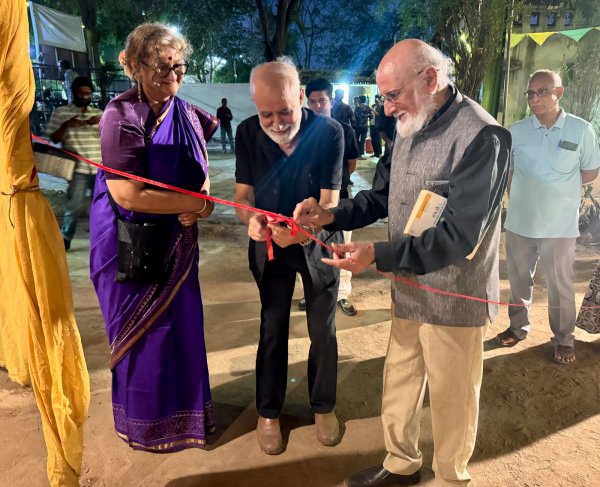 Inauguration by Sitanshu Yashaschandra & MK Raina Inaugurated by Sitanshu Yashaschandra, the festival was dedicated to the cherished memory of. Jyoti Baradi and Hasmukh Baradi, while also paying homage to Rajoo Barot--figures whose artistic legacies continue to inform and inspire contemporary Gujarati theatre. The curatorial vision of M. K. Raina lent the festival intellectual depth and artistic rigour, while Festival Director Manvita Baradi shaped its conceptual and experiential framework with sensitivity and cohesion, crafting a festival that was as reflective as it was performative. 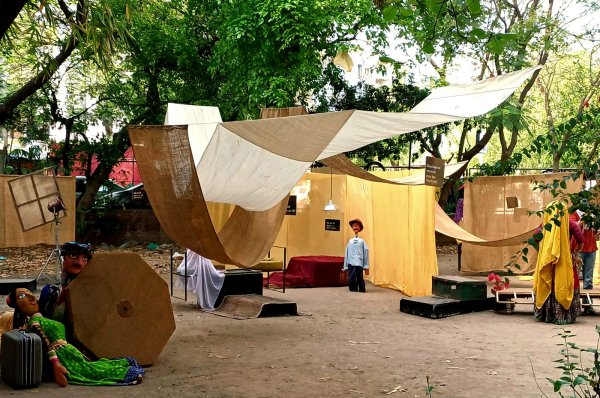 Installation on manifestation of the idea: Beyond the proscenium The TMC campus itself became an immersive scenography. Thoughtfully conceived installations and puppetry interventions transformed the grounds into a site of inquiry, gently unsettling preconceived notions of theatre. These spatial experiences acted as thresholds--preparing the audience for the central exhibition, 'Beyond the Proscenium: The Hasmukh Baradi Theatre Archives.' This meticulously curated archive offered a rare and intimate engagement with the evolution of theatre through manuscripts, models, costumes, photographs, props and audio-visual records--each artefact carrying within it the memory of performance and the echo of lived histories. A defining strength of the festival lay in its pedagogical depth. The masterclasses, led by eminent practitioners, opened sustained and rigorous engagements with the grammar of theatre-making. Govind Singh Yadav's intensive on Theatre Lighting Design revealed light as an expressive and dramaturgical force, shaping mood, rhythm and meaning. This was followed by M. K. Raina's masterclass on Theatre Direction and Playmaking--an immersive journey into text, interpretation and staging, culminating in participants presenting their own renditions of Riders to the Sea. Kriti Sharma's master class explored costume as an intrinsic narrative language, where materiality and imagination converge to shape character and context. 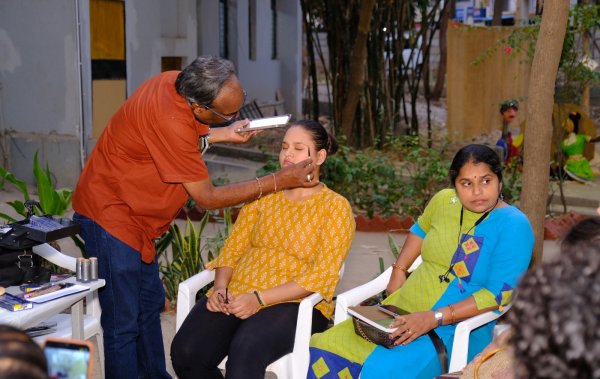 Makeup workshop - Tushar Tapodhan Complementing these were a series of workshops that expanded the actor's and practitioner's sensorial and expressive vocabulary. From Diana Raval's engagement with Chitra Abhinaya to Janak Rawal's instinct-driven Abhinaya Unplugged, the performer's inner and outer landscapes were explored with immediacy and depth. Workshops on makeup by Tusharbhai and Gautambhai Tapodhan, the playful and liberating clowning sessions by Walter Peter and explorations of voice, speech and scenography by Manvita Baradi collectively underscored the festival's commitment to a holistic understanding of performance. Interdisciplinary dialogues--such as Dr. Viraj Amar's introduction to Hindustani classical music and Malini Vishwanath's engagement with Carnatic traditions--reminded participants of theatre's porous and interconnected nature. 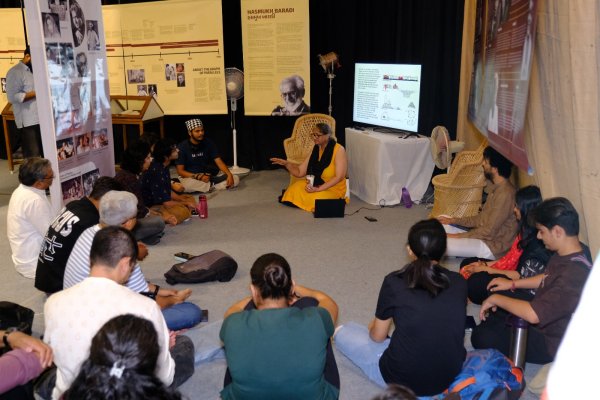 Set design & theatre architecture workshop by Manvita Baradi The performance programme reflected a thoughtful curation of tradition, experimentation and contemporary relevance. 'Eklun Aakash', written by Hasmukh Baradi and directed by M. K. Raina, emerged as a quiet yet powerful center piece--its repeated stagings becoming an act of homage as much as performance. Folk idioms found vibrant expression in Bhavai Vesha, while 'Raat, Vaat ane Nirant' foregrounded the enduring potency of vachikam, where the spoken word itself becomes theatre. Narratives rooted in history and identity found compelling articulation through Allaabeli by Gunvantray Acharya, revisiting the courage and resilience of the Vagher community. Contemporary works such as Chir Agni and Aurat engaged with pressing social realities with clarity and force, while Vyuham by Shivangee Vikram, offered a layered re-reading of the Ramayana through Kaikeyi's perspective--unsettling familiar moral binaries and inviting introspection. 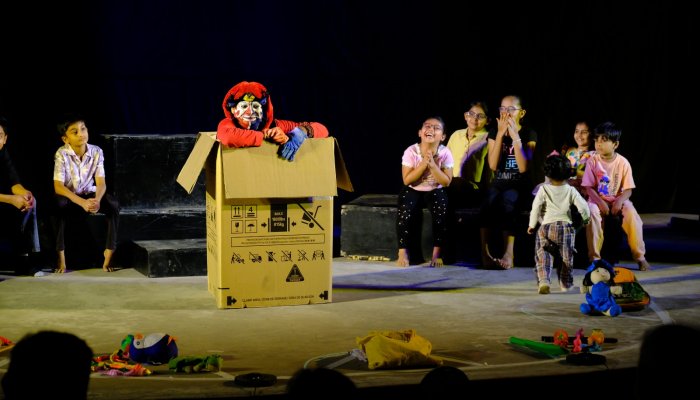 'Laa po laa' by Walter Peter Music and storytelling flowed seamlessly into the festival's dramaturgy. 'Rangbhumina Sadabahar Geeto' stood as a poignant tribute to Rajoo Barot, reviving the emotional resonance of Gujarati theatre songs. 'Ananta', a Carnatic vocal concert by Malini Vishwanath, brought a meditative sonic depth, while the closing evening offered a beautifully layered culmination--from 'Laa Po Laa', Walter Peter's tender, wordless celebration of play, to 'Dastan Shah-E-Sabarmati', a compelling Dastangoi that reanimated the city's founding narratives through the evocative power of oral storytelling. 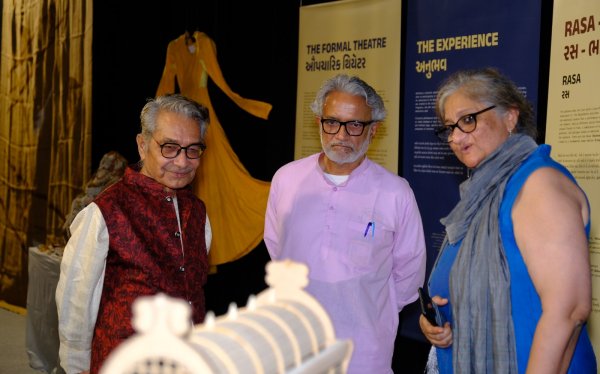 Playwright Madhu Rye & novelist Keshubhai Desai Marked significantly by World Theatre Day and graced by luminaries such as Sitanshu Yashaschandra, Paresh Naik, Janaki Vasant, Bhagyesh Jha retired IAS, Nisarg Trivedi, Harish Vyas, Dr. Mahesh Champaklal, Madhu Rye, Kapildev Shukla and Dr. Kuldip Arya. The festival situated itself within a larger cultural and philosophical discourse--one that recognises theatre not merely as performance, but as a vital, responsive and enduring human impulse. Ultimately, All About Natak Fest 2026 transcended the idea of a festival as a sequence of events. It became a space of encounter--between tradition and contemporaneity, discipline and play, memory and imagination. It reaffirmed that theatre does not reside solely within the proscenium; it lives in the spaces we inhabit, the questions we ask and the stories we continue to tell. Organised by Theatre & Media Centre (TMC-BUDRETI Trust) with the support of Gujarat Sangeet Natak Akademi and Urban Management Centre, the festival stands as a significant and evolving cultural landmark--one that continues to expand the possibilities of what theatre can be and where it may be found. 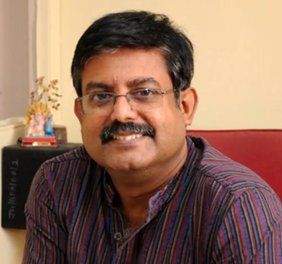 Son of journalists K Shivram and Amni Shivram, the first Malayali woman English journalist, Bijoy Shivram is an accomplished Indian classical dancer trained in Bharatanatyam and Kuchipudi. A passionate promoter of the arts and a skilled graphic designer, he currently serves as the Vice Principal of JG College of Performing Arts and the Assistant Director (Operations) overseeing 17 JG colleges. He is also the founder of Preksha, an organization dedicated to the promotion of art and culture in Ahmedabad. Since 2020, Bijoy has curated the YouTube series 'Gurudakshina - An Ode to our Gurus,' celebrating the legacy of mentorship and tradition. |
