 |
       |
|
|
 Enchantment: A bio play on Pt Ravi Shankar- Chitra Maheshe-mail: chithoo@gmail.com Photos: Pushpa Visuals September 19, 2025 It would be too presumptuous to try and encapsulate something as humongous as Pandit Ravi Shankar's life into words that please or even try to explain the entirety of the artist made up of all parts of the man - someone who had his glorious moments as well as those that made him all too human. After all, is it not what happens to everyone? Part human and part divine so the work can be done? Enchantment, Gowri Ramnarayan's bio play on Pandit Ravi Shankar, was staged at the Museum Theatre, Chennai, on September 12 under the auspices of REACH, a prime organization working to eradicate TB and to bring awareness of it through the medium of art! And what art it was! As a playwright, singer, choreographer, a keen observer of history, and a sensitive, rather brilliant writer, Gowri brought to the stage the man who strode many worlds to leave behind a legacy hard to fulfill. His art always preceded his personal life, but it was also something that was so much a part of him that his music became a poignant cry addressed to the Divine. It is also not easy to write a script of this nature, about a great musician and composer par excellence. Not everyone may agree that in this 9 decades journey, the balance see-saws between the torturous and the exquisite. But Gowri did. Here is a point where one has to forget the little things that did not make it perfect - there were moments when the action seemed to slow down, the enactment showed the effort that went into it, and maybe there was not enough of the maestro's music. But the play has to be seen in its entirety for the viewer to understand just how well she pulled out nuggets to showcase the man, his vulnerabilities, foibles, and his supreme command over the sitar. 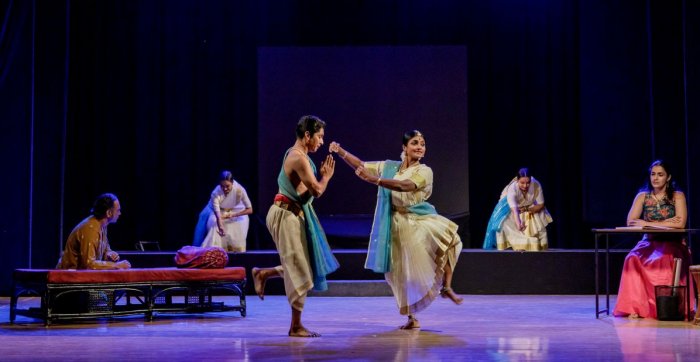 In the one hour 30 minutes, there were small interludes of exquisite dancing (Renjith and Vijna), and a soundtrack weaving a pale thread of nostalgia with a lost era humming along. Like a game of hide and seek where you can say 'here it is' and then 'there it is not'. Suffice to say the bio play began with a young maestro, whose formative years included music, dance and world travels. Having an elder brother like Uday Shankar so known for his dance and his showmanship, gave Ravi Shankar a true understanding of the international stage. 'All the world is a stage' showed him exotic places - Europe - Paris primarily, America and more. The performances he participated in were somewhat life changing. That phase ended when the sitar beckoned him and he left his 'marvellous days' to come under the tutelage of Ustad Allauddin Khan in Maihar, a tough taskmaster who eventually got him married to his daughter. Years of pressure turn coal into diamonds and the more you beat gold, the more beautiful is the ornament admired by all. This honing made Ravi Shankar the world renowned artiste that he was and that continues through the music he has left behind. 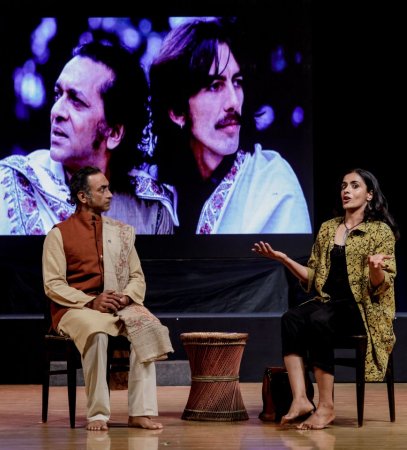
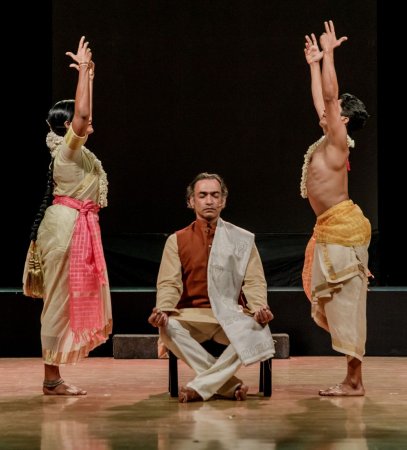
The narrative moved insidiously and smoothly - and before long you realised you were in his life as realistically as possible. The compositions came and went like a long lost lover, reimagined and sung marvellously by Bombay Jayshree, and by Aditya Prakash, Vignesh Ishwar and Chaitrra Sairam. Honestly, I have not very often heard so much charm in the rendition that wove a strand of melancholy around me as I watched the enactment on the stage. I would have loved to hear more soundtracks of the maestro, but that is for the next time. With such a famous presence on the scene, can films be far behind? I pretty much grew up listening to his composition from the film 'Anuradha' - Hai re woh din kyun na aaye and Kaise din beete, kaisi beeti ratiyan! 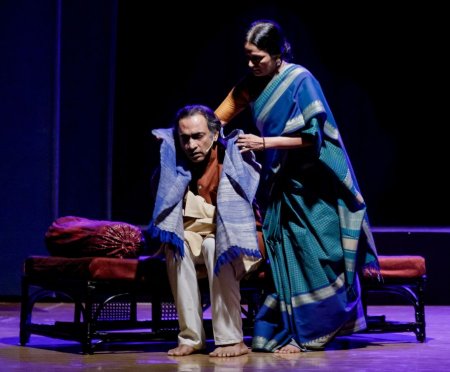 The personal relationships - with his first wife Annapurna Devi and long term partner Kamala (played with utter restraint by Vidhya Subramanian), were taken up without any queasiness or diffidence. Aarabi Veeraraghavan was like that bright star that flickers in the night sky. She was beautifully respectful, mildly playful and lovely enough to keep us rivetted as the journalist, the sutradhar, and as Sukanya. For me, Yohan Chacko (as the sitar maestro) began looking more and more like the master with every passing scene. Costumes were adequate and unobtrusive props were merely aids to the spoken word, the music and the dance. Sneha Sheejith's sensitive use of the lights was something I noticed with great delight. It added to the mood of the play. The last scene tugged at the heart stings - for no greatness comes easily and without angst. And this is what stood out for me in the way the play was structured and written. I also realised that unless we acknowledge the darkness within, no light can come through to the inner being. The questions lingered. What do we do when we get into a self-introspective mood at the end of it all? Did we recognise the blueprint kept in place for us in our life? Or were we just kicked into our life's mission at random? Anyway, did we make the right choices? Did we honour the sacred within us? If we had the chance to live our life again, would we have done things differently?  Chitra Mahesh is a senior journalist based in Chennai. |
