TAALAM
BY LEELA VENKATARAMAN e-mail: leelakaverivenkat@gmail.com
Story telling through dance
November 25, 2026
YARN FESTIVAL
Conceived by Pratyush Puru Dadheech and presented by Natwari Kathak
Nritya Academy, at Stein auditorium, Delhi on October 29th, dancer
Harshita Sharma Dadheech, who has been declared 'as the torch bearer of
the Dadheech tradition' as the daughter-in-law of the house, was the
opening performer for an evening of Kathak based on story telling
through dance. The theme she selected was spun round the Pancha Kanyas
of Hindu scriptures - namely Ahalya, Draupadi, Kunti, Tara and Mandodari
- each of these highly placed, independent minded heroines having to go
through life facing unusual situations. Their life stories are too well
known for detailing and in this writeup, the concern is with how their
histories were dealt with in the dance. The Puru Dadheech gharana has
been defined as a blend of the Jaipur and Lucknow school elements. In
the performance, the accompaniments with percussion support on tabla by
Arun Bhatt, music composed and sung by Vaibhav Mankad, padhant by
Damyanti Miradwal, a student of Vibha Dhadheech and sitar support
provided by Alka Gujjar, the dancer was well supported.
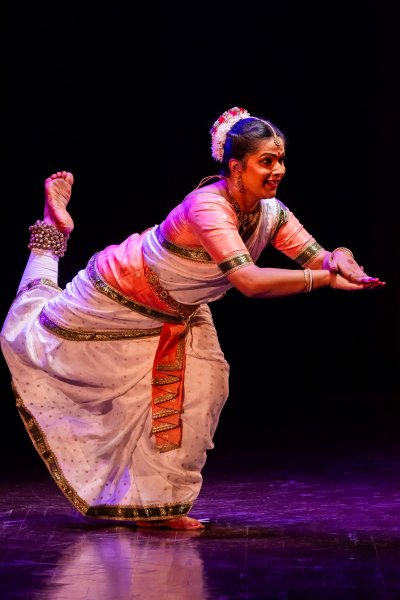
Harshita Sharma Dadheech (Photo: Innee Singh)
After a melodious start with the Gajananam bhoota ganadhi sevitam... prayer
to Ganesh, the performance saw a neat saree clad dancer, with
expressional felicity (very central to dramatic histories woven through
the dance), present in brief the history surrounding these heroines.
Given her mobile face for emoting, the highs and lows of what these
women went through saw a variety of situations - emotions of
Ahalya - Hoja pathar ki - where a moment's temptation in a generally
barren marriage resulted in the curse of being turned into an immobile
rock like state, till rescued by the divine feet of Rama; Panchali's
fate in being made to serve five husbands for no fault of her own;
Kunti's agony and tears in private, flowing from her own deeds; Tara,
lawful wife of Sugreeva but pining for Vali and weeping at his death;
Mandodhari the Buddhimati, lavanyavati, forced to undergo the suffering
of her husband's lust for another married woman, even when she knew
Ravana was on the wrong path - were all brought out with clarity. But in
the very straight forward narrative treatment, there was no trace of
the rich layakari of either Jaipur or Lucknow Kathak, and the 'chakkar'
virtuosity, except for a few tukras at the end of each episode, was
totally absent. Since I have never seen this dancer before, one does not
know that if the total absence of improvisational frills of
nritta, so central to Kathak, was deliberately resorted to in a 'story
telling' narrative. As it was, the dancer had occupied a good deal of
the time and by the time the next dancer was presented, a bare skeletal
audience remained in the auditorium - sad for they missed one of the
really enterprising performances.
I must commend the Dadheech family for selecting a Bharatanatyam dancer
like Arupa Lahiry, whose presentation of Prantath was proof of how a
creative mind can conceive of a dance work, out of the most unlikely
subjects. Here the subject matter was provided by stories and motifs of
ancient maritime trade routes linking Gujarat and Maharashtra with Rome,
Persia and the Middle East!
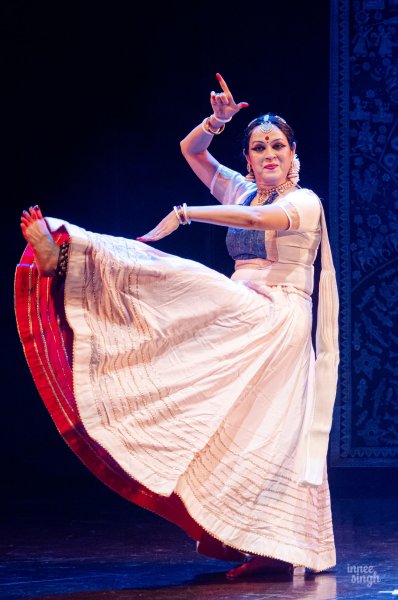
Arupa Lahiry (Photo: Innee Singh)
The story begins with a remarkable and rather fearsome bronze statue,
about 14.3 cm high, excavated at Kolhapur's Brahmapuri, dated first
century CE, bearing witness to the well- established Indo-Roman cultural
exchange through maritime trade. In this regard, Yogesh Gadhvi, former
chairman Gujarat Sangeet Natak Akademi wrote a kavit on Charni Devi
Vahanavati with her Seven Sisters or Sikotri who protects sailors
battling the wild winds of the sea during thunder and storm. As for the
rhythm of the Seas, Prantath expresses this through a the Kavit and a
Jatiswaram! Exotic Indian goods showing dancing peacocks, marble
Patiana, ferocious tigers, sensuous snakes, silk, shell artifacts, glass
bead jewellery, pottery are sent through the sea routes and in return,
as Roman writers Periplus of the Erythraean Sea describes, India earned
gold and silver.
This prosperity that India earned through these exports, is shown
through a Kriti to Goddess Lakshmi, "Hiranmaye Lakshmi sadaa bhajami,"
with reference to Pompei Lakshmi, an ivory statue 24-25 cm tall,
believed to have been made in India, housed today in the archeological
museum in Naples, the image discovered in 1938 in the ruins of Pompei,
the Roman city destroyed through a massive earthquake when Mount
Vesuvius erupted in 79CE. And historians believe that Indo-Roman trade
was at its peak during the Satavahana dynasty's rule in India. The
word Pompei Lakshmi, has given place to a researcher's view that the
statue could refer to a tree spirit - a Yakshi. But whatever the figure,
the Indo-Roman connections remain unimpaired, by either finding.
The feel of the sea is best captured through songs, special to a
seafaring people. But the ocean is an unpredictable entity. It may yield
a lot of things, but it also demands a great deal of sweat. And the
work ends with a prayer like that of the great sailor Dayan Khandavi,
located in the Gulf of Kutch considered central to India's maritime
trade. The task of preparing the dye of Ajrakh (Indigo - a
prevailing practice amongst the Khatri community of Gujarat) is referred
to, in a song where Ajrakh means Azrak (and the poetry in the song
mentions indigo sky, white stars gleaming, "Washed ten days, dipped four
times, its steadfast hues are loyal like the mariner!") The finale, on a
poetic note is with a Bengali Lalan Fakir song from the Baul tradition,
wherein the poet refers to life itself being like an ocean, with God as
the boatman, who holds us steadfast.
For a production of this nature, one needs, aside from rootedness in the
dance form one specializes in, a mind open to all types of information -
which in the end can yield mental images - inspiring greater ideas for
creativity. One has to acknowledge Arupa's Guru Chitra Visweswaran's
contribution too for inculcating in her such an inclusive mindset.
While the idea originated in the mind of Arupa, without the linking
Dastango narrations by Zahid Hossain, in a language combined with
emotion, heightening the dramatic impact of the story telling, the
programme would have had less of an impact. And full marks for the music
composition by Sudha Raghuraman! One needs to be an innovative
imaginative composer to think of music for themes as paradoxical as
trade between countries!
Arupa Lahiry's research was assisted by Nelon Menezes, with the
dancer's ideation and choreography, with orchestral support having
Venkateshwaran Kuppuswamy providing the singing, with nattuvangam by
Varun Rajashekharan, Mmridangam percussion by Vignesh Jayaraman, violin
played by Raghavendra Prasad, Dastango Zahid Hussein, vocals and other
special instruments Sukrit Sen, Art design and execution by Hardika
Dalal and Shivangi Krishna and Milind Srivastava providing light design,
all aspects governed by established artistes.
MUSIC AND DANCE SERENADING THE CAUSE OF IMPERILLED PRITHVI
This is the moment, more than ever before, that imperiled Prithvi, is
reminding us of how Nature and Man are interconnected in this world -
and that the prosperity of one cannot be at the expense of the other.
Very topical that the IIC festival for this year should have chosen
Prakriti: Ecology and Existence as its theme. The
interconnectedness between Man and the Universe, has perhaps its highest
expressions in Hindu cosmology, where evolution itself has the Dancing
Shiva as metaphor. The unity and interrelation of all phenomena point to
a relationship between Nature and Man - reflected in our theology where
rivers, mountains and animals are all deified. Poetry, art expressions
of painting and dancing and even music, as conceived, reflect the close
bond between Man and Nature. The harmony between the two is what defines
Prakriti.
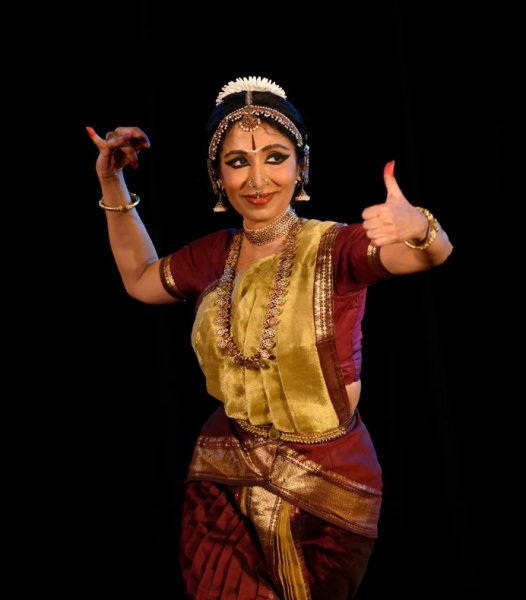
Alarmel Valli
With rain playing spoilsport, Bharatanatyam star Alarmel Valli's
recital, as the inaugural event for the dance part of the festival, had
to be shifted from the original venue of the outdoor stage near the
Fountain Lawns, to the Indoor Deshmukh auditorium. While the entire
audience was difficult to accommodate within this closed space
(arrangements were made for viewing by people sitting outside), Valli's
recital Scent of the Earth, for this critic, was a pointer to her
indomitable spirit, which neither in the face of loss of a loved one,
nor amidst challenges of unexpected health impediments, has been
crushed. Nor has the dancer lost her innate feel for poetry - which has
always been a feature of this dancer's creativity. Her method of
braiding Bharatanatyam with poetic ideas from sources outside the time
old repertoire, gives Valli's Bharatanatyam a texture which is
different. This sensitivity to poetic expression, expresses itself right
from her own introductions to her items - the eloquence of language and
emotion, earning her audience approbation even before she begins
expressing herself through the dance! This is a different Valli though
over time. Instead of the immaculate anga shudha and prolonged
teermanams, one sees an emphasis on rasa emerging from an emotive
response to a collective of verse set to raga music - again an aspect
Valli is particularly responsive to, as a longtime student of late T.K.
Muktamma.
The dancer began with mention of verses of Kalidasa whose poetry shows
varied phenomena in Nature connected with ecological disruptions,
emphasizing the close connection between Nature and man. Verses depict
behavioral shifts noticed in animals in Nature, as a kind of warning in
response to certain situations - like the peacock which abandons its
dancing, pariyakta nartana mayura. In Abhijnana Shakuntalam,
Ritusamhara, Meghadootam, you see verses showing non typical behaviour
among animals in Nature, pointing to this closeness of how these
creatures react to situations and environmental changes. Valli 's
closeness to Tamil Sangam poetry like the Arunaanooru finds Nature
painted as a wonderful backdrop for man's activities. Neelakkanna (The
blue eyed one) is about the pining young maiden, who, in her absence of
the chieftain her heart is lost to, makes a contrasting picture of
unrequited love - even as Nature is full of scenes of gaiety, with
lilies in full bloom and girls dancing and playing by the stream and not
even the dancing peacock can distract the pining young woman in her
forlorn condition. And this poetry armed with the music scored by Prema
Ramamurthy, gives Valli the full emotive background for expressing the
young maiden's forlorn condition.
Next Valli danced to the work of a modern Telugu poet Jandhyala Papayya
Sastry - Pushpa Vilapam. The poem is a lament on the unfeeling nature of
humans, who pluck flowers to adorn their homes and their hair, and to
offer to the Gods. Do they realize how much pain they cause to the
plant? If Nature had a voice, it would lament to express its distress
but alas in its silence, it is abused. Then came another poem on how
flowers are crushed and ill treated for 'attar' which people smear all
over themselves. Again, this shows insensitivity to Nature, which gives
man so much. The recital ended with the lines Natakonro Katakonro.... wherein one concludes with the verse showing how between Man and Nature,
the welfare of one depends on the wisdom of the other. Whether wild
forest or low lying valley or a high mountain- wherever the people are
virtuous, you (Nature) too are at your best! Ultimately, it is
man's treatment of Nature which will determine preservation of Prithvi.
Valli's experienced team of accompanists had P.K. Vasudevan providing
nattuvangam support, Vasudha Ravi as vocalist, Shaktivel Muruganandan on
the mridangam, KC Nanda on violin and Sruti Sagar on flute.
PARVATHY BAUL
That everything in the macrocosm of the Prithvi, exists in man as the
microcosm and that the welfare of one is inextricably tied to the
welfare of the other, is the belief underlying the spiritual mysticism
of Baul philosophy. And representing this group of wandering minstrels,
as one of its most prolific and sought after female proponents today,
travelling to various parts of the world, is Parvathy Baul, who with
matted hair brushing the floor as she moves about the stage, strumming
the Ektara strung to one side of her, while simultaneously playing on
the Duggi kettle drum on the other side, started her appearance in the
IIC Festival, with the prayer to the Guru. Baul philosophy, very
heterodox, in its mix of Gaudiya Vaishnavism, Sufi Islam, Tantric
Buddhism, with no belief in rituals of any type, believes that the body
is the temple housing divinity - one prays to become one with that
divine principle.
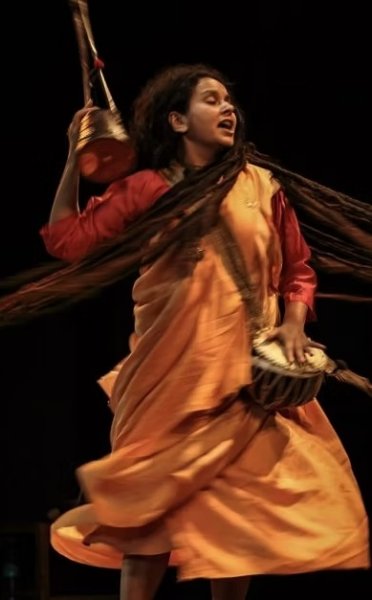
Parvathy Baul
Addressing the Goddess Kali, Tara.., the performer as devotee asked many
questions - Ma amar chinta korucchu (Mother, do you think of our
welfare?). Ma, she said, took many forms, and was the creator of
everything. For the Yogi, she stated, simple things become miracles.
From songs with the high philosophy with references to purity,
formlessness (Sudhham, Nirakaram, Chitaanandaroopam) etc, it was most
entertaining to listen to the Agomoni song Hyma Kemone... addressed to
Parvathy about her quirky feelings of desire for one like Shiva. What
kind of a bridegroom would he make for the beautiful Parvathy, the
Digambar, surrounded by his pretas (goblins), riding a bull, dancing in
the Smashaan. However for Parvathy, Shiva represents her heart's
longing. The Bengali song goes, "Amar mone ashe aibar shono..." (Listen it
comes to mind). In Bengal, Shakta poets have referred to Shiva in
Shakta philosophy as the unmanifested consciousness which can be made to
act or be energised only by Shakti, the dynamic kinetic animating
principle. Menaka does not know that her daughter is Maha Maya - She is
the Kali form dancing (Nache eva Dulali) and Shiva is Maha Kaal. There
is a lot of humour evoked by the marriage of Parvathy to Shiva. Along
with the consternation of what kind of a bridegroom Shiva would make,
Menaka, Parvathy's mother takes consolation in the fact that Shiva will
be the 'ghar Jamai' (living in the wife's home and family) which will
enable her to keep daughter Parvathy beside her always! It is amazing
how the Gods are imagined in daily life situations like the humans!
Hinduism has this kind of Ninda Stuti, as a bhakta's way of showing
one's love for the Almighty, addressing the Lord in a tone of mockery,
making fun of him! This song by Parvathy Baul has a perfect substitute
in the Padam "Ettanai sonnalum", very well known to dancers of
Bharatanatyam, wherein Parvathy's mother Menaka, using the very same
images, wonders why despite all the derision in the family, her daughter
persists in her crazy love for one she believes is this oddity called
Shiva!
RAMAKIEN: SIGNIFYING INDIAN/THAI CULTURAL ECOLOGICAL HERITAGE
Cultural associations between the emerging Northeast Eco Forum working
to sustain inclusive and sustainable development in Northeast India
(ENEEF) like Thai-Bharat Cultural Lodge, with the ultimate objective of
respect for cultural/ecological heritages, presented Natya
Bharata:Ramakien, a group dance projection of Thai Dance and
Bharatanatyam, through scenes from the Thai Ramayana. Influenced by
Valmiki's Ramayana sometime during the trade between India and Thailand
round the 13th century, the Thai Ramakien, while based on the
righteousness of prince Rama (Rama being the title the Kings of Thailand
carry), is a reshaped version despite its main characters of Phra Ram,
Nang Sida (Sita), Thotsakan (Ravana) and Hanuman, reflecting Thai values
of art and Theravada Buddhism. Details of the Thai Ramayana, like Sita
being born to Ravana and of Hanuman as a warlike, frolicking,
flirtatious character and the ending of the epic are different from the
Indian Ramayana. The modern contact started with Tagore's visit in 1927,
to approach the Thai Royalty for a Chair of Buddhism in his
Vishwabharati University, and in 1932 the Thai Bharat Cultural Lodge
Association was formed.
Starting with the Gods and Goddesses dancing the celestial dance of joy
and blessings, (the restrained artistry with the delightful hand mudras
with fingers of a Pataka mudra going right back was a joy to watch).
After a scene wherein the mighty King of Lanka appears before Sida, came
the Bharatanatyam by a Thai dancer trained at the Kalakshetra
presenting 'Nee uraipai Hanumane' in ragamalika, an Arunachala Kavirayar
composition, from Rama Natakam. Rama asking Hanuman to set off as his
messenger to Sita, tells him to mention some facts of how he killed
demoness Thataki, of asking Sita to join him for a walk in the forest
and her agreeing with a smile, and of how their troubles started with
Sita's insistence that he go after the golden deer. These incidents were
to establish Hanuman's veracity, as one sent by Rama. As an item of
Bharatanatyam, and celebration of cultural harmony, it was well done.
The delightful masks and Thai-made crowns and the instruments in the
music like the Pi Nai, xylophone, gongs playing core melodic line,
wooden clappers, all made for a very different sound of music.
Very different from Indian music on the other hand exploring the
relationship between Prakriti and sensory perception through the
emotional world of Raga music, not to speak of our compositions which
are so influenced by the moods of Nature.
DEVI DURGA KATHAK SANSTHAN IN FULL PLAY AT AAVARTAN
Photos: One Frame Story
Neither of the brothers Devi Lal and Durga Lal lived long - and yet the
richness of Kathak they, singly and together left behind, is beginning
to establish itself as a delightful school of Jaipur Gharana Kathak, led
by Devi Lal's wife Geetanjali Lal and son Abhimanyu Lal. Geetanajali
with her classical music background, even before entering the field of
Kathak, shows how a knowledge of the classical music which provides the
melodic background for a classical dance form, provides that extra
dimension to a teacher/dancer - and this was a quality that both the
Devi/Durga brothers had - Durga Lal, with the most melodious vocal
chords being a fine singer apart from his dance wizardry.
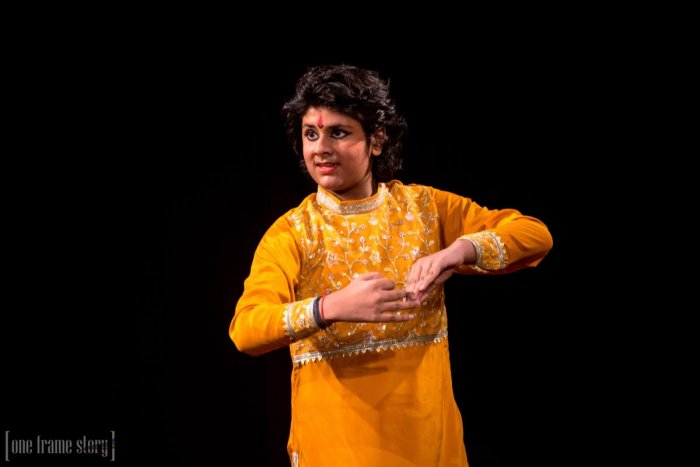
Siddhant Kinchi
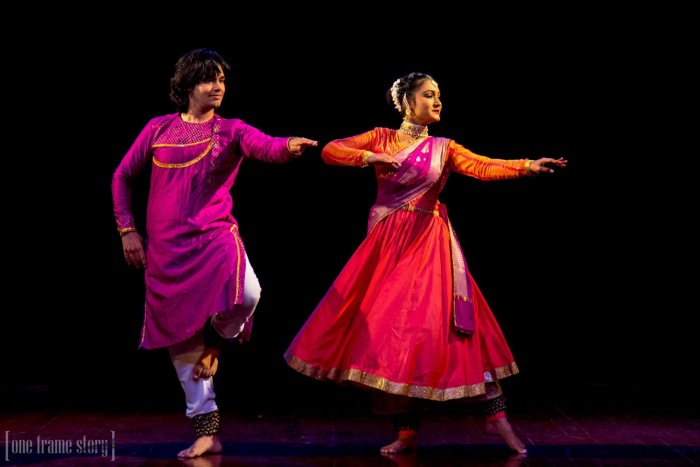
Akshar Tekchandani & Gaurvani Katoch
The evening of November 12 at Triveni Kala Sangam, Delhi, began with
young Siddhant Kinchi's solo. This son and student of Amit Khinchi, has
learnt Kathak under Guru Rajendra Gangani and ever since he began
performing, has attracted the attention of several Kathak lovers.
Starting with Krishnacharitam set to raga Shuddha Sarang, with a Kavit
composed by his father Amit Kinchi, Krishna Chandraleela Karat Govardhan
Giridhari, the dancer went on to nritta in teental. This
youngster with a fine stage presence and good 'ang' also exhibits a fine
feel for rhythm, thereby showing all round prowess for a successful
career in Kathak. But what this critic found extremely distracting was
the haircut with the fringe - almost covering his eyes completely!
Fashion is fine but has to be tempered to the needs of the dance and
cannot be at the cost of full visibility of the dancer's eyes, which
play such a prominent part in the art form.
The duet featured Gaurvani Katoch and Akshar Tekchandani, both senior
disciples of Abhimanyu Lal, with Akshar learning from senior teacher
Geetanjali Lal also. The pair presented a Tarana in
Chandrakauns, a composition composed and choreographed by Geetanjali.
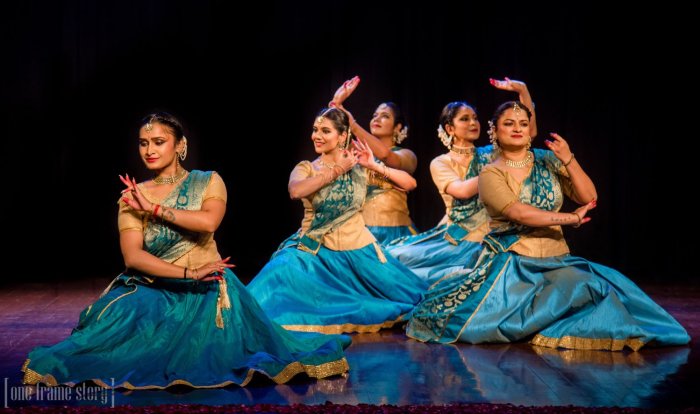
Disciples of Geetanjali Lal
The next was a group presentation by Geetanjali's students Manjari
Sharma, Arushi Lal, Harshita Sharma, Anamika Mondal and Himani Arya, who
danced to a traditional Hindustani classical composition, Jhanana
Jhanana in raga Chhayanat, set to teental, and true to the words of the
song, the dance, as composed by Geetanjali, evoked the music of the
ankle bells. Turned out in delightful seagreen / blue lehengas with yellow
tops, the item showed the artistic bent of mind in the way it was
conceived. The idea of young maidens getting ready to meet the beloved,
the air of expectancy, were beautifully caught in just the way the
rhythm of the ankle bells sounded.
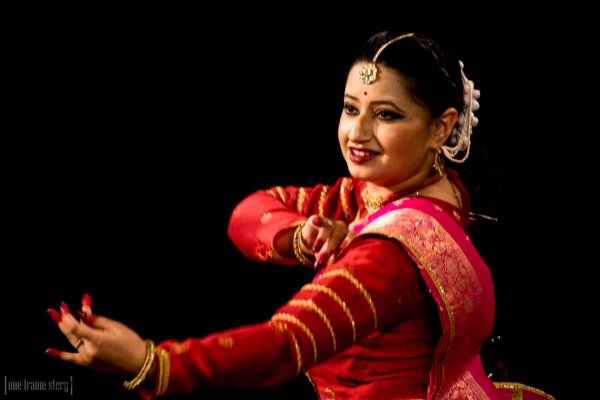
Varsha Lal
The Triveni stage was next taken by an established senior dancer of
Kathak- Varsha Lal, with an A grade awarded by Doordarshan, trained
under Abhimanyu Lal. Varsha is now employed as a Kathak teacher at the
Shri Ram Bharatiya Kala Kendra. Confidence and mastery over laya in the
varying accenting, and improvisations spun round the lehra in Gaud
Sarang, as also the freezes in different poses, and in the abhinaya
built round the proshita patika whose husband has gone overseas, when
she asks that her message Palan lagi mori akhiyan piyo, be conveyed to
him. And here I must commend the singer Sankumeya Debnath, whose dulcet
voice added a great deal of emotive musical value to the dance
performance, a factor which in Kathak one finds not getting the
attention it deserves. Yogendra Gangani on tabla, Mahavir Gangani on
pakhawaj, Nasir Khan on sarangi, and last but certainly not least,
Abhimanyu Lal with the excellent clarity of his padhant at the highest
of speeds, spoke of quality accompanists.
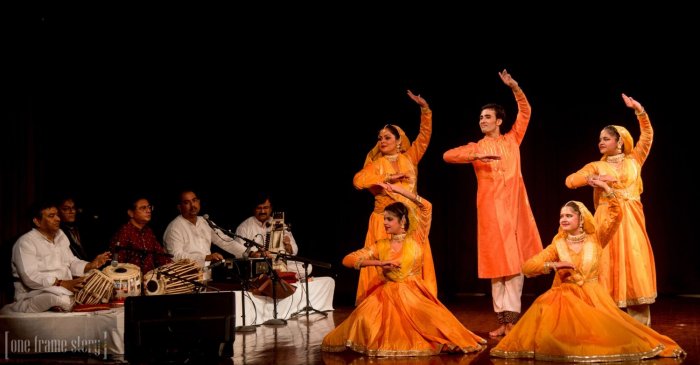
Disciples of Abhimanyu Lal
The concluding presentation was a group item for which the choreography
was by Abhimanyu Lal. Deepal Jiswal, Asavari Singh, Reva Sreevastav,
Kashish Bhatt, Maitri Bhatt presented a Tarana in raga Durbari, set to
teen taal. Altogether a fine effort which Devi Durga Kathak Sansthan can
be proud of.
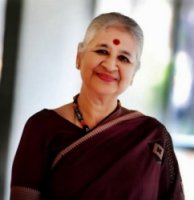
Writing on the dance scene for the last forty years, Leela
Venkataraman's incisive comments on performances of all
dance forms, participation in dance discussions both in
India and abroad, and as a regular contributor to Hindu
Friday Review, journals like Sruti and Nartanam, makes her
voice respected for its balanced critiquing. She is the
author of several books like Indian Classical dance:
Tradition in Transition, Classical Dance in India and Indian Classical dance: The Renaissance and Beyond.
Post your comments
Please provide your name along with your comment. All appropriate comments posted with
name in the blog will also be featured in the
site.
|