TAALAM
BY LEELA VENKATARAMAN e-mail: leelakaverivenkat@gmail.com
Captivating folk and classical dance expressions of 'Call of the Beloved' in KNMA's dance festival
Photos: Whistleman Films
© Kiran Nadar Museum of Art (KNMA)
November 10, 2026
Even after he had burnt Kamadev to ashes with the fiery power of his
third eye, Shiva, unable to totally eradicate desire, is compelled to
revive his victim as the formless one - and Kama continues to incite
passion and intoxication through his unseen presence in the sweetness of
wine or on a moonlit night when the air of bountiful Spring beckons to
lovers. At the Sunder Nursery, the four day KNMA festival of dance (Oct
15 to 18), aimed at fostering a deeper connection between arts and the
community at large, wove the event round the theme of the 'Call of the
Beloved' as conceived by festival curator dancer Leela Samson. In the
expanse of the open air amphitheatre, the brilliantly illuminated stage
setting bordering the rear, had a Picasso like abstract geometrical
mosaic of a multi-layered, dynamic assemblage of oblong shaped wooden
cutouts, arranged at varied fragmented angles, which, looking very
modern, made one wonder if dance forms of traditional genres classical
and folk, even in their contemporary manifestations, would clash with
the theme of the layout, particularly in such a large performance space.
But senior finished dancers, aided by lighting expertise, managed to
keep the focus on the performance. The disadvantage came when, away from
the center, notwithstanding the galleried seating, one was relegated to
a side seat in the amphitheater with its semi-circular seating
arrangement. With dancers focusing on interpretative numbers where
abhinaya demanded a frontal view, some in the large audience, unable to
find a vantage point, left in disappointment.
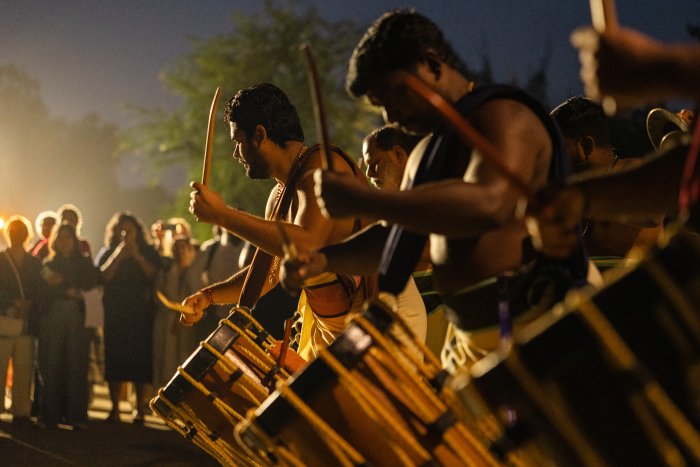
Delhi Panchavadyam Trust
After a welcome by Aditi Jaitley, Associate Director, KNMA Performing
Arts Team, the first evening started with the heralding notes of Chenda
Melam by the Delhi Panchavadyam Trust. Focusing on senior
established dancers on the opening day, Ananga Ranga was the curtain
raiser for the dance projection featuring veteran Swapnasundari
presenting Hamsa Sandesham (The Message of the Swan), a unique Sanskrit
work by Sri Vedanta Desika, the venerated religious philosopher of 13th
CE and disciple of Sri Ramanujacharya, the avid proponent of
Vaishnavism, as represented in Sri Pancha Ratna Agama Sastra. Herein
dignified Rama, given his princely and stately composure, is portrayed
atypically - totally in the grip of passion and desire for his wife
Sita, visualized here as a woman in all her physical attraction. Sending
the swan as messenger to Sita held in captivity in Lanka, Rama wants
his ache and suffering to be conveyed to his wife.
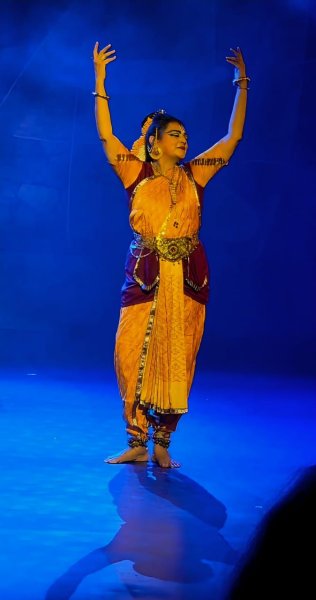
Swapnasundari
(Photo courtesy: Swapnasundari)
Swapna's stage adaptation of Hamsa Kavya, with choreography in Vilasini
Natyam and Agama Bharatam, the two body languages flowing from her
intense research, first into the dance of the Andhra Devadasi and then
her findings drawn from ancient texts on the temple tradition of dance
in temples, is set to her own (taped) musical score, with vocal music
rendered by her and Venkateshwaran Kuppuswamy, V. Sreedhar Acharya on
percussions, R Shreedhar on violin and Siddharth Dalbehera on the flute.
Rama here is seen as a mere mortal, intoxicated by his inconsolable
state of inflamed desire, the mind in his pining filled with frankly
carnal images of Sita - with her fish-shaped eyes, and her body bent by
the weight of her bosom. Sita also pines in Ashokavan. Bereft of the
choodamani, and plunged in the darkness of despair, her mind recaptures
the innumerable pleasures of love she enjoyed with her beloved.
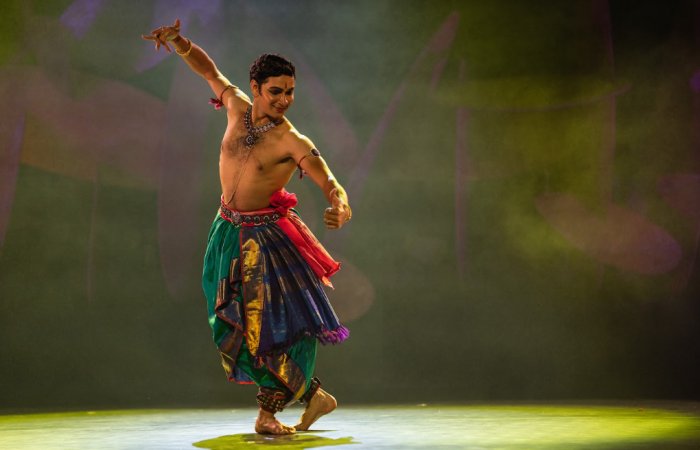
Sundaresan Pandurangan
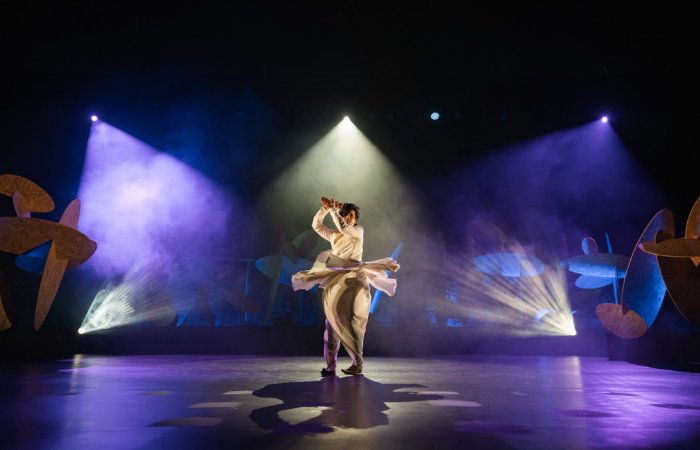
Gaurav Bhatti
Kamadev was represented in two solo appearances, one in Bharatanatyam,
set to the choreography of Leela Samson, the dancer being Sundaresan
Pandurangan, an emerging solo artiste trained under V. Balagurunathan.
The other in what appeared as a kind of divertissement, quite brilliant
in the breathtaking pirouettes round the entire stage, was by Kathak
dancer Gaurav Bhatti, whose appearance seemed to have no direct
connection with the Hansa Sandesham narrative. Constantly moving between
India and Canada, his unique qualities stem from mixed training in
Contemporary Dance and Kathak, for which he is under the guidance of
Aditi Mangaldas. The music to which Gaurav danced was by Rushal
Ranjan and Max Guthrie, with Dhanma and tabla by Bhanu Sisodia. Given
Swapna's abhinaya versatility, my seat at the side, not enabling a
frontal view, was a disadvantage.
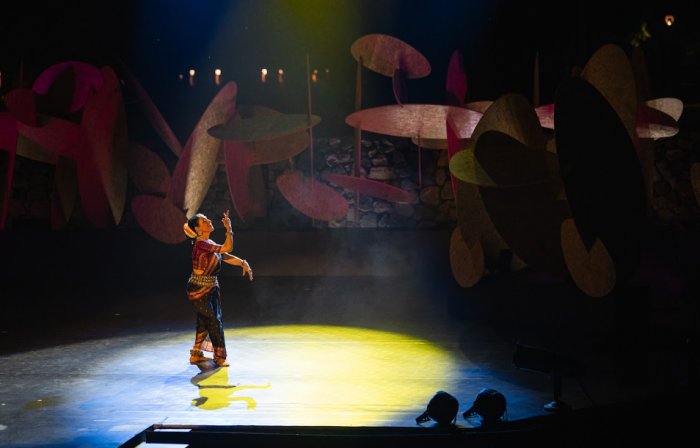
Madhavi Mudgal
Next came Odissi veteran Madhavi Mudgal whose recital (specially created
for this festival, again portraying a female dancer expressing the
feelings of a male in love) was based on the 10th -11th century verses
of poet Rajashekhara, describing the hapless state of the lovelorn
Nayak, awaiting union with the beloved. It is Spring but in the fever of
love with the delayed arrival of the beloved, even the cool moon rays
sting and seem to torment the Nayak, and in utter desperation he orders
to 'whip away the perfumed breeze and bind the southern wind in chains,
imprison the cuckoo mocking him with its amorous notes and grind the
Moon into powder.' But gradually as better sense prevails, the Nayak
realizes it is unwise to be deceived by appearances, for the moon was
after all born of the same womb as poison during the ocean's churning
and the perfumed breeze is from sandalwood trees housing poisonous
snakes, just as the pearls he wears as adornment come from the same
corrosive salty ocean. For that matter, even the lotus only blooms when
the scorching sun shines. Given the metaphor filled poetry Madhavi was
performing to, and given her style which believes in subtlety and
underplay, one sorely missed a front seat. The music composed by Madhup
Mudgal, had vocal music by Khushal Sharma, Jitendra Kumar Swain as
percussionist on pakhawaj and tabla, flute played by Kiran Kumar, and
sitar by Mehtab Ali Niazi.
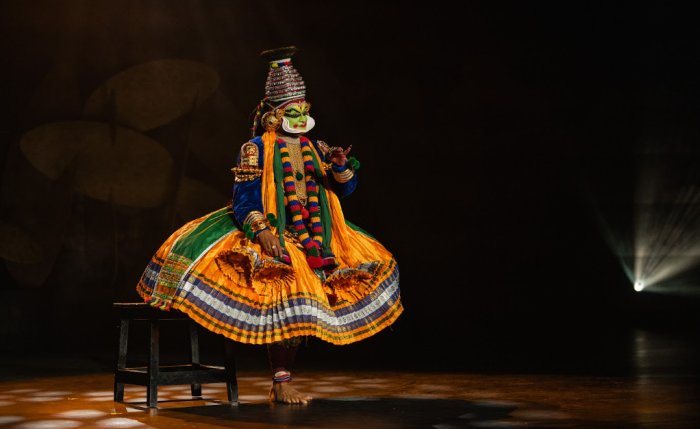
Kalamandalam Balasubramaniam
Kathakali as a strong, dramatic form of dance theatre, has an inherent
advantage, given the dancer's exotic getup with colourful makeup. And
with reputed artiste Kalamandalam Balasubramaniam, positioning himself
upfront on the stage, with the accompanists (vocal by Sadanam
Sivadasan), chenda percussionist Sadanam Ramakrishnan and maddalam
played by Sadanam Ratheesh) standing slightly in the rear to the
dancer's left, visibility had no problems. The presentation was woven
round Spring, as described in Kalidasa's Ritusamhara - with the usual
pictures of blossoming nature filled with flowers and fragrance of
gentle winds inciting hearts of the ladies with amorous feelings. The
picture is of cooing cuckoos, the male intoxicated with the honey of
mango flowers. The audience was fascinated watching the play of the
cheekbones and facial muscles and eyes of the artiste in the
abhinaya! When the artiste arrived in his plain everyday attire in
a dhoti sans makeup, for the curtain call at the end, it was a
realization for many in the audience, of what a transformation they had
witnessed in the performance!
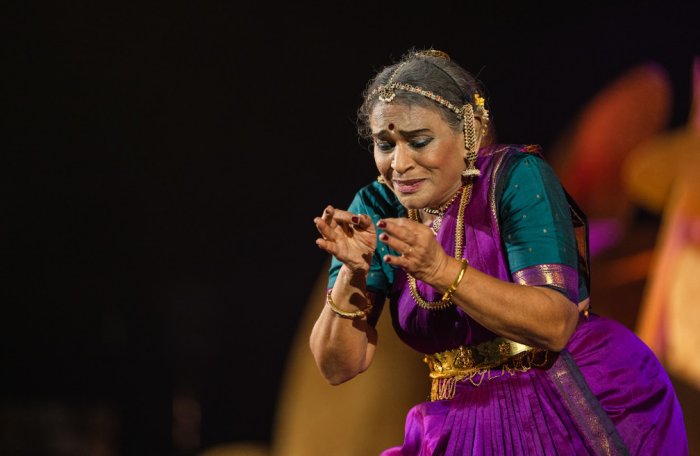
Bragha Bessell
It was wonderful to see Bragha Bessell, after a long absence, return to
performing. One of the finest Bharatanatyam exponents of abhinaya, one
could not help feeling that the minutiae of her expressional range got
somewhat lost in this space. Her work requires more intimate space. Her
recital addressed the God of love in opposed moods. The first as
specified in a Ponniah Pillai varnam in Bhairavi set to rupaka talam
where as a Proshitabhartrika (a nayika pining for the husband, long gone
on work) pleads with Manmatha, the God of love, to spare her from his
flowery darts. She blames him for daring to enter her house attacking
her when she is alone unprotected by the man of the house. "Let him
return and I will take revenge on this swagger of yours," she says. In
the next item Manmatha Pooja, the tone addressing the Love God changes
fully. Here is a nayika, experienced in the ways of love, who
unabashedly distributes her favours to more than one man -
in this case Manmatha, the Love God, as also Tiruvengada or
Trivikrama. Addressing the God of Love after what she terms as her
faithful worship of him, during the waxing fortnight in the month of
Masi, she pleads to be granted the privilege of intimate service to the
lord of Tiruvengadam, who bears the blazing discus that emits fierce
flames and who is the Lord who measured the world in three strides.
Warding off Manmatha, she says, "Why this amorous play knowing full well
that my love is for Tiruvengada?" She pleads that this was hardly the
time for his advances and that he would have to wait. Why this restless
excitement? For after all a well's water will not run away? I am forever
yours. But wait for the time. Bragha's abhinaya ability for treating
even what would be considered risque themes with dignity and restraint,
is well known. The taped music had some of the finest musicians
for dance today - vocalists Nandini Anand and Kanyal Hariprasad,
nattuvangam by Srisudarshini, Vedakrishnaram providing mridangam support
and Rigesh on violin. Resource person was Dr. S Jayachandran.
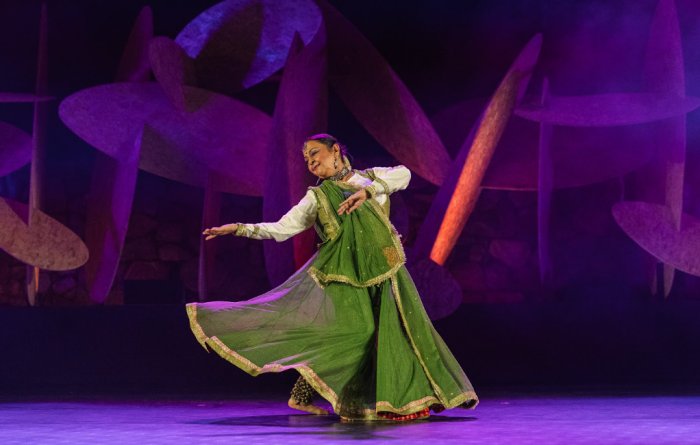
Vaishali Trivedi
The concluding dancer on what turned out to be an overlong opening
evening for the festival was Vaishali Trivedi, a long-time student of
late Kumudini Lakhia, with a special flair for interpretative dance,
given her musical talents. She also studied under Pandit Birju Maharaj
and with Ravi Shankar in his musical theatre, being a singer herself. A
description based on Mahakavi Kalidasa's Ritusamhara, set to an eleven
beat time cycle with the music set to raga Vasant, saw the dancer weave
fulsome images of Spring - the mango tree full of flowers, the water
bodies filled with lotuses, with the fragrant wind filling women with
desire. As for the body-less hero Kamadeva, the blossom filled mango
tree is his arrow, his bow is the Kimshuka flower, a swarm of bees his
bowstring, and the spotless moon his white parasol, while, like an
intoxicated elephant is the Malaya wind with cuckoos, the eternal bards
with their singing. Always known for her expressional flair, the next
item built round the festival of Holi, based on a Horipada set to raag
Paraj, in taal Dhamar was based on a music composition of Pt. Atul Desai
and Ramesh Bapodara, with singers being Pt Atul Desai and Vaishali
herself. It had the dancer painting a picture of Holi showing
Radha protesting to Krishna during Holi play not to rough up her
carefully tailored hair, while Ramsakhi pleads that her face not be
unveiled. Sringara in Indian poetry delights in tones sensual and
spiritual and in this composition, the playful romantic mood ends on a
spiritual tone of love and surrender at the feet of the Lord.
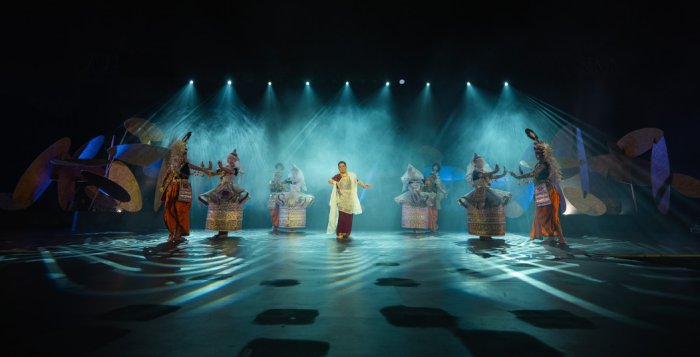
Ananda Lila
In Ananda Lila by Anjika Society for Manipuri Dance and Movement
Therapy, Manipuri Maharas was presented based on the 10th Canto of the
Bhagavatam, Krishna assuming as many forms as the Gopis, giving each
Gopi a feeling that Krishna had partnered her. The choreography was by
Prithi Patel, the Manipuri expert.
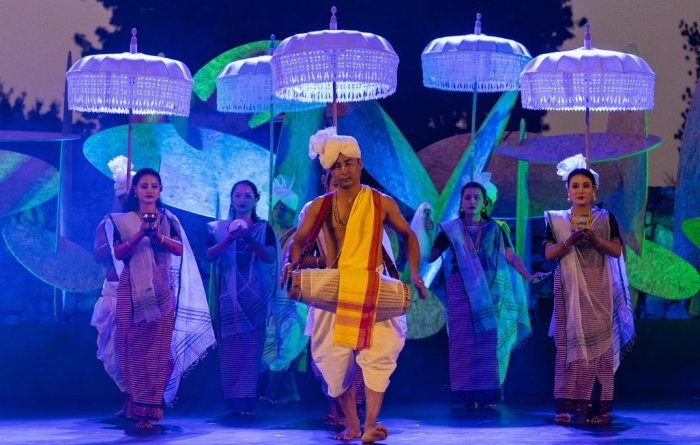
Subharambha by Anjika Society
The second evening began with Subharambha by Anjika featuring drumming
on the Pung and Pung Cholam, with a benediction to the five elements,
with the recitation of the PanchaBhuta Gayatri Mantra, which constitute
the human body, with, Mei (Fire), Ising (water), Nungsit (Air/Wind),
Leipek (Earth) and Atiya (Space) held together by the soul, Thawa. The
artistes were K.Ratan Singh, A Surjit Singh, S.Joy Singh, N.Bikrom Singh
and A.Ratan Singh.
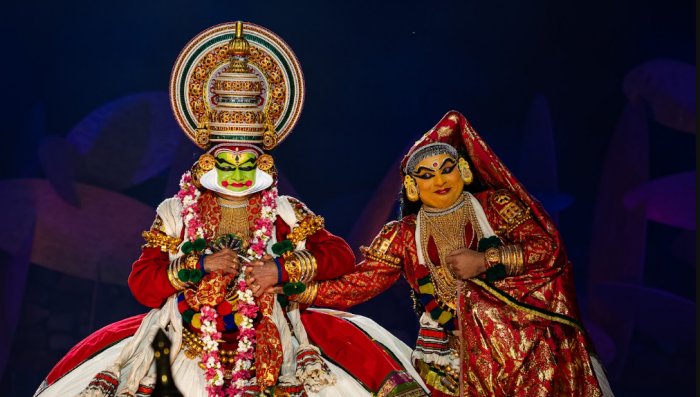
Kalamandalam Balasubramaniam and Bipin Shankar
This was followed by Sringara Manjari in the Kathakali form.
Kalamandalam Balasubramaniam as Nala, and Bipin Shankar in stree vesham
as Damayanti had the audience engrossed with their Kathakali
presentation of a scene from Nalacharitam wherein Damayanti, unable to
trace husband Nala, as a ruse, announces her swayamvara to be held the
very next day for selecting another husband. Nala, wandering in the
forest due to Kali, as a return for saving the snake Karkotaka from a
wildfire, acquires boon of disguise, as a dwarf Bahuka and finds
employment in Ayodhya as King Rutuparna's cook. Keen to win Damayanti's
hand, Rituparna, eager to reach Vidarbha (where Damayanti's home is)
which is far from Ayodhya, uses Bahuka known as the greatest of
charioteers, to drive his chariot to reach the swayamvara place in time.
With the food a giveaway in its Nalapaakam, Damayanti recognizes the
cook as Nala, who by the grace of Karkotaka regains his real form and
with Sani period having ended, the reconciliation is complete between
Nala and Damayanti.
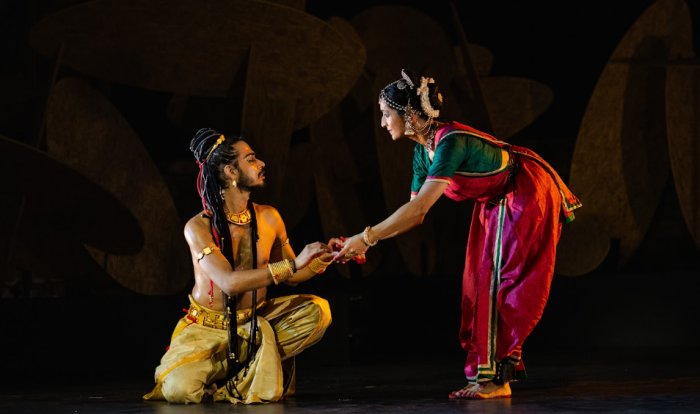
Sayak Mitra and Amrita Lahiri
Next came a unique, very persuasive, contemporary presentation Prema
Darpana, woven round the Saundarya Mahakavya by Ashvaghosha, a Sanskrit
text from the 1st century - the work conceptualized by Piyal
Bhattacharya known for his significant contribution to the
reconstruction of natya based on the Natya Sastra. The dynamic
combination of Vachikabhinaya using the Sanskrit language, and body
language (Marga Natya) based on the Natya Sastra, has attracted several
artistes, all being trained in his institution Spanda Art Space located
in Boral. Ashvaghosha's Mahakavya is woven round the story of
Nanda, the half- brother of the Budha, and the work as conceived, uses
body language of two genres - namely Kuchipudi by Amrita Lahiri who
plays the role of Nanda's beauteous wife Sundari, and Marga Natya for
Nanda's role, played by Piyal's student Sayak Mitra. Both performers did
their roles proud, and the smooth rendition belied what was actually a
premiere presentation. The plot revolves round Nanda's deep attraction
for his beautiful wife while his other side is not able to ignore the
call of service to suffering mankind. This everlasting tension
between kama and dharma, plays on his mind - much as in the case of
brother Sidhartha's years ago. The Buddha (not shown in this work)
realizing the desire as the cause of Nanda's weakness cleverly uses this
as leverage, forcing on Nanda the realization that desire, even in
heaven with celestial nymphs rivalling the beauty of Sundari, can only
trap him endlessly with kama, with no equanimity or detachment in sight,
for which desire needs to be conquered. The performance takes a sudden
turn in an unexpected symbolic touch, with a ladder and unfurled
parasol, under which both Sundari and Nanda stand as realized souls
attaining Arhatship, free from the cycle of rebirth - the umbrella
representing protection, a symbol of the Buddha, who by sublimation of
desire, attained nirvana.
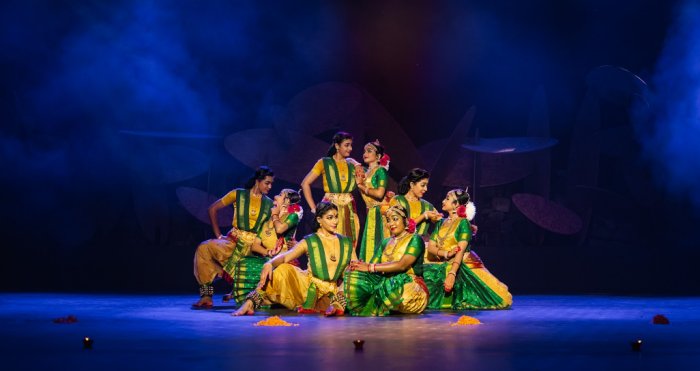
Anuragam by Sridevi Nrithyalaya
Srividya Nrithyalaya's very neat group presentation of Anuragam,
choreographed by Sheela Unnikrishnan, looked at all forms of love and
friendship, based on the core philosophy of Tiruvalluvar, the great
Tamil poet (3rd century BCE and 5th century CE) who in his work
Tirukkural, has devoted twenty five chapters to love and friendship as
the primary emotion governing the world. The neatness of group
formations showed a very disciplined group. The dancers were Bhairavi
Venkatesan, Sanjena Ramesh, Mrinalini Shivakumar, Sai Smriti Suresh,
Vishnu Sree, P. Nishkala Ranjeev, Meghna Unnikrishnan and Smritika
Janarthanaa.
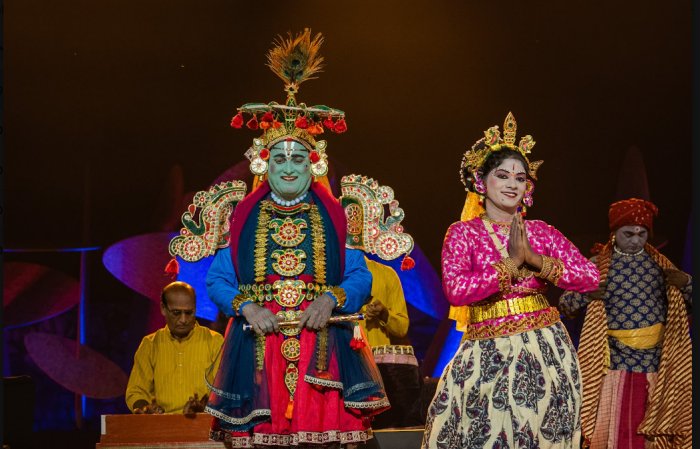
Kattaikoothu Sangam
Day three commenced with Kattaikoothu, a high energy form of theatre
very popular in the rural areas of Tamilnadu, where dancers turned out
in ornaments and hand-carved crowns of wood from the Kalabaora tree,
play to themes generally based on episodes from the Mahabharata,
contextualized with references in the dialogue to suit present day life.
Their most well-known play Thangavel Vattiyar's Subhadra Dhananjayan,
woven round Krishna, is built round helping to bring about the marriage
of Arjuna and Subhadra, who desire each other. But being the eternal
trickster, Krishna has his fun at the expense of both Subhadra, his
sister and his friend Arjuna, saying he has already agreed that she
should be given in marriage to the Kaurava Prince Duryodhana. But
ultimately, he enables Arjuna to elope with Subhadra! D. Rajagopal,
Director and playwright, leads his own team, As a writer / actor he has
brought in subjects of relevance in present day life and has written
works concerning women's issues including a work based on the Male Gaze
(Parvai). Dr. Hanne M de. Bruin, is helping raise funds as a non-profit
initiative to uphold quality in this type of theatre.
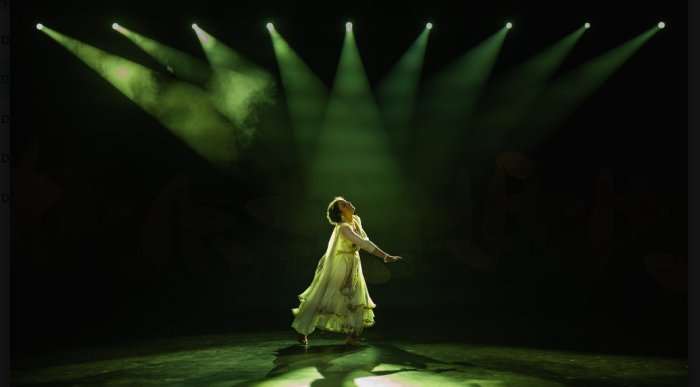
Meera Sreenarayanan
Meera Sreenarayanan's Bharatanatyam recital Milan, based on the poetry
of Piro Preman (Aik Sau Sat-Kafian, Piran Ditti or gift of the Pir), the
19th century mystic Punjabi poet, epitomizing love and defiance by
women, for this critic, marked one of the high points in the festival.
Piro's mystic poetry of startling candour, thinking of love as the
essence of God, denounced all religious tenets and social norms as
oppressive - starting from the faith she was born to as a Dalit Mirasi
courtesan of Muslim faith, to Hinduism and even Sikhism - all of which,
according to her, subjugated woman. Life in Lahore's Heera Mandi
followed by her later unusual relationship with Gulab Das (founder of
the epicurean religious sect in Punjab, the Ghulabdasis), kindled in
Piro a new sense of freedom, investing her with the courage of defiance
against the arrogance of a male dominated society. Discarding all
social norms as oppressive, Piro's poetry, often compared to Meera
Bai's, addressed the world through her Kaafis.
Looking like a delightfully beautiful blithe spirit in her tasteful
Punjabi outfit in shimmering white, the dancer exuded the joyous spirit
of love - dancing to the Kaafis of poetry in a language resembling
common man's, but alluding to divine love or Ishqe-Haqiqi - with
music composed by Radhika Sood Nayyar and Rajkumar Bharati, with the
instrumental support including a wide variety of instruments used in
different musical systems - the Tumbi, the Rabaab, the Mandoline,
the Bouzouk, the Dulcimer. Meera was like a light footed gazelle,
covering the stage, in movements exuding joy and spirit of freedom of
love. Given the dancer's personal training in Kuchipudi, Mohiniyattam,
and Bharatanatyam now under Bangalore's Indira Kadambi, and not least in
her abhinaya knowhow with classes in Navarasa Sadhana under Guru G.
Venu, one senses an overall creativity in Meera's Bharatanatyam, drawing
on inspiration from various genres of poetry and music.
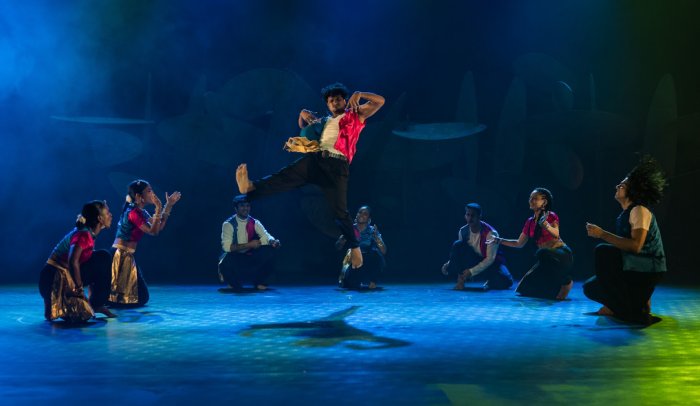
Jahnavi Sheriff and friends
Continuing with creativity stemming from inspirational sources, both
traditional and Contemporary, was Anurakti by Jahnavi Sheriff and
friends with music by Chandana Balakalyan, both known for fusion art -
in Jahnavi's case a Bharatanatyam dance base with training from no less
an institution then Chennai's Kalakshetra which along with
Jamaican Dancehall and Global Street Dance is one of the high energy
fusion attempts at bridging the gap between Indian and western on the
one hand and between the traditional and the contemporary. The ideal
musician, for such cross-overs is provided by Chandana Balakalyan, adept
at traversing scales between different genres of music ranging
from expertise in Carnatic classical to Hindustani, Sufi and Jazz. What
happens when love of a lifetime, makes every other type of association
in life seem worthless? Jahnavi 's work is based on Akka Mahadevi's
Vachanas expressing her love for her Chennamalikarjuna (Shiva white as
Jasmine) who she worshipped as her divine Lord, rejecting her marriage
to her husband. The dance becomes a collective celebration of bhakti
prompted by a sense of defiance of binding social norms, applying to men
and women. The performers were Ashwini, B-Boy Comic, Utsav Shah, Tilo,
Saber, Diksha, Aditya, M.S, Smritika Janarthan.
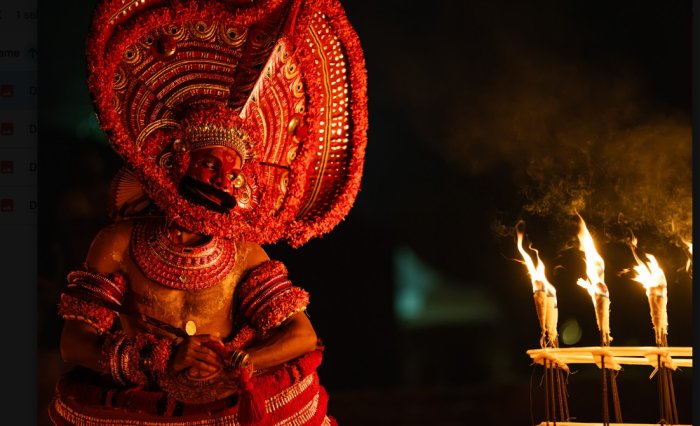
Kathiavanoor Veeran Theyyam
The last evening began with a Theyyam ritualistic performance, very
sacred and part of North Malabar culture, presented by International
Centre for Folklore and Culture, arranged in another part of the lawns
in the park. The ritual enactment embodying divine energy, pertained to
Kathiavanoor Veeran, a heroic deity, based on the tragic love story of
Mandappan Veeran whose love for his wife Chemmarathy survives death and
becomes divine. Working in Kodagu of Coorg, after a battle as a soldier,
Mandappa Veeran having won the battle, goes back to the battlefield
looking for his ring with the finger (that has been chopped off) and is
treacherously killed by the Kodagu enemies, with a grief stricken
Chemmarathy throwing herself later into his funeral pyre. Mandappa
Veeran becomes the divine Kathiavanoor Veeran, a heroic deity, the
apotheosis of Kodugu women, celebrated through the ritual space of
Theyyam. The performance cell has an elaborate cell with a setup
made up of banana and multi coloured dyes and sticks with fire
(Chemmarathy Thara representing Chemmarathy); there are 64 pieces
(Mandappa Veeran is also believed was cut into 64 pieces). The Theyyam
performer with sword in hand, clad in a dhoti or a grass skirt, or one
fashioned from coconut fronds, performs with energetic movements, and
the fire sticks one by one are snuffed out! After the performance,
questions asked of the performer by the audience, are answered. Involved
in the performance were Suresan, Gireesh Kumar, P.P. Abhishek, V.K.
Maneesh, P.K. Vinod, Manoj Kumar, Balan M.K, Shyju A, Suresh P.K.
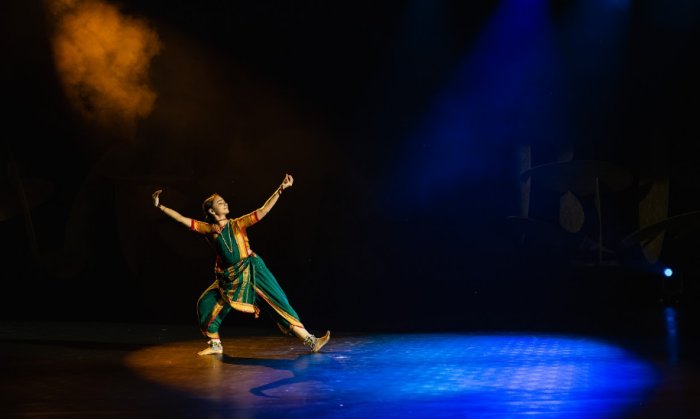
Harinie Jeevitha
The audience came back to the open-air amphitheatre to watch a
Bharatanatyam presentation titled Pranidhana by Harinie Jeevitha, a
student of Sheela Unnikrishnan trained in Sridevi Nrithyalaya. The
performance was woven round the story of Jana Bai, a maid servant who
worked at Sant Namdev's home, who rose to become one of the greatest
saints of the Varkari tradition of Maharashtra (13th-14th century) which
defied caste divisions, and spoke of the Bhakti Marg against
ritualistic practices. Orphaned early in life Jana Bai had been
adopted into Sant Namdev's family where, working as a domestic, she
accepted Namdev as Guru and sang the praise of Vithala through her
Abhangs - and Vithala is supposed to have come to her aid helping her in
the household chores, lightening her burden. Along with her persuasive
abhinaya, and neat Bharatanatyam, she had the advantage of music
composed by Rajkumar Bharati, rendered by fine vocalists Swarathmika and
Srikanth Gopalakrishnan, tabla by Ganapati Subramaniam, flute played by
Naveen and on the sitar was Kishan Kumar.
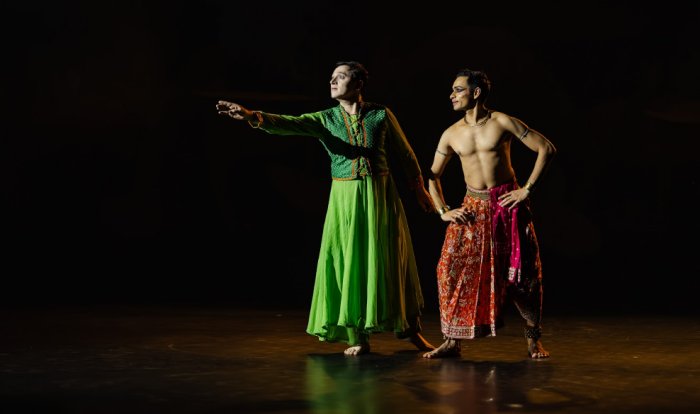
Dhirendra Tiwari & Adithya PV
The next program in a Kathak / Bharatanatyam blend presented Rang Ruhai,
woven round the relationship of Amir Khusro and his spiritual Guru
Nizamuddin Auliya. Sitting in the tomb of Nizamuddin Auliya, (where
tombs of both teacher and student are located), Khusro's mind goes back
to fragmented memories of a long relationship of a teacher and his
student. The relationship goes through periods of deep and abiding
affection, of separation, grief, surrender - slowly building up to one
when the difference between teacher and student begins to wear thin with
a state of oneness, resulting from an inner journey into the Self. The
music by Samiullah Khan and Raje Purushottama brings together two
dancers, one of Kathak in Dhirendra Tiwari, trained under Rajendra
Gangani of the Jaipur gharana, and the other in Adithya P.V, a
Bharatanatyam dancer, trained under Lata Edavalath, Sandhya and Kiran,
now under Sudharani Raghupathy for advanced training. In this production
the two dance languages seem to be in total sync at times, and
different at others. Adithya was very communicative while the Kathak
dancer was calmer, and it was an enterprising effort to weave
Bharatanatyam round a theme which is far from the usual
repertoire!
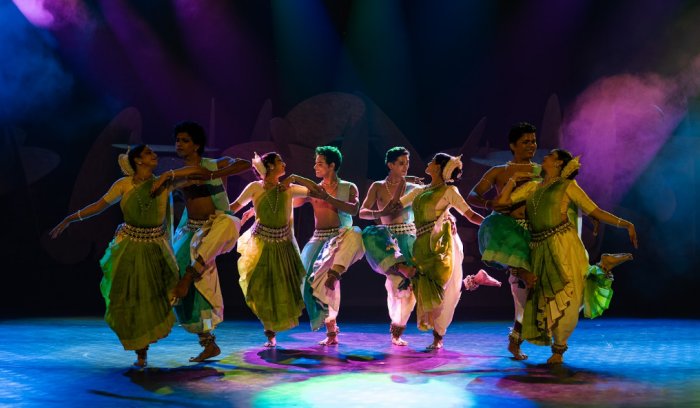
Orissa Dance Academy
The finale for the four day festival was Basanta Anuraga staged by
Orissa Dance Academy group under the creative director Aruna Mohanty.
Built wound Spring and that eternal charmer Krishna, the very epitome of
sringar and bonding between man and Nature and worshipped as the
largest alchemy against negative forces, this joyful dancing provided
the best anthem for a festival on love in all its manifestations.
A fine effort on the whole with a feast in variety of fare!
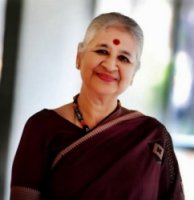
Writing on the dance scene for the last forty years, Leela
Venkataraman's incisive comments on performances of all
dance forms, participation in dance discussions both in
India and abroad, and as a regular contributor to Hindu
Friday Review, journals like Sruti and Nartanam, makes her
voice respected for its balanced critiquing. She is the
author of several books like Indian Classical dance:
Tradition in Transition, Classical Dance in India and Indian Classical dance: The Renaissance and Beyond.
Post your comments
Please provide your name along with your comment. All appropriate comments posted with
name in the blog will also be featured in the
site.
|