TAALAM
BY LEELA VENKATARAMAN e-mail: leelakaverivenkat@gmail.com
Bharatanatyam constructs built round philosophy of Jyotirlingam
Photos: Anurag Chauhan
November 2, 2026
It all started with Dr. Bibek Debroy's book, co-authored by Amit Kapoor
on the concept of Jyotirlingam, that triggered R.K. Usha's mind. Ever on
the lookout for new ideas as theme for dancers, what could be more
challenging than trying, through dance expression, to correct the
etymology of linking this term, which stands for a nuanced and profound
philosophical idea, with a phallic symbol? Jyotir means that which
illuminates and lina means to merge or dissolve. Far from a biological
identity, the architectural representation emerging from humanity's
attempt to visualize the infinite, makes the Lingam form a metaphor -
referring to a cosmic attribute surrounding an unmanifested divine
crucible, like a metaphysical space of fluid movement, into which all
creation merges. Untamed column of divine golden fire refers to a
non-physical form of pure consciousness. Abhinava Gupta used the word
lina gamaka as merging the space between two musical notes and emergence
of something seen as illuminating light.
Amongst the Trinity of Brahma, Vishnu and Shiva, the base and below
ground level space is sustained by Vishu, with Brahma at the pedestal of
sky and above, while the shaft or illuminated space between the two
worlds is governed by dissolver Shiva. One knows the popular myth of
Brahma and Vishnu wanting to find out the extent of the illuminating
light which is Shiva, with Brahma as swan searching in the upper world
and skies while Vishnu as a boar searches underground - with neither
able to discover the beginning or end of this illuminating force.
The Bharatanatyam program at the Habitat, sadly attracting a very small
gathering, presented two finished performers, Mithun Shyam and Nilava
Sen. The presentation at Stein auditorium constituted four of the twelve
Jyotirlingam sites. Aiding the dancers were a team of capable musicians
topped by Sudesh Menon the vocalist, whose melodious singing,
includes creativity - for each of the Jyotirlingams was presented
through a varnam composition of his own creation, without mangling the
format of this musical genre, while adhering to the thematic specifics
of each of the holy places. Uma Ganeshan on the violin with Ratul Kumar
on the mridangam provided good support. Shreyasi's nattuvangam, despite
voice and diction clarity, faltered a couple of times - the vocalist
stepping in at one point, while the other saw one of the dancers suffer,
when she gave up while reciting a jati.
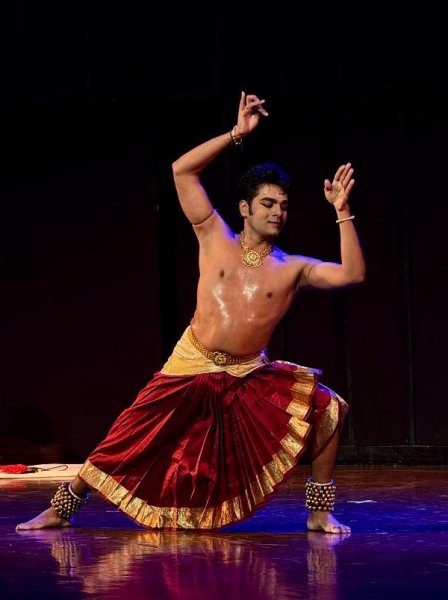
Mithun Shyam
Mithun Shyam heralded a start with Somanatheswar as his theme. This very
ancient temple, very well known for its indomitable survival despite
frequent destruction, pillage and plunder, has its sthala purana in the
story of Chandradev (Moon God). Married to the 27 daughters of Daksha
Prajapathi, he earns the wrath of his father-in-law by his all-consuming
love for wife Rohini, neglecting all the others. Cursed by
father-in-law Daksha for his indifference to the other daughters,
Chandradev suffers an ailment resulting in his illuminating brilliance
fading away, leaving the world plunged in darkness, till Brahma advises
penitent Chandradev to pray to Lord Shiva. Chandradev's deep penance at
Prabhas Kshetra where rivers Kapila, Hind and Saraswati meet, chanting
the Mrityunjay mantra, pleases Shiva, who appearing before him,
ameliorates the curse of Daksha, by bestowing upon him the boon of
regaining his brilliance for a fortnight in the month - while for the
other half, as atonement for his sins, he will remain consigned to his
powerless fate - and hence the waxing and waning moon. Pleased with
Chandradev's homage, Shiva as Jyotirlinga resides permanently in
Somanatheswar. The varnam in ragamalika form starting with Gowri
Kalyanam marking the marriage of the Moon God to Prajapati's daughters,
with a flow of ragas, with each line of the sahitya in a mode to suit
the mood, with ragas like Hamsadhwani, Malkauns, Arabhi, Darbari Kanada,
Athana, Todi, to mention a few, flowing along with Mithun's polished
performance, immaculate in dance lines, made for a handsome
presentation. And how well the teermanams were executed, the Vazhuvoor
Jatis learnt under Padmini Ramachandran, were rendered with elan.
Altogether a very stately performance!
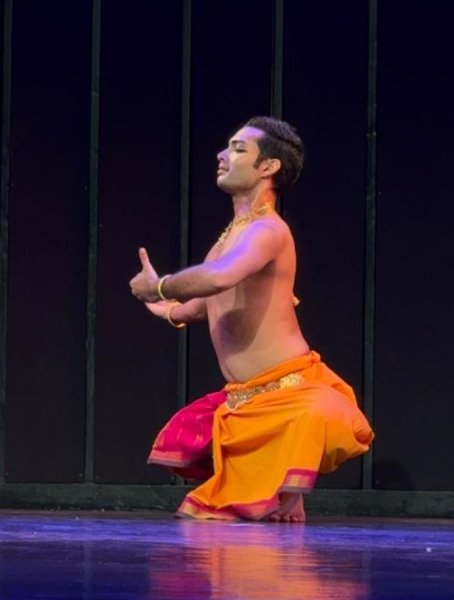
Nilava Sen
Next came another fine performer in Nilava Sen, presently a student of
Rama Vaidyanathan after studying the Uday Shankar technique under
Tanushree Sankar. His presentation concerned the Omkareshwar Linga at
the temple situated in Mandhata Island, also called Shivpuri, in the
shape of the Devanagari Om, located in the region of river Narmada in
Madhya Pradesh. The story of twin places Omkareshwar and Amareshwar
housing Jyotirlingas is based on the purana about Mount Vidhyachal, who
through intense worship of the Shivalinga made of earth, wishes to
establish ascendency over Mt. Meru gaining in height. Shiva solves
the altercation by being represented in both places with shrines
housing the Shiva Linga, and pilgrims visit and pay their homage at both
places. Very communicative, in the composition Omkareshwara deva devam,
one could sense that the dancer has a penchant for trying out new
themes in his dance. The two dancers, while very proficient, are
distinct personalities and this factor is reflected in the
Bharatanatyam, stamped by the dance persona.
Mithun Shyam presented the next episode based on Kedarnath in the
Himalayas - not accessible to pilgrims during the winter months.
According to Shivpuranam, the temple was built by the Pandavas, who,
wishing to atone for the sins of killing their kin in the Kurukshetra
war, wanted to meet Shiva, who disguised as a bull escaped them.
Recognized and chased by Bhima, Shiva disappears into the bowels of the
Earth, with only the hump sticking out and visible (Shivling here is
self-manifested (Swayambhu) in the rock, its shape resembling the hump
of a bull). Considered very sacred and part of the Char Dham Yatra,
Kedarnath houses the samadhi of Shankaracharya, who visited the place in
the 8th century A.D. The dancer, with his bare torso, was draped in a
red very tastefully tailored kacham style costume. As the singing
of the refrain line in raga Shankarabharanam went on Shivananda Roopam
Shivoham Shivoham, with a jati in ragamalika, and each passage in the
charanam in a different raga, one had to admire the manner in which the
entire performance was visualized.
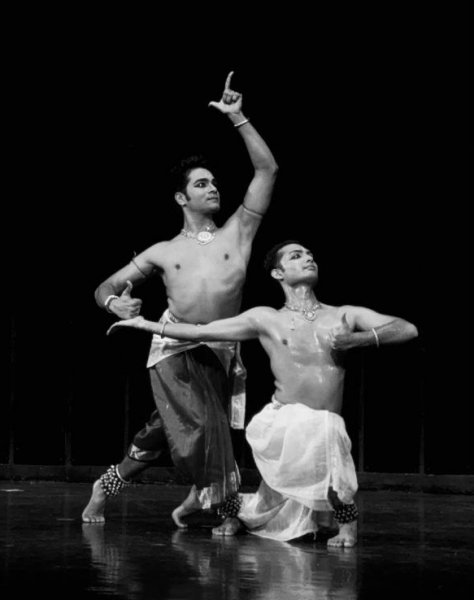
Mithun Shyam and Nilava Sen
The concluding session with Nilava Sen taking the stage was devoted to
the Jyotirlinga at Kashi, which for every devotee is the most sacred of
places for Shiva worship. Here, the entire city is Jyotirlinga for the
eternal light of Shiva shines here with the God himself said to declare
This is my abode. Parvati wants to know from her husband the greatness
of this Kshetra. Shiva replies that Arjuna acquired the Pashupata from
him after worship in this place. The entire city being my abode, there
is no need for great deeds for people to attain moksha. Just by living
in this city, even those with no Sanskaras, Dhyana, Chants and Worship
to their credit will attain salvation. The Ganga flows through this city
which is the home for the dead and the living. This home of mine
carries eternal light, says Shiva.
Painstakingly put together, it was an evening to remember. And plaudits for the idea and its presentation in dance!
Writing on the dance scene for the last forty years, Leela
Venkataraman's incisive comments on performances of all
dance forms, participation in dance discussions both in
India and abroad, and as a regular contributor to Hindu
Friday Review, journals like Sruti and Nartanam, makes her
voice respected for its balanced critiquing. She is the
author of several books like Indian Classical dance:
Tradition in Transition, Classical Dance in India and Indian Classical dance: The Renaissance and Beyond.
Post your comments
Please provide your name along with your comment. All appropriate comments posted with
name in the blog will also be featured in the
site.
|