TAALAM
BY LEELA VENKATARAMAN e-mail: leelakaverivenkat@gmail.com
Kathak as dance theatre in Shovana Narayan's Lalitarpan Festival
October 26, 2026
Lalitarpan, the annual festival of Asavari established in 1979, this
year centered its celebration round the Yudhisthira/Draupadi
interaction, based on Pavan Varma's book inspired by a work in Urdu,
going into the emotional depths of this uneasy alliance between the head
of the Pandavas and their wife Draupadi. With mother Kunti's blessings,
made from within her chamber before seeing her sons that they 'share
equally whatever prize had been won', Draupadi's ecstatic love dreams of
a first wedding night with Arjuna she had instantly fallen in love with
and garlanded during her swayamvara, were shattered. "Ma Kunti,
bachalo mujhe, Vapas lo vachan apna," she begged to no avail. Five
Pandav husbands now had claims over her and adding insult to injury was
Arjuna's stand that as the eldest it was Yudhisthira who would have the
first night with Draupadi as bride. Worsening the animosity of a botched
relationship, was the supposedly wise Yudhithira, indulging in a game
of Dice with the Kauravas using her as stake, after having lost his
entire kingdom, followed by the horrific attempt in the Kaurava court to
disrobe her, with not one of the five stalwart (!) husbands coming to
her rescue - till her cry to Krishna saved her honour.
The smouldering negative feelings for Yudhisthira simmered when she
found herself, as the only one still surviving along with Yudhisthira,
for the other Pandav brothers, while crossing the pool to the gates of
heaven, unable to answer the queries of the Yaksha who owned the pool,
had all perished. It was with Yudhisthira's answers to the Yaksha's
queries that she realized that here indeed was an exceptional human
being. At the answer to the last query that were Yudhisthira given the
option of bringing back to life any one of the four brothers, who would
he choose - the answer that since Mother Kunti had one son alive in him,
he would ask that Nakula be restored so that the other wife Madri of
Pandu, could also have one son to call her own, won the Yaksha's heart
and blessing him, revealing himself as Dharma in disguise, he asked
Yudhisthira to ask what he wanted. "Let me overcome grief, conquer anger
and learn charity," was the answer. Thinking that while Arjuna after
all had his Subhadra and Bhim his Hidimbi, it was Yudhishthira alone who
had none other than Draupadi. Looking beyond the alienation thus far,
Draupadi forgave Yudhisthira for his weakness for Dice play, for after
all vices were present in all, and her spouse's remorse had been
genuine. And she of the fire born greeted him with new abandon.
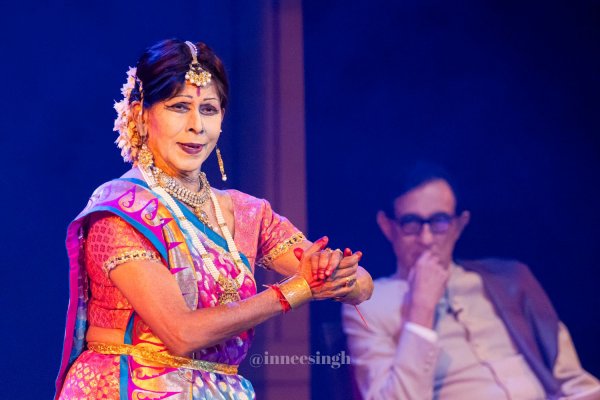
Shovana Narayan & Sunit Tandon
(Photo: Innee Singh)
Presented as dance theatre, the entire production heavily drew on the
incredibly power packed acting of Sunit Tandon - seated on one side - as
quiet Yudhishthira to start with and then as the fiery Yaksha. Perfect
equanimity as Yudhishthira, and later literally breathing fire as the
Yaksha asking questions, his exceptional performance will be remembered
for a long time. Shovana Narayan as Draupadi, while emoting, tended to
get anchored to one spot with a hurt leg, and barring quiet chakkars,
every now and then, could not cover stage space. But what helped her
emotionally, was also the music composition of late Jwala Prasad, sung
by his son and student and music Director, Madho Prasad, who has learnt
to impart a feel of theatre to his singing, with Mahavir Gangani on
pakhawaj and Shabaaz Khan on tabla, Saleem Kumar on sitar and Azhar Khan
on violin doing their little bit. Even when 'bols' were recited in
places, Madho, in the utterance, pitch and distance between syllables,
conveyed emotion.
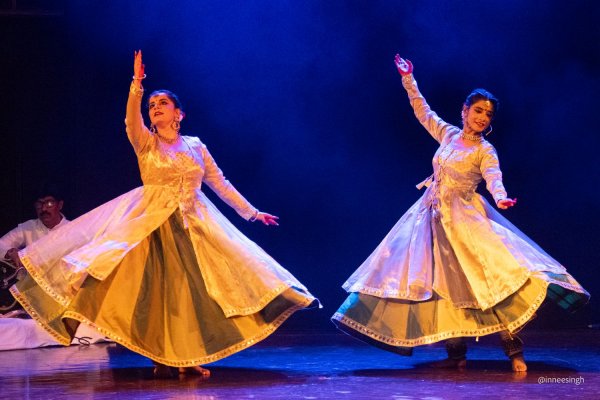
Mahima Satsangi (left) & Suparna Singh (right)
(Photo: Innee Singh)
On the second evening of Lalitarpan, Shovana Narayan's students, Suparna
Singh and Mahima Satsangi, who are Repertory Members of Asavari,
presented a very polished performance titled The Space in between on the
position of Women in Society. It was on the societal contradictions
defining a woman - always looked at in relationship to somebody as wife,
mother, daughter and what have you and never for what she herself is.
The Self is always in shadow. Searching within her silence is Mandodari
whose supreme loyalty to her husband went as far as to claim 'Ravan mere
bheetar bhi'. Despite sharing the throne as his queen, he took all the
decisions and there was little that she could say, when he went on the
suicidal path of losing his heart to Sita. The next dancer took up the
case of Urmila, Lakshman's wife who became Mauna Maya, pining for years
for a husband who went to serve his brother and wife leaving her alone.
She became the unheard tune - unsuni dhwani ban gayi. 'What name do I
join my name to?' she wondered. Inside her too was a stoic silence. The
two dancers come together to question why a woman is just a wife, or
queen meant to live in silence. The concluding statement was that, it is
not woman but the world that needs to change its way of looking at a
woman - always through the lens of a relationship instead of seeing her
as an entity with thoughts and feelings - as someone in her own right.
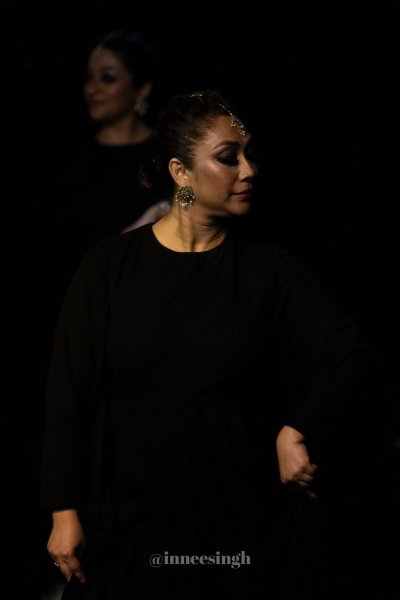
Sanjukta Sinha (Photo: Innee Singh)
The concluding slot for the festival provided star dancer for the
evening, Sanjukta Sinha, trained under Arjun Mishra and Kumudini Lakhia,
was mind blowing in her presentation of Noor, taking the audience,
along with her students, through the contemporary /expressional
vocabulary of Kathak, on a rhythmic/poetic search for the Divine. "Kaise
samjaoon apne manko," says the devotee. With the music in a melodious,
slow lehra refrain in teental, if the slow movements were full of grace,
and variety, Sanjukta's pirouettes were like spun silk - delightfully
smooth in execution, even as her footwork, in the clarity of changing
accents on different syllables had complete authority over rhythmic
precision. "Everything in this world I have left to your grace," claims
the devotee. "Omkarji tum aisa geet banao." The ending with a Tarana had
the students in a bhakti/teertha expression through rhythm. Providing
accompaniment were singers Faraz Ahmed and Samiullah Khan, with Mohit
Gangani providing tabla and padhant support. Altogether a very memorable
end to Lalitarpan.
FINE DEBUT BY KALASHREE STUDENTS IN LUCKNOW GHARANA KATHAK OF GURU MUNNA SHUKLA
Kathak youngsters do not have the equivalence of an Arangetram, marking
the dancer's formal stage appearance in a full-length performance. What
students of Kalashree presented at the India International Centre
auditorium, was a debut on similar lines for Kathak students of Kavita
Thakur, a senior disciple of Lucknow gharana's late Kathak Guru Munna
Shukla. That Kavita is an imaginative teacher was visible from the
performance, even though it was based entirely on recorded music - which
for a form believing in weaving on-the-spot elaborations, can only be a
starting point. What was impressive was that while all four students
showed good technique, the individuality of a dancer had not been
swallowed in the sameness of stereotyped teaching.
The youngest Kaveri, from the Ram bhajan "Sri Ramachandra kripal bhaj
man," to presenting nritta of 13 beats (Jayata taal) showed great
confidence, the chakkars clockwise and anti- clockwise executed with
confidence. The clarity of presentation in Mridula was seen in the
Astamangal tal nritta rendition, though the lehra refrain on the sarangi
could have been more in sur. The same dancer presented Dayanand
Saraswati's composition "Bho Shambho" for which the dance choreography
was by late Guru Munna Shukla himself. Akshita showed sensitive
understanding of abhinaya in her presentation of the Ashtapadi -"Sri
nataranga nachata suandha" with Kavits worn into the choreography by
Guru Munna Shukla. Mitali showed maturity and grace in presenting the
Bindadin Thumri "Meri suno Shyam" in Brindavan Saranga presenting the
Madhya Nayika. And her grasp over technique was apparent with the nritta
in chautaal.
The introductions by Kavita Thakur herself showed how she regarded each
student as an entity with special qualities, which needed to be
explored. Now that these dancers have a grasp over technique with clean
dance profile, they need to work with live music, particularly rhythm on
the table, which can pose its own challenges! That Kavita is a caring
teacher is obvious.
Writing on the dance scene for the last forty years, Leela
Venkataraman's incisive comments on performances of all
dance forms, participation in dance discussions both in
India and abroad, and as a regular contributor to Hindu
Friday Review, journals like Sruti and Nartanam, makes her
voice respected for its balanced critiquing. She is the
author of several books like Indian Classical dance:
Tradition in Transition, Classical Dance in India and Indian Classical dance: The Renaissance and Beyond.
Post your comments
Please provide your name along with your comment. All appropriate comments posted with
name in the blog will also be featured in the
site.
|