TAALAM
BY LEELA VENKATARAMAN e-mail: leelakaverivenkat@gmail.com
Steps of time present against backdrop of time still in Indraprastha Nritya Mahotsav
October 24, 2026
Standing as a majestic Sentinel of Time is the Purana Quila of Delhi, a
16th century construct of Humayun and Sher Shah Suri, with surrounding
excavations revealing remnants going back to Shunga, Kushan, Gupta,
Rajput, and Mughal periods in what is termed Indraprastha City. What
greater testament of India's time past and time present can one have,
than Delhi Tourism's three day, Indraprastha Festival - with
contemporary versions of classical dance showcased against this
architectural backdrop from the hoary past? The scene takes one back to
the days of the Ananya Festival, conceived by Sangeev Bhargav of Seher,
with classical dance groups. featured in the same venue. The present
Indraprastha Nritya Mahotsav (Oct 2 to 4, 2026) held under the auspices
of Delhi Tourism, 'conceived, designed and executed' by Maitreyee Pahari
of Lok Chhanda, opened to a fleeting sound and light overture,
visualized by Gautam Bhattacharya, as a declaration from the Fort, the
voice emerging from illuminated sections of the fort's facade,
proclaiming to be standing where the Pandavas once ruled over
Indraprastha - its stones reminiscent of the time when Kings ruled, with
the air all round seemingly heavy with muted cries of joy and distress
of its peoples. "I belong to Time and the Jamuna" declares the
voice, as pipes, live drumming by percussionists, and a recitation by
Sama Veda specialists, conclude the introduction.
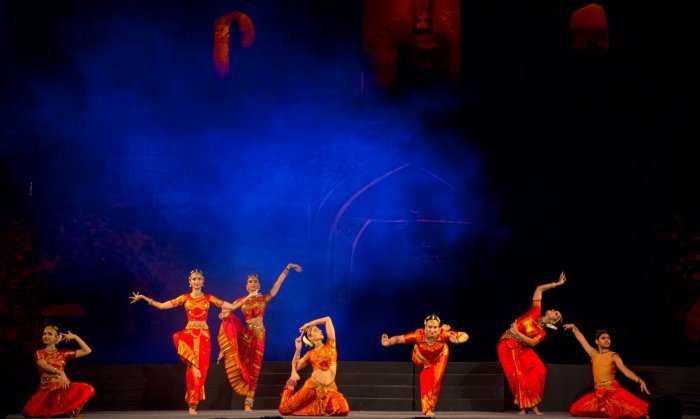
Natya Tarangini ensemble
Heralding a start to the performance part was the Kuchipudi group of
Raja and Radha Reddy comprising dancers Shloka Vaidyalingam, Gauri
Taneja, Sanjana Jain, Pernia Qureshi, Avika Bassi, Yukta Vaishnavi and
Harish Narayan. After the introductory Mahapranadeepam in raga Shubha
Pantuvarali set to adi taal, with nritta in chaturam, tisram, khandam
and sankeernam, came the presentation of 'Shivoham Shivoham' based on
verses from Adi Shankara's Nirvana Shatakam, expatiating on the ultimate
state of non-duality - stressing peace and formlessness - as propounded
in his Advaita Vedanta. Conceived round the philosophy of neither/nor,
enshrined in the concept of Ardhanariswaram as a reference point with
Shiv/Parvati as one entity, followed the nine basic states-of-being from
sringaram to shantam in a quick moving navarasa, concluding with a
short Tarangam footwork built round the words "Ananda nadana vinoda
... sachhidananda nadana kesha..." with dancers' feet planted on a
brass plate.
Wisely restricting the major part of the presentation by the group to
pure dance on this large stage, the expressional Navarasa too, very
perceptively, was visualized as a solo representation of each
stage-of-being with the dancer stepping to the extreme front of the
stage (enabling better visibility of facial expressions, otherwise lost
on this large stage open to the skies). The same group of young dancers,
impressive in closed auditorium space like the Kamani, a couple of
weeks ago, on this performance space open to the skies, having to
communicate with an audience seated far back, notwithstanding technical
correctness and earnest execution, evoked no more than polite audience
response. Not having live music, was an impediment, the music on tape
(with vocalist Adarsh Nair, M.V Chandrasekhar for mridangam support,
Prakash Koduru on flute and Vasu Shastry on violin with the assertive
thrust, of Kaushalya Reddy's nattuvangam) not having that sense of
immediacy.
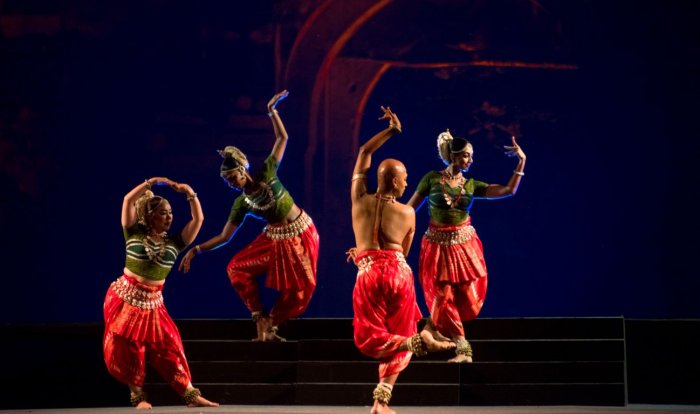
Sutra Dance Theatre
Fragrant Odissi, peak performance of the day, rendered by Malaysia's
Sutra Dance Theatre, with choreographic designing by its head Ramli
Ibrahim, provided a shining example of traditional dance, exquisitely
tailored for the space it was rendered in. With a crew of excellently
trained dancers in Geetika Sri, Tan Mei Mei, Harendiran, Harini,
Vikneswaran and Navineesh, the performance tapestry was spun round a
suite of three items pertaining to the Debaparasad school of Odissi, in
which Ramli trained. The traditional start was Mangalacharan - an
old composition set by Guru Durga Charan Ranbir, with the Stuti part a
homage to powerful and beguiling Goddess Mahishasuramardhini, shining
bright as gold and endowed with the third eye!
This was followed by an abhinaya item "Muha muhi Kishora," a composition
of medieval poet Sri Gopal Krishna, woven round a bunch of Gopis, each
recapturing an accidental encounter with Krishna on the banks of the
Yamuna river. The conclusion, showcasing Odissi nritta in its lyricism
and poetic grace, comprised a Pallavi in raga Rageshri, a commissioned
item of Sutra, going back to 1993, with dance composition by Gajendra
Panda - rearranged, for group choreography by Ramli. Just six dancers
filled the stage with imaginative group formations and sheer excellence.
Impeccable in technique and the way they held themselves, one admired
the interpretative maturity shown, as each gopi recollected her meeting
with Krishna. Altogether a superlative performance with the lusty
applause speaking for itself.
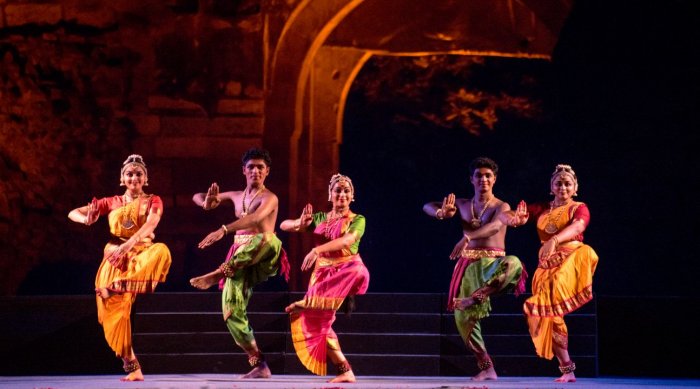
Kalakshetra ensemble
Armed with a theatre manager in Anitha Suresh, faculty member Sreedevi,
and a sizable group of dancers - Abhiram, Anandhu, Krishna, Nakshatra,
Angana, Tannishta, Swarnapali, Kshitija, Nevasene and Rohini - Chennai's
Kalakshetra group of which much was expected, proved disappointing.
With a start based on the Papanasam Shivan Padam in Kedaragowlai set to
adi talam, "Anandanadamidum paadam," describing Shiva's dance of bliss
in the Golden Hall of Chidambaram with Gods and sages in attendance, the
next item was based on a composition of Sadasiva Brahmendra in raga
Hamsadhwani set to adi tala "Thunga tarange Gange," a homage to the
river Ganga whose cleansing waters wash away sins, with the concluding
item being a Tillana in Hindolam. The performance seemed to be hemmed in
by the conventional margam mode of execution in auditorium spaces, with
dancers standing tangentially or in a row, for barring the exactitude
of movement profile and technique, (acknowledged hallmarks of
Kalakshetra training), there was little or no choreographic imagination
displayed in formations for the kind of space wherein the performance
was to take place. The accompanying music on tape seemed very old
(Kalakshetra is noted for music of the highest standard), seeming to rob
even Kaniyal Hariprasad's voice of its melodic excellence.
Dhwani ensemble
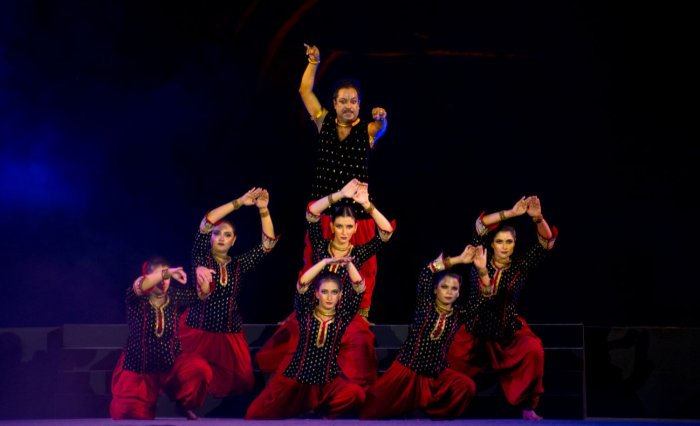
Concluding the first evening's programme was the Kathak presentation of
Dhwani, The hero in Shades, conceived and directed by Vaswati Misra and
assisted by a senior member of the institution, Daniel Freddy, the
script by Ajanta Dutt had narration by Vaswati herself with vocal
support by Jeetu Singh with Qawali rendered by Sabri Brothers. The
dancers were Daniel Freddy, Ipsita Misra, Vasundhara Sharma, Ankita
Biswas, Oishee Bhattacharjee, Vansika, Gauri Bansal, Sridatri, Ishika,
Dia, Nayantara and Dipika. The entire concept, in tune with the
performance site of Indraprastha wherein the Pandavas ruled at one time,
entailed throwback to fleeting reminders of stark events from the
Kurukshetra war, with the entire clan of Kauravas comprising a hundred
sons of Dhridharashtra, destroyed. In the nature of mother Gandhari's
Lament - the bitter/enraged plaint of a grieving mother, is addressed to
Krishna, calling him the 'Master Strategist' tilting the balance of the
war in favour of the Pandavas. Krishna it was, guiding the war as the
charioteer for Arjuna, using the Sudarshan Chakra to track the enemy,
employing the ploy of Shikhandi to destroy and kill Bhisma the
infallible Commander, and finally helping trace her only living son
Duryodhana, thereby destroying her entire clan - cries of grief
stricken Gandhari cursing Krishna that he will live to see the last of
his Yadava clan killed, before he dies. Swiftly covering stage space,
dancers constantly on the move, punctuated with just a sniff of episodic
touches based on the script, were costumed in black kurtas with legs
covered in red harem type of pants aiding free movement. Away from the
usual paraphernalia of Kathak's ad-form items, technique here was for a
theme, different from proving technical virtuosity. Unfortunately, the
delayed start, and formalities of chief guests called on to the stage to
present tokens to each dancer after every group presentation, ate up
time, with many in the audience leaving before the last group
performed.
Parshwanath Upadhye and Adithya P.V.
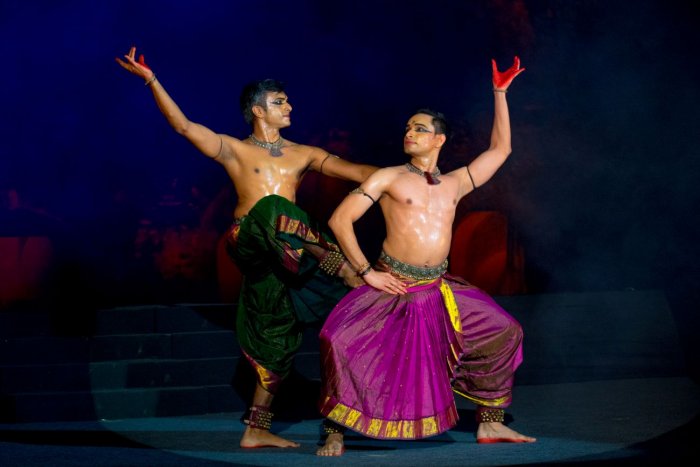
Just two dancers to hold audience on this open air stage? The second
evening began with the Bharatanatyam duo, both acclaimed dancers of
Bangalore, Parshwanath Upadhye and Adithya P.V. heading Upadhye School
of Dance and Punya Dance Company. The duo opened with a composition of
Neelakantha Shivan "Anandanadamaduvar Tillai" in Poorvi Kalyani, woven
round Shiva's ecstatic dance in Chidambaram (Tillai ambalam tannil).
'For those who surrender at his feet, there can be no defeat or failure'
claims the poet. The duo as dancer and worshipper, interacted with the
expertise born of long practice. They next shifted to Krishna homage
concluding with Kanaka Dasa's lilting composition "Baro Krishnaiyya
bhaktara manege eega." The music tape comprised Chandana Balakalyan and
R.Raghuram providing vocal support, with the mridangam percussion and
jati compositions by Harsha Samaga, and nattuvangam by Adithya P.V. -
with violin and flute accompaniment by Pradesh Achar and Keshav along
with Raghusimha and Nithish Ammanayya. With such established performers,
performance quality was not the concern, as much as the presenting of
interpretative items demanding facial expressions, hardly visible beyond
the first half a dozen rows. But what retained audience support was the
accent, in the latter half, on Krishna consciousness - which in the
North with Brindavan round the corner, has several followers.
Anita Sharma and group
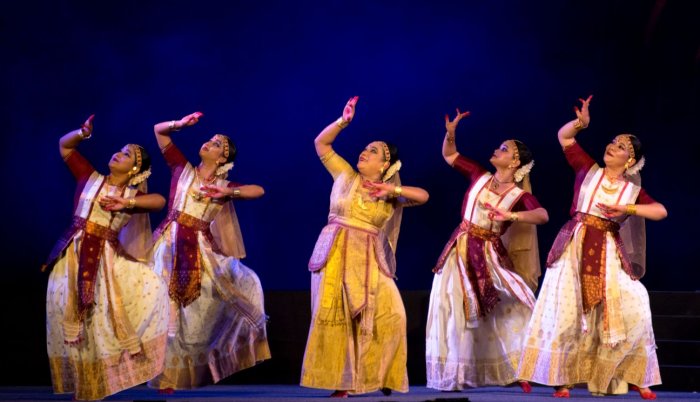
From far South, accent shifted to the North East, in the continuing mood
of Krishna bhakti through the Sattriya dance presentation by Abhinay
Society of Guwahati, led by Anita Sharma. Krishna is the sole divinity
for this monotheistic tradition, reared in the monasteries of Assam's
Sattras. The opening Krishna Vandana with music composed by Bhaskar
Jyoti Ojha, was in ragas Suhai and Dhanasri set to Ektaal and Rakta
Taal, with dance visualization by Anita Sharma. This was followed by a
purely rhythmic item Chali Nach, strung to taals Suta and Ektaal, with
the presentation concluding with Leela Govindam. While the group
comprising Namrata Goswami, Pratisha Mazumdar, Violina Hazarika,
Manjisha Choudhury, Bagmee Gogoi, Bhagyadhri Banik and Kasturi Deka
performed with good technique and coordination, it was Anita's very
animated expressions in Leela Govindam that really enlivened, through
punctuation, a form exuding quietude, with enough dramatics to sustain a
prolonged performance on this open air stage.
Pallavi Krishnan and ensemble
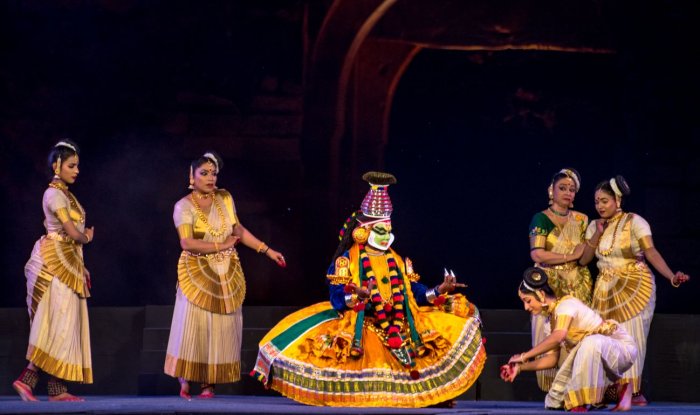
The Kathakali/Mohiniattam confluence Radha/Madhavam, spearheaded by
Mohiniattam dancer Pallavi Krishnan (with her conceiving the
Mohiniyattam half, and the Kathakali part choreographed by Guru
Sadanam Balakrishnan), provided a strikingly spirited contrast,
portraying Kerala's main classical forms - one predominantly lasya
oriented for the female, contrasting with the virile, male form of
Kathakali, traditionally the exclusive preserve of the male performer
but attracting many female performers too today. The participants were
Pallavi, Hemamalini Nandilath, and Kalamandalam trained dancers
Jayashree Harikrishnan, Pournami Chandran, Devika, Tulsi Ashirvad,
Syamdas, Vaishnavi and Ananya Saril. The Mohiniattam dancers, as Radhas
in their off-white sarees with artistically painted designs on the
border, counterpointed by the heavily madeup Kathakali performers in
their enormous skirts and headdress as Krishnas (dancing the Purappadu),
had the audience glued to the stage, along with the constantly changing
tenor of the music through a host of ragas like Bhairavi, Todi,
Mohanam, Kamas, Kalyani, Hindolam, Madhyamavati et al. This Raslila
juxtaposing two forms of dance was an eye catching, enchanting way of
introducing people to the spectacle of Kathakali, whose masculine power
in a normal dance drama presentation needs closed auditorium space for
its mukhabhav, apart from being a highly theatrical form, not easily
absorbed by uninitiated audiences.
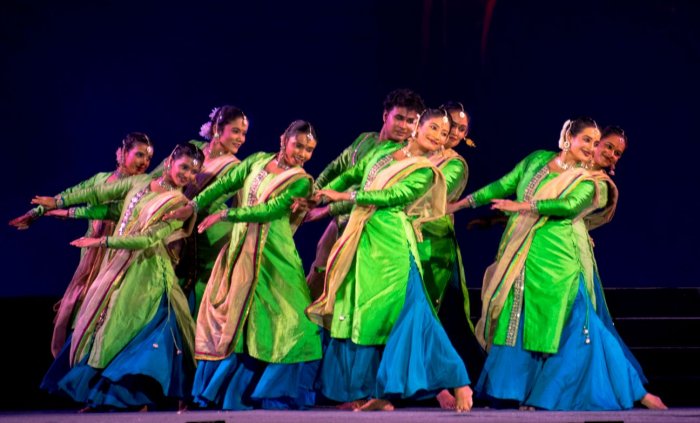
Shama Bhate's ensemble
Kathak Guru Shama Bhate with dancers of Nad Roop, presented her own
composition Anvesh, wherein she has explored dialogues between the North
Indian Kathak movement performed to music of other genres like Carnatic
music and also between Kathak rendered to Western Harmonic Symphony.
Generally, language of an area, and the kind of music it is expressed
in, as also the dance forms of the area in pace and gait, share a
distinct regional similarity. Bhate's attempt in making a unified
artistic statement through Kathak movement exploring contrasts and
similarities performing to genres of music pertaining to different
regions - like Tandem - wherein the dance was performed to Carnatic
music from South India based on raga Keerawani and the next item titled
Intrigue with Kathak designed to a blend of Symphony music and finally a
traditional Tarana from the Gwalior gharana. Both provided sparkling
Kathak - the clarity of footmark, and the fluid grace in which space was
covered, proving how naturally opposites can be reconciled,
complementing each other - given the challenging spirit spurred by the
right explorative creative urge. The troupe comprised dancers Ameera
Patankar, Shraddha Mukhade, Sreya Kulkarni, Pramod Wagh, Prachiti Bhave,
Nayan Kohalee, Mrunmayi Kulkarni, Shalaka Kango, Sanika Godse, Riya
Phadke with light design by Anoop Joshi.
Lok Chhanda Repertory
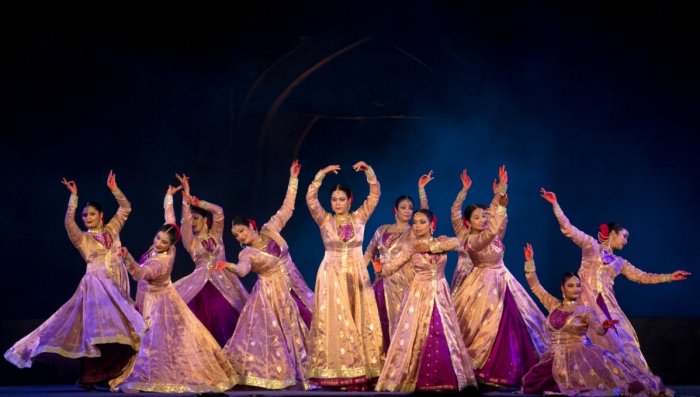
Heralding the curtain- raiser for the final evening was festival
designer Maitreyi Pahadi's Lok Chhanda Repertory Group in a
presentation designed by her. The immediate impression for this critic
was the tasteful costuming with the front of the peshwa during movement
gracefully parting to reveal the lehenga underneath in a contrasting
colour and the way the dancers held themselves right from the entry on
to the stage to the finale as their names were announced with each
taking a 'pirouette' in acknowledgement. It was the refinement and
finish of dancers Shailaja Nalwade, Ansua Majumdar, Shilpa Verma, Meera
Rawat, Apala Verma, Sonali Vishwakarma, Anchal Rawat, Happu Biswas,
Gauri, Muskaan and Nath Bharadwaj, that stood out.
Muralika demonstrated the eternal call of the bansuri swar of Krishna's
flute melody, which for the Gopis becomes the soul of existence - ever
beckoning, no matter in what swar, as they pirouette in ecstasy, even
while driven by a never-ending search. Neither theme nor dance is new,
but it is in the aesthetics of presentation by finished dancers, with
immaculate detailing in every aspect of presentation, that made the
group stand out.
Nrityagram ensemble
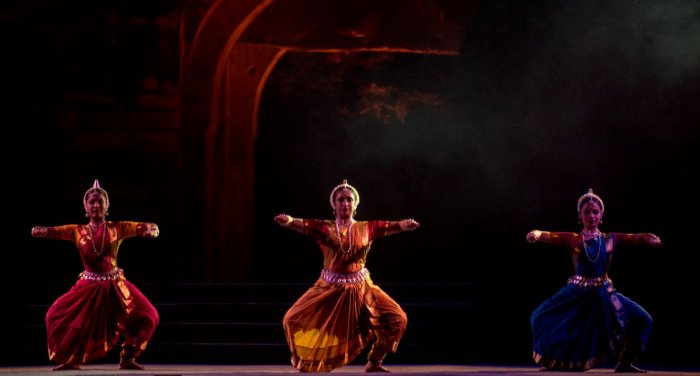
Nrityagram functioning in the quiet of its natural environs, away from
the madding crowds of Bangalore city, took the stage with just four
dancers, the seniormost and experienced Pavithra Reddy leading the
troupe comprising Anoushka Rehman, Daquil Miriyala and Namaha Mazoomdar.
It is strange how a feel of emptiness due to unoccupied ground space,
was to an extent ameliorated by live music filling sound space. For
Nrityagram, during all these years, the musical inspiration has remained
faithful to the legacy of veteran composer Raghunath Panigrahi, who
stayed and worked in Nrityagram for long stints during his post Sanjukta
days, with the other source being Pt Bhubaneswar Mishra, whose
contribution to Odissi music is immeasurable. The live team of musicians
comprised Jatin Sahu for vocal music and harmonium, mardal percussion
by Rohan Dahale also providing tuneful chanting and recitation of
ukkutas, Anup Kulthe on the violin, and choreographer Surupa Sen
conducting with the manjira.
Just a ta dheenaka theeni, or a kadatakadhi na dhin dhin na phrase
- the way it was uttered and with the four dancers with technically
flawless movement profile with the articulated tribhanga and the
isolated torso in fluid sideways movements (which was so predominant in
Guru Kelucharan's style), it was a wise choice to make the first
item entirely nritta based, with dancers covering stage space in
grace abounding movement and formations. This was followed by a
salutation to the Mother Goddess in her benign grace as Sharada,
Induroopini, Kamala dala, Sakala Kala Vilasini, as also in her
ruthlessly powerful manifestation as the killer of evil Mahisha - the
poetic part provided by the Aigiri Nandini prayer to Maishasuramardhini.
Latasana Devi and group
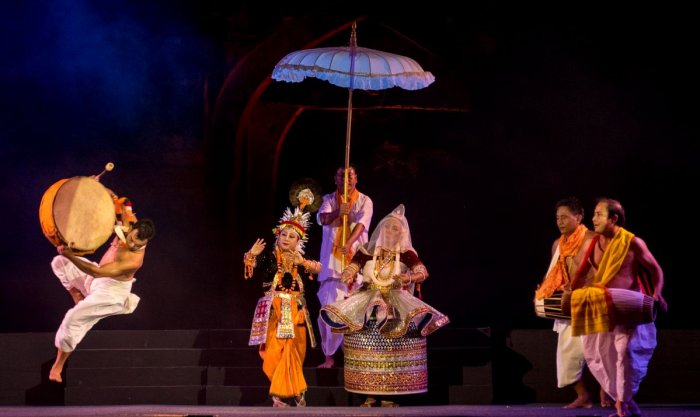
Manipuri of late Guru Bipin Singh vintage took the stage next. The Guru,
training students in Manipuri Nartanalaya founded in Kolkata, much
later established Govindji Nartanalaya in Manipur proper. Latasana Devi
and dancers of Kaina Foundation presented Ras Lila as visualized by
Bipin Singh with later contributions by his disciples Latasana Devi,
Darshana Jhaveri and others. The dance with its gorgeous costumes held
the audience enthralled. Next came the vibrant Pung Cholom wherein male
dancers simultaneously dancing while playing on the Pung percussion
slung from the waist, kept the audience engrossed and rounding off the
recital came Dhol Cholom. Regarded as a folk instrument, acrobatics spun
round the Dhol are a great part of the festival of Holi. The
aerobics of male dancers in spins, athletic leaps and jumps while
simultaneously beating the big drum the Khol, kept the audience
rivetted.
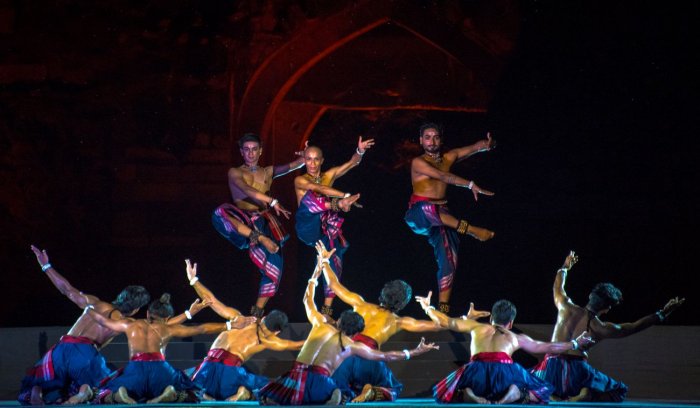
Vaibhav Arekar's group
Stealing the thunder and ringing a finish to the festival with a bang
was the group presentation in Bharatanatyam designed by Vaibhav Arekar
of Sankya. One of the finest choreographers, his group of dancers
comprising disciples of many gurus, all of a piece in excellent training
and trim bodied agility had Advith Shashidhar, Kedar Gurav, Nilava Sen,
Sachidananda Narayankar, Saketh Anna Sasane, Sarath, Shobith Ramesh,
Sreyas Nayar, Vidhun Kumar and Gautam Marathe. The performance was based
on the theme of Shiva as the unchanging consciousness dwelling within,
and as the Auspicious One who evokes varied responses, worshipped in
innumerable manifestations as Narankar, Nirguna on the one hand and also
as Shiva Shankara, Gangadhara, Neelakantha, Jatadhara, Chandramauli,
Karpooragandha, Chandrashekhara, Kapali, Vishwanathan et al. Shiva is
also the one representing and presiding over Time, Space, Energy,
Breath, Prithvi.
The rendition revelled in ever changing quicksilver formations, leg and
hand stretches in perfect linear geometry, with spirited footwork and
movements. With excellent group energy and with such an accomplished set
of performers, movements acquired an expansive quality, along with a
constant change in rhythm patterns. Few understand group geometry
as Vaibhav does and rendered to the fulsome music scored by Sudha
Raghuraman, with a play on words, dropping syllables one by one, and
then adding them on, ending with the Thillana in Poorvi
nirinirigamagarisa... notes the performance with bare topped, trim
youngsters in elegantly draped customary male costuming for
Bharatanatyam with oddyanam waist bands, had such elan, evoking
thunderous applause from the large audience. With costume designer
Sushant Jadav who also looked after the lighting, the performance lacked
nothing. Strange that with Vaibhav's own dancing, his training of
students and his group productions being of such quality, when viewed
against the proliferating Padma Shris and Padma Bhushans in the dance
field, this dancer has not merited even an SNA award!
With Sadhana Srivastava's experienced compering and given the large
space open to all, one must commend the efficient management of the
festival.
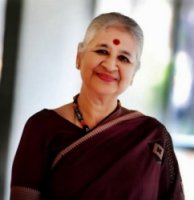
Writing on the dance scene for the last forty years, Leela
Venkataraman's incisive comments on performances of all
dance forms, participation in dance discussions both in
India and abroad, and as a regular contributor to Hindu
Friday Review, journals like Sruti and Nartanam, makes her
voice respected for its balanced critiquing. She is the
author of several books like Indian Classical dance:
Tradition in Transition, Classical Dance in India and Indian Classical dance: The Renaissance and Beyond.
Post your comments
Please provide your name along with your comment. All appropriate comments posted with
name in the blog will also be featured in the
site.
|