TAALAM
BY LEELA VENKATARAMAN e-mail: leelakaverivenkat@gmail.com
Retaining authenticity while catering to contemporaneity
October 11, 2026
It was a praiseworthy interactive initiative, spurred by Odissi dancer
Madhulita Mohapatra heading Bangalore's Nrityantar - to round off the
institution's annual celebration of Naman festival - with the invited
dance critics and art column editors from different parts of the
country, addressing the gathering of students in Bangalore's beautifully
appointed Presidency University, on the occasion of the Performing Arts
Colloquium 2026. The subject for the event Beyond the
Performance, what sustains an Art form, saw proceedings comprising
different aspects of this theme, allotted to each speaker. Opening
remarks, warmly welcoming the guests, came from the Vice Chancellor
Vidya Shankar Shetty, and Pritha Sanyal, Head of Presidency School of
Liberal Arts and Science, Presidency University.
As the opening speaker, on the theme of Art above the Artiste, I was
struck by the irony of having to address a gathering of youngsters, bred
in the prevailing climate of self-assertion, on how the Indian Art
Tradition believed in what the great Coomaraswamy eloquently referred to
as a self-conscious transcendence from self-identity. This non-
assertion of individuality (evident in India's innumerable architectural
wonders named after the great kings and rulers, with not a mention of
the artisans / artists who toiled for years to create these marvels in
stone, sandstone, marble et al) was not by volition, design or accident,
but flowed from the school of thought, right from the time of Bharata's
Natya Sastra. Little or nothing is known about author Bharata, to
whom is ascribed the earliest text, revered even today, as the most
authentic treatise on the Classical Arts inclusive of music, painting,
literature, sculpture and dance. The purpose of Art was to evoke 'rasa'
which referred to a state-of-being, above what was experienced in daily
life. Flowing from the distinctive dynamics of continuity of traditions,
universals going beyond time were evolved with art technique prescribed
in the Sastras. The entire discipline of dance from hasta, to eye
movements to mind resulting in emotion, leading to the pinnacle of
'rasa' (a kind of transcendental experience?), demanded total
involvement from the practitioner, the artiste's capacity for
evoking this 'rasa' depending on the prerequisite of submerging the
narcissistic 'I Ness' or ego, without which, aspiring for that state of
'ananda' or bliss was not possible. In dance, with the body (a
particularly vulnerable instrument) as the instrument of communication,
evoking 'rasa', becomes that much more problematic.
'Rasa' as a felt experience evoked by the artiste and enveloping the
audience, demands years of immersion in the art form, and to convey
through words, a state-of- being essentially involving the inner
artiste, is difficult. Shedding the feel of Self, prevalent in each of
us, for attaining a higher purpose, is to use a metaphor, like the
sculptor who instead of carving out the stone image, makes it stand out,
by scooping out and removing all the unnecessary stone around it. From
Being to Becoming, the dancer with the technique, is required to
eradicate the ego, to create that inner space and mental state for
experiencing 'rasa.'
Kiran Prakash, Resident Editor of the New Indian Express in Kochi,
touched on the question of catering to public memory, his concern with
culture journalism and public memory being with telling and publicizing,
the story of the Arts.
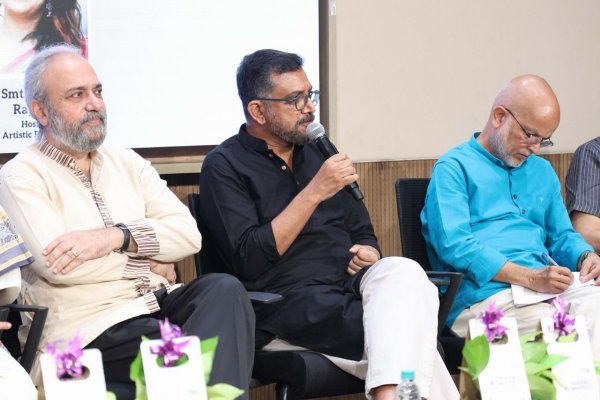
Ashish Khokar, Kiran Prakash & Shyamhari Chakra
(Photo courtesy: Presidency University)
V. Kaladharan, well known critic based in Kerala, stressed on the need
for the 'discerning eye' for keeping up standards in art forms. Art at
its best, for him cannot be made to cater to a neutral homogeneity,
acceptable to all, for such an aim to please can suffice at the popular
level rather than the artistic. Art for him was for initiated audiences.
He touched on legendary names like the Kathakali guru Kalamandalam
Krishnan Nair and Koodiyattam guru like Mani Madhava Chakyar, concluding
that serious criticism still mattered.
Tapati Chowdhurie, dance writer, on the theme of Witness and the Word,
dwelling on her experience under Guru Gopinath, stressed on the
importance of the Guru, who by example performing and teaching,
contributed in keeping the art alive while maintaining standards and
making suitable changes answering contemporary sensibilities.
Ashish Khokar, editor of the journal Attendance, in his spirited
fashion, referred to the need of the hour, for archives preserving the
memory and history of our dance traditions. Screening a short film on
his late father Professor Mohan Khokar (whose vast collection of
archival material on dance has been handed over by his family to the
IGNCA, where it is on display), he passionately advocated that
youngsters develop a special regard for memorabilia relating to the
arts, because of their associations with the history of the art form.
Without having an awareness of traditions, how does one sustain them?
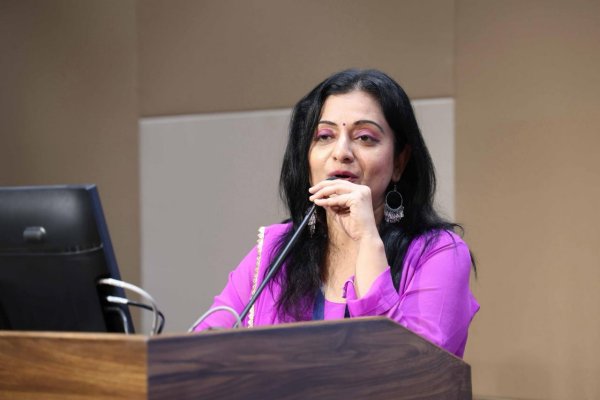
Dr Pritha Sanyal
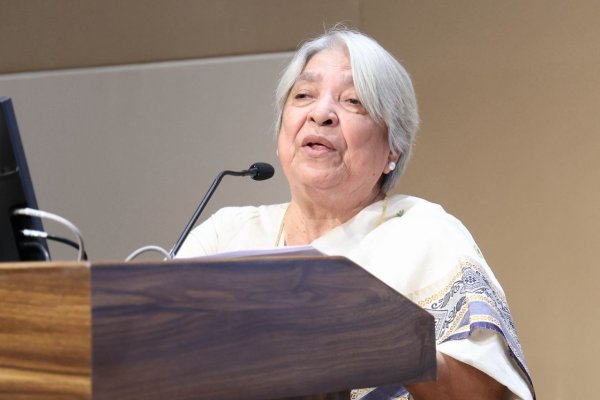
Tapati Chowdhurie
(Photos courtesy: Presidency University)
Dr. Pritha Sanyal stressed on why Arts belong in education, helping
groom and create culturally aware young minds. Very significant though a
tad long, was the talk Stone, Story and Stage by Dr.Choodamani
Nandagopal, art historian and scholar, tracing Karnataka's art history
continuum and how she, as a practicing dancer in her youth, got involved
in this documenting study and research.
Dance writer connected with the Hindu and other journals, Shyamhari
Chakra, voicing his deep involvement with People and the Changing World
of Odissi, brought out the pertinent point on how State support was a
deeply felt need in preserving art forms - and in this direction the
previous Odisha ministry by vigorously supporting the art forms of
Odisha, had given a special boost to Odissi and other arts of Odisha.
Kedar Mishra - poet, scholar and art commentator - touching on Beyond
Technique, Philosophy and Inner Life of Dance stridently argued for the
need for dance, as all Art, to express the hunger and thirst of the
times (instead of getting lost in time honoured themes) for after all,
even what we understand as 'tradition', while based on a technique and a
'margam', is a reconstructed entity in all forms of dance. He argued
that all art is politics, without which art is lifeless. As one who has
aided Odissi dancers in research work on manifold themes, his outsider
comments flow from his experience as an insider.
Rommal Singh, journalist on art for New Indian Express, speaking on
Audience for Dance, asked the pertinent question - Who is the audience?
You are! He pointed out the present situation in classical dance with
each dance genre having its own small clientele, going to see its
performances. Bharatanatyam people go to see other Bharatanatyam
performances and so it is with all the forms.
A more correct statement was never made - and this frog-in-the-well
attitude is widely prevalent. Having to constantly watch dancers
performing in large auditoria to audiences of 30 and 40 people makes one
sad. The gap in interaction between so-called elitist artistes and the
general public, needs to be removed.
While we may be a most enduring civilization, in the cultural melting
pot which our cities have become today, how to preserve the specificity
and quality of our art culture will always pose challenges. Art will
continue to exist at varying levels and cannot be made to cater to a
flat homogeneity, acceptable to all. SPIC MACAY type of endeavours of
taking the best of art to schools and colleges, need support - to bridge
gaps between dancers and the general public. Instead of being the
elitist high, dancers need to interact with people from various fields
and Madhulita's method of an informal luncheon get together on the
terrace of her home, without the starchiness of formal performances in
the auditorium, encouraging the students to ask questions, with the
guests with dance scholars and writers stating their points of view, is a
very fruitful way of lessening the distance between scholars, critics,
students and performers.
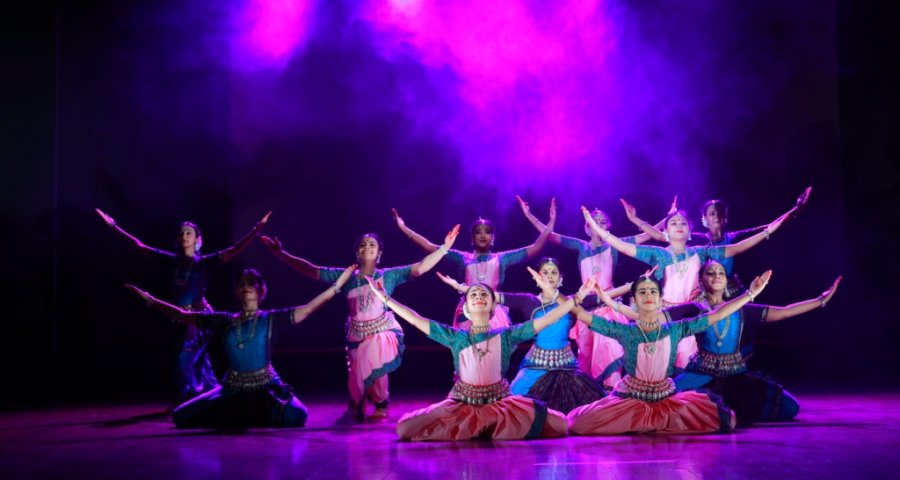
Shoonya to Sufi (Photo: Srivatsa Shandilya)
One saw the desire for bringing varying mindsets together in Madhulita's
entire festival, with her choreography expressing concepts like Shoonya
to Sufi built round the Adhvaita concept, extolling the lone light of
the almighty, shining equally on all mankind - underlining the idea of
harmony of faiths - Tam eva bhatam anubhati Sarvam,tasya bhasa sarvam
idam vibhati, presented by dancers Angeleena Avnee, Saanvi Sahoo,
Sreyashi Dey, Aditi Das, Devika, Reshma, Nandana Sashikumar, K Reddy,
Priyanshi Meher, Natania Sharma and Hansini.
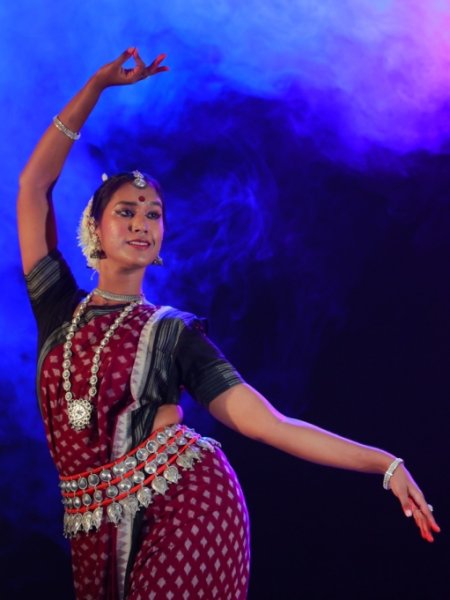
Vivekini Das
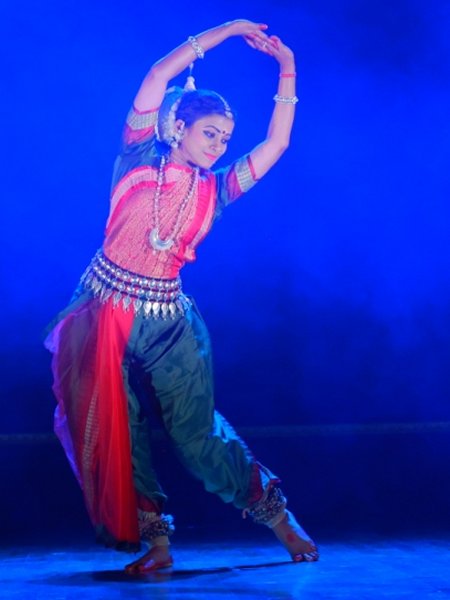
Debabrata Dutta
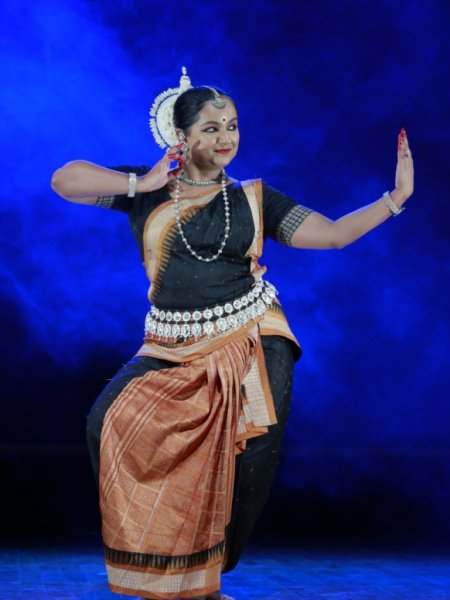
Meghna Das
(Photos: Srivatsa Shandilya)
Having trained under several Gurus starting with Gangadhar Pradhan
followed by Aruna Mohanty, Pabitra Kumar Pradhan and Krishna Chandra
Sahoo, Madhulita's festival of Naman featured dancers from other schools
of Odissi like those of late Guru Kelucharan Mohapatra, Ratikant
Mohapatra, Guru Debaprasad, and Durga Charan Ranbir - this inclusivity
extending to the entire Odissi fold is a feature characteristic of
dancers like Aruna Mohanty. The opening day saw a host of Pallavis
rendered solo by the more senior dancers - with Madhulita's student
Vivekini Das presenting the Malhar Pallavi (music by Bijay Kumar Jena
with rhythmic part designed by Vijay Kumar Barik). Debabrata Dutta
presented Megh Pallavi in Jhampa taal, with dance designing by Ratikant
Mohapatra. Bageshri Pallavi with the choreography by Bijayini Satpathy
was presented by Meghna Das. The tribute to Shiva describing him
"Nagendra haraaya, trilochanaaya" based on Ramhari Das's music
composition in Ahir Bhairav set to Khemtatal, with dance envisioned by
Aruna Mohanty, was rendered by Sonali Mohanty.
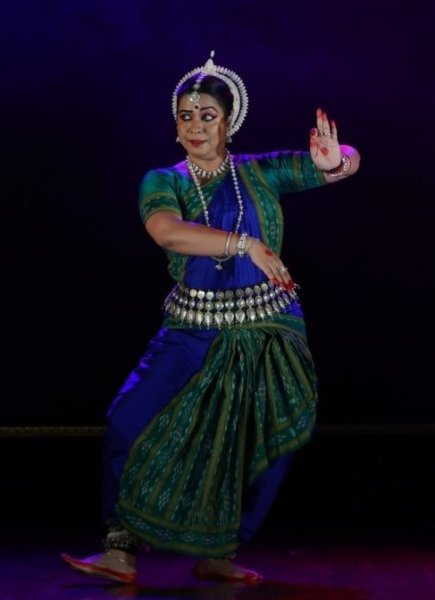 Sonali Mohanty
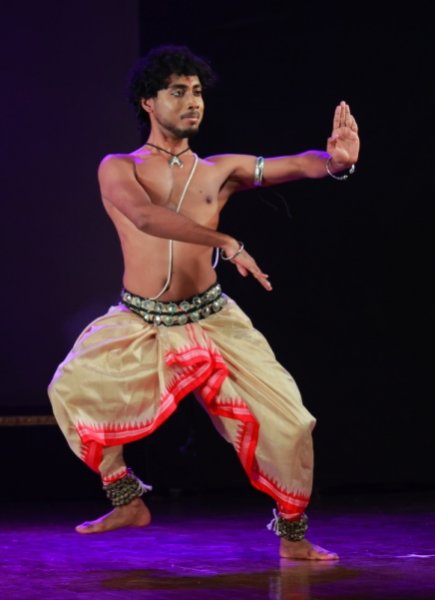
Prasun
Mondal
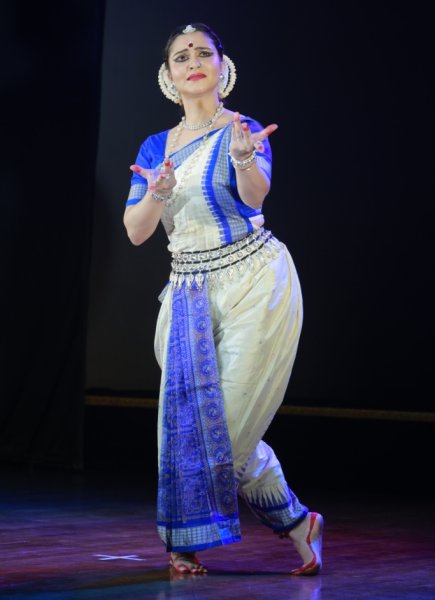 Paridhi
Joshi
(Photos: Srivatsa Shandilya)
Yet another prayer to Shiva as the dancer Nataraja, Shivam dheemahi with
scripting and inputs of Nityananda Misra was rendered by Prasun Mondal.
The Gita Govinda Ashtapadis presented were "Yahi Madhava Yahi Keshava"
showing Radha as Khandita Nayika berating Krishna for appearing late at
her door with the tell-tale signs of a night spent with another nayika.
Set to Ramhari Das's musical score in Bhairavi, Paridhi Joshi rendered
the dance and abhinaya rendered to Debaprasad Das' choreography. The
other Ashtapadi from the Gita Govind "Sakhi hey Keshi mathanamudaram"
with music by Rupak Kumar Parida in Misra Khamaj with rhythm set by
Dhaneswar Swain was rendered with a group of dancers, instead of just
the sakhi and Radha in dialogue. The abhinaya in parts like Radha in the
heat of her desire, confiding in the Sakhi about the first intimate
encounter with Krishna and how deftly he had made her overcome her
extreme shyness, got somewhat diluted.
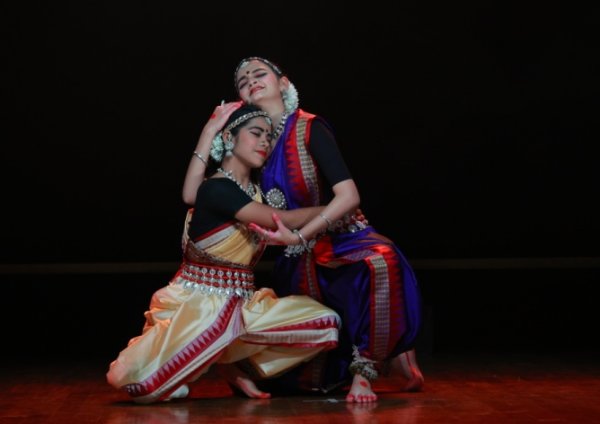
Legend of Dharmapada (Photo: Srivatsa Shandilya)
Legend of Dharmapada telling the story behind the temple of Konark, with
lyrics by Nabakishore Misra and composed by Satyabratha Katha, with the
rhythmic part devised by Ajay Kumar Choudhary and Sowbhagya Narayan
Chotray, was enjoyed as a narrative by the audience with the part of boy
Dharmapada creditably played by very young Saanvi Sahoo, with the role
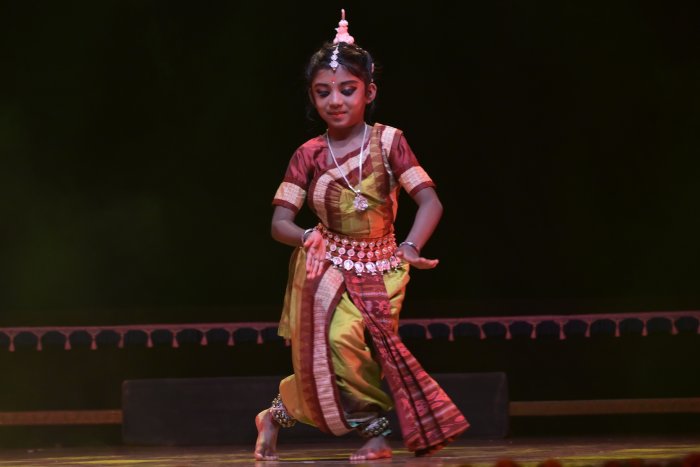
of the chief architect taken by Sreyashi Dey. One found little Mihika
Mahnoor, Madhulita's precocious five-year-old daughter doing her little
bit by aping boy Dharmapada. She had her formal debut the next day
as Nrityantar presented its major Dashavatar production.
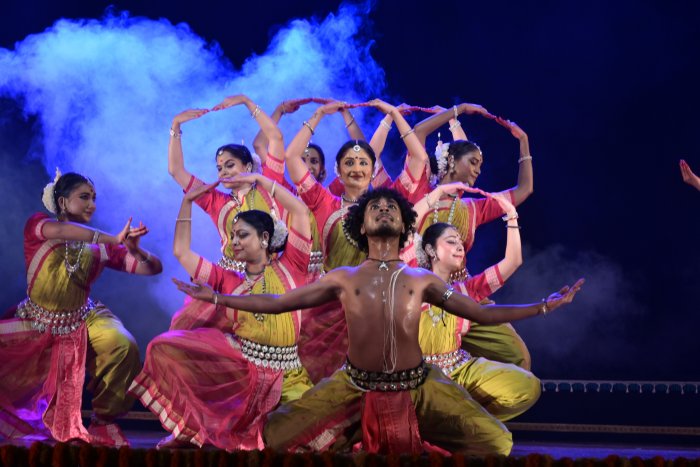 Nrityantar ensemble in Dasavatara
 Mihika Mahnoor
(Photos: Srivatsa Shandilya)
Based on the very familiar text of the Gita Govindam, Madhulita in her
choreography of dance theatre, converted this sedate religious text into
a highly dramatized narrative in the manner of virile folk traditions
of Odisha like Daskatia - wherein the ten incarnations of Vishnu, in the
narrative, acquire an added virile rhythmic zest, with the narrator
wielding the wooden clappers or castanets held in the hand. The
preparatory research comprised Kedar Mishra's Odiya text added on to the
Sanskrit original, with Rupak Kumar Parida's musical inputs and
Dhaneswar Swain's rhythm. The entire enactment with the involved
students in quick changing group arrangements, revolved round the ever
present refrain that when evil burdens the universe, the Lord will take a
form to appear in this world, to crush evil and reestablish the power
of the law. Referring to this innate faith and hope, poet Shelley
ironically noted - Hope lies eternal in man's breast, Man never is, but
always to be, blest. The entire crew of students, including Mihika in
her debut as young Prahlad, unshaken in belief in Narayana, despite
father Hiranyakashipu's tyranny, gave off their best.
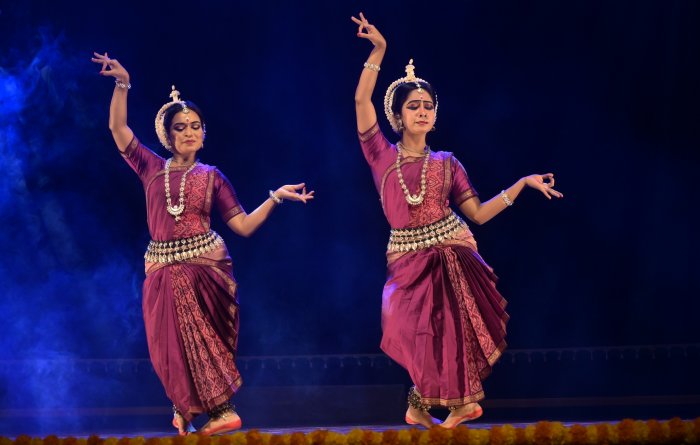
As is her wont, Madhulita's festival invited guest artistes like
Rajashri Praharaj trained under Kelucharan Mohapatra and now under the
guidance of Ratikant Mohapatra, and Preetisha Mohapatra, daughter of
Sujatha Mohapatra and Ratikant. Their duet had the start with Ratikant's
reworked version of the Yugmadwanda Pallavi in Bageshri, based on
Raghunath Panigrahi's music, with dance choreography by Kelucharan
Mohapatra. With the history of this Pallavi, as the favourite of late
Sanjukta Panigrahi, with its jawab / sawal type of competition between
dance and music, the Ratikant choreography evinced a duet, flawlessly
rendered by the two dancers. The interpretative next half based on the
Ramayana, dilated on two scenes of Sita Swayamvar and the final Rama /
Ravana duel with music by Pradip Kumar Das. Combining in smooth
efficiency, with every move perfectly silhouetted, with the right
abhinaya, both dancers showed the results of excellent grooming,
combined with perfect understanding regarding the spacing for the duet.
Altogether an impeccable performance!
 Rajashri Praharaj & Preetisha Mohapatra
 Leena Mohanty & Debasish Pattnaik
(Photos: Srivatsa Shandilya)
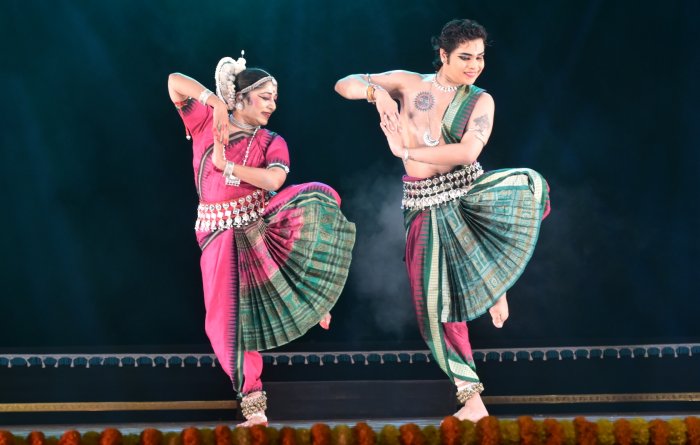
The next artiste Leena Mohanty, Head of Odissi department of Kalpana
Dance Theatre of Malaysia, a student of Debaprasad Das and now under
Durga Charan Ranbir, in partnership with another student of Durga Charan
Ranbir, Debasish Pattnaik, presented a Pallavi in raga Madhymadi, set
to Ektali. A nritta based item, fashioned round the mood of Shravana,
the presentation involved through pure rhythm, a sringar like
interaction between the dancers. For this writer, Debasish's facial
responses tended to be somewhat exaggerated. The duo ended with
Debaprasad Das' famous creation "Jago Maheswara." Dr. Dheeraj Kumar
Mohapatra's music in raga Gundakriya set to a talamalika, is woven round
the greatest Yogi Shiva - clad in ashes, with the Ganga and crescent
Moon perched on his matted locks. The song is an awakening call to the
dweller on the cremation grounds, worshipped by demons and goblins. Here
the situation as represented in the composition, could have
accommodated a stronger emotional response than seen.
This camaraderie among dancers of different schools, like Madhulita
vibing with people of varying denominations, particularly with
universities with intelligent young minds, is the way to spread the
message of the dance. Where one wants to place oneself - as a totally
tradition- bound performer or one with ideas answering today's world of
challenges, is the artist's choice in a free country.
PROMISING SOLOISTS IN LASYAAYAN'S RAGANGA FESTIVAL
It is amazing how Odissi, having caught the imagination of the dance
loving world within the span of seventy-five years, has been steadily
attracting a larger clientele of dancers. At the Shri Ram Centre, Delhi,
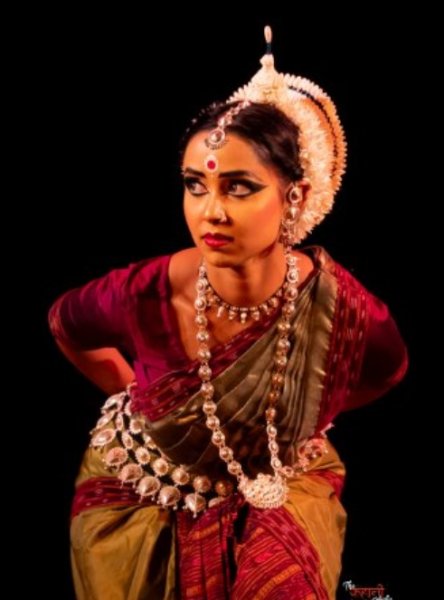
Lasyaayan, the Odissi institution headed by dancer Shimran Zaman,
presented their Biennial Raganga Festival.
Shimran Zaman
Shimran Zaman herself inaugurated the performance, after formalities of
greeting and presentation of the Lasyanga award, with Mangalacharan
having after 'Bhoomi pranaam' the "Angikam Bhuvanam" hymn, with
salutations to Shiva, who with the cosmos as his theatre, is the Lord of
cosmic activity, the central motif of his dance representing creation,
preservation, destruction and grace. Rendered to music by Satyabratha
Katha and Shibananda Barik providing percussion on the mardala, the
recitation of the ukkutas added its own melody. This was followed by the
mimetic item descriptive of Krishna's dance emphasizing Odissi's
tribhanga, Ki bhangi kolla se ja banki chahilla. With good technique,
the mood of hide and seek of mild flirtation, as the Gopis watch and
delight in Krishna's dance, was sensitively caught in Shimran's
abhinaya.
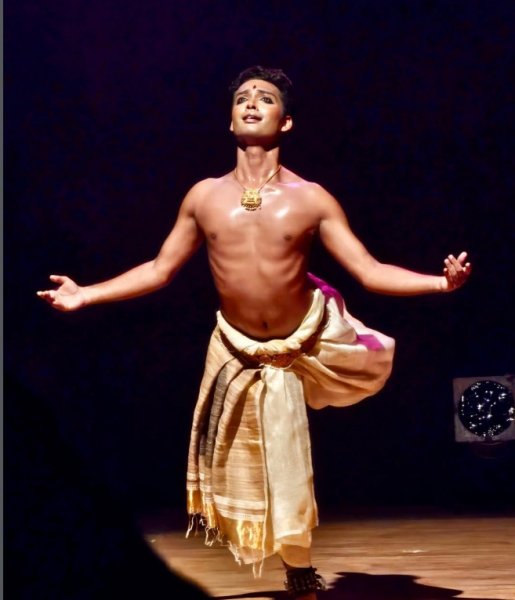
Nilava Sen
The next part was a Bharatanatyam solo by Nilava Sen, a student of Rama
Vaidyanathan. His presentation emphasized the eternal bond between the
individual and the Supreme consciousness - here in the form of Krishna's
flute music reverberating through the Universe - with every living
creature from man to the birds, the peacock, the deer et al rivetted by
the divine music, the repetitive musical line Murali naad sunao in
Hameer Kalyani, set to adi taal. Along with other students of Rama, the
dancer shares the quality of assertive command over line and nritta,
particularly in the jathi interludes. What struck this critic, was the
idea of body as a neutral instrument of the dance, taking on the gender
the dancer endows it with. The dancer, in this case could not have been
more female in abhinaya, portraying Gopis in sringar, decorating
themselves and seeking Krishna. Altogether a very enlivening
performance!
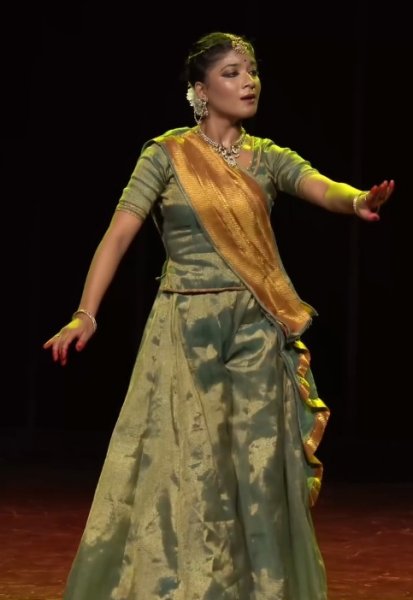
Moumita Ghosh
Equally well-crafted was the Kathak solo by Moumita Ghosh, whose Kathak
training has been under several teachers starting from Pt Birju Maharaj
to Deepak Maharaj and Saswati Sen. At present, she is working with Aditi
Mangaldas' Dance Company. Her presentation titled Antar Dhwani
concerned the inner journey of an artiste. The dance music comprised
sounds emerging from a stream of consciousness. It caught in flashes,
echoes and images from the past - from the start with hair being pulled
and being told that nothing moves without the Guru's teaching. She moves
to lingering sounds of lines woven round Takathai tatthi - with simple
rhythmic passages woven round Kharbooja and Santra. The journey creates
expectations, with doubts about many aspects and of feelings of
nothingness. The music with the way chakkars and movement, softly
executed, communicated varying stages of the artiste's response to the
dance, showed creative imagination. There were snatches of the
Nasadiya Suktam (129th hymn from the 10th Mandala of the Rig Veda)
with the profound philosophical hymn exploring the origins of the
Universe - the time beyond existence and non existence - when no cosmic
elements existed. With time, doubts give way to other aspirations,
Gradually, the Tarana sounds indicate that nothing in the world stops
for anyone. A dancer's life is like dice play - up one movement and down
the next. But as the dancer's mind begins to have clarity about her
place in the dance, the performance acquires a more set pattern. A
Kavit follows - finally ending with glory and benediction to the Guru,
"Meri Awaaz hai pehchaan...." Punctuating Kathak chakkars at varying
speeds can suggest many thoughts beyond being part of virtuosity in
technique. Taking an abstract theme like this, Moumita showed a maturity
utilizing Kathak for an inward looking theme.
The concluding session by the students of Lasyaayan, while showing
varying standards, shared one uniform quality - of great enthusiasm for
the dance. It was heartening to see even male dancers taking to the form
- one after hardly five months of learning showing, despite the need to
further polish the dance line and tribhanga, an inbuilt joy in
participating in the art form.
With all its enthusiasm, Lasyaayan must develop greater respect for the
clock. What was publicized as starting at a certain hour, did not begin
till half an hour later. Time consciousness is a must, specially for
accommodating people coming from far off places overcoming the traffic
mad roads of the capital.
Writing on the dance scene for the last forty years, Leela
Venkataraman's incisive comments on performances of all
dance forms, participation in dance discussions both in
India and abroad, and as a regular contributor to Hindu
Friday Review, journals like Sruti and Nartanam, makes her
voice respected for its balanced critiquing. She is the
author of several books like Indian Classical dance:
Tradition in Transition, Classical Dance in India and Indian Classical dance: The Renaissance and Beyond.
Post your comments
Please provide your name along with your comment. All appropriate comments posted with
name in the blog will also be featured in the
site.
|