TAALAM
BY LEELA VENKATARAMAN e-mail: leelakaverivenkat@gmail.com
Malavika Sarukkai's inward journey into dance/space relationship keeps audience spellbound
September 24, 2026
Speaking of a world she inhabits, where dance is the language of
communication, Malavika Sarukkai's talk at the IIC titled Dance Speak,
held a rivetted audience enthralled. Totally divorced from textual
theory and based entirely on her own intensely personal journey into the
relationship of how dance sculpts and interacts with space, she had
arrived at the conclusion that 'Space and Dance were partners'. Dance
for her had become a language. Her natyadharmi, she discovered, was
decided by space. Mudras and hastas don't speak by themselves. The
gravitas of a hasta stems from its placing in space - as for example
showing a 'sitting bird', just holding the mudra is not enough.
One has to make the hand in hasta travel through the air and settle down
to convey and suggest the message of a sitting bird. It is the
elaboration of the hasta and its movement and placing in space, that
conveys the full meaning.
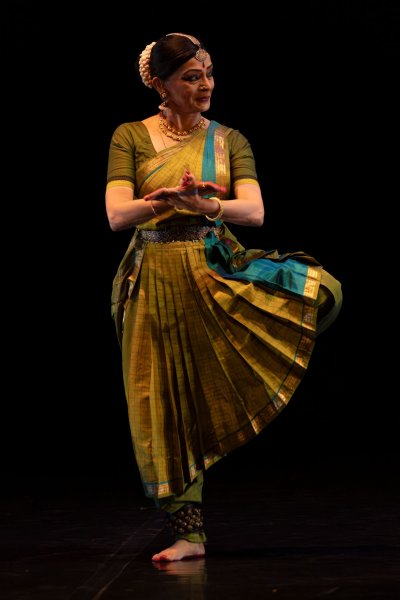
Malavika Sarukkai (Photo: Innee Singh)
The dancer's references to rhythm in space, were demonstrated with
riveting examples. Taking part of a trikala jathi from a varnam, she
showed how in Indian dance, the grounded dancer is constantly in
partnership with floor space - with feet planted on, and tapping
the floor, drawing energy from the Earth - the timing in the
foot-tapping a constant indulgence in a kind of Poetic Maths, to use a
phrase used by Malavika. In a rhythmic cycle, apart from the arithmetic
based on the language of syllables, the feet tapping, softly or
emphatically, with changing accents, provides different patterns of
rhythm.
Giving an example from late C.V. Chandrasekhar's creation Sthiti Gati,
the dancer showed how in a rhythmic cycle, by playing round with
shifting accents, the dancer can evoke different emotive tones through
the rhythm - the treatment, with the same sollukattu suggesting moods -
sombre one moment and playful the next. And in evoking these tones, the
nattuvangam narration of the sollukattu is as involved as the
percussionist's playing on the mridangam or whatever percussion - the
long time mridangist in this case being Nellai Balaji, who with years of
association with Malavika' s dance, vibes well with what she wants to
convey through the dance. The nattuvangam was by Neela Sukhanya and violin by Venkat Subramaniam.
The vocalist Krithika Arvind through the words of the sung composition is a prime
co-artiste, contributing to the totality of mood, with her bhav soaked
music. From a feeling of being commanded by Space (Space commands me),
the dancer has arrived at the conclusion that she dances with Space and
that the dancer and space are partners.
In the Dance and Space connection, the demonstration and talk touched on
the aspect of dance being a combination of movement and stillness, with
the dancer referring to the very subtle and significant aspect of the
connection between the two. One can sense movement in stillness just as
one can convey stillness through movement. She gave the example of a
bronze statue of Nataraja, which in the stillness conveys a strong
suggestion of movement. So it is with movement in dance, which can
suggest stillness. What is the secret of that dynamic element or that
Prana, which enables the suggestion of movement in a still bronze or for
that matter a stone statue? The speaker mentioned the most important
criterion - which is of 'dancing with complete awareness', by which
alone can one impart to motion that quality of stillness.
The silences when there is no movement also speak. Taking an example of
Nachiyar Tirumozhi, Malavika described a scene where maidens building
sand castles on the seashore, see Krishna for the first time. The
reaction of the maidens is a blend of emotions and the dancers struggle
to cope with "inner sand castles of emotion".
The involved accompanying artistes totally in sync with the dancer, help
create a synergy wherein music, dance and percussion, through silences
and movement, convey the mood. Drowned in Krishnaness as the dancer
called it, the scene from a composition strung to music by Rajkumar
Bharati, describes the bewitched maids, referring to Krishna's lotus
eyes, his mischief in flattening out the sand castles built, his speech
and deeds (ungal pechhhum seikaiyum). Diving deep into the
possibilities suggested in one phrase or sentence, the totally involved
dancer while treating space to silences and movements, is propelled by
the mood buildup of spaces created in several spheres of the poetry, of
the music rendition, of rhythmic syllables and of percussion. It is this
totality of involvement, along with expanding inner spaces in the
dancer's consciousness, which lead to a better understanding of Space
outside.
Based on the music of Sitarama Sharma, the scene from Srimat Bhagavatam
of the scene of Krishna's battle against the serpent Kaliya who by
poisoning the waters of the Yamuna river is causing the large scale
destruction and death. The demonstration was a statement on how dance
demands a total immersion (much like the serpent and those in the river
for various reasons) in the moment - and it involves the inner dancer -
the elaborations built round rhythm and movement in a space, making the
dance speak. Awareness which, through years of hard discipline,
gradually seeps in, awakens space inside the dancer's mind, which paves
the way to a deeper understanding of the full relationship of dance in
space and ultimately with space.
The conclusion with Taanam was a benediction, a prayerful thanksgiving to the powers that be, for grace and rain.
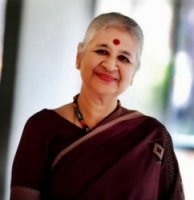
Writing on the dance scene for the last forty years, Leela
Venkataraman's incisive comments on performances of all
dance forms, participation in dance discussions both in
India and abroad, and as a regular contributor to Hindu
Friday Review, journals like Sruti and Nartanam, makes her
voice respected for its balanced critiquing. She is the
author of several books like Indian Classical dance:
Tradition in Transition, Classical Dance in India and Indian Classical dance: The Renaissance and Beyond.
Post your comments
Please provide your name along with your comment. All appropriate comments posted with
name in the blog will also be featured in the
site.
|