TAALAM
BY LEELA VENKATARAMAN e-mail: leelakaverivenkat@gmail.com
Individual dance creations of compelling resonance
September 19, 2026
VILASINI NATYAM PREMIERE
Photos: KDC, Delhi
It all started at the Stein auditorium of the Habitat with a stunning
solo premiere in Vilasini Natyam by veteran dancer Swapnasundari,
followed by a group presentation of her creation of temple dance in the
Agamic style. The evening constituting an annual in memoriam was under
the aegis of The Madhavi Foundation instituted in the name of Madhavi
Gopalakrishnan - a lover and sponsor of the arts, with the yearly homage
as pitra rin mounted by her ever grateful and admiring offspring - Rama
Vaidyanathan, Meera Khanna, Indira Nair and Colonel Ravi Nayar.
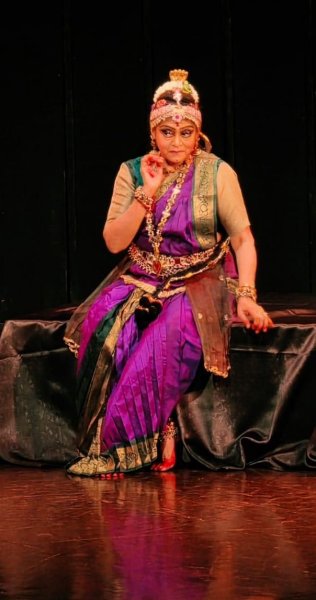 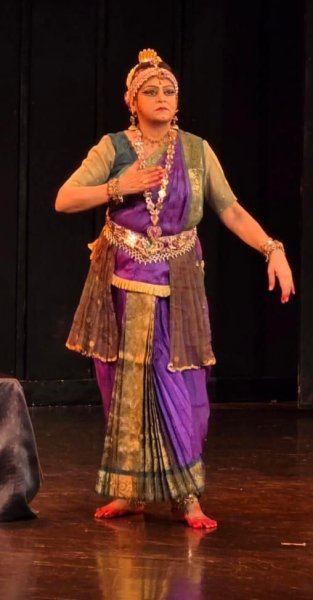
Swapnasundari
Known for the encyclopedic range and depth of scholarship, it is hardly
surprising that Swapnasundari's Vilasini Natyam, in presenting the scene
of heroine Satyabhama's entry, should be based on her findings and
research of one of the oldest librettos (banned by law) with gadhyam,
padhya, slokam, daruvu of Parijataapaharanam - acquired from another
researcher - the work ascribed to Siddhendra Yogi himself by Kuchipudi
followers, having had several Telugu authors. As she enters proudly
saying Na peru Satyabhama, the range of the dancer's improvisation could
only come from one who combines musical knowledge with aesthetics of
movement into a true theatre of imagination. The metaphors used to
describe the sharp nose, the satiny texture and mirror like transparence
of the skin, the slender tiger's waist, the conch shell like neck, the
long braid, the lips had to be seen to be believed!
What made for very informative interludes were the explanations from the
text further embellishing the performance. While describing Lord
Krishna - and the jewellery adorning his person, the references to
precious stones like earrings with pearls from Iraq (!), a reference to
the Strait of Hormuz (!), rubies (Kempulu) shaped by gem cutters from
Gujerat - Madana Mohana Rayude, Satyabhama in the chokkili nokku muttu
pettina phrase shows how Krishna kissed her on the lips!
"With all this, why did he leave you," Satyabhama is asked and she
mentions the incident of the two seated on the swing when Krishna asked
who of the two of them was better looking - and I proudly replied that
it was I, of course, upon which he left and has never returned.
Finally comes the lekha part when Satyabhama sits down to pen a letter
to the Lord, expressing her feelings. Interspersed moments with
Swapnasundari's dulcet singing - as notes of Mohanam, Kamboji, Vasanta,
Arabhi, Atana et al flowed making this an unforgettable performance.
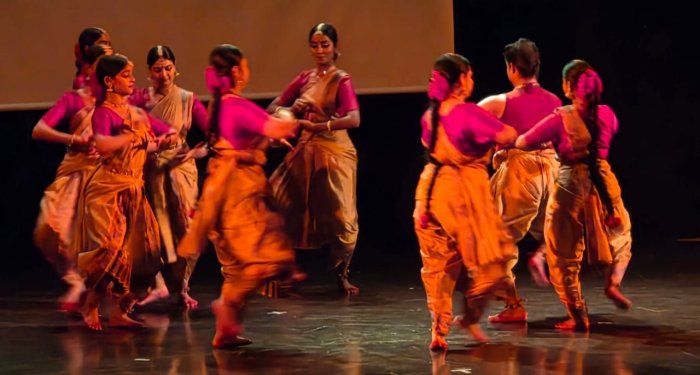
Agama Bharatam
The second part of the evening based on her transcreation and
choreography of Agama Bharatam as dance worship in the Sri Ranganatha
Swamy Temple, was performed by a group of dancers from her institution
and from Ganesh Natyalaya (where she had conducted a workshop on this
subject and had taught students of Rama Vaidyanathan).
Dance connected with temple worship had long ceased, and Swapna's
research into this aspect involved months of looking for shards of
information, on what goes back to pre-Vedic period according to some,
concerning ritual in temples. Not even the priestly pariwar could
provide details she sought - and it was through painstaking research
into libraries, long travels to temples and whatever bits of information
she could gather that Swapnasundari finally has succeeded in putting
together a set of movements of worship - not pertaining to any
prescribed textual form - but based on her own creative imagination. The
entire effort comprised an evening of amazing history and information
into special ragas and talas assigned to each deity, all of which the
dancer has created in her handiwork of Agama Bharatam.
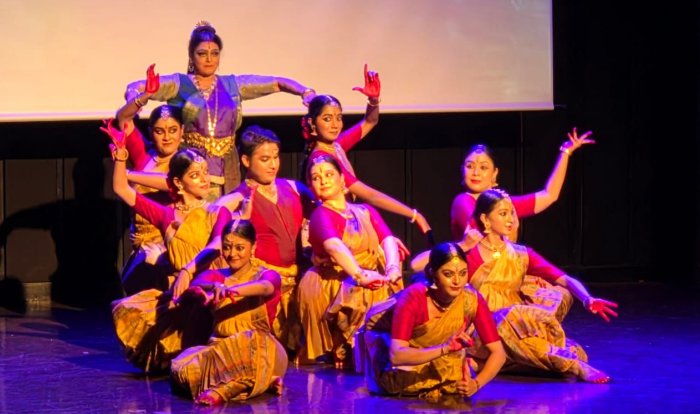
Agama Bharatam
After the opening Sarve jana sukhino bhavantu, the offering of
ashtavidha pushpams and prayer to Ganesh, followed offerings to
Indra (striker of Vajrayuda), Agni (Lalita ragam and veeravikrama
talam), Yama (Malahari ragam and choodamani talam), Varuna (Megharanjani
ragam), Vayu (Vasanta Bhairavi ragam), Kubera (Sri Ragam, turanga
talam), Ishana - the guardian deity regarded as one of the forms of
Shiva guarding the North east - worshipped to attain moksha and to be
freed from rebirth (nandi talam, Shankarabharanam ragam).
Rare talams one knows little about made this a fascinating evening and
it must be said to the credit of the evening that the students combined
with excellent group discipline, the dancing spearheaded by a sense of
deep involvement.
PARABOLA OF DANCE
Aditi Mangaldas' generous initiative in starting what she has named
Parabola of Dance, featuring creative efforts by dancers pertaining to
different dance traditions, with the performance part succeeded by
discussions on the constantly evolving process behind these creative
enterprises, has been attracting larger sections of dance lovers. The
encouragingly growing audiences with ticketed shows where half is taken
by those making their spaces available for the evening, with the other
half shared among the artistes for their contribution, hopefully will
bring in more deserving compensations for dancer efforts.
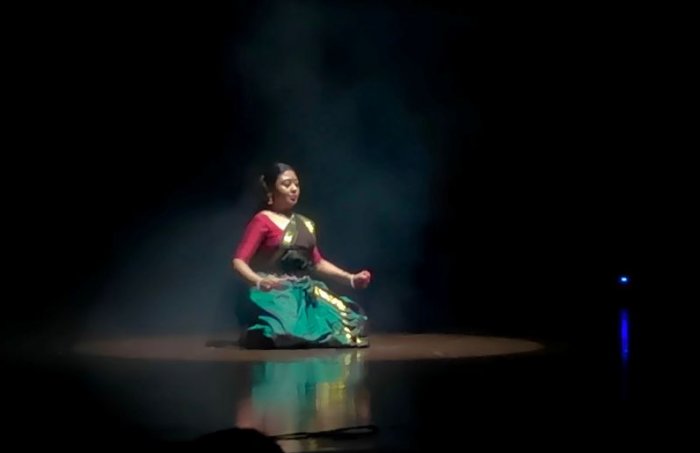
Sayani Chakraborty (Photo: Avinash Mishra)
The interesting evening began with Bharatanatyam dancer Sayani
Chakraborty, choreographer and founder director of Dhrubha Institute,
and a student of Rama Vaidyanathan, presenting Matangi/The twin
side. One of the Dasha Mahavidyas, Matangi is regarded as the
tantric version of Goddess Saraswati, explaining the dual-aspected
nature. The performance began with the Beeja mantras representing
the Uchhistha Bhoga, unfolding the esoteric chakra Yantra of Matangi
with the bindu. IN her benign form as the embodiment of knowledge, the
arts, and speech (Vakdevata), and beloved of Lord Shiva, she is Raja
Matangi and Satya Vahini, who also nurses a fierce aspect of Uchhistha
Chandalini. And it was this twin aspect of grace combined with ferocity
that the dancer caught in her dance successfully. The music composed by
Dr. Durba Singh Roychoudhury who also provided vocal support, with Aswin
Subramaniam's rhythmic inputs on the mridangam along with nattuvangam
with Srivatsa's veena, helped mood buildup. This was an aspect with
recitations of syllables, raga music, with fleeting taanam bits and
rhythmic passages and this could have been one of the aspects
highlighted in the discussions which were somewhat subdued, though
Sayani's nritta in particular, like her guru, has an emphatic quality.
In fact, with all this preparation, the overplayed lighting was a
distraction.
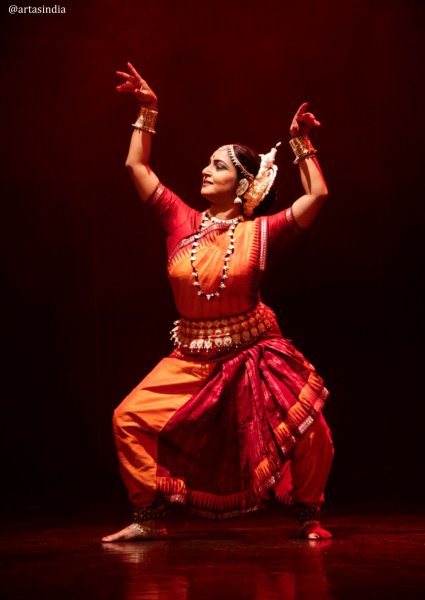
Swapnokalpa Dasgupta (Photo: Arijeet Mukherjee)
As an Odissi dancer, Swapnokalpa Dasgupta, now working as Head of Dance
department at the prestigious NCPA, is a very strong communicator. She
too chose a theme centered round Devi - whether by chance or design.
Speaking of the Bengali's fondness for Kali, her choice of Kali Tandav
Stotram (written by Shankaracharya) was despite her mother's warnings
not to mess around with Kali, who is the chief matrix from which the
Dashamahavidyas rise. Swapnokalpa's tribute is based on Shakta/Shyama
Sangeet traditions - profound genre of Bengali devotional music
dedicated to Kali the Divine Mother goddess. Based on Shaktism where
supreme power is female, this musical movement has made intimate
folk-based melodies out of complex tantric philosophies. Combining the
metaphysical with the devotional Kirtan as in Baul music, the Goddess
associated with burning skulls and fierce forms becomes an approachable
Mother.
The dancer spoke of the Agamani and Vijaya songs sung to celebrate the
daughter's homecoming to her parents' house. Performing to N.N.
Shivprasad's music with his combined Carnatic and Odissi background,
with Vijay Tambe's flute and sitar by Shuklaji and mardala by G
Ramprasad, her creditable presentation apart from the known images of
power and grace associated with Kali, showed the Goddess without the
tongue hanging out. In a fleeting stance of Kali with the garland of
severed heads, one needs to remember that Chinnamasta (of the
Dashamahavidyas) portrayed with her own severed head signifies the
eradication of all self and ego - as different from Kali whose
association is with after life - hence the burning ground. The only
regret was that at times the lighting dulled the strength of her
mukhabhinaya.
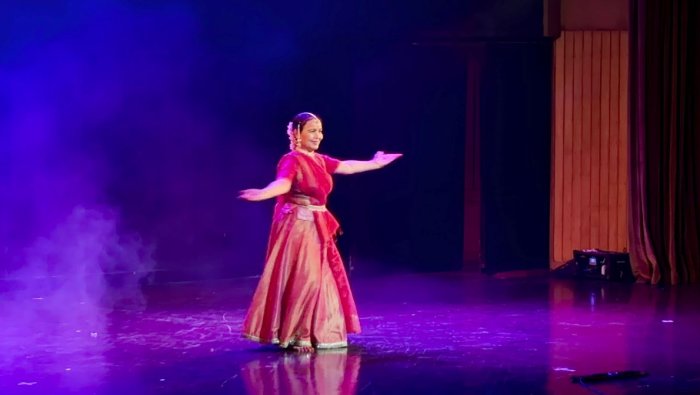
Malti Shyam (Photo: Avinash Mishra)
The evening could hardly have wished for a better finale than Kathak
choreographer/and dancer Malti Shyam's conceptualization of
Baajo-re-Baajo, based on a traditional composition of chota Khayal set
to raag Shudh Kalyan. The awareness and appreciation of music always
makes for a more sensitive dancer, and Malti Shyam's students are
emerging more and more with that refined element coming from musical
knowhow, imparted in them by the teacher. Malti herself, sans a shred of
I ness, is an intrinsically evolved artiste - and this composition
driven by the sound of the mandala, an instrument played during
auspicious and festive gatherings, evoked a deep sense of collective
joy. The chakkars of Kathak flowing as a natural part of movement, cut
out the feeling of virtuosity for its own sake.
The spontaneity, grace, and clean lines of dance of the group led by
Malti, comprising Ashwini Soni, Gauri, Anchal Rawat, Nikita Vats, Dolma
Gupta, Harshita Sharma, with music arrangement by Malti Shyam and Jay
Dadeech with Jay Dadeech's vocal and harmonium, tabla by Aman Ali, flute
by Kailash Sharma, sitar by Amitabh Chatarjee, sarangi by Ehsaan Ali,
padhant by Harshita Sharma turned out to be a clean winner, exuding joy
and togetherness. With Rachna Yadav and Sangeeta Rana as moderators, the
process sharing finale made for an evening blending entertainment with
information.
SWAN LAKE IN ODISSI
Photos: Rahul Naag
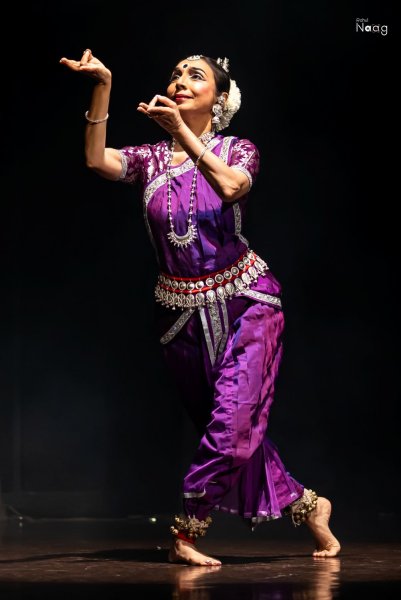
Sharmila Mukerjee
Hansika
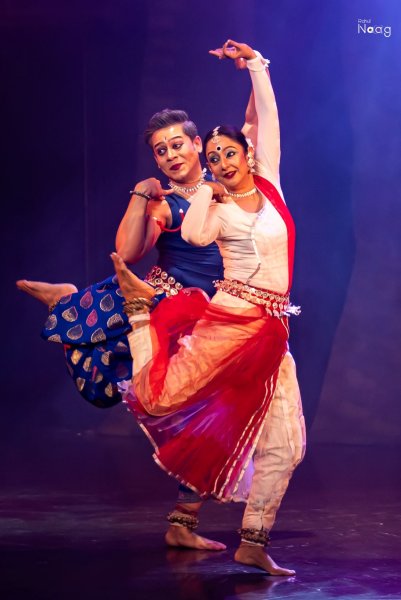
Sharmila Mukerjee (student of Guru Kelucharan Mohapatra) and her group
of students from Sanjali Ensemble of which she is the Artistic Director,
presented her creation of Hansika, based on the famous Swan Lake Ballet
of Pyotr Ilyich Tchaikovsky; the work in the Odissi format premiered
back in 2018. For this writer, watching it for the first time, the most
heartening aspect of the presentation was that the work has achieved its
goal without compromising with the Odissi idiom. There was a twist in
the story from the western Ballet version - in that the evil sorcerer
Roth Bart, was here substituted by a female figure, who is represented
as the other sister Odile (in the role of the Black Swan) whose jealousy
and spite, curse the younger sister Odette (White Swan) to transform
into a swan during the daytime, with her human form resumed only in the
night. The curse is to be erased only by true love - with a man losing
his heart to Odette. Prince Siegfried, chancing upon Odette at night,
loses his heart to her and decides to marry her. Odile learning of his
intentions, with a heavily veiled face, dupes the prince acting as the
bride, and Siegfried on discovering the trickery, rejects her. But for
heartbroken Odette drowning in the lake is the sad end.
Hansika
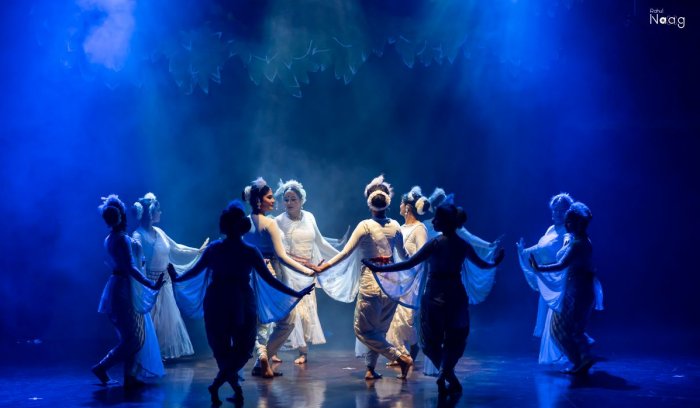
The dancers were well chosen. The very experienced Surajit Som as Prince
Siegfried danced with command, and Sharmila herself was most convincing
in the role of the jealous sister. And Srijita Sanyal made a graceful
Odette. The simple choreography retained the original Odissi flavour in
movement. Sridhar Muthy's set design, Vijay Katara's makeup and the all-
white costumes for the swans were of a piece. What was particularly
evocative was the one line from the original Tchaikovsky score for this
Ballet, that kept coming at regular intervals as a refrain in the music
composed by Praveen D. Rao - with pentatonic modes like Hamsadhwani and
Mohanam, along with Bijay Barik's mardala and the sonorous ukkuta
recitation at different points, reaffirming strongly the Odissi
identity, with flute and vocals by Varijashree Venugopal, Shruti Kamath
on sitar, Dr. Jyothsna Kamath on violin, Gurumurthy Vaidya on tabla, and
Praveen D. Rao himself on the keyboards.
LOKCHANDA CULTURAL UNIT PRESENTS EVENING OF NRITYA KATHA
Designed by Maitreyi Pahadi, the Nritya Katha evening at the Habitat was
predominantly a Kathak event, with one exception of an item of
Mayurbhanj Chhau, the event centered round the Monsoon theme. The start
with Neeranjali composed by teachers Anasuya Majundar and Meera Rawat,
was presented by students of Mrittika Studio, Shuddhitta Uniyal, Anika
Chowdhary, Reet Bhatia, Sanvi Pal, as an offering to the raindrops based
on a bandish - Savare Badare - with its very propitious associations
(ati mangala), with every movement capturing the rhythm and music of the
rains.
The next Mayurbhanj Chhau presentation Bhoomi or Prithvi, presented by
dancers of Lokchanda Repertory, trained under Janme Jai Babu. Here
movement with its dynamic energy represents the Bharatiya spirit. The
costumes in white contrasted with a braidlike tie round the waist in
black had yogic flair in mantra recitation and stances of dancer
standing atop another dancer. The cartwheeling body circling round the
stage, the Gong sounds with the Dhumsa drum in the finale comprising the
Hathyadhara movements based on weapon wielding, wherein the duo of
Govind Godiyal and Uma Bisht are joined in the martial art movements by
Sunil Mehra, Pradeep Kumar and Mehra.
The Kathak intensive Chaturmel had four highly accomplished dancers -
(each with intensive training under different Kathak stalwarts) now
working for the Lokchhand Unit. Anusua Majumdar began with 14
matra Dhamar, followed by Shilpa Verma presenting Pancham Sawari of 15
matras, followed by Meera Rawat presenting 9 matra Basant tal, with
Shailaja Nalwade presenting jhaptal of 10 matras. While all are highly
experienced performers, it was difficult to make them stick to
time-bound, short presentations, after getting warmed up - which in a
programme featuring so many dancers, cannot afford to ignore the clock -
and despite overstepping the time limit, each dancer may well have felt
time playing constraint. And in the Pancham savari, the dancer was
finding complete understanding with the accompanists a little tough. But
of the class of all the performers, there was little doubt. The finale
had all four combining in the Bindadin composition Nirata Karata, a
lakshana geet, spelling out Kathak theory, in a performance format. The
musicians for the evening were Yogesh Gangani and Vivek Misra on tabla,
vocal by Anuradha Kuber from Pune, sitar by Fateh Ali, Waris Khan on
sarangi, Dheeraj Pande on flute and Asmita Aich for padhant.
The evening concluded with a solo performance by Mamata Maharaj, whose
nritta part right from the way the torso bent to execute a movement
during Thaat to the tukras, Ginti tihais, Paran Dhit Taranga dha... (with
Mumbai's tablist Vivek Misra for percussion), had mastery writ all over
it - and one could tell that being the daughter of late Pandit Birju
Maharaj, khoon bolta hai (blood speaks). One expected the best of her in
the abhinaya for which she has a special aptitude. But as luck would
have it, constraints of time did not allow the kind of elaboration one
looked forward to in the Bihari Lal rachna Kaisi baja gayo Shyam,
followed by the Thumri showing the khandita asking the beloved why he
has come to her house, 'the composition 'Janedo maika...' et al. Sadly,
the most looked forward to part became very elementary.
UMA SHARMA'S CUSTOMARY JANMASHTAMI
 Uma Sharma
 Uma Sharma's disciples
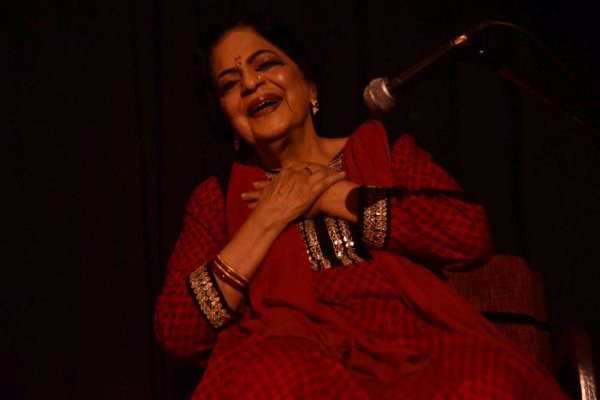
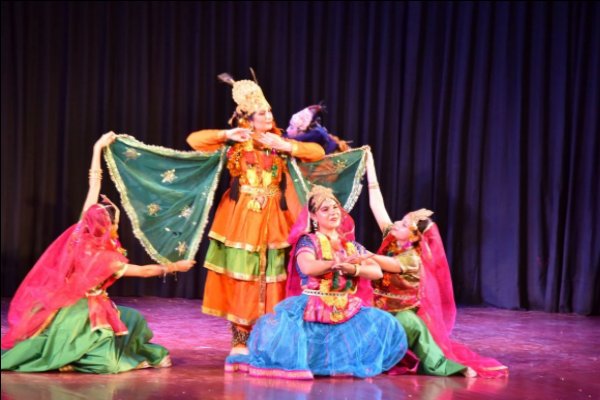
Veteran Uma Sharma's Janmashtami evening Sree Radha at the IIC,
saw her students of Bhartiya Sangeet Sadan present Nritya Ras, her
annual homage to the Krishna Janma Bhoomi -which constitutes her
personal contribution to the world of dance - based on the research she
undertook, in the Brindavan area and its vicinities. It brought back
flavours of her programmes in the past - with Madho Prasad singing songs
tuned by late Jwala Prasad, his father, with the old team of musicians,
with Khalid Mustafa on sitar, Zuhaib Khan and Divyansh Prasad on tabla
and Yograj Panwar for padhant and Ayush Bansal on flute, one felt a kind
of nostalgia for the past. The students performed their part but it was
sad to see ill health having slowed down Uma- who was helped on to the
stage to sit on a chair and do Baithaki bhav for the song Maiya mori
mein nahi maakhan khayo. For Uma, Sree Radha and all that goes with it
is an article of faith - and to be looked upon and judged as such.
TWIN SHADES OF FOLK AND CLASSICAL AT IIC
In support of its recent approach supporting both fold and classical,
IIC Double Bill concert presented an evening clubbing Kajri music with
Kathak. Hailing from its home in Rajasthan, Chattisgarh, Lucknow and
Bundhelkhand of Uttar Pradesh, including areas like Mirzapur and
Benares, the Kajri genre of songs, largely clothed in Bhojpuri and other
dialects, is said to come from the word Kajal (kohl applied to the
eyes) - a metaphor for dark rain bearing clouds of Sawan Masa - the time
for joy, love and bittersweet ache of viraha or separation. Kajri has
stepped into the semi classical format with famous Hindustani singers
like Pandit Channulal Misra and Girija Devi and many others excelling in
Kajri renditions. The artist for the evening Dr. Mannu Yadav, a
Bismillah Khan and later SNA awardee, and author of the work Kajri
imamsa, as President of Rashtriya Biraha Akademi, has even travelled to
Mauritius, Bhutan and Dubai with his art. Along with his co-singer
Anshika Singh, the accompaniment of chorus as it is called had Ram
Janam Yadav and Shashi Bhushan Singh with Bijendra Kumar on harmonium,
Suraj Kumar on dholak with Changur Singh on kartal.
The beauty of Kajri is its reflection of everyday life, descriptions of
seasons, with agricultural activity on fields, and free references from
the epics. And in the simple language, dialogues from everyday life
centered round husband/wife exchanges with both Dr.Mannu Yadav and
Anshika Singh in a musical dialogue. And in the song, the husband urges
his wife not to go home when he is set to go away on work for some time,
for there would be none to care for the mother. From the jawab-sawal ki
Parampara, the exchange is ultimately resolved with the man agreeing to
find a job close by so as to accommodate all. One wonders what the
present cries about women's downtrodden state with need for emancipation
fits in - when age old compositions prove that adjustment was common
amongst village folk. The Charu lochana comprised composition with each
line of the song starting with a succeeding letter from the alphabet.
This was followed by Desh mera Ghulam, the Tirang Geet, a patriotic song
with references to Jhansi Rani's courage.
The modest sized audience enjoyed the evening, the second half of which
comprised a Kathak recital in the Lucknow gharana by Dr.Prema Rana,
holder of a Visharad in Kathak and a master of Performing Arts and
winner of gold medal from Bhatkhande University, an A grade Doordarshan
artiste. The tuneful accompaniment comprised vocal and harmonium by
Ustad Arif Khan, Pandit Vikas Mishra on tabla and padhant and Shubhankar
Sharma on the sitar, with Divya Rawal also providing padhant. The
performance began with homage to Shiva, entailing a full description of
his attributes. Since the deity governs over the five principles, he
presides over both the expanse of the Akash and the Earth on which we
stand. Despite visible nervousness to start with, the dancer acquitted
herself creditably in the Teen tala nritta, with clarity of footwork and
a smiling demeanour. In the typical Lachhu Maharaj Kathak style Paran
Amad, the Dha Taka Thunga and in the taka takita.. syllable based
footwork nritta, abhinaya was subtly woven in. So, one finds the
Vipralabdha, the Khandita nayikas expressed sans words. In the drut laya
too, in parmelu, tode, tukre too emotive aspects were woven in.
The Kavit Nachat Gopala was another delicate composition. The only
aspect one did not see enough of, in spite of her rising to the
challenges thrown by the tablist in tukras, was ladhi with the dancer's
own improvisations woven in. Finally, no Kathak from Lucknow could end
without the poetry of a ghazal - Hamare dil ke aineme. The Nazaquat
element while pleasant needed more subtle touches, which can come with
time. With a fine tablist and tuneful singer, Prema Rana had all the
ingredients needed for a successful performance.
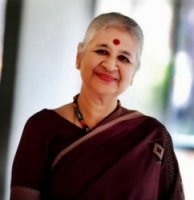
Writing on the dance scene for the last forty years, Leela
Venkataraman's incisive comments on performances of all
dance forms, participation in dance discussions both in
India and abroad, and as a regular contributor to Hindu
Friday Review, journals like Sruti and Nartanam, makes her
voice respected for its balanced critiquing. She is the
author of several books like Indian Classical dance:
Tradition in Transition, Classical Dance in India and Indian Classical dance: The Renaissance and Beyond.
Response
*
I thank Leela Venkataraman-ji for her review of my performance of
Parijatham in Vilasini Natyam. Thanks also to Narthaki for publishing
it.
I am responding to a line of the review which reads as "one of the
oldest librettos (banned by law) with gadhyam, padhya, slokam, daruvu of
Parijataapaharanam - acquired from another researcher - the work
ascribed to Siddhendra Yogi himself by Kuchipudi followers, having had
several Telugu authors."
I wish to clarify for the benefit of readers that;
a) Librettos based on the Telugu literary genre called Yakshaganam fell
into two categories. One composed by a single poet and the other, a
compilation of Daruvus, Padyams, Shokams etc drawn from various sources.
Each type had its merits.
b) The libretto which I danced in Vilasini Natyam has no connection with
Kuchipudi Yakshaganam nor with Siddhendra Yogi. It is an unpublished
libretto for the most part, with the exception of one or two Daruvus
also found in other (Non-Kuchipudi related) librettos. It was compiled
and propagated in North coastal Andhra Pradesh by itinerant librettists
who had no links with Kuchipudi tradition.
Indeed, it is also my understanding that Siddhendra Yogi, the chief
proponent of Kuchipudi Bhama Kalapam / Parijathaapaharanam may not have
been the sole composer of its libretto which draws Daruvus, Padyams and
Shokams from external sources too.
More public discussion on the Parijaatham will help throw light on the subject. Hope Narthaki takes a step in this direction.
- Swapnasundari (Sept 21, 2026)
Post your comments
Please provide your name along with your comment. All appropriate comments posted with
name in the blog will also be featured in the
site.
|