TAALAM
BY LEELA VENKATARAMAN e-mail: leelakaverivenkat@gmail.com
Monsoon showers along with a program deluge
August 29, 2026
PARAMPARA FESTIVAL
Following a fairly barren two months, came a deluge of programmes in the
capital starting with the annual Parampara Festival of the Reddys –
which this year, considering the vagaries of sudden monsoon showers, was
held at the Kamani auditorium, instead of the usual haunt of their own
open-air theatre in their Saket home.
An aesthetically assembled video with visual images, with compere
Sadhana Srivastava’s (longtime compere for Reddy programmes) voice-over,
was a wise way of settling the restless audience - providing
informative introduction to Natya Tarangini, and the work contributed by
the Reddy family with the trio of Raja, Radha and Kaushalya
contributing hours of diligent teaching, apart from efficiently
administering the institution.
Barring the opening day, when, contrary to the Reddy attention for
detail, dignitaries called onto the stage for the lamp lighting stood
waiting, before the tall empty lamp (sans oil or wicks!) was ready for
lighting, the reputation of Natya Tarangini for immaculate planning, was
perceivable right through the three- day event.
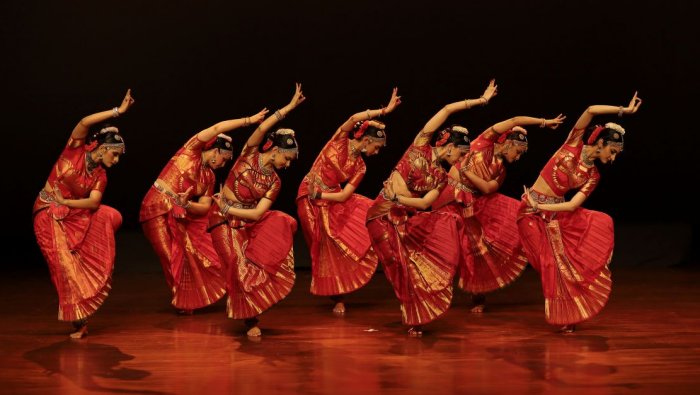
Natya Tarangini ensemble
The performance by the students of Natya Tarangini, with Kaushalya
conducting the programme with her nattuvangam, commenced with a
traditional prayer to Lord Ganesha through the famous hymn Vakratunda
Mahakaya Suryakoti Samaprabha, Nirvighnam Kurume Deva Sarvakaryeshu
Sarvada. The devotee addressing the large-bodied, elephant-headed deity,
whose radiance equals that of a million suns, seeks this Vighna
Ishwara’s (remover of obstacles) blessings, for a performance without
hurdles. The invocation was followed by Muddu Krishna, with his peacock
feather in the hair, presenting his triumphant dance Kaliyamardana on
the hood of serpent Kaliya.
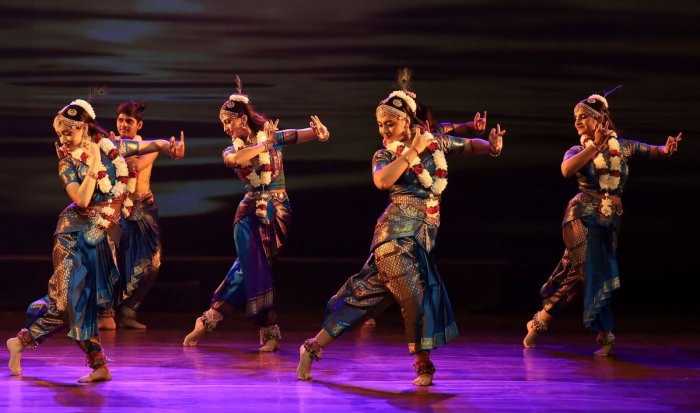
Natya Tarangini ensemble
What is visualized as a physical feat by young Krishna, is a metaphor
for the conquest of evil with a victory of divine righteousness. The
serpent symbolizes the polluted mind with the ego, which leads to a mind
full of negativity. The poisoned river Jamuna with the venom of Kaliya,
is likened to vicious desires polluting man’s mind, and the victory of
divine righteousness signifies the person overcoming these coils of
pride. To carry the analogy further, this process of achieving victory
can be a long process over many births - which explains a seven-hooded
serpent! Against a prominent visual backdrop of water waves and a
cherubic Krishna dancing, balanced on one foot on the enormous
multi-hooded serpent, was the performing group of immaculately trained
young dancers displaying movement clarity with commendable group
discipline – obviously the fruit of no-pains-spared teaching. This
writer however felt that instead of dancing with backs to the visual
with the group formation facing the audience, a V shaped arrangement on
both sides leading from center-stage to the extreme two sides would have
been more effective - particularly when showing the Nagins asking for
forgiveness and pleading with young Krishna that their mate Kaliya be
spared. Through ragas Gambhira Nattai and Vachaspati, the competent
accompaniment headed by Kaushalya’s nattuvangam had Aadarsh M. Nair’s
vocal support, MV Chandrasekhar on the violin, Prakash Koduru on flute
and Vasu Shastri on the violin.
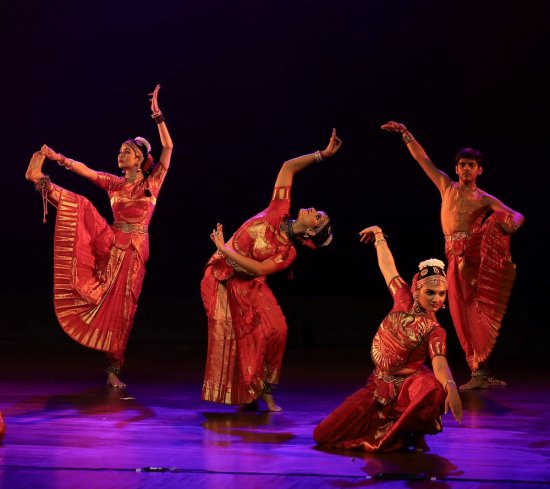
Natya Tarangini ensemble
Set to ragam Shubhapantuvarali followed the homage to Shiva, the Lord of
Dance, comprising many aspects. Shiva who encompasses in his divinity
the powers of creation, preservation and dissolution, as Ardhanareeswar
combines the masculine and feminine energies in a complement of
contrasts. To the great ancient sage Panini was revealed the Ashtadhyaya
of the Maheswara Sutras, comprising the fourteen foundational sounds
emerging from Shiva’s drum. Perini Tandav, the dance of Shiva which was
popular during the Kakatiya period in Andhra region, was performed by
warriors and the dance has been revived by Nataraja Ramakrishna. Knitted
into the fabric of the entire Shiva adoration blending with energetic
dance, was the Navarasa depiction with nine emotional states-of-being
(reminding one of Raja Reddy’s signatory Adenamma which he performed
with such zeal) to conclude with Tarangam or dancing with feet planted
on the rim of the brass plate.
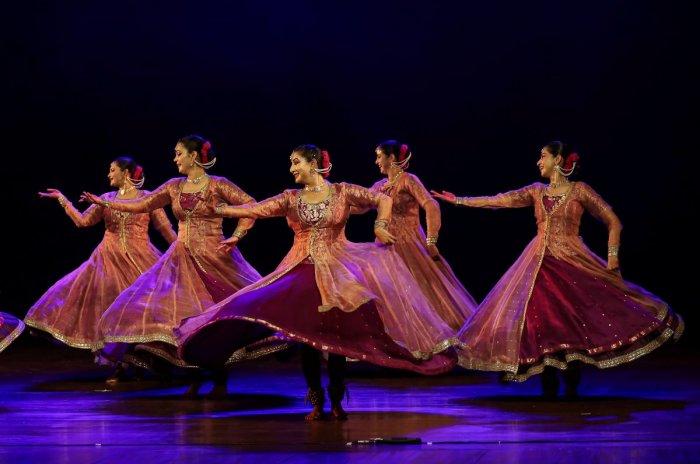
Maitreyee Pahari’s ensemble
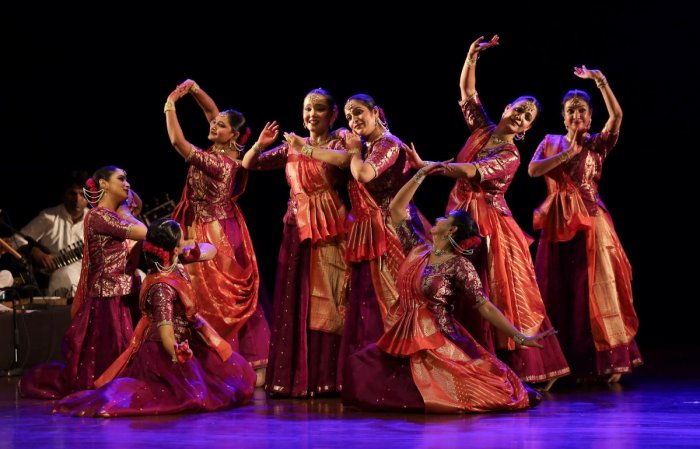
The Kathak performance on the second day was by Lokchhanda Cultural
Unit, an organization of Maitreyee Pahari, who with her background as
gold medalist in Manipuri and a long time Kathak trainee under late
Pandit Birju Maharaj and Saswati, has been in demand for her aesthetic
planning in putting together programmes which are a blend of the
classical, with folk, martial arts, music and Sufi poetry and what have
you. Her dancers in what was a pure Kathak oriented programme this time,
knit Kathak aspects presented as individual items, into a thematic
presentation Anuragini, visualizing an internalized journey from
awakening of love to the ultimate state of fulfillment and wholeness –
linking the stylistic element comprising pure technique, with the
interpretative wedded to achieving a state of being. The start embodying
the grace, beauty and divinity of Gauri, was a salutation to eternal
feminine energy as creator and nurturer, with the beauty of devotion and
spirit of surrender. The dance was based on a hymn in the Dhrupad form -
Gauri Aradhang Nachat Sangeet Shankar Tripurari. Right through,
what contributed to the rounded artistry of the performance, apart from
the focused, neatly turned out dancers, was the very well-balanced
musical support - not always a feature of Kathak recitals. With vocal
support provided by Jayavardhana Dhadheech and Dr.Aditi Sharma, and
Gulam Waris on sarangi, Dheeraj Kumar Pande on flute, and Kishan Kathak
on sitar, what one found most heartening was the padhant (when needed)
by Gauri Sharma, radiating a clarity with the right intonation. Also, a
very heartening fact for this writer, was experiencing how much Yogesh
Gangani’s tabla support has evolved - the mood involved mellow softness
with which he plays now, a vast change from the original pounding he
subjected the instrument to, and on the pakhawaj was Mahavir Gangani.
Maitreyee Pahari’s ensemble
Gauri was followed by Saanjh- the Whisper of the Heart. As the day
progresses, with the onset of twilight, a more silent nature results in
stirring tender emotions lying dormant within the heart. Love’s moods of
waiting, of longing and of devotion, of joys of togetherness and the
ache of separations begin to make themselves felt. Through ups and downs
finally the journey is towards inner fulfillment. Then follows the
Tarana in a contrast of emotion to rhythmic virtuosity. What
better to capture the sringar involvement than Radha’s yearning for
Krishna which is expressed through the Thumri rendered by singer Dr.
Aditi Sharma, Jhoolan Jhoole Bagiyan and Aise naval ladli Radha.
The final prayer symbolizing the merging of the self with universal
consciousness has the Bhajan Mai tiharo dhyaangyan mohe deje e Kali. In
what was an ensemble presentation, the well-knit team of dancers
comprised Shailaja Nalwade, Anasua Majumdar, Shilpa Verma, Meera Rawat,
Sonali Vishwakarma and Nidhi Bhardwaj.
Pavitra Bhat and Aparna Shastry
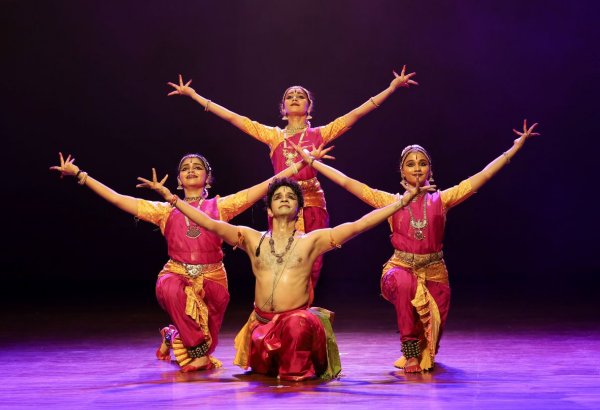
The concluding Parampara evening’s Bharatanatyam programme by Pavitra
Bhat received a standing ovation. Trained under Deepak Majumdar in
Bombay, and with vast experience as the hero of dance drama productions
presented by several other famous dance teachers of Chennai, Pavitra
Bhat now runs his own institution Kalanjali apart from Pavitra Art
Visual Institute. Along with his troupe of four students, the very
traditional start with the Melaprapti and prayer to Ganesh, Vighna rajam
Bhaje in ragam Gambhira Nattai set to khanda chapu talam, came the
Alarippu, a well profiled rendition with a takatakita Khanda nadai,
ringing in a vivacious tone to the start of the performance. This was
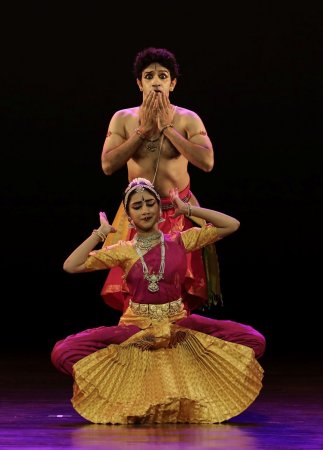
followed by the Ardhanariswar Stotram, Champeya Gauranga set to a
Ragamalika in adi talam, symbolizing a united and harmonized
Shiva/Shakti - the male and female half (standing one behind the other
with Shiva’s half hidden by Parvati’s body in front, featuring the
couple Pavitra and Aparna Shastry, showing superb spatial understanding,
without which the item loses its centrality.
Pavitra Bhat and ensemble
The centrepiece, a varnam in Mohanam, Bansi valene man moha, was
rendered in a highly communicative solo form by Pavitra. Even as damsels
filling pitchers with water forget the work at hand to follow the tones
of Krishna’s magical flute, and the entire animal world sways to its
bewitching spell, Nature with birds and blooming flowers too,
magnetlike, gets drawn to the music – and the captive nature of
Krishna’s flute was well brought out by the dancer’s flair for abhinaya.
The Varnam composer being from Kerala, the charanam after the
Pallavi and Anupallavi, very understandably, took the form of a homage
to Padmanabha Prabhu Deena Bandhu, concluding with a prayer to the
Dashavatar manifestations of Lord Vishnu. The accompanists were from
Mumbai and Delhi. With sahitya lines embellished with taanam
punctuations, rendered by fine vocalist Vidya Harikrishna from Mumbai,
and with Delhi’s Sridhar Vasudevan for nattuvangam with Sreedhar Raju on
violin, mridangam percussion was provided by Mumbai’s Satish
Krishnamurthy. The recital concluded with a group rendition of the
Tillana in Sumanesha Ranjani ragam set to adi talam. Altogether, a very
vibrant note on which to end the dance part of the festival.
While this is a column on dance, I touch on the musical half of each
evening, which apart from keeping pace with the dance, represented the
idea of Parampara in all respects - with the first evening’s Bach to
Bhopali, featuring the musical family of Pandit Shubendra Rao on sitar
with wife Saskia Rao de Haas on violin cello and their son Ishan Leonard
Rao on the piano, in what turned out to be a most sensitive East/West
Triveni of instruments from east and west playing music from India – and
here again with a sitar the two ragas Hemavati and Simhendramadhyamam
belonged to the pantheon of Carnatic ragas! Ishan’s touches on the piano
along with his solo rendition of Asturius, a famous piano composition
by Spanish composer Isaac Albeniz (19th-20th century) showed the fine
touch flowing from inherited musical talent.
On the second evening was the sur-filled vocal concert of Madhup Mudgal
along with daughter/student Sawani Mudgal, rendering Puryadhanashri and
Malkauns followed by a Tillana, with Arvind D. Thatte on the harmonium
with Vivek Bhola and Kushal Sharma on tanpura. What better than the
Benares gharana Khayal singing lineage (now in its sixth generation) of
Sajan Misra, joined by his son and disciple Swaransh Misra, rendering
Gaud Malhar and Megh on a monsoon day – with the ecstatic audience
encore for continuing, after the conclusion.
SARE JAHAN SE ACHCHA
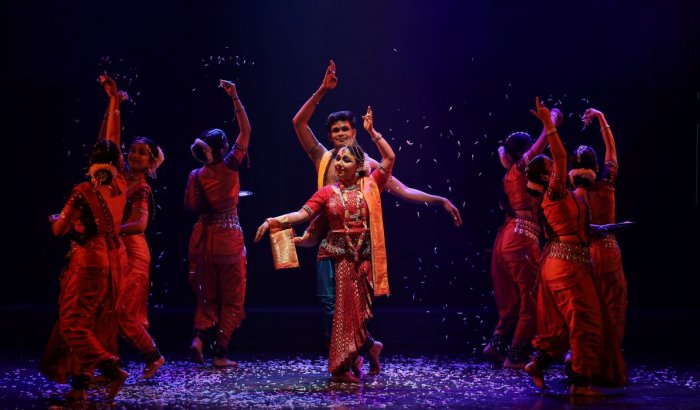
Odissi exponent Ranjana Gauhar’s annual festival Sare Jahan se Achcha,
began in the customary way established so far with the first evening
being devoted to a presentation by the host institution Utsav. This
year’s presentation Chitrangada based on Tagore’s play, with
concept, script and direction by Ranjana and music direction by Saroj
Mohanty, had Sandeep Dutta’s technical direction, for what has become
the institution’s most prolifically staged nritta natika presentation.
Based on what constitutes ideal womanhood, away from the outward
fripperies like beauty, modesty et al that the male and society
associate woman with, Chitrangada is perhaps one of Tagore’s most
prolifically staged works staged in all dance forms, with its emphatic
woman’s lib message.
Chitrangada by Ranjana Gauhar’s ensemble
In what was announced as the 112th show of Utsav’s Chitrangada, since it
was produced (an enviable achievement by any standards!), the chief
dancers of the institution Vrinda Chadha as Chitrangada and Kevin
Bachhan as Arjun were the lead pair, with Ankita Bakshi as the
transformed Chitrangada, and Tusha Arya as Madana – all of who fulfilled
their respective roles with conviction. As garbed and made up (for
movements encompassing male dominated martial endeavour), Vrinda was
made to look such an alluring Chitrangada, that one wondered if Arjun
had to have his senses examined on why he was not attracted by her! In a
dance drama, unlike classical dance presented with the dancer as an
impersonal performer conveying the message of what he or she is
presenting, the dancer takes on a role and has to look the part. One
felt that Vrinda could have been turned out to look a little plainer –
contrasting with the other Chitrangada, who also, as a finished dancer,
did full justice to her role. Chitrangada proudly asserting Ami
Chigrangada,-- Rajendranandini, nohi debi nohi shamanya nari (I am no
ordinary woman but skilled in martial arts and warfare), the changed
tone of melancholy in unrequited love’s singleness for Chitrangada in
the midst of the bounty of Spring, Rodhan bhare E Boshonto, being drawn
to Arjun who has declared himself a brahmachari, overwhelmed by feelings
of love, Bodhu kon alo laglo choke are songs one has heard often. Very
expressive, Vrinda as a proficient dancer, filled the role
competently. The group scenes were fair, though the taller dancers
need to work on a better articulated chauka centrality, without which
the torso bends with tribhang lose their sharp silhouette. Arjun
realizing that Madana’s transformed Chitrangada he was infatuated with
was not the real person, and that there is more to a woman than physical
charm, accepts Chitrangada for what she is. For this critic, the dancer
who has evolved in both line and profile of movements, blending grace
with interpretative intensity, is Kevin. The music tape, generally
tuneful, for some reason had the singer hitting flat notes in a couple
of places. Bankim Chandra’s Vande Mataram with the original composition
reset with Saroj Mohanty’s music, as performed by Ranjana’s group
started the next day’s festival proceedings.
Stunning Odissi duet by Rajashri Praharaj and Preetisha Mohapatra
As Director of Srjan and Dean of Faculty of Arts, Communication and
Indic Studies of Sri Sri University, Cuttack, Ratikant Mohapatra, son
and disciple of late Kelucharan Mohapatra has, over time, evolved into
one of the most successful Odissi gurus. Well versed in percussion on
the mardal, dancers trained under him are among the very proficient in
Odissi today – benefitting from not just the dance instruction but from
the allied subjects in the University, shaping body, mind and psychology
of the dancer.
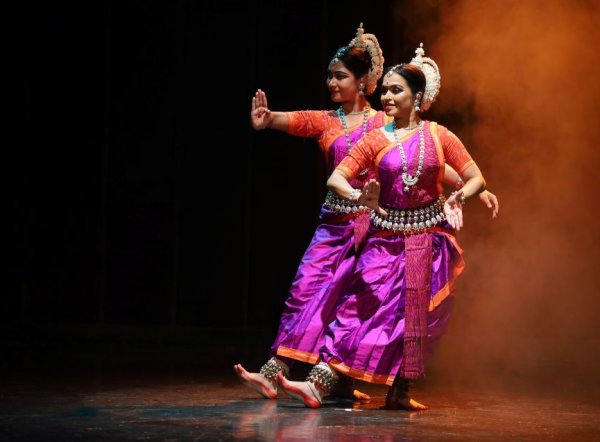
Preetisha Mohapatra and Rajashri Praharaj
Two of his leading disciples, Rajashri Praharaj and daughter Preetisha
Mohapatra on the second evening of Sare Jahan Se Achcha presented a
duet, the disciplined professionalism of which, left the audience
amazed. Right from the start with Shantakaram Bhujaga shayanam prayer to
Lord Vishnu, followed by the Ardhanareeswaram hymn Champeya Gauranga
with music composed by Raghunath Panigrahi in a ragamalika set to
talamalika, it was an impeccable, mesmerizing performance. The
homage to a single Saivite divinity, comprising seemingly irreconcilable
male and female identities, given the immaculate technique of a
beautifully defined mandala posture, with grace abounding torso
silhouettes - topped by deep-seated involvement, created dance evocative
of the magic and ultimate tranquility of the cosmic order, amidst its
plurality of forces. With Rajashri at the back and Preetisha in front
covering one half of her, with the other half visible, maintaining
exactitude in levels and placing – the two dancers moved as one body
almost belying reality. And the ecstatic involvement of the twosome made
this one of the finest Odissi expressions!
The aesthetic music on tape with Ratikant Mohapatra’s mardal lead, had
singer Dr Bijay Kumar Jena, Ramesh Chandra Das on violin, Nityananda
Mohapatra on flute, Ravishankar Pradhan on sitar, Saroj Kumar Rath on
Vibrophone, with synopsis of items announced in the voice of Aditya
Mohapatra and last but not least, Debiprasad Misra doing the sensitive
lighting.
Navarasa in Bharatanatyam by Shankarananda Kalakshetra
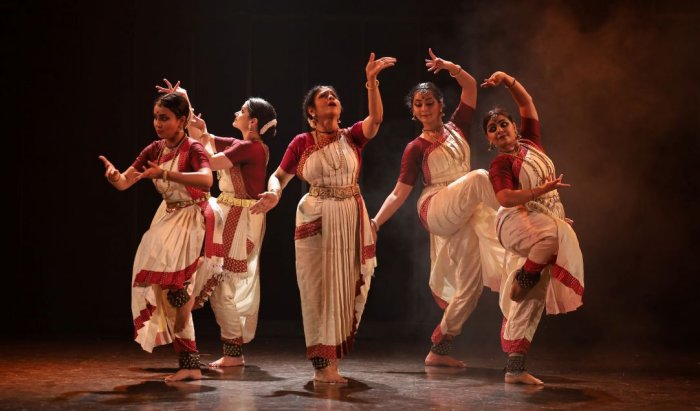
Ananda Shankar Jayant and group
Amongst all the high profile, senior artists presented in Sare
Jahan se Achcha, was dancer Ananda Shankar Jayant, whose institution in
Hyderabad Shankarananda Kalakshetra, presented Navarasa built round the
nine moods of Sringar, Krodha, Bhayam, Arbutam, Bhibhatsa, Veeram,
Karunyam, Hasyam and Shantam. Instead of pinning each of these
states-of-being, to an event from scripture, history et al, as is the
general mode, with the chosen episode helping mood build up, here the
episodic treatment was completely done away with. Ananda’s treatment
demanded instant danced attitudes of mind and body, evocative of the
particular mood. And here in the absence of any sahitya, the
accompanying raga music of Prema Ramamurthy was the catalyst, and given
the meticulously trained dancers of the institution, the presentation,
with Ananda dancing as one of the group, lacked for nothing.
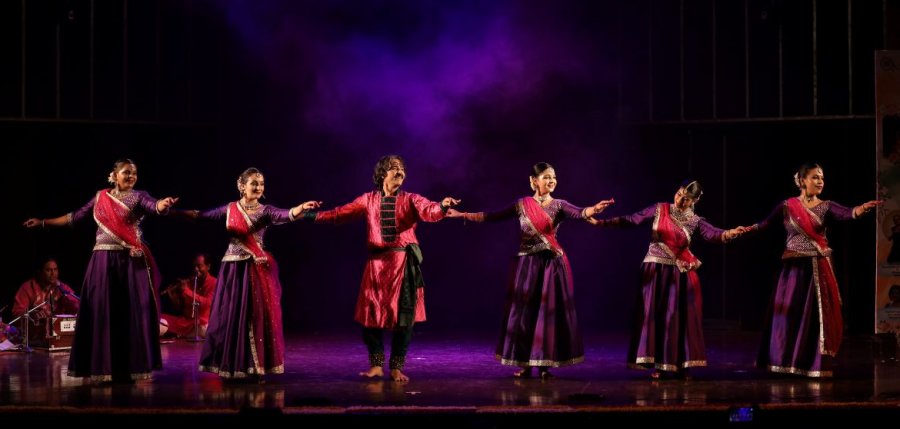
Rajendra Gangani and disciples
Kathak by Rajendra Gangani and students, which took on a spirit of desh
bhakti in keeping with the Sare Jahan Se Achcha festival title, began
with homage to Nature and the weather all round, Pawan Mand Sugandh,
with emotions in full play. And the presiding deity over all these nine
moods or Rasas is Rasraj Krishna, celebrated through the lyric Nachat
banke tu Krishna, with singer Samiullah Khan’s rendition in raag Misra
Kaushik Dhwani. From adoration of Nature and the almighty follows love
for the land you live in. This tribute to India, Gao desh rang, Sab mil
gao, Desh hamara, Sabse pyara, sings the praises of the mountains and
rivers of the country - the Himalayas, not just as a bulwark shielding
us from dangers, but as a sentinel of peace, keeping us connected to our
roots. When movement celebrates our innermost thoughts, with music and
rhythm becomes our heartbeat, it is Anand Utsav, which was signified
with Guru Rajendra Gangani joining in with a spate of footwork in the
drut laya. Known for his straight forward approach to Kathak of Jaipur
vintage, it was a welcome experience to find Rajendra Gangani bringing
all facets of Kathak into quick flashes of dance, with a performance
designed for the event.
UNUSUAL KUCHIPUDI/KATHAK PERFORMANCE
Performing for a Delhi audience for the first time, Ritusri Chowdhuri
and Amrita Singh settled in Kolkata, provided an evening of Kathak and
Kuchipudi respectively, at the Stein auditorium. A senior disciple of
late Shobha Naidu, Amrita studied under Padma Subrahmanyam too for
a while. She began the Kuchipudi recital with Pranamam yaham Sri Gauri
sutam homage to Ganesh. With movements replete with supreme grace her
dance stylistically, was very reminiscent of Guru Shobha Naidu’s
Kuchipudi. Episodes from the life of Ganesh, along with his weakness for
the sweet modakam were all brought out juxtaposed by winsomely rendered
jatis.
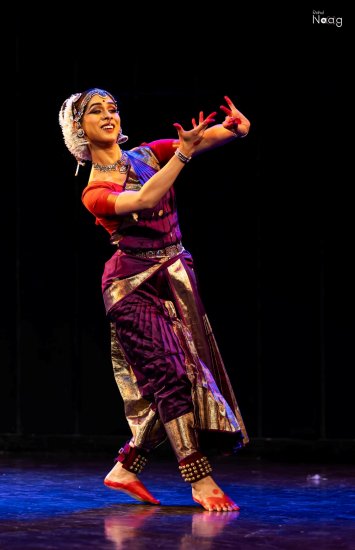
Amrita Singh
The rest of the programme largely featured her students. Starting with
raga Malkauns (Hindolam) and Devgandhari, dancing to the song Kolavai
Konnade tulavai konnade, was the prayer to Shiva Devadevudu, visualizing
iconographic aspects of Shiva. The usual ploy of two dancers one seated
and one standing visualized the four-armed God in Kunchita Padam
standing on the Apasmara purusha, with the half-moon on his head. The
Jatis in-between verses were typically Vempati Chinna Satyam in tone -
very natural since Shobha Naidu, Amrita’s teacher was the prime student
of guru Vempati Chinna Satyam for years. Then came the Meera Bai bhajan,
Pada ghunguroo in Ragamalika choreographed by Shobha Naidu. The entire
story with Meera forsaking her royal ties and proclaiming openly as
belonging to Krishna (Maito apni Narayanaki), dancing in delight with
feet shod in ankle bells (Pada Ghunguroo se), followed by her surviving
the ‘vishaka pyala’ incident when the Rana tried to poison her, without
success - were all depicted. The item left a feel of being overdrawn.
The Tarangam footwork with feet planted on the rim of a brass plate was
included in the Tillana in raga Desh. The programme ended with a short
version of Vande Maataram. With students contributing most of the
programme, one could not help feeling that for a maiden performance in
Delhi, Amrita should have opted for a solo presentation, instead of her
own appearances becoming rather minimal.
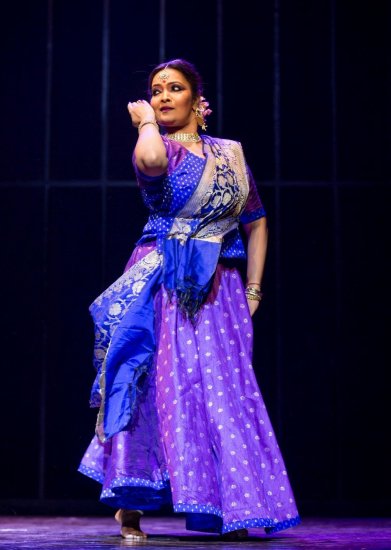
Ritusri Chowdhuri
Ritusri Chowdhuri of Kolkata, for many years a repertory member of
Padatik Dance Centre, was trained under Madhumita Roy with advanced
training under Pandit Birju Maharaj and Saswati Sen, and works currently
as choreographer and Artistic Director of Nrityakshar Foundation. The
starting prayer to Shiva in Nagendra Haaraaya trilochanaya hymn rendered
by a group of dancers, barring the chakkars for the Harahara Mahadev
line, did not make much of an impression. It was when Ritusri performed
her solo abhinaya Nazariya lage nahi kahin, describing the nature of the
pull of love with the gaze fastened on the loved one, that the best in
her was seen. That magnetic attraction of love is described as
that of the Chakor for the moon (Tum chanda mein chakor).
Knit between stanzas was pure dance with Thaat, Mor Gath and teental
tukras to the Lehera background – and one was treated to the real
classical aspects of Kathak with nritta offers comprising compositions
Dha taka Thunga and later Takita Takita ghini ghini ghini...in the drut
section. While the abhinaya aspect was done with feeling, one had,
fairly or otherwise, a lurking feel of the filmy influence with overdone
costumes and makeup, which in classical presentations takes away from
the gravitas. One had the same feeling when the students performed
nritta of 14 matras - obviously well trained, the white costumes with
less frills and flounces would be better.
REGALING TWOSOME FOR IIC’S MONSOON FESTIVAL
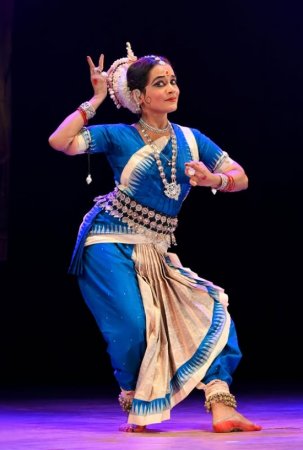
Geetanjali Acharya
Geetanjali Acharya, a student of Guru Kelucharan Mohapatra, trained in
Srjan, the Guru’s Odissi institution, performing at the IIC , given the
brief recital, comprising the first half of the first evening, for the
two-day Monsoon Festival, showed in her dance the unmistakable stylistic
impact of the Guru. Every part of watching the Salabeg composition Ahe
nila saila (Nila brought in the mind’s eye, Kelubabu performing the
item Neela Achalo or Blue Hill referring to the original home of the God
worshipped by the Savaras, later housed in the temple at Puri as
Jagannath). Entering the temple with the flag flying high on the
pinnacle, the devotee offering his worship to the Lord, sings the Lord’s
greatness describing his acts of generosity to his bhaktas - like
coming to the rescue of elephant Gajaraja who while drinking water in
the river, had had his leg caught in the jaws of a crocodile. He then
sings praises of the Lord as saviour coming to the rescue of Draupadi,
saving her from the shame of being disrobed by the Kauravas, and finally
as Narasimha emerging from the pillar to save Prahlada from his father
Hiranyakashipu’s wrath.
Excelling in both nritta and abhinaya, the next item set to raga Desh in
Attatali was Vande Mataram – which of late has become a song for dance
visualization. What was significantly special was the opening line
played on musical instruments for a while with a subdued, very mellow
pakhawaj overture by Ratikant Mohapatra, after which the dance
expression began. Lines describing homage to the Motherland, Su
madhura bhashineem, with the flora and fauna of India were sensitively
captured, the dancer’s adherence to the Odissi technique as taught by
Guru Kelucharan keeping pace with the expressional involvement.
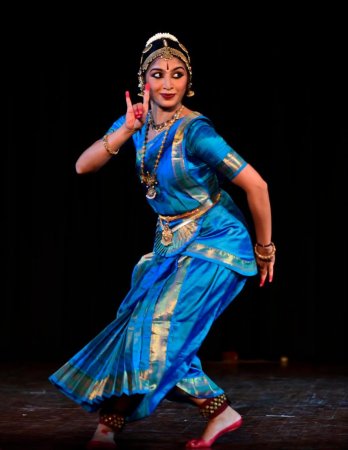
Apeksha Kamath
The Odissi recital was followed by a superb Bharatanatyam presentation
by Apeksha Kamath, a student of Indira Kadambi of Bangalore. For the
first time after a number of years, one found a dancer stressing the
idea of the Monsoon (in the title of the event) as a central theme,
while planning the recital. Accompanying musicians not being easily
available at this time of the year, with most of them on outside India
assignments, Apeksha pinned her dance on music available on YouTube, of
celebrated singers like Ranjini and Gayatri and Ajay Chakrabarty -
rendering ragas specific to the Monsoons like Amritavarshini and
Mia ki Malhar. The dancer showing in-depth training in both technique
and interpretative dance, began with lines from Tiruvalluvar’s
Tirukkural (Tamilnadu recognizes 31 CE as the time he lived though it
could be between 300 CE and 500 CE), vana ninru ulagam vazhangi
varudalaal…….) where rain is described as the nectar of the world for
sustaining life. The world with the expanse of seas will still suffer if
clouds deceive rain. Existence of this world without water is as
inconceivable as water existing without rain. The devotee questions God
on why he has brought about man’s agony with all the ill effects of
drought. And at last, when the drops from the sky descend, the solfa
syllables Dheem tat taani taa-dhirana dhaani in increasing speed signify
the thrill of the rain washed land.
The Kannada Varnam in raga Amritavarshini set to adi tala, obviously
choreographed by the guru, composed by Dr.Geeta Seetaram was sung by
T.V.Ramprasadh. Swami kare taarini nee Venugopala, urges the nayika of
the sakhi to fetch Venugopala who lifted Mount Mandara, and who is the
Sundaranga Madanahaasa, Madanana murali manohara to her presence. If you
explain my condition to him, (Odi baruvane) he would come post haste.
He is described as the heart throb of the Brindavan Gopis. In the
charanam Bare …karunatore Amritavarshini, the dancer pleads with the
sakhi to show some compassion, for she is being bombarded by Manmatha’s
arrows. With the firmness of technique on the one hand, and expressional
nuances on the other, Apeksha’s Bharatanatyam speaks for itself.
Post-varnam was a Bhajan, Barse Badariya savan ki in raga Miya ki Malhar
composed and sung by Sreevalsan J. Menon from his album Monsoon
Anuraga. The item comprised verses from the Varsha Ritu chapter of
Kalidasa’s Ritusamhara. The nayika as abhisarika is portrayed here,
venturing out with the raindrops falling, for meeting the beloved, with
scenes from Nature with animals all round. Altogether a well rounded
fine performance!
What with Monsoon and the Independence celebrations, it has been a very crowded couple of weeks for dance.
Writing on the dance scene for the last forty years, Leela
Venkataraman's incisive comments on performances of all
dance forms, participation in dance discussions both in
India and abroad, and as a regular contributor to Hindu
Friday Review, journals like Sruti and Nartanam, makes her
voice respected for its balanced critiquing. She is the
author of several books like Indian Classical dance:
Tradition in Transition, Classical Dance in India and Indian Classical dance: The Renaissance and Beyond.
Post your comments
Please provide your name along with your comment. All appropriate comments posted with
name in the blog will also be featured in the
site.
|