TAALAM
BY LEELA VENKATARAMAN e-mail: leelakaverivenkat@gmail.com
Mixed week of folk and stylised traditions
August 9, 2026
Treated generally to tailored, stylized fare of classical music and
dance, the audience at the IIC auditorium, Delhi, seemed to get caught
on the wrong foot, with the very different texture of the
no-holds-barred exuberance, very much in the old Mujra style of the
Lavani and Jogwa dancers from Maharashtra (performance courtesy NCZCC
and Culture Ministry). Originating during 18th -19tth century
Maharashtra under the Peshwas, who were great patrons of this art form,
as a means of morale boosting entertainment for soldiers, Lavani
performers are mostly from among the community of Dangars (shepherds) of
the Sholapur region of Maharashtra, their art a provocative blend of
storytelling, dance and music, brimful of socio-political satire, built
round society, religion and politics.
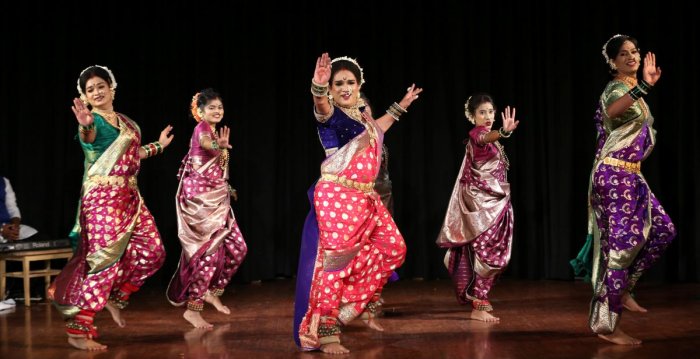
The dancers Riya, Mahak, Soumya, Arshad, Akash, Samrudhi turned out in
their nine-yard sarees (nauvari or lugade), draped kacha fashion,
sporting heavy jewellery, with hair in a jooda decorated with flowers,
performed with abandon - the in-your-face sensuality, a feature of
Lavani in both its versions - standing or in Baithakichi (seated form).
Used to performing in Maharashtra to large, enthusiastic male audiences,
responding to openly sensual gestures with cries of appreciation - not
excluding suggestive comments, the dancers were gently taunting of the
restrained applause from a straightlaced IIC audience, comprising a
large female section. The entire performance content was aimed at
mocking societal inhibitions, patriarchy, et al.
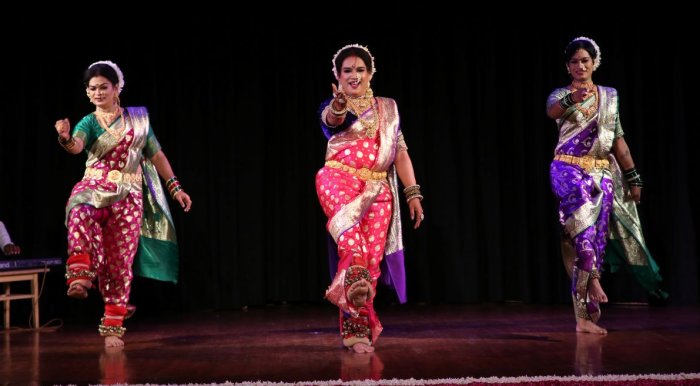
Ghanraayaa tara yaavu Daavani went the song. Performed to lusty rhythm,
the dancers had musical accompaniment comprising musician Ritu Akash
Bahadure, Lokesh on keyboard, Ajay and Ranju on dholak, and Divya
providing occasional vocal support. The sheer exuberance and joy of
rhythm, the lusty hip shaking, the wiggling back view of the dancers
with generous expanse of the back, thanks to the low back cut blouse,
and the sheer joi-de-vivre in the movements of tight-fleshed, well-built
bodies, with enviable balance, was infectious. One was struck by the
total unselfconsciousness of the five-year- old, seated with the
musicians at the side of the stage, shaking her body to the rhythm of
each moment, with hands working in different ways! Seemed a natural!
ELEGANT PANDANALLUR BHARATANATYAM BY SNEHA MAHESH
At the Habitat Centre’s Stein auditorium, watching the poised
Bharatanatyam in the Tanjore Bani presented by Sneha Mahesh, trained
under dancer Priya Murle of Chennai, one was surprised that this dancer
had never before performed in Delhi. Entering the starkly bare stage,
her curtain-raiser was a Muthuswamy Dikshitar composition Ananda Nadana
Prakasham in raga Kedaram, one of the panchabhuta sthala kritis
dedicated to Lord Shiva as the embodiment of space or akash in the
Nataraja temple. Brilliant as innumerable suns, the Lord as granter of
worldly pleasures and liberation, reveals himself with his dancing feet,
to sages Patanjali and Vyagrapada.
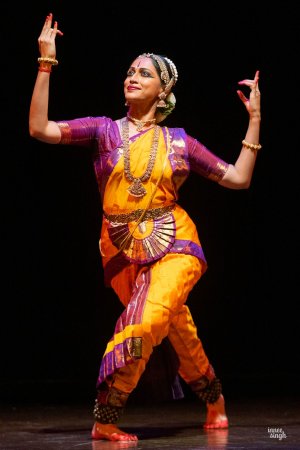
Sneha Mahesh
Next came the Kavutvam (hymns in distinct talas and mudras, which, as
part of ritualistic fare in temples, are dedicated to specific deities).
Part of the Navasandhi Kavutvam paying obeisance to the deities of the
nine directions, was the Brahma Kavutvam set to music in raga
Madhyamawati with a peppy ending with sollus (rhythmic syllables) in the
tisra ekam tala, which the dancer neatly executed - the defined plie or
araimandi a feature of the presentation. The Swarajati E mayaladira Na
Sami in ragam Usseni set to tala roopakam as the centrepiece, saw the
dancer in fine fettle portraying the jealous Nayika, who, noticing the
Lord’s lessening response to her overtures of love, wants to know who
has poisoned him against her. E mandu pettanu ra she asks. “What is the
potion this woman has fed you with, to put this distance between us?”
Addressing warrior King Pratapa Simha with lavish praise, the Nayika
speaking of her steadfast love for him, scornfully describes the other
woman as a bee flitting from flower to flower. After a long solfa
syllabic refrain, the tone of the abhinaya in the charanam part
undergoes a complete change in mood. Having had enough of trying to win
back the love of the Lord, the Nayika now becomes aggressive and taunts
“Go, go to the other woman”. The contrast in the Nayika’s attitude was
well brought out and altogether it was a competent presentation. The
post varnam interpretative part saw the well known Muthutandavar
composition in Kamas, Teruvil Vaaraano, ennai chattru tirumbi paarano.
Here, the Nayika mesmerized by the sight of Lord Nataraja in procession,
wishes, “If only he would turn around and cast a glance at me in the
crowd!” The performance concluded with the Tillana in Brindavani
Sarang.
The music on tape comprised experienced artistes. With Priya Murle on
nattuvangam conducting, Nandini Sharma Anand provided vocal support with
violin by Nandini Sai Giridhar and Prof S Vijayaraghavan, flute by J.B.
Sruti Sagar and S. Anjani on the veena.
EVOCATIVE ODISSI NRUTYA ARPANA BY PRAVAT KUMAR SWAIN
With a capital in siege for a week, understandably lean audiences at the
Habitat Stein auditorium greeted both the Bharatanatyam and Pravat
Kumar Swain’s group Odissi Nrutya Arpana. This writer was struck by one
stark difference, in that Sneha Mahesh performed on a bare stage - with
even the announcements from backstage - whereas the tastefully decorated
altar for Jagannath greeting the onlookers for the Group Odissi recital
led by teacher Pravat Kumar Swain, was the starting point of
prolonged formalities, which went on for over quarter of an hour – with
every person known to the dance world in the audience, being called to
the stage to be honoured - draped with elegant dupattas, with the
hospitality involving a bag containing other goodies! In fact,
post recital, this profuse thanksgiving resumed - at one point with more
people on stage than in the audience! One appreciates warm fellow
feelings amongst the dance community. But knowing how poorly
compensated dancers in general are, for performances (barring the very
important, title endowed few, who are the privileged exception), would
not just a mention on the microphone, of persons whose presence the art
group would like to acknowledge suffice, with the more elaborate welcome
reserved (if dancers feel it is a must) for the chief guest, called to
the stage for the lamp lighting formalities?
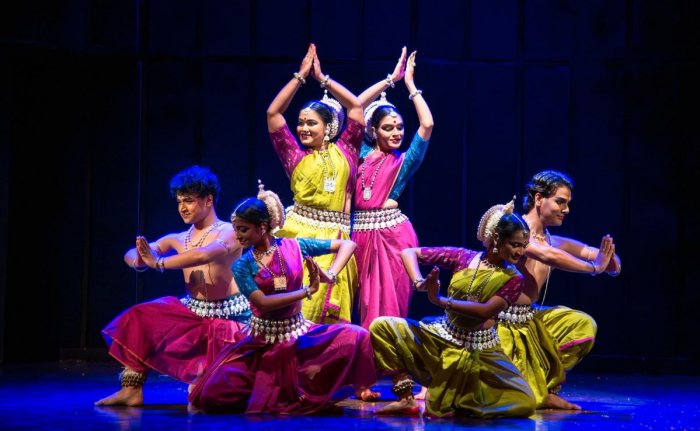
Pravat Kumar Swain and ensemble
Pravat Kumar Swain, a Bismillah Khan awardee, was Gotipua trained,
before coming under Odissi Guru Aruna Mohanty. Now running his
institution Nrutya Naivedya in Bhubaneswar, he was selected by the ICCR,
for a teaching assignment in Bali, Indonesia. A painstaking teacher as
Pravat is, his group comprises fine dancers. Right from the
Mangalacharan start (set to music by Sukanta Kundu with rhythm and
mardal playing by Dhaneswar Swain), one could see the finished quality
of the dancers offering their salutations to Lord Jagannath – who in
this version is also worshipped in his earliest avatar, housed by the
Sawara tribals on the Neelachala hills, as Neela Mahadeva. This same
deity later presides as Lord Jagannath in the Puri temple! Aside from
the neat body positions, concluding Mangalacharan with the group
standing at an angle, paying salutations to the stage altar, was
artistic – though the group should have positioned itself closer to the
altar, so as to prevent the flowers they offered to the God, being
trampled upon by the next line of dancers!
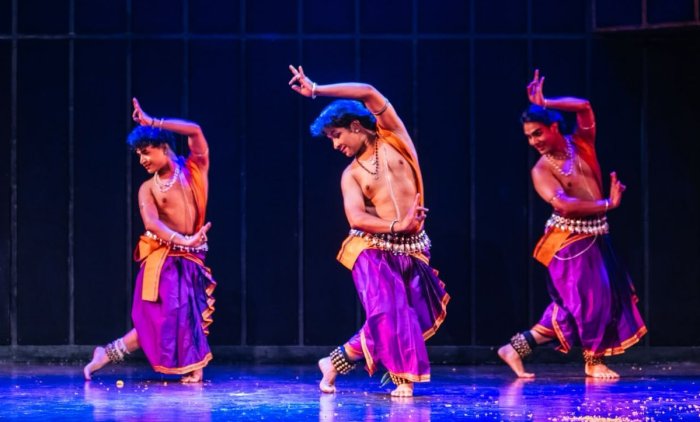
The Pallavi, with music set to raga Bakulabharana, again by Sukanta
Kundu, with dance visualized by Pravat Kumar, had Dhaneswar Swain’s
mardal rhythm, with the recitation of the ukkutas, Thingina ta thai
ta… by the percussionist adding a special touch of vibrancy to the dance.
The two male dancers and three female dancers, apart from immaculate
technique, radiated a visible sense of joy in rhythm.
The Ashtapadi Kuru yadu nandana, wherein Radha, basking in the glory of
love’s fulfillment with Krishna, lovingly demands that he help repair
her rumpled after-love state, was presented. The interpretation for the
Ashtapadi, by Pravat’s Guru Aruna Mohanty, is based on music composed by
late Subhas Pani. After Guru Kelucharan, Pravat Kumar Swain is perhaps
one of the very few male dancers attempting this Ashtapadi attributed to
Radha!
Namami Gange
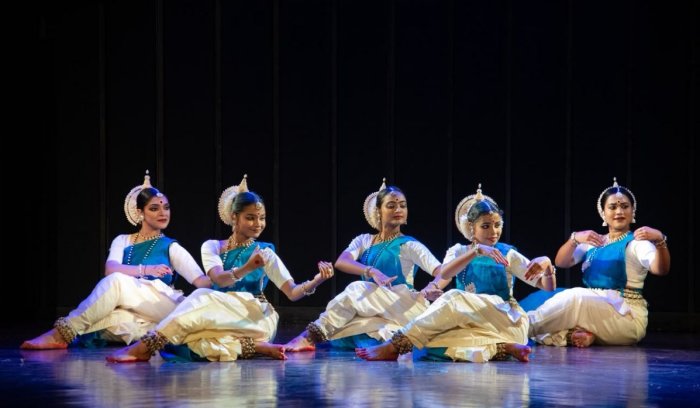
The next group offer Namami Gange about ‘Ganga’s tears’, showed the
influence on Pravat Kumar Swain’s mindset of teacher Aruna Mohanty - who
is known for her work based on issues of concern to the present day
world. Again, it was Sukanta Kundu, composing and lending vocal support,
to the concept and script by Pravat Swain. Costumes in blue and white
greeted the swirling joy of waters from Mother Ganges, who, over time
loses her ebullience and life-giving strength thanks to the abuse of
man. Parts of the work were very effective – though one would have
wished that visualizing Man’s ill treatment of the river’s bounty, could
have been articulated through more pungent images than just discarding
of left overs of food and prayer ceremonies.
The finale, based on script by Mahendra Acharya was Sadaripu - built
round the six ills that bring about the fall of a human being – namely
Kama (lust and desire), Krodha (anger), Lobha (greed), Moha (desire or
attachment), Mada (an inflated sense of self importance) and Matsarya
(envy) – showed the downfall brought about by each of these conditions,
visualized through events in mythology in swift moving, short
narratives. Hiranyakashipu’s anger against son Prahalad’s refusing to
regard him as God Almighty in place of Narayana, Sita’s desire in
wanting to possess the golden deer, pain of death made Buddha go through
penance to arrive at the truth of Moha or desire being the cause of all
ills of man, Matsarya or envy of the Kauravas, which led to the
treatment meted out to the Pandavas and their Queen Draupadi,
Dasaratha’s attachment for Kaikeyi with the promise he made when
she saved his life, exploited by her in the avarice to get the
kingdom for her son, with Dasaratha breathing his last with no son by
his side - were brought out through snippets. A fine effort on the
whole!
QUIETUDE OF TWAMAHAM VANDE TOUCHES AUDIENCE HEARTS
With no virtuosity of chakkars or footwork, or overspun, cleverly
arranged teermanams, it was the undisturbed quietude of the inner
dancer, that warmed the cockles of audience hearts at the IIC auditorium
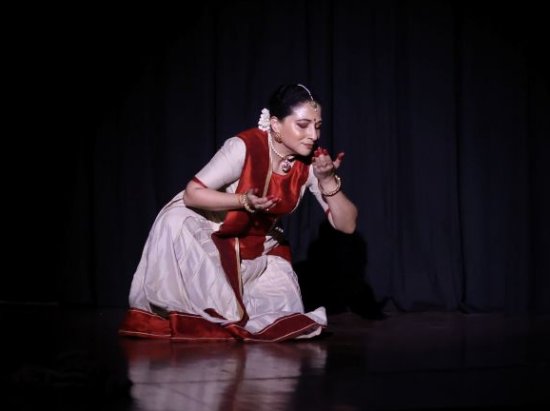
as Jalsa Chandra with her group, presented Twamaham Vande. It was a
spiritual journey enveloping Bhakti through varied manifestations, all
tracing the mystic search for that ultimate union of the micro with the
macro, in a unique ceaseless cosmic dance of creation, preservation and
destruction. Conceived, choreographed and directed by Jalsa, one admired
the controlled, internalized strength of the work, never yielding to
the temptation of any type of loudness or razzle/dazzle - the work
employing two movement styles - Bharatanatyam and Kathak. Nothingness
suggested through peculiar sounds gradually enveloping audience space
with a darkened stage, the mood was set for an other worldly theme. The
start to this journey, amidst the darkness of void, is with the Hymn of
Creation comprising the tenth Mandala of the Nasadia Sukta of the Rig
Veda posing the question - Naasad aasin no sad aasit tadaanim, naasid
rajo no vyoma paro yat - wondering about the primordial state of the
universe, with neither existence nor non-existence, and in whose keeping
was it?
Jalsa Chandra
Even as mankind accepts the natural rhythm of the cycle of creation,
preservation and destruction of the universe, Kabir’s verse, with its
timeless wisdom, cautions man about the impermanence of this existence.
Similarly referring to the precarious nature of this body, is Lalon
Fakir, Bedeche amono ghor shunyer upar pota kore, pointing to the truth
of the brittleness of body built on empty space in dhonno, dhonno boli
tare - Why does man then strive to possess so much?
The Bengali flavour yields place to the Rajasthani vibes of Meera’s
unconditional love for Krishna. No matter how he may feel about her,
addressing the Lord, Meera says that her heart’s bond with him can never
be replicated, “Jo tum todo piya, Mai nahi todun re- Tosaapreet todi
krishna, kaun sang jodun .” The journey of that eternal search now
changes to the South with a 6th-7th century Tirunavukkarasar Tevaram
hymn ‘Vanamai (m) madi soodiyamaindanai tenanai tiru Annamalaiyanai’
addressed to Shiva, described with the half moon on his head, as the
lord presiding over Space (the five elements are presided over by Shiva)
dwelling in Tiruvannamalai Kshetra. This group scene caught the image
of a typical procession of the Lord in south Indian temples.
In this bhakti peregrination through parts of India, Maharashtrian
Abhang comes next with a scene from Sant Tukaram’s works Nindastuti -
Pandhari che bhooth mothe, aalya gailya zzhatapi vaatay, wherein in a
reverse psychology (Sant Tukaram says with wry humour, that any person
going to Pandharpur is bound to fall under the spell of Lord Vithoba’s
divine will, and lose all track of normal worldly life.) The lilt of the
Abhang was followed in the next scene by a Tulsidas line from his
Ramcharitmanas - Kaha ke pathik tum kinho he gamanwa. During the sojourn
of Rama, Lakshman and Sita to the forest the question is asked by
curious dwellers in various places as to where they are from and where
they are headed and the reason for dwelling in the forests, and the
answer is given that they are two sons of Dasaratha Raja of Ayodhya,
whose living in the forest is to fulfill their mother’s pledge! In fact,
Sita calls all beings fellow travellers in life born somewhere and
ending somewhere else.
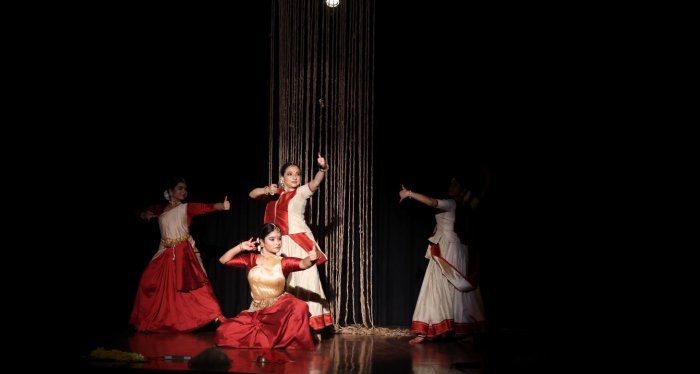
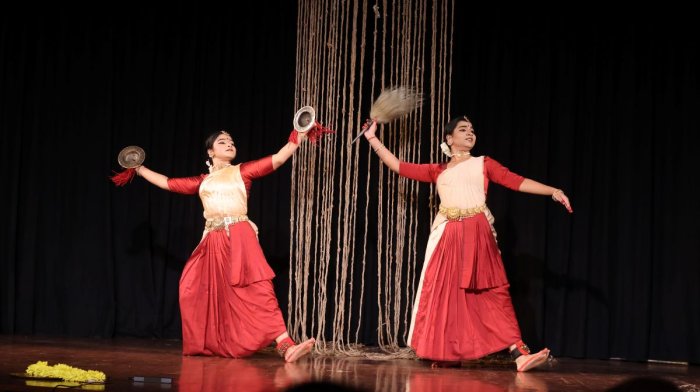
Both this scene and the next from the Gita where Krishna is delivering
his sermon that the devotee and what he seeks are closely linked like
pearls strung together, show that it is the realization which is lacking
– and once that state is reached as the Mundokya Upanishad says, Yatha
nadhya syandamanah samudre stam gachhanti… like the river which joins
the Sea, Brahman is realized and like fire and flame cannot be
separated, the search ends. The entire production stands on excellent
music arrangement by Shankar Narayanaswamy, with regional musical
identities scrupulously preserved even in the percussion tones like the
Thumak for Lalon Fakir’s Dehi tatwa verse.
With such a strong musical base as the take off point, were other
contributions - Narration by Gour Basu, light design by Soumen
Chakraborty, production design by Utsab Ganguly, with Shreejit Datta as
programme consultant. The simple but tasteful costume in two colours red
and off white (representing two states-of-being, macro and micro), and
above all a well trained group of dancers led by Jalsa Chandra, who
never wavered from the deep seated concentration called for a theme like
Twamaham Vande deserve kudos.
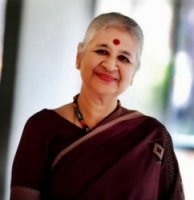
Writing on the dance scene for the last forty years, Leela
Venkataraman's incisive comments on performances of all
dance forms, participation in dance discussions both in
India and abroad, and as a regular contributor to Hindu
Friday Review, journals like Sruti and Nartanam, makes her
voice respected for its balanced critiquing. She is the
author of several books like Indian Classical dance:
Tradition in Transition, Classical Dance in India and Indian Classical dance: The Renaissance and Beyond.
Post your comments
Please provide your name along with your comment. All appropriate comments posted with
name in the blog will also be featured in the
site.
|