TAALAM
BY LEELA VENKATARAMAN e-mail: leelakaverivenkat@gmail.com
Debadhara Festival built round Debaprasad style of Odissi
Photos courtesy: Debadhara
July 14, 2026
The three-day festival at Habitat's Stein auditorium in Delhi, featuring
Odissi of the Debaprasad school, was a joint effort by Debadhara run by
Binayak Panda and Tridhara, the institution under older brother and
guru Gajendra Panda, at Bhubaneswar of Odisha. With the dance tribe in
general facing daunting financial limitations in arranging events
involving the larger circle of dance practitioners, the brothers must be
credited for managing grants by the Ministry of Culture and other
Corporate Sectors enabling the sponsoring of such a festival, involving
dancers from forms outside Odissi too.
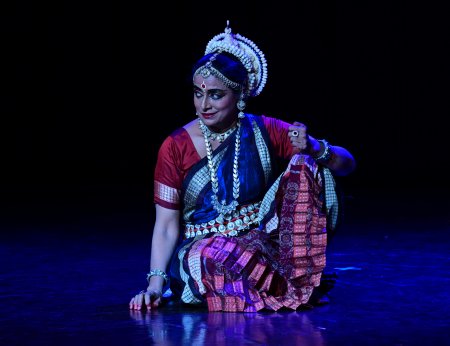
Sangeeta Dash
It was heartening to witness the first day's programme, after the Deepam
Jyoti curtain-raiser presided over by dignitaries, having its opening
recital featuring Sangeeta Dash - a dancer at one time regarded as one
of Guru Debaprasad's prize students, who unfortunately, got sidetracked
due to unforeseen developments in her life and seemed to have
disappeared from the Odissi radar. Being treated to a performance by
her, after a long gap, it was very reassuring to see that time had not
dimmed that old fire. Her opening invocation Namastestu Mahamaye
Mahalakshmi Namostute saluting the Goddess of wealth and prosperity,
fashioned on music by Ramahari Das with rhythmic inputs by Dhaneswar
Swain, was rendered with evocative power - followed by an abhinaya based
item. Sangeeta has eloquent mukhabhinaya, and in this composition of
Kavi Surya Baladev Rath, "Nahi Auo" ,the Nayika reflecting on Pitambara
Sundara Krishna with his peacock feather in the headdress, his
bewitching flute music, feels nothing can ever compare with that image.
Even a nostalgic recollection of images makes her get overcome with
shyness and ecstasy - all moments recaptured from a time, never to
happen again.
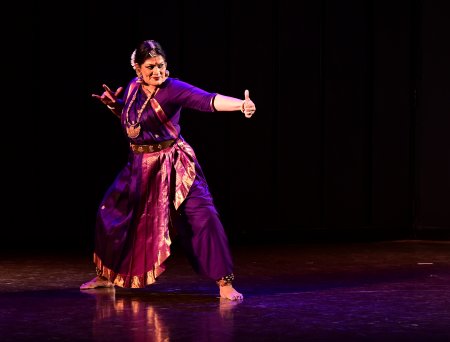
Geeta Chandran
The scene next shifted to Bharatanatyam dancer Geeta Chandran with a few
disciples from her institution Natya Vriksha. Having spent half a
century with Bharatanatyam, Geeta has been engaged in Art education
through lectures, looking at dance in its totality - comprising
technique of Bharatanatyam, music (as a trained Carnatic musician), and
the poetic content forming the dance base. Her process of dance
education involves an awakening of both body and mind. This short
program, away from the usual clutch of sublimated Margam items,
involving young students, started with an item of playful zest, woven
round children's games - contrary to an age when the world seems to play
only computer or war games - to quote the pithy aside of a Natya
Vriksha promoter!
The next item Sringara Vaibhavam demonstrated the resilience of an
experienced dancer in being able to convey ideas and thought through the
language of gesture and expression. Geeta's interpretation had its
opening in a quote from the age-old poetry on the subject of love,
Kuttana Mata, an erotic 8th century work by Sanskrit poet Damodar Gupta,
who rose to be a high- ranking minister in the court of Jayapida of the
Karkota Naga dynasty of Kashmir. The work is built round flourishing
courtesan life of the times! The theme of love in Indian dance,
invariably takes recourse to metaphors abounding in the poetry of
Kalidasa's Ritusamhara, the immortal verses built round the seasons,
with ardent advocacy of Vasanta or Spring as the season for sringar.
Vasanta is the chief lieutenant (Vasanta Yodha) of Kamadev, the God of
love, who is portrayed holding his bow of fragrant flowers, with a line
of honeybees clinging to it. The lines starting with "ratimukha
shatapatra... chumbana brahmara," shows Spring in all its bounty,
exciting the senses, as the ideal time for love. (Drumah sa pushpaah
salilam sa padmam striyam pavanaah sugandhi). Imagery of Spring with the
fragrant breeze is painted with trees laden with blossoms, lotuses in
full bloom in water and women filled with desire. Each type of flower -
White lotus, Ashok flower, Mango blossom, Jasmine and Blue lotus, aimed
through Kamadev's arrows awakens a particular aspect of sringar in the
victim, which when quickened by the flowered darts, results in the
victim being intoxicated with desire for the loved one, seeking
fulfillment.
With heightened understanding of the text based on late Chandra Rajan's
English translation of Kalidasa's work Ritusamhara, Geeta's performance
demonstrated how abhinaya which corresponds to the inner dancer's
perception, builds on not just an understanding of sahitya, dance
technique and the gestural vocabulary, but also on knowledge of music
which provides prime emotive inspiration as the take-off point. Here
musician Venkateshwaran's rendition and concept, with the music in
ragamalika, using one main raga like Kanada for the refrain, with
changing ragas for different images, reverted each time, to the central
mode.
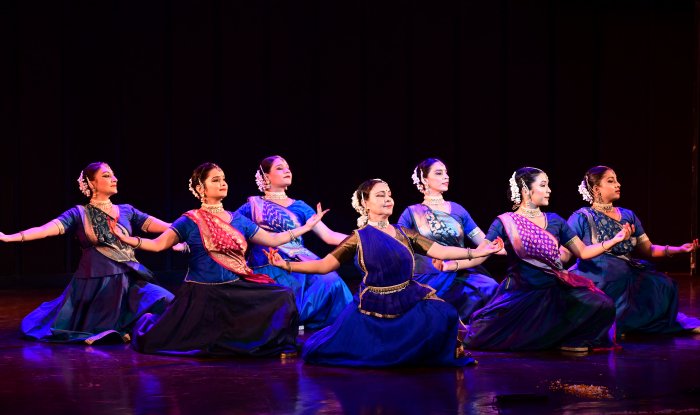
Malti Shyam & disciples
After Bharatanatyam came a very efficiently put together presentation of
abhinaya and nritta by Kathak veteran, trained under Reba Vidyarthi and
Pandit Birju Maharaj - viz Malti Shyam with her students. The
curtain-raiser was with Tulsidas' Bhasma Anga as invocation to Shiva,
the ultimate vanquisher of desire, with the nritta part built round
Vasant Taal of nine matras. Meticulous neatness of dance profile
in the rendition made for delightful viewing. Apart from her own
expertise, presenting a Kavit or Trivat - Dhina Dhi Dhi Na, what one saw
clearly, from watching the students, was what a fine teacher Malti
Shyam has turned out to be!
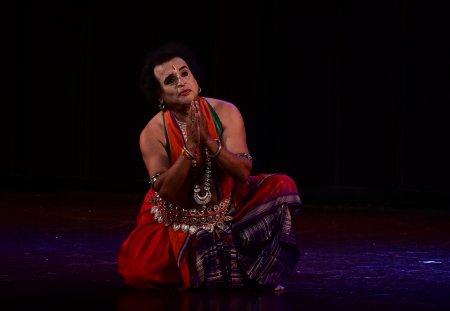
Gajendra Panda
The last evening started with Guru Gajendra Panda's predominantly
abhinaya- based performance in the Debaprasad gharana - with its
Saptaswara Patha identity totally flowing from the Guru's staunch
belief in all Odissi stylization as a flow, representing a continuity
from folk/tribal traditions existing on its soil. "Mana udharana koro
he" in raag Chinta Kamodi set to Triputa tala, a composition of the 17th
century poet Upendra Bhanja, saw Gajendra Panda pay homage to
Jagannath, who saved the elephant Airawat from the Jaws of the
crocodile, and who was the sole saviour of Draupadi's honour when she
was being shamed in the Kaurava court. The devotee addresses Jagannath
as Neelagiri Natha, referring to his original avatar in the hills,
worshipped by the Savaras. In the same devotional mode was the Guru's
next presentation of a Rama Bhajan, "Bhaja Rama Nama Pada" from the
Keertana temple tradition of South Odisha, particularly among Daskatia
performers, who wielding castanets in their hands, have invested the
song with a special rhythmic pulse. Gajendra Panda's performance had all
the devotional conviction.
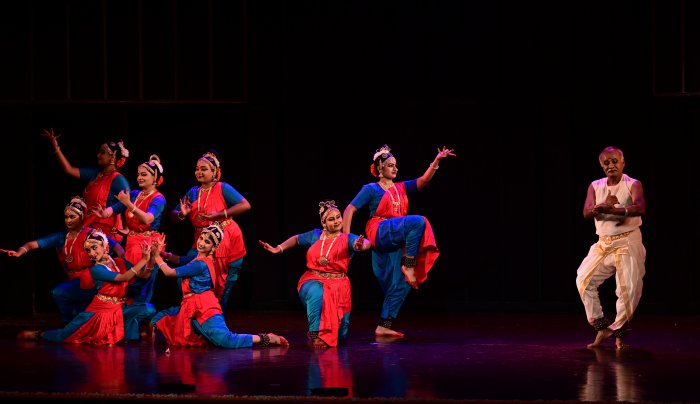
P Nagajothy & disciples
The next slot in the program in Kuchipudi, for this critic, represented
the weakest link in the chain of dance forms. Rendered by the group, led
by the couple conducting Kuchipudi classes in the Tamil Sangam
premises, viz Sita Nagajothy and husband P. Nagajothy, along with
daughter Abhinaya Nagajothy, the group presentation with a suite of
three items, began with the traditional item made so famous by late
Vempati Chinna Satyam "Jayamu Jayamu Lalita kala Vaniki," a
well-known offering of homage to the goddess of the arts, with a final
passage naming Siddhendra Yogi, the originator of the art of Kuchipudi,
with nritta passages knitting up the sahitya parts. Next came
Annamaiyya's composition, "Okapari Kokapari" in raga Karaharapriya based
on Madhura bhakti, portraying the love of Lord Venkateshwara and
Alamelumanga, an item visualized by Sita Nagajothy. Concluding was the
item saluting Lord Shiva, with the composition "Shiva Shiva bhava bhava
sharanam" set to music by Sudha Raghuraman, as rendered by the group
with the finale "Ananda natanavo bhoga / Satchidananda vigalita kesha,"
as refrain for the Tarangam.
Sita Nagajothy was introduced as a student of Guru Vempati. Having
witnessed the sheer perfection, late Guru Vempati Chinna Satyam
insisted on in his students, one was left wondering how the mediocre
fare sans movement finish being presented, could trace connections with
Guru Vempati Chinna Satyam! Even daughter Abhinaya's dance fell woefully
short of perfection. Sita Nagajothy has animated expression, but her
nritta is not immaculate in line and profile and P. Nagajothy barely
executed any movement. Present day Kuchipudi appears short of great
achievers among senior dancers.
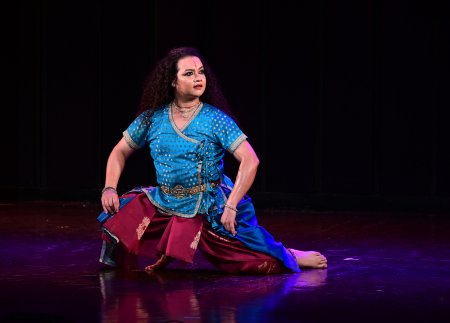
Vishal Krishna
Concluding the festival was a Kathak recital by Vishal Krishna, whose
Benares gharana Kathak was centered round Krishna - "Sindhura Vadana
Madana Shyama Sundar." Kathak dancers are wont to use Birju Maharaj's
way of describing Sam, the starting point of a cycle of tala - as
Krishna-- with all of technique in nritta regarded as a search through
varying arrangements of Amad / Toda / Paran / Tihai etc ending with
finding him at the finishing point to start the rhythmic voyage of
search again with the sam. The dancer's Mayur Gath was particularly
graceful and typical of the peacock's gait. The first human/divine
coming together of Radha and Krishna in the Surdas's composition
"Bhoojat Shayam kaun tu gori," has been presented by other Kathak
dancers too, like veteran Uma Sharma, whose magnum opus this item
became. This version by Vishal was based on a choreography of Madhavi
Mudgal (whose career started as a Kathak dancer), with music composed by
Madhup Mudgal. The maiden meeting, with Krishna wanting to know more
about the fair stranger in their midst and Radha's cheeky reference of
having heard about the cowherd who is a butter thief, with Krishna's
defiant query ‘What have I stolen from you?'
Vishal Krishna with his wavy locks flying in the air, over the years,
seems to have remained unchanged in both physical presence and the
Benares gharana items he represents - though the extreme physicality of
high vaulting leaps to land on the sama in the seated position, may have
become a trifle less vigorous over the years. In a fine program, what
proved irritating in the recorded music was the stringed instrument
playing the lehera, unable to be sur faithful!
A fine festival effort on the whole though I would expect more of young
really deserving talent emerging from Binayak Panda's institution.
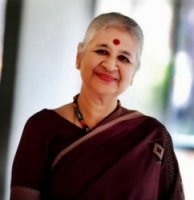
Writing on the dance scene for the last forty years, Leela
Venkataraman's incisive comments on performances of all
dance forms, participation in dance discussions both in
India and abroad, and as a regular contributor to Hindu
Friday Review, journals like Sruti and Nartanam, makes her
voice respected for its balanced critiquing. She is the
author of several books like Indian Classical dance:
Tradition in Transition, Classical Dance in India and Indian Classical dance: The Renaissance and Beyond.
Post your comments
Please provide your name along with your comment. All appropriate comments posted with
name in the blog will also be featured in the
site.
|