TAALAM
BY LEELA VENKATARAMAN e-mail: leelakaverivenkat@gmail.com
Trip down Odissi's memory lane in Orissa Dance Academy's Subarnima
Photos courtesy: Orissa Dance Academy
July 4, 2026
Celebrations marking fifty years of an art Institution, can take on many
hues. Apart from marking a milestone, it can be a time for stock
taking, for renewing pledges and also reveling in still retaining a
place in a fast-moving world with a penchant for splashes of brilliance
rather than longevity. What one saw in Subarnima of Orissa Dance
Academy, an institution with a hyper active calendar of events,
established in 1975 by the enterprising Guru, late Gangadhar Pradhan and
now managed by his top disciple Aruna Mohanty, was a thoughtfully
designed umbrella of items, encapsulating a salutation to the artistry,
of all the great Gurus of Odissi - but for whose Herculean efforts,
present day Odissi could not have boasted of such a large presence in
the prevailing dance scenario of India. All credit to Aruna Mohanty,
Creative Director cum Secretary of Orissa Dance Academy, who by laying
stress on the contribution of the entire family of teachers, has
subsumed the invariable contradictions existing between and amongst
different Paramparas. By this one act of unifying the entire Odissi
brigade with so much grace, the three day Subarnima event (June 22 to
24, 2026 at Rabindra Mandap, Bhubaneswar), acquired a special texture of
togetherness and bonhomie.
The auspicious start with lamp lighting by Hon Minister Babu Singh , MLA
Ekambara, had pioneering stalwarts participating - like
Priyambada Mohanty Hejmadi whose performance in the Youth Festival
started the history of Odissi as a dance form in the pan Indian
scenario, Kum Kum Das who shepherded the fortunes of the
Odissi Research Centre for years before retiring, Madhavi Mudgal, a
stalwart and one of Guru Kelucharan's earliest students,
Snehaprabha Samantaray, Guru Durga Charan Ranbir and many others.
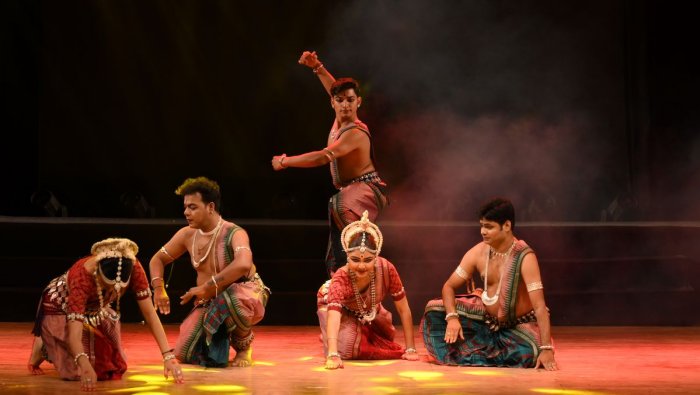
Nrutyayan
The performance part started with Mangalacharan presented by Nrutyayan,
in the Debaprasad gharana, set to raga Bairagi and Ektali, the
salutation evoking HariHara (Vishnu and Shiva in one icon), representing
the ceaseless flow of all energy of atoms in the Universe in polar
relationships of action and reaction - life and death, of pleasure and
pain - engaged in ceaseless activity of destruction and
resurrection. Using mudras associated with both deities, the group
of dancers finally concluded with nritta in Trikhandi pranam.
Continuing in the same Debaprasad school of Odissi, the group presented
Sthayi, one of Debaprasad's most challenging creations - a blend of both
the Mahari and Gotipua traditions. The choreography by Durga Charan
Ranbir, a prime student of late Guru Debaprasad Das, of this item based
on music by Ramahari Das with the Ekatali rhythmic inputs by the
mardal expert Dhaneswar Swain, while efficiently rendered, seemed to
this critic to be somewhat changed from the original version of
Debaprasad, one had witnessed. The typical Shabda swara patha
recitations comprising movement technique (similar to the lakshanageet
of Kathak) the late Guru delighted in, and a fleeting moment showing the
Banda nritta influence with the pirouettes clockwise and anti-clockwise
were all features. But I remember the original item as composed by the
Guru to be much more exacting and somewhat longer from this version.
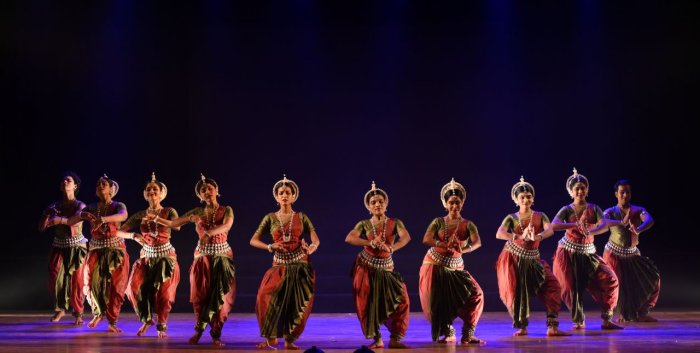
Yugmadwanda Pallavi by Srjan
Srjan, late Guru Kelucharan Mohapatra's institution, now under his son
Ratikant Mohapatra, next presented Yugmadwanda Pallavi in Bageshri - the
dance rendered to this Raghunath Panigrahi musical composition, made
immortal by late Sanjukta Panigrahi. The choreography by Guru Kelucharan
as reworked by Ratikant Mohapatra for the group, was presented.
The same group next went on to present Vande Sooryam built round the
journey of the Sun across the horizon, riding his chariot drawn by seven
horses. Set to music by Agnimitra Behera in ragas Bairagi, Ahirbhairava
and Vibhas, Surya is addressed variously as Aadityaya, Bhaskaraya,
Markandaya et al. A feature of Ratikant's group expressions is in the
way the dancers synchronize flawlessly, in an exemplary exhibition of
group discipline.
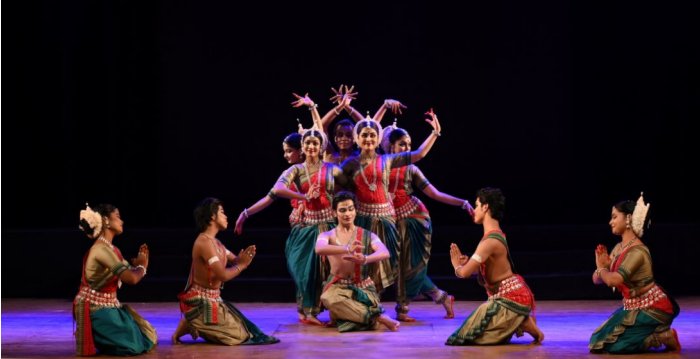
Utkal Sangeet Mahavidyalaya
Matru Bhoomi Vandana, a salutation to the motherland, based on Lingaraj
Pradhan's composition set to Bijay Kumar Das' age old tune 'Tumi Maa
Janama Bhoomi', was presented by dancers from Utkal Sangeet
Mahavidyalaya, the item representing a work by the guru regarded as the
Pitamaha of Odissi, namely Pankaj Charan Das.
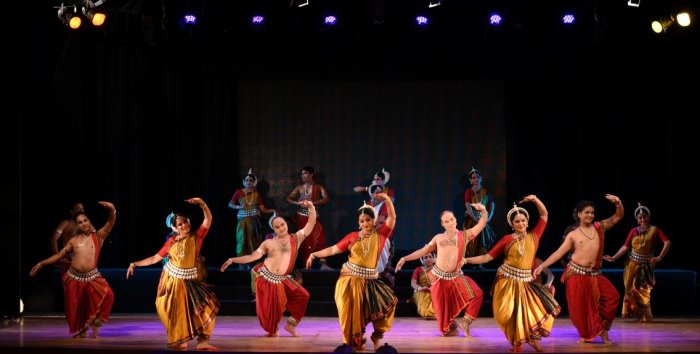
Konark Lasya Leela by Orissa Dance Academy
The evening concluded with late Gangadhar Pradhan's choreography Konark
Lasya Leela based on the epic poem on the Sun Temple of Konark, composed
by Late Mayadhar Mansingh, comprising a magical scene of the timeless
icons standing as sentinels in the Konark temple, on a moonlit night,
coming alive to trip the light fantastic! Presented by a large group of
finished dancers, with one of Orissa Dance Academy's recognized dancers
Madhusmita Mohanty leading the work, it marked a flawlessly rendered
fitting finale for the thanksgiving evening, recapturing pages from
Odissi history. Ramesh Chandrakant's lighting illuminated the
proceedings of the evening, with Dr. Srinivas Ghatuari 's verbal deluge
as the anchor, adding its bit to the evening. The event gathered under
one Rabindra Mandap roof, the who's who of Odissi. For this critic,
Aruna Mohanty's crowning achievement, in keeping with her guru bhakti,
was in having both Guru's wife and son, amongst the gathering.
A panel discussion, Bahirangam, in association with GKCM Odissi Research
Centre, was mounted at the Utkal Rangmancha of Orissa Dance Academy,
the next morning. Moderated by an ex-SNA Delhi official Helen Acharya,
who retired after a spell as Secretary of the Central Akademi, the
discussion centered round various aspects of Odissi dance, involved
senior dancers Madhavi Mudgal, Daksha Mashruwala, Jhelum Paranjape,
Sharmila Biswas, and Aloka Kanungo - all students of Guru Kelucharan
Mohapatra - dance critic Tapati Chowdhurie who recently won the SNA
award and this writer. A heartening factor was that every participant,
rather than getting involved in generalities, stuck to personal
experiences, thereby giving the event a tone of experiential sincerity.
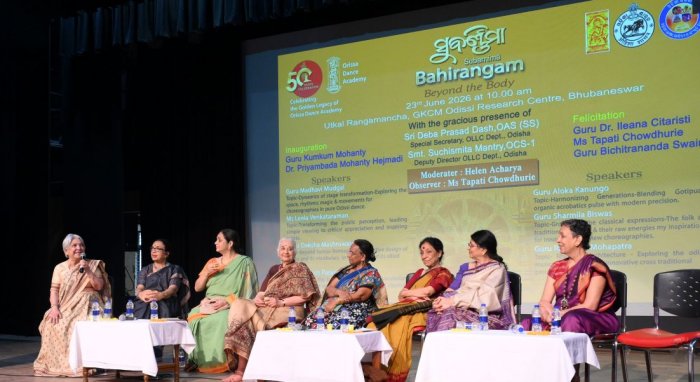
Bahirangam
Madhavi Mudgal spoke of how she worked out group geometry with rhythmic
combinations based on ukkutas, keeping stage spacing in mind. Jhelum
Paranjape spoke of her challenges, prompted by her own urges, as also
requests from outside quarters, of Odissi rendered to film music. Aloka
Kanungo dilated on her work with Gotipua Dance - and the need to respect
these dancers (an aspect she felt was lacking amongst the larger breed
of classical dancers). She referred to the fact of the background of
these youngsters, comprising diligent training involving music, a yogic
control over bodily movement stemming from the most demanding asanas,
and also knowledge of literature of old Oriya songs - while reminding
the audience that most of our great gurus had Gotipua training as their
base before stepping on to Odissi greatness. Sharmila Biswas outlined
her concept of modernity -as Odissi dance shaped on the foundations of
research and reclaimed the intrinsic music culture of Odisha sans
Carnatic or Hindustani influences - of chanda, chautisa, champu, janana,
etc forming the musical backdrop. That for her would be unalloyed
Odissi in both music and movement. Daksha Mashruwala who was, according
to the session as envisaged by the organizers, to share her experiences
with Odissi while creating new choreographies, chose to put the accent
on how dance had inspired her creative energies and how she worked with
concepts relevant to the times and younger generation of artistes. She
spoke on how she had taken recourse to movements from the Chhau
technique while working on ideas choreographing animal gaits.
Talking of dance writing, I mentioned my own trials in acquiring a
degree of confidence. Acting as a vital link between art and the
audience, discovering a language which communicates to the general
readership without a profusion of technical terms is as important as
principled critiquing, sans fear or favour. The very nature of the work
does not provide ready recipes for popularity. At best, one may earn a
grudging respect for maintaining a degree of fairness. Tapati Chowdhurie
had a word of gratitude for all the work done before she joined the
Dance Writing tribe, which had provided her the stepping stones for her
work.
Little asides, during the morning, with guest Priyambada Mohanty
mentioning an incident from the past in late fifties and early
sixties, with the likes of P.V.Krishnamurti of All India Radio Cuttack,
and Kelucharan Mohapatra working together - to produce a group work
before late Pandit Nehru, whose impatience with having to watch a
cultural dance show was mollified with remarks that he had to watch only
as long as he wanted to - with the late Prime Minister sitting till the
end and then coming on to the stage asking for the choreographer
(Kelucharan Mohapatra) who had to be dragged on to the stage, from his
earnest task at the back of the stage premises preparing his 'bidas' for
the day and aesthetically arranging them in the little box he carried!
This writer was the one to compere that programme! These
interventions made for interesting nuggets from Odissi's past, adding to
the morning discussions. It was heartening to see a full hall of
attentive students and gurus for the event.
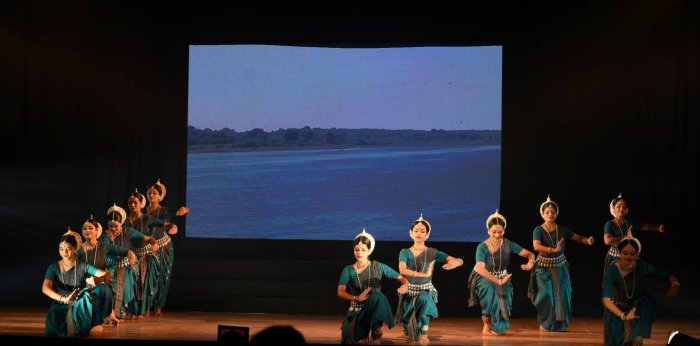
Mahanadi by Orissa Dance Academy
The second evening's presentation at Rabindra Mandap belonged entirely
to the Orissa Dance Academy, with dance in both solo and group
manifestations, finding high quality representation. For a riverine
culture like Odisha's, which has had the mighty river Mahanadi - the
Utkala Ganga as it has been called - its lifeline, vegetation, life
patterns, rural, tribal or urban, had all been shaped by the waters. A
sunrise in Konark, a temple site in Puri, or a Sambalpuri tribal dance,
Odisha in her variety, has been subjected to extreme manifestations of
Nature - both droughts, and cyclones. Creating a dance travelogue, with
manifestations of folk, and classical dance, the work Mahanadi
supplemented with tasteful visuals, with music composed by Agnimitra
Behera and rhythmic contribution by Ramesh Chandra Jena with Aruna
Mohanty's choreography, added up to a feast of colour, movement, and
above all tasteful costuming catching the likes of tribal and urban
cultures. The immaculate rendition from a large group of finished
performers spoke highly of the training imparted in Orissa Dance Academy
and the fact that at any moment over fifty fully trained dancers are
available for any production.
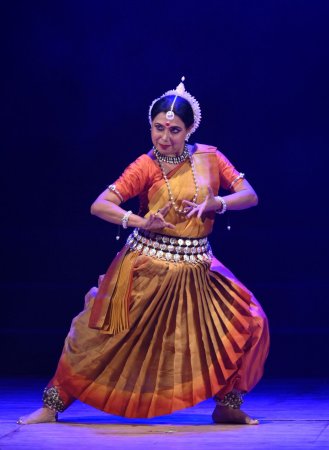
Amba by Aruna Mohanty
The solo offer for the evening Amba, rendered by Aruna Mohanty herself,
was a lethal combination of fire and stillness, based on her uninhibited
zeal for treading areas reflecting contemporary issues. Amba, a
princess of Kashmir, literally abandoned and jilted at the altar after
being abducted from the swayamvara by Bhisma who is sworn to his
inflexible code of celibacy, and rejected by Shalva, the man she loved,
as already betrothed, turns into a cauldron of burning fury, seeking
revenge. Born in the next life as Shikhandi, neither man nor woman,
driving her chariot in the Kurukshetra war, her shower of arrows spell
the death of Bhishma, whose dharma will not accept fighting a woman. Who
prescribes these inflexible codes specifying what constitutes societal
man or woman or different gender and sexual identities? Physicality of
body apart, what of the inner man with mind and emotions? Time
past and present become one in this Mahabharata episode, pointing to an
existentialist crisis - as relevant today as then. How does society even
today look at the transgender community? Have we created a society
treating each person as an individual - with one's own simmering aches
and gender predilections? Based on Kedar Misra's research and script,
and music by Agnimitra Behera, Aruna Mohanty's incisive abhinaya, with
its quality of immediacy, puts the spotlight on an eternal question - of
how society has always treated those who defy conventional stereotypes.
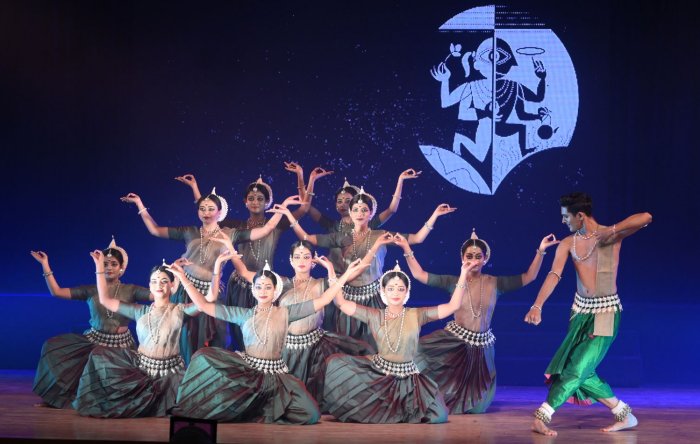
'Song of Life' by Orissa Dance Academy
The evening ended with the Song of life based on couplets from the Gita,
comprising Krishna's sermon to Arjuna who on the Kurukshetra
battlefield, confronting the Kaurava army, sinks to the ground, with the
Gandeevaam slipping from his hands, helpless at the idea of having to
fight his relatives and persons with whom he has had close interactions
in life. The item sees Krishna in different roles - from the romantic
image of young Krishna frolicking with and serenading the Gopis with his
flute music, under the Kadamba tree, ('Kadamba tole'), the action
changes to the same Krishna as Avatari presiding over the ten
incarnations, for eradicating evil on Earth - manifesting in successive
incarnations as Matsya (fish), Koorma (tortoise), Varaha (boar),
Narasimha (half man half lion) , Bali (dwarf), Parasurama (axe man),
Balarama (ploughman), Rama (epic hero), Buddha (messenger of peace) and
finally yet to appear Kalki - representing evolution of life
- appearing first in the waters as fish, in water and land as tortoise,
in land as boar, then in a mixed animal / human form as Narasimha, then
the first human as dwarf (Vamana), followed by the ploughman and tiller
of the soil (Balarama), warrior with bow and arrow (Rama) and finally
as the emancipated great thinker/ teacher Buddha and yet to
manifest as saviour Kalki. The same Krishna, as charioteer, opens
Arjuna's mind to the realization of the impermanence of this body.
Speaking of life and death as a part of life, Krishna in his great
teaching on Dharma points to the imperishable part of man which is the
Self or Atman. Knitting this whole philosophy, with lines from the Gita
thrown in, into a dance paradigm was done with skill. The rich lighting
was by Guru Ramesh Chandra Jena, with Mrutyunjaya Rath in his quietly
efficient manner, the anchor for the evening.
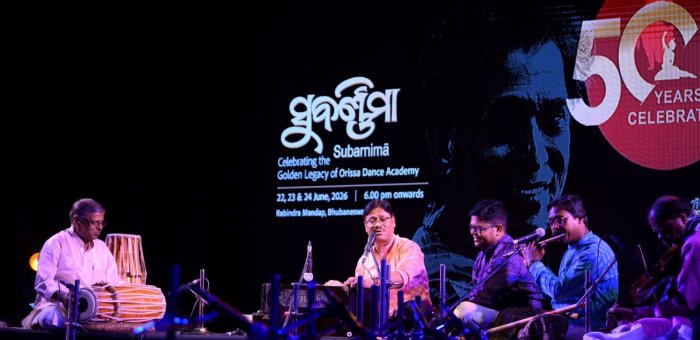
Odissi vocal by Bijay Kumar Jena
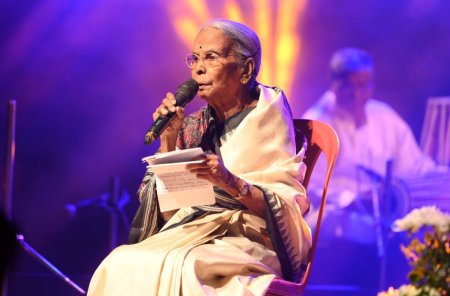
Odissi vocal by Shyamamani Devi
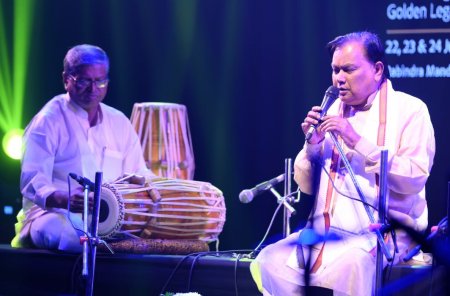
Odissi vocal by Ramhari Das
The concluding evening was devoted to Odissi musicians - again bringing
back old memories watching the chief guests for the evening - with
veteran figures like Shyamamani Devi, a now older and frail Gopal
Chandra Panda led by his daughter, Dr.Ramhari Das, and mardal figures
like Dhaneswar Swain. Though reluctant, with the constant mention that
she was too old for solo singing now, Shyamamani's full throated
singing of "Jamuna teere kadamba moolare," the song composed by
Raghunath Parikh, was so different from the thin voiced rendition by
most female singers today, was delightful to listen to. Ramhari rendered
one Champu Pada, "Madhura Manda manda" and Chhanda -the curves in the
gamaka with the strong voiced singing, typical of his musical rendition.
Bijay Kumar Jena sang "Mohana Madhuri dekhethile Nari". Mathru Prasad
Das, this year's SNA awardee sang "Nahi ke kari dela", the song which
has become an important part of Odissi dance history.
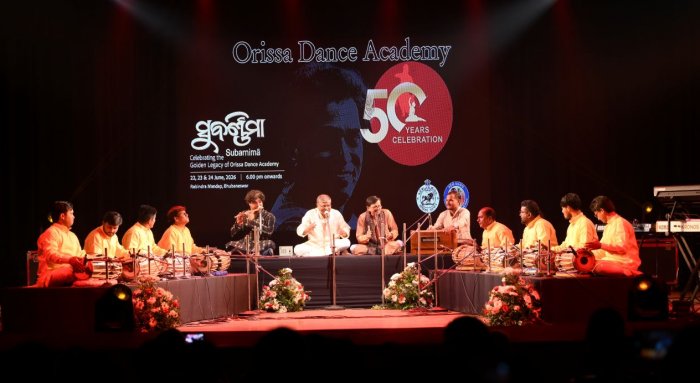
Tala Vadya by Dhaneswar Swain & Sachidananda Das
The fairly long Tala Vadya percussion session saw mardal players lined
up on two sides, one led by Dhaneswar Swain and the other by students of
Sashi Maharana - all trained at Odissi Research Centre. The 3,4,5,7
combinations were all given spirited rhythmic orchestration - though I
would have liked the odd interventions with just a solo mardal playing -
because the melody of sound that this percussion instrument produces,
gets lost in the orchestration with several instruments. But with
Banamali Maharana and greats like Kelucharan, the mardal as a percussion
instrument has been fully visible and contributed handsomely to Odissi
dance history.
Pallavi Murchhana by Agnimitra Behera and group
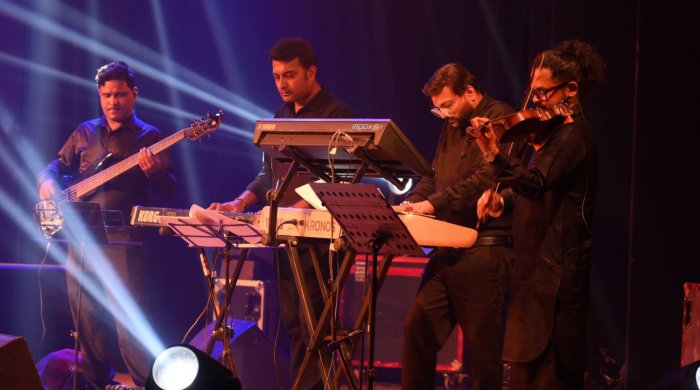
The orchestral play with many violinists led by Agnimitra Behera,
playing a chief role in music making of today's music/dance scenario in
Odisha, presented Pallavi Murchhana, a four-in-one medley of Pallavi
compositions, saluting the great pioneers Bhubaneswar Misra, Raghunath
Panigrahi, Bankhim Chandra Sethi and Ramahari Das for their contribution
to Odissi. Ragas Shankarabharanam, Kirawani, Bilahri and Bageshri as a
medley was rendered with expertise, and perhaps there is no other way of
paying respect to musicians no longer with us. But for this
critic, the solo compositions are so moving that this bits and pieces
cannot be the same. More than anything in a painstakingly planned event
deserving kudos, music which is to be heard, gets distracted with the
kind of light designs - with rays shining on the musicians in different
colours. How can melody work to a mood with so much distraction?
That apart, one has nothing but praise for Subarnima!
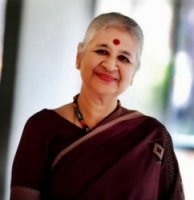
Writing on the dance scene for the last forty years, Leela
Venkataraman's incisive comments on performances of all
dance forms, participation in dance discussions both in
India and abroad, and as a regular contributor to Hindu
Friday Review, journals like Sruti and Nartanam, makes her
voice respected for its balanced critiquing. She is the
author of several books like Indian Classical dance:
Tradition in Transition, Classical Dance in India and Indian Classical dance: The Renaissance and Beyond.
Post your comments
Please provide your name along with your comment. All appropriate comments posted with
name in the blog will also be featured in the
site.
|