TAALAM
BY LEELA VENKATARAMAN e-mail: leelakaverivenkat@gmail.com
Double Bill Summer Dance Festival at IIC
June 20, 2026
EXCEPTIONALLY EVOCATIVE ODISSI BY SOURAV MOHANTY
IIC's Summer Festival, for its dance component on the second day (June
12), attracting a fair-sized audience, could not have envisaged a more
rewarding recital than that of Sourav Mohanty - a rare male Odissi
talent, whose evocative dance effloresced in both stillness and
movement. A product of training under Durga Charan Ranbir and presently
under Rahul Acharya, both hailing from the Debaprasad gharana of Odissi,
Sourav's dance with its impeccable lines, could be a reference point
for both delicate artistry and aesthetic sensibility in Odissi.
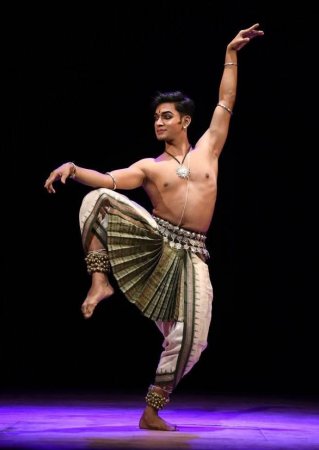
Sourav Mohanty
The delightfully crafted recital began with Mangalacharan set to raga
Bairagi in Ektali, an invocation to Harihara - unifying in one
manifestation, the contrasting powers of both Vishnu the protector and
Shiva the destroyer (of the undivine) - built round the action/reaction
principles specifying all movement in the universe. Elegantly turned
out, without ostentation, the dancer's sole ornament being the
delightfully crafted Bengapatti fastened neatly without wrinkles round
the waist, each moment of the invocation till the concluding trikhandi
pranam was a delight.
The Pallavi, a composition of Guru Pankaj Charan Das considered the
father of Odissi, with the piercing melodic vibes in the music in
Shankarabharanam by Harihar Panda (bringing back, for this critic,
nostalgic vibes of Odissi raising its classical profile sometime in the
1950's), with no needless hurry in the Tajhenuta..... syllables, saw in
the dance, a savoured opening out of each movement. And Pankaj Charan's
use of the torso, with his approach to the dance greatly influenced by
his upbringing in a Mahari household, is subtly different from that of
Guru Debaprasad Das. One sensed more than just the physical
involvement in each movement, with the inner dancer also reacting -
though the deeper emotional underpinnings of full-blooded abhinaya got
mapped out in depth, in the ashtapadi Priye Charusheele, with the
music in raga Desh set to tala Rupaka, with dance choreographed by Rahul
Acharya, the dancer's present Guru.
Gita Govind's Krishna assuaging the hurt feelings of Radha while making
his ultimate declaration of love for her (the only instance of its kind
in our sacred literature of a deity proposing to a mortal being), in its
ascending tone of urgent persuasion, which for me in the Twamasi Mama
Bhooshanam, Twamasi mama Jeevanam (You are my ornament, my life's
breath) could have been more fervent, however rose to a crescendo of
involvement, treating the audience to the ultimate in godly humility, as
Krishna kneeling before Radha passionately offers his bent head
for Radha to put her foot on (smaragalakhandanam mama shirasi mandanam
dehi pada pallavamudram).
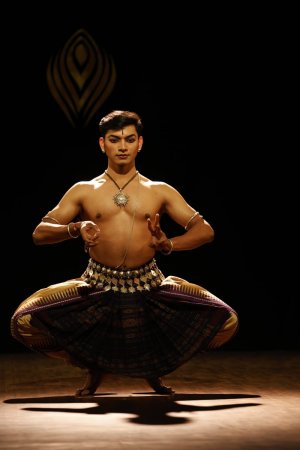
Sourav Mohanty
After such an appeal, the finale of the recital, Suryashtakam, with
music in Bairagi set to Jati tala, choreographed by Guru Durga Charan
Ranbir, struck a contrasting tone, with movement creating a proud
picture of the Rising Sun ushering daybreak, its warmth making the lotus
petals open out and bloom, riding across the horizon in his chariot
drawn by seven horses, enabling what was a perfect finish to an
exhilarating recital! The audience rising to a thundering applause
said it all.
Sourav is still at the early stages of a career that has a long way to
go, and without relaxing, one hopes he will retain the intensity of
dance purpose, along with keeping his body, the instrument of the dance,
in the same peak condition.
VIVACIOUS BHARATANATYAM NEEDS MORE STILLNESS
The next half of the program featured Bharatanatyam dancer Sandhya
Easwar, this year's winner of the Spirit of Youth Series in Chennai.
Trained at Chennai's Kalakshetra, followed by a spell under Roja Kannan
with abhinaya lessons under Bragha Bessel, the dancer is presently
pursuing her training under the Dhananjayans.
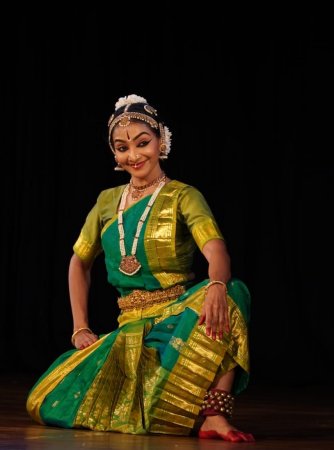
Sandhya Easwar
With training under such experienced heads and given her exuberant
smiling presence, the dancer has much going for her - though her stage
entry with a prayer to Ganesh in raga Arabhi, set to adi talam, one felt
was too pacy, for an invocatory tone. Instead of availing of the
services of the efficient compere for the evening (who had compered the
Odissi programme) the dancer from behind the stage, in her own voice,
chose to briefly outline the recital mentioning items. Particularly for
the centrepiece of the recital, the varnam in raga Bhairavi, Mohamana en
meedu, a two sentence explanation of the Pallavi/Anupallavi and
Charanam statements, would have been very helpful for the mixed Delhi
/IIC gathering (with only a few able to follow the Tamil language).
The love smitten (Mohamana) heroine, addressing Lord Tyagesha, the
presiding deity ensconced in his divine home (tirunagaril vaasare),
gives vent to her impatience at his not responding at once to her
message of love (modi seyyalamo), with a quick flurry of taanum here -
punctuating rhythmic passages following each statement, all done at a
clip, had much happening, but with little staying power. Savouring each
statement, but with economy of expression, with deeper involvement in
each moment, would empower the dancer's communication. As for the line
Bhoga Tyagesha, Anubhogham seyyavaa, when the Nayika, in supreme
surrender, is offering herself to the lord, an abstract expression with
the hand showing the flowering of the Kundalini (with most not
understanding the sahitya), communicated very little to the
audience.
The choice for the post varnam abhinaya was the ashtapadi, Keshi
Mathanam Udaram with the music set to raga Shuddha Sarang. Overpowered
by longing for Krishna her love, Radha asks the Sakhi to convey her
message urging Krishna to hasten to her side. And then follows Radha's
reminiscence about her first intimate encounter, recalling how Krishna
had artfully led her, through the initial intimacies of love, making her
overcome her extreme shyness. Here again economy of expression with
deeper involvement could be more potently communicative. The dancer is
learning from Bragha - best teacher to show her how less can be more.
It is heartening to see how the IIC sponsored dance/music evenings are attracting larger audiences. Hope the trend continues.
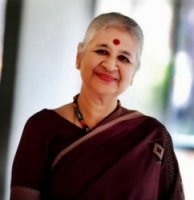
Writing on the dance scene for the last forty years, Leela
Venkataraman's incisive comments on performances of all
dance forms, participation in dance discussions both in
India and abroad, and as a regular contributor to Hindu
Friday Review, journals like Sruti and Nartanam, makes her
voice respected for its balanced critiquing. She is the
author of several books like Indian Classical dance:
Tradition in Transition, Classical Dance in India and Indian Classical dance: The Renaissance and Beyond.
Post your comments
Please provide your name along with your comment. All appropriate comments posted with
name in the blog will also be featured in the
site.
|