TAALAM
BY LEELA VENKATARAMAN
e-mail: leelakaverivenkat@gmail.com
Blend of experienced and aspiring dancers
June 2, 2026
ART FOUNDATION PRESENTS SAMHRTI
Photos: Deepak Bhardwaj
Milind Srivastava's Art Foundation, with World Dance Day round the
corner, celebrated its own annual effort at the Habitat Centre, Delhi,
featuring both experienced and aspiring talents. The curtain raiser was a
short Modern Dance item conceived and choreographed by puppeteer Salim
Zaidi, titled Samhrti - 'an exploration of existence and transcendence
through the art of dance.' The performance looks at the cyclical nature
of the Universe with the eternal rhythms of creation and dissolution. In
what was described as 'a transformative experience' wherein the
boundaries between the Self and the cosmos dissolve, the set designing,
the voiceover and light design by Murugan Krishnan, not forgetting the
music arrangement by Saahas Verma, along with the broad sweeping
movements of dancer Narayan Sharma were all of a piece.
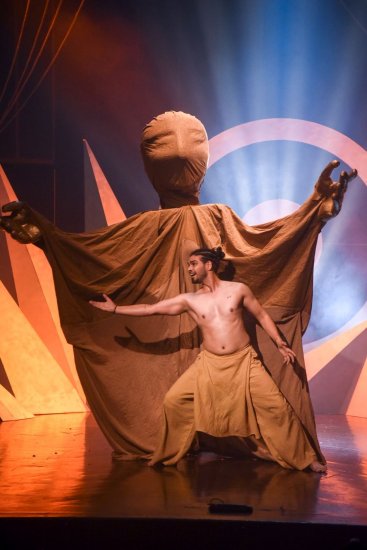
And I was immediately reminded, seeing the oversized puppet in the
background, its covered face and torso looming large as if presiding
over the whole of creation, of Dadi Padamjee the puppeteer and his work
with late Astad Deboo - and as it happens, the dancer's own background
comprises working with both Astad and Dadi! Smoke curling out of burning
embers in a mud pot at the side, the entire stage designing and the
dancer's cautious, slow moves, as if in never-ending exploration of a
space armed with uncertain forces, man is constantly having to contend
with, the feel of the likelihood of being overwhelmed at any moment by
unfamiliar forces, came out strongly. All one can say in conclusion is
that the dancer managed to convey the message of a symbiotic
relationship between Man and the Universe - though what that
relationship is, could not be defined.
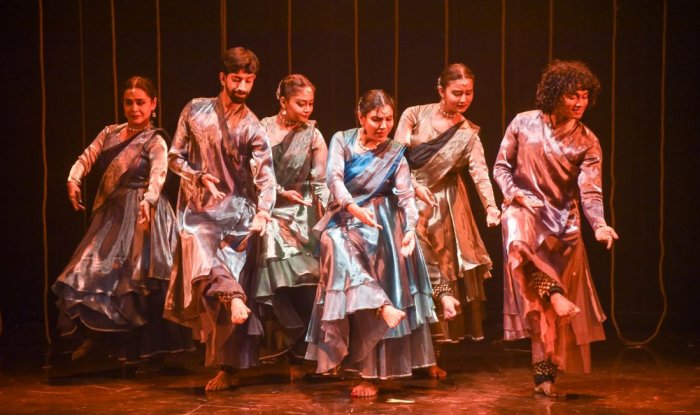
Kathak ensemble
The next item 'Mirage - Lust for Life visualized by Kathak dancer
Sangita Chatterjee performing with her group, with Anirbhan
Bhattacharya's music, has been presented earlier. Man's greed for life
is never ending. But what is it that he is looking for? Mai dor mayaki -
he resembles the musk deer intoxicated by its own fragrance - always
just beyond reach. Where is the Eldorado he is in search of - for the
closer he feels he has come, the farther it seems to go away. Entangled
in the many threads of life, he tells himself "Maya ki jaal todde." This
prison caused by Maya must be broken, he says. The group shows that as
they are about to reach the destination, the point recedes and they are
in search of what they know not. It was a competent group of dancers -
with finish and grace in movement. Trying to reach out and suddenly
having to turn back was well brought out.
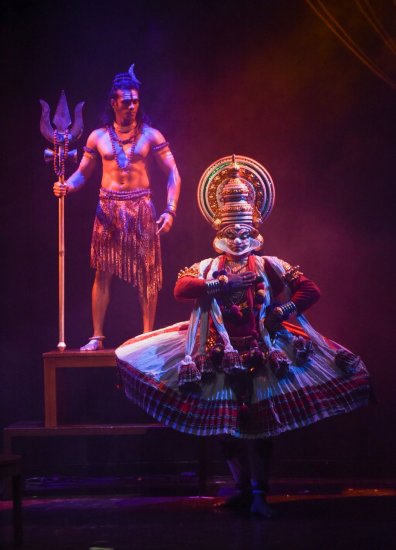
The third part of the first day's program constituted the scene
portraying Bhasmasura being destroyed by the beauteous Mohini. Unni
Viswanath Marar, son of Kathakali Guru Balakrishna Marar in the
Kathakali kathi vesham as Bhasmasura, and Unni Viswanath Marar as Mohini
cast in a Mohiniattam mould, with Kottakkal Jayant's music, comprised
this production - the two dance forms from Kerala providing a perfect
male/female contrast for the two roles. Behind the tirasheela
curtain held by two hands, one heard the deep penance of Vikasura the
demon, a great Shiva devotee. His deep Namah Shivaya penance
having evoked Shiva's appearance, with the boon to ask for anything,
resulted in the demon's desire that anything he touched be turned
to ashes. After winning the boon, his temerity in trying to burn Shiva
himself to ashes, had a Shiva fleeing post haste, seeking help from
Vishnu, who himself dons the 'avatara' of the beautiful Mohini. Smitten
by her beauty and encouraged to dance with her, imitating every gesture
of hers, with Mohini slyly putting her hand in a nonchalant fashion over
her own head - the gesture in an automatic imitation by Bhasmasura,
results in the rakshasa being reduced to ashes.
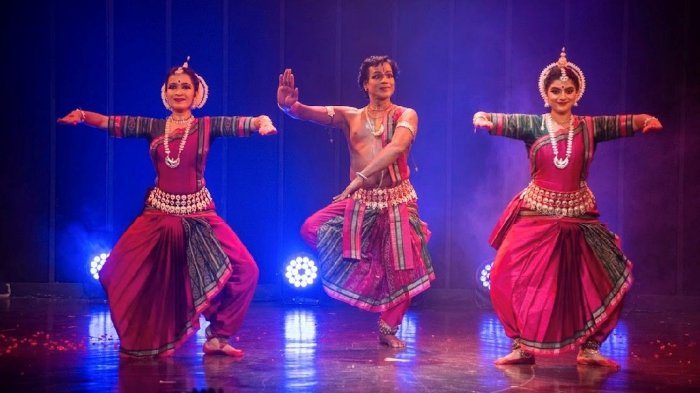
Odissi ensemble of Sudarshan Sahoo
The second day's program waiting for the chief guest's arrival, made for
a late start. With three recitals planned for each evening (which seems
one too many), the finale at 10pm and above, made it difficult for
persons travelling long distances to attend the program. The group
Odissi start was presented by students of Sudarshan Sahoo, who mastered
Odissi under gurus like Gangadhar Pradhan, Aruna Mohanty and Ramesh
Chandra Jena. Mangalacharan after obeisance to the prayer Shobham karoti
kalyanam, Deepam jyoti namstubhyam went on to the Shiva Panchakshara
Stotram, Shiva as Parvati Pathi portrayed in the act of reducing
Manmatha to ashes. Group coordination was good.
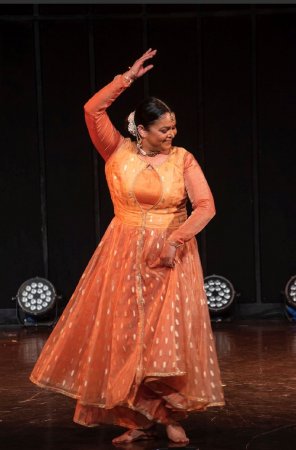
Gauri Diwakar
Next came Kathak performer, at present teacher in the Kathak Kendra of
Delhi - Gauri Diwakar. Starting with Thaat in teen taal, with the upaj
part rendered to the lehera, after the Digi digi thai ta thai ad-form
came the Paran Amad, Seedi gat, and then the short abhinaya presentation
based on the words Aali Albeli Sundar Nari, portraying the nayika
decorating herself (Kar sringar) before setting out to meet the beloved.
The Gat Nikas part was a blend of what was imbibed from the Guru, along
with what her own creative imagination had been able to add. With
Akilesh Bhatt on the tabla, Shankumoy Debnath providing vocal support
with harmonium, and with Ghanshyam Sisodia on the sarangi, the dancer
had dependable accompaniment. The Na Dhin Dhin Na finale in the drut
laya came as the conclusion. With the auditorium sporting some of Kathak
Kendra students, familiar with the well-known ad-forms presented, Gauri
as teacher/performer, evoked enthusiastic approval.
The festival ended with dance theatre built round what the Blacks
suffered in the plantations - a grim chapter in history reminding the
world of what man can do to man. Chained, confined and subjected to ill
treatment beyond one's comprehension, the black finally throws off his
chains. The artiste Nandakumar, who works for Sadhya and Kalaalayam with
a dance background combining Mayurbhaj Chhau and Modern Dance, very
similar to Santosh Nair who is Artistic Director of Sadhya, presented
scenes evoking the past. One felt that the cry of Freedom and Hope,
after so much despair, needed to be underlined in a stronger dance
statement, and the dancers seemed raw amateurs, not able to bring out
the intensity of both despair and hope.
HABITAT'S WORLD DANCE DAY A BLEND OF MANY COUNTRIES
At the Habitat, the World Dance Day celebration brought together in one
program, not just all Indian dance forms, including classical and
tribal, but also international groups from countries like Indonesia,
Cambodia, Bangladesh, and a mixed African group. The event
essentially stressed togetherness and bonhomie - represented through
dances pertaining to various cultures - each with a distinctive
identity. Mohiniattam dancer (who also teaches Bharatanatyam) Jayaprabha
Menon, the choreographer, within the very short time she had for
planning, wisely decided to enlist the help of foreign students studying
in different colleges of Delhi. In what became a variety program of
dance, each of the groups was given a separate slot of a few minutes,
before coming together in the finale.
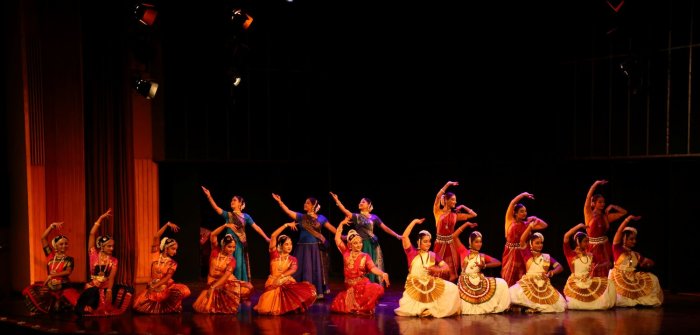
Called Prachi Sudha or Nectar of the East, a metaphor referring to
India's nourishing heritage of togetherness through art and
spirituality, the evening started with Mohiniattam and
Bharatanatyam dancers in a takundari kukkundari beginning, with
salutations offered to Ganapati, the music ending with a prayer to
Satvika Shivam adorned with the universe as garment with moon as
adornment, the timing on Kerala drums like the mizhavu and
maddalam adding a drum-evoked sonic mood, which is special.
A short scene on Sharad Ritu and the full moon, with the Seasons,
each set to music set in a different raga, the scene shifted to the
Devaki/Vasudeva Nanda rescued from prison, with Gandharva kinnara
Devagana rejoicing at the child Krishna stealthily taken away to Vraj,
where he grows up - the scene concluded on a happy note of Vraj Shyam
Nirakat.
The Odissi excerpt was based on the Gita Govinda ashtapadi "Lalita
Lavangalata" in raga Vasant. After a fleeting glimpse of Manipuri Vasant
Raas, Kuchipudi was represented with an abridged Tarangam by Kuchipudi
Centre. Diu was also represented and tribals performing "Murali
bajjaiye, tanviripu duajariye."
DOUBLE BILL AT IIC
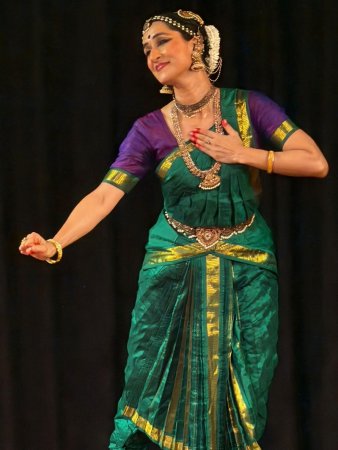
Amrita Lahiri
(Photo: Balatchandirane Govindasamy)
Fighting against very heavy traffic, I reached IIC too late to take in
the starting item of dancer Amrita Lahiri's Kuchipudi program. The
second item comprising a scene from the full length dance drama Usha
Parinayam, revealed a dancer whose Bharatanatyam training with its
linear geometry, has not influenced or detracted in any way, the
mercurial grace and lyrical sensuality of Kuchipudi, which is in a
compartment of its own, with her training under Jaikishore Mosalikanti
and his wife Padmavani. This item "Vidale nee Vanusuta," however, was
learnt under Swapna Sundari. Usha, the daughter of Banasura, recapturing
scenes from her dream of Aniruddha, wonders about the man, whose voice
still lingers in her ears, and who has left marks of his kisses on her
lips…. "Sakhi idi yemo telpalede". "I cannot explain, or take this agony
of suspense anymore," she tells her sakhi. The emotion laden vachika in
typical Kuchipudi style, wonders about this lotus-eyed young man who
made love to her and thwarted by the flowered darts of love that she has
been struck with, she draws for the sakhi, a likeness of the man
(Valapola jaalane).
A Tillana in Behag taught by her guru, concluded the recital. One
heartening factor of Amrita's recital was the competent musical support
with Satish Venkatesh's singing, Manohar Balatchandirane on the
mridangam, Rajashekharan providing nattuvangam and violin played by G.
Raghavendra Prasath.
The second half of the evening comprising a Bharatanatyam duet by Yogesh
Kumar and Sneha Narayanan settled in Bangalore, had to depend on
recorded music. The couple has acquired a name for thematic productions.
Starting the recital with Sabha Vandana (obeisance to the Sabha) the
duo danced to Muthuswamy Dikshitar's Ardhanariswara Stotram in ragam
Kumudakriya - in a demonstration of Uddhata Sukumara Prayoga, which
refers to a uniting contrast of manly vigor and feminine grace in Shiva
as Ardhanari. And this unity is defined as being as indivisible - as
what exists between a word and its meaning - demonstrated in Kalidasa's
frequently quoted words Vaak Artha vivasampruktau.
The couple next went on to the Ramayana narrative based on Swati
Tirunal's kriti "Bhavayami Raghuramam". As a male/female duo, the story
begins with the Putrakameshti Yagam, with the birth of Rama,
Vidhyaabhyasam, Ahalya Moksham, Sita Kalyanam, Exile, meeting with Guha,
Dandakaranya and the Shoorphanaka episode. The couple as a twosome
sharing the male/female roles were effective in the episodic treatment,
wherein interpretation does not depend on dilating on each line of the
poetry. Some dramatized incidents, as customary, were spun out
like the Sita Swayamwara scene, in which Rama wins the hand of Sita, and
in Lanka with Sita in utter unhappiness about to kill herself, Hanuman
in the nick of the moment lands as saviour - with a solfa syllabic
passage in ragamalika, as padding. Yogesh Kumar happily seems to have
worked on his poor balance, from when I saw him last - and is able to
hold stances without wobbling. The performance ended with Mangalam
wherein homage is paid to the five elements concluding on the note of
Bhoomi Mangalam, obeisance to Mother Earth.
SATVIKAA SHANKAR'S MATURE BHARATANATYAM PERFORMANCE
Yet another double bill presentation at the India International Centre,
saw a very finished Bharatanatyam performance by Satvikaa Shankar,
trained under Chennai's Anitha Guha. After gaining special accolades for
her performance as Hanuman, it was a vastly different Margam dancer one
witnessed with her opening comprising a rare varnam in Kalyani, a
composition of Sivanandam of the Tanjore Quartette, addressed to the
great patron of Arts, Maharaja Shivaji II, "Sarasa shikhamani neevani
tsala nammiti." Set to dance by the dancer herself under the overall
guidance of her guru, she specially mentioned her gratitude to both
Nandini Ramani and Anupama Kylash for their help in better understanding
the varnam.
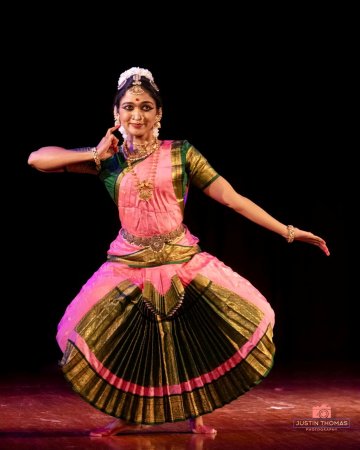
Satvikaa Shankar (Photo: Justin)
The dancer's introductory remarks about this varnam with specially
contained sensuality in the courtesan's address to the ruler in the days
of yore, was neither here nor there. For taking away the sensuality
from a courtesan would be like clipping the wings of a bird. All that
one sees in this varnam is that the Pallavi and Anupallavi are full of
words of praise and admiration for the elevated qualities of a just
ruler - the sharadendru, Gunasheela- a patron of learning, and the arts -
with the really significant part of offering herself, comes in the
charanam part. Varnams were part of the arsenal of the court dancers -
and the tone of sringar draped in artistic subtlety, needs no apologies.
What one appreciated was the confident bearing of the dancer, full of
grace and pride, and the mood radiated a feel of the court dancer
addressing the King in equal terms, sans any servility. Both
interpretation wise and in terms of perfect technique with immaculate
dance lines, the performance left little to be desired. And the dancer
had the springboard of an excellent team of musicians on the tape - with
Hariprasad's vocal support, Jayashree Ramanathan conducting the
recital, with Ramshankar Babu on mridangam, Eshwar Ramakrishnan
providing violin support and Sruti Sagar on the flute.
The post varnam abhinaya section was woven round a delightful Shiva
/Parvati exchange full of light hearted banter between the couple,
equally matched in intelligence. Humour, more common in theatre, has its
presence in limited doses in classical dance. Shiva knocking on
Parvati's door announces himself as Neelakanthan (the blue throated one)
and Parvati mischievously says that she sees no peacock and does not
open the door. He then announces himself as Pashupati (lord of all
living creatures) and the answer is that she sees no Pashu, (meaning
animal - Shiva's vahana is the Bull), the next announcement as Shooli,
meaning one with the trident is equally unproductive for the one with
the trident is Shiva's son Subramania and finally only on Shiva
announcing Jeevitosmi Shivayaha (life partner of Parvati), the
door opens! The item was a perfect foil for the tone of the
varnam. The end was with Tillana in Maru Behag set to matya talam.
Altogether a mature performance!
STUDENTS OF GAURI DIWAKAR SANSKRITI FOUNDATION PROVE THEIR PROWESS
At the Shri Ram Centre, Kathak students of Sanskriti Foundation, the
institution run by Gauri Diwakar, presented an evening of dance. With
youngsters and the more advanced students participating, the program
understandably, of varying standards, shared one pleasing feature, which
was seeing all participants of different groups, turned out in simple
salwar/kameez outfits of varying colours, deriving joy out of the entire
enterprise. Since Gauri is now engaged in teaching at the Kathak
Kendra, the planning of the program was left to Vinay Tiwari - whose
obviously Bharatanatyam approach, when at odds with Kathak, was set on
the right course by Gauri.
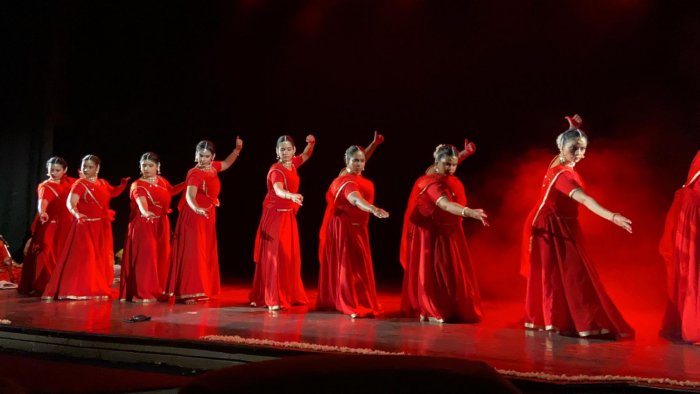
Gauri Diwakar's disciples
The accompaniment with Gauri Diwakar's parhant, comprised Yogesh Gangani
on tabla, Asish Gangani on pakhawaj, vocal music by Jaiwardhan
Dadheech, Anil Misra on sarangi, and Umashankar on the sitar. The
evening began with the prayer to Ganesh, Vighnaraja, Lambodhara,
Gajananam, with abstract dance comprising ginti compositions, both in
the ascending and descending scale. Slightly senior dancers presented
the item signifying homage to divinity in the female aspect - Ma Sati,
Chamunda (with Beeja Mantra sounds included) Chamunda Vighna Namah, the
Mahishasuramardini, Aigiri Nandini, Jwalamukhi. The standard naturally
improved as the more experienced students took the stage after the first
twenty minutes.
The best part of the evening came towards the finale woven round Bihar's
Chhat Puja (also performed in Jharkhand and Eastern parts of
Uttar Pradesh) which celebrated with great dedication over four
days, a thanksgiving offered to the Sun God and ending with homage to
Devi Chaiti Maiya - variously described in the Puranas as Earth Mother
regarded as daughter of Brahma. While Chhat Puja offers prayers to the
Sun God, Chaiti Maiya is worshipped for wellbeing of progeny and
particularly for fertility eradicating the curse of lack of progeny.
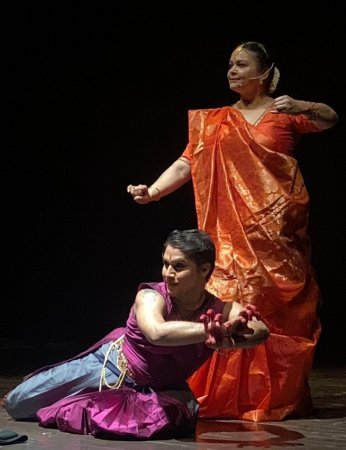
Gauri Diwakar & Vinay Tiwari
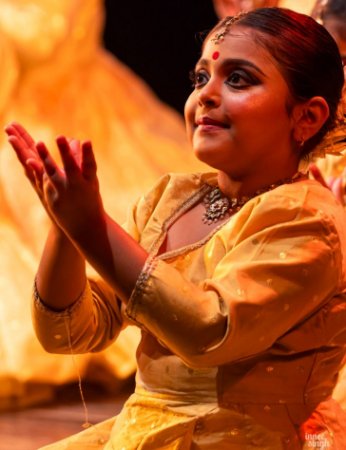
Gauri Diwakar's young disciple
While the entire production was neatly rendered, the last part duet
presenting both Bharatanatyam and Kathak, with Gauri and Vinay Tiwari
joining in, in a jugalbandi, was particularly noteworthy. Vinay
representing Chaiti Maiya whose vahana (vehicle for communication) is
said to be the cat, presented the Cat Alarippu which he choreographed a
few months back and it was amazing to see how the Tam dhit tam kitataka
thai dhi tai rhythmic syllables were used to represent the cat. Since
one saw it months back, Vinay has perfected his work. Such Jugalbandis,
apart from bringing in a good deal of variety, are healthy of different
dance traditions opening themselves to fresh perspectives. The evening
ended on a very happy note.
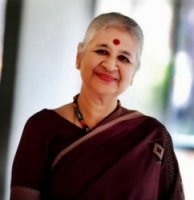
Writing on the dance scene for the last forty years, Leela
Venkataraman's incisive comments on performances of all
dance forms, participation in dance discussions both in
India and abroad, and as a regular contributor to Hindu
Friday Review, journals like Sruti and Nartanam, makes her
voice respected for its balanced critiquing. She is the
author of several books like Indian Classical dance:
Tradition in Transition, Classical Dance in India and Indian Classical dance: The Renaissance and Beyond.
Post your comments
Please provide your name along with your comment. All appropriate comments posted with
name in the blog will also be featured in the
site.
|