
|     |
|
| |

TAALAMBY LEELA VENKATARAMANe-mail: leelakaverivenkat@gmail.comNew perspectives - old themesMay 28, 2026 NEW DIRECTIONS IN DANCE It is heartening to see that youngsters are on the lookout for new directions, with novel themes as base for performances. The more encouraging factor is that organisations like Bhagyam Fine Arts and Ideas are willing to sponsor such attempts, at the risk of not getting sizeable audiences. What with minds full of the archetype of the slim and shapely dancer performing, to watch Dakshina Vaidyanathan Baghel, the Bharatanatyam dancer present Ayoga Vaatsalya built round the anticipation and excitement of a mother-to-be, with the dancer herself now in the seventh month of pregnancy, was to say the least, out of the ordinary. 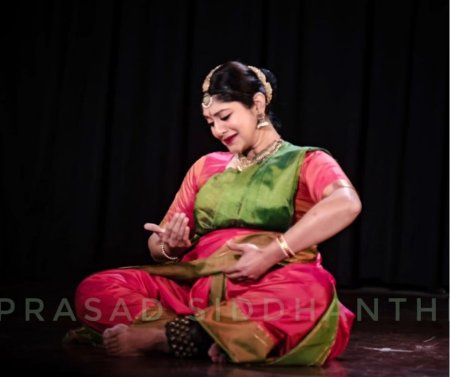 Dakshina Vaidyanathan (Photo: Prasad Siddhanthi) Built round an English poem Pratyasha (Expecting) by Vaidyanathan herself, the highly immotive dialogue of the mother-to-be with the unborn child, was rendered with intense involvement. She wonders about this extreme bond shared with a being not yet seen - could be a boy or a girl, it hardly matters. Unlike sringar between man and woman, which for fulfillment yearns for dualism to be erased in total bodily unity like the river joining the sea, for a mother the fulfillment and joy come with the other, now within her, beginning to live separately, the child blossoming under her care, like the lotus under the Sun. Tanam presentation, symbolized the joy at the end of nine months when the child is born, after all the ordeal and final pain. While concepts of the body beautiful in dance, cannot be wished away, for a dancer to become the dance, it is the body of the art painted through the art form that needs to stand out - and here deep conviction guided Dakshina's performance. As a consequence of the mother's joy and absorption in the newborn child, the reaction of the father, was captured by Mayuk Bhattacharya, a Kathak dancer. One admired the thought process behind the manner in which he had planned the short recital. The start in Yaman "Eri aali piya milan" showed the early joys of courtship and marriage, till the arrival of the newcomer, with the preoccupation of the hitherto beloved as mother, making the father feel isolated. But gradually with the growing child trying to find his halting baby steps, the father begins to find joy in watching the little boy - shown through the composition "Thumak cchalat Ramchandra" in raga Desh. The father/son bonding as the child grows with the finale of a Tarana, glorying in Kathak technique in full bloom provided a fine ending. And to end the evening was a short discussion as conclusion for the evening. It is heartening that sponsorship for Arts is at times as enterprising as the artistes themselves and shows a willingness to take risks. MALE DANCERS IN FULL CRY Photos courtesy: Drishtikon Dance Foundation Aditi Mangaldas Dance Company Drishtikon Dance Foundation, in collaboration with Oddbird Theatre in the third of its Zeroing In series, presented a Jugalbandi of two art forms - Kathak and Bharatanatyam. The attempt is itself bold, for dancers of the two dance genres, exceptions apart, have not been known to work very closely. The mini auditorium, ideal for experimental theatre, with ticketed shows evoking a good response, aside from close performer audience interaction, accommodates about five rows of audience on chairs at the same level as the performers, with five to six rows beyond of galleried seating. 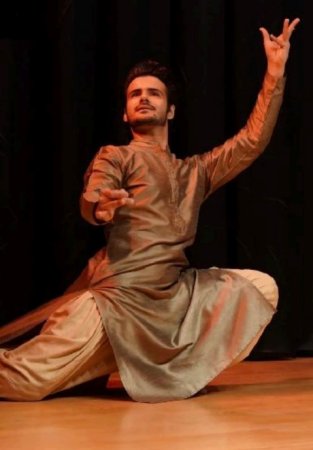 Gaurav Bhatti The evening began with Kathak dancer Gaurav Bhatti, trained under Saveeta Sharma, Lata Bakalkar and Aditi Mangaldas - with a reputation for looking at tradition with a contemporary perspective. The devotee in this address to Lord Shiva bemoans the frozen cold surrounding the Lord's person - ensconced in his home in the Himalayas, with matted locks, and the Ganges with its waters and the moon radiating cool rays perched over his head, his body smeared in sandal paste, garlanded by cold serpents, with the daughter of the Himalayas, Parvati, on his left side. 'Come and reside in me, your ardent devotee, burning with worldly desires. I will provide you with the warmth you so sorely lack, while you lessen the burning within me.' Grounded in excellent technique with an interpretative ability accommodating situations in sringar without inhibitions, Gaurav Bhatti seems equipped with all the arsenal, for a powerful performance. Led by choreography and concept of Aditi Mangaldas with music in the recorded track, commencing with Appiah Dikshit's sung literature, featuring names like Samiullah Khan with percussion support by Ashish Gangani, Mohit Gangani, sitar by Fateh Ali Khan, and with Dheerendra Tiwari for kavit, the dancer had all the support needed for expertise to flower. Tastefully turned out in a pastel coloured salwar/kurta outfit, it was interesting to be informed that the costume design was AI suggested, with inputs from Aditi Mangaldas, Aamrapali Bhandari and Gaurav Bhatti! 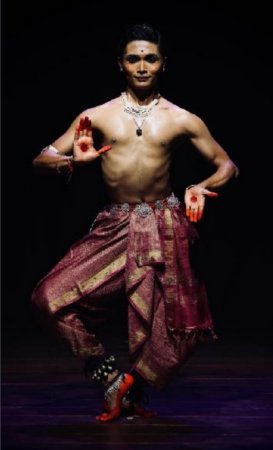 Pritam Das The Bharatanatyam in the second half of the first part of the program featured fast rising Bharatanatyam dancer Pritam Das, now working under Rama Vaidyanathan, and his presentation of the Ashtapadi "Kshanamadhuna Narayana manugatamanusara Radhike," choreographed by Rama, showed after all the misunderstandings, Krishna's searing passion, as he welcomes Radha, aching with desire, to his den on the banks of the Jamuna, of tender shoots and buds. After the sensuality of the Ashtapadi, the dancer's presentation of Tribhangini to his own choreography, was built round Adyakali, a Shakta and Tantric concept, and primordial form of the Divine Mother, revered as the ultimate source and root cause of the Dasha Mahavidya concept wherein Devi is revered in forms of Tara, Kali, Shodashi, Tripurasundari, Bhairavi, Chinnamasta, Dhumavati, Bagalamukhi, Matangi and Kamala. The composition by Sadak Ramprasad set to a ragamalika format in the music composed by Debapriya Adhikari and Dr.S Vasudevan, saw the dancer's searing passion and intensity, a feature of Pritam's mimetic prowess, with no holds barred. He looked almost possessed. 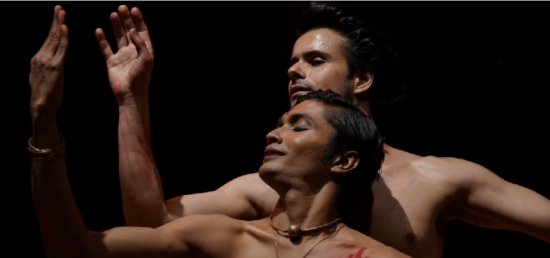 Gaurav Bhatti & Pritam Das The finale, of approximately half an hour's duration, titled In-Between, took the form of a Kathak/Bharatanatyam duet, comprising contrasts in complementarity - thematically woven round the flow of the Nadis or channels of energy located along the spine - Ida, Pingala and Sushumna - engaged in the reception, assimilation and transmission of vital energy. Intuitive, feminine Shakti which guides creativity is Ida, and when it joins the masculine Pingala, the result of this union being Sushumna Nadi - the central channel embodying the essence of the Ardhanariswara concept, which represents the state of complete composure - wherein the male/female polarities complement each other in a state of togetherness. Before this state is reached is the constant play between opposites, till equanimity is realized. How one negotiates space between dancers is what determines the success or otherwise of the duet. And with the chemistry between this twosome, that space was charged. In what was composed by the dancers themselves, the live accompaniment with Sankumay Debnath's vocal and Amir Khan on sarangi, had its main dhwani in rhythm reflected in the drums with Ashish Gangani on pakhawaj, and Shounok Banerjee on ghatam and kanjira. The building of the sub-text with the masculinity and femininity contrasts and the anga and torso movement minutiae, the abhinaya intensity, with many moods of rhythm in different tala combinations, in both Bharatanatyam and Kathak saw the burning male/female tensions - peaking to an almost smoking point of intensity till finding that boundless silence in unity. Altogether a high-powered evening leaving the audience drained, after all the whipped-up excitement. It is a welcome sign that Kathak dancers would seem to be breaking that barrier of hesitation when it comes to abhinaya. FAMILIAR THEMES IN NEW PERSPECTIVES EVOKING WONDERMENT Once again, outside the conventional box of dancers, particularly in Kathak, is Sudip Chakraborty, trained initially in Kolkata's Kalakshetra in Bharatanatyam before branching out to Kathak under Kolkata teachers Pranab Sanyal and Sandip Mallik - to finally - (in his 17 years spent with this dance form) come under Jaikishen Maharaj in Delhi. Now running his institution Nirvana Arts Foundation, he has caught the public eye, with his ability (stemming from a deep seated interest in literature, and general reading) for fresh perspectives, to bear on what would be deemed, cliched themes. In his performance titled Blue God at the Habitat, Delhi, the dancer views Krishna, not from the usual perspective, but as one who so completely transformed the lives of many, who came in contact with him in any relationship - as child, as companion, as friend, as saviour, as lover, et al. 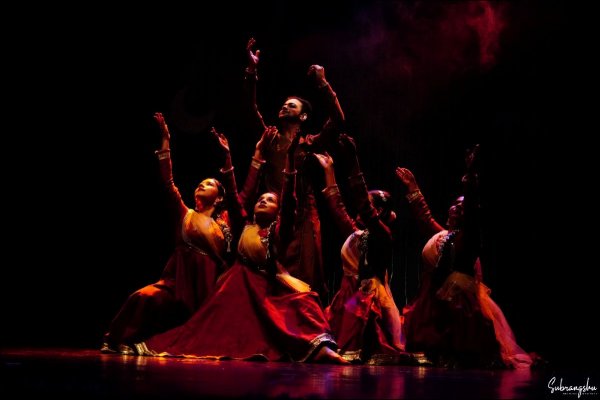 Sudip Chakraborty and group (Photo: Subrangshu Chakraborty) Making the presentation similar to the katha natya storyteller's art, the presenter takes the audience into confidence, introducing them to the why and wherefore of the subject chosen. The curtain rises on a group freeze of Sudip with five student performers. With a Padavali of Vidyapati "Madhava bahut minati" and a crisp abstract presentation, a brief introduction by the narrator in the group, mentions context and essence of the first heroine Putana. As Ratna Mala, daughter of demon King Bali in her last birth, and a staunch Vishnu devotee, she had nevertheless sworn revenge on the God who as Vamana had killed father Bali. Now as Putana, she sets off on the errand assigned by brother Kamsa, to kill the god child, who is Vishnu in his manifestation as Krishna. Stealthily entering Vraj wherein baby Krishna, saved from Kamsa's wrath, is growing in the home of Nanda (background song "Ambari nagarime basat hai nand ke laal" in Desh raga set to Jhaptaal, the dancer's own creation) Sudip stealthily enters in his opening avatar as Putana - a red veil draped over black salwar/kurta outfit. Brindavan scenes are visualized by the dancer through movements showing lush nature with joyfully leaping deer, and cuckoo bird cries in Ambari Nagarime - a world untouched by cruelty. It is the mother in Putana rushing to the fore, on eying the baby in the cradle. True to the milk of human kindness she wants to feed the baby, till she reminds herself of what Kamsa, her brother, has commanded her to do. Anointing her breasts with poison, she slowly offers the baby her breast. The dancer's abhinaya depicting the slow change in mood, the tussle between her natural instincts and what she has been ordered to do, and her struggle as life is sucked out by the powerful tug at her breasts - with the music in aalap changing from slow bliss to agitated drut laya, made for very powerful impact. Jaydeep Sinha's music (taped) and Sudip seemed so much in sync! Killed by the god himself, Putana attains moksha. The next heroine was Draupadi whose tresses are shown in the act of being anointed with the blood of Dushasana. Quick glimpses of the dice play in the Kaurava court, Draupadi's humiliation with the shock of her impassioned appeal to the five husbands, who stand as mute statues shorn of all virtues of manhood, the appeal to Krishna - was all in the best traditions of dance theatre. 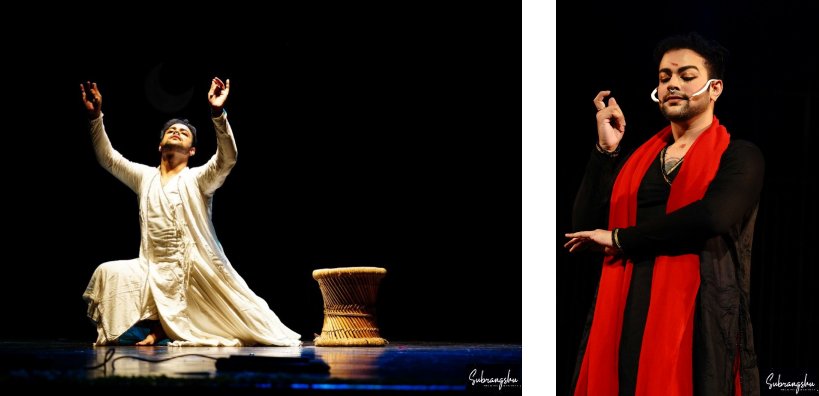 Sudip Chakraborty (Photo: Subrangshu Chakraborty) The next scene was like a personification of Krishna's Bansuri. Mentioned in Padma Purana as a Brahman devotee Debabrath, whose overweening pride, earned him the curse of being born as a bamboo stem in Vraj, bent low in modesty, till it became the flute fashioned for Krishna! What the flute represents in terms of the divine music produced on it, its closeness to the body and lips of Krishna, with much of Vaishnavite poetry of devotees like Andal, and the Gopis jealous of the flute for its proximity to the Lord's body, the instrument is regarded almost as an alter ego of Krishna. Krishna on leaving Vraj for Mathura, left behind his days of romancing for ever - and he never again played the flute. The inspiration for this scene was student Atul Kumar's penned words Mein bansuri hare Bans ki, which assumed a final shape in Jaydeep's musical arrangement. After Bansuri, the concluding scene, by all logic had to feature Radha, who the dancer describes as 'between longing and liberation'. Old and frail, forced to serve the man she was wedded to, while the man of her heart was now far away in Mathura, for solitary Radha the music of the flute seems to be playing on in her ears "Jag pari mai to piyake jagave" in Khamach, the raga of love. Seeing river Jamuna in spate ("Nadiya bhairi bhai" in raga Desh) she begs the boatman to take her to the other side where the life after, beckons, ending forever the longing and pain of being separated from Krishna. Reaching the other side, she sees a radiant Krishna the same as ever, while she is old, and it is Krishna whose flute music accompanies her final moments as she ecstatically crosses over to the other side of life. The Tarana in Bhairavi, a composition of Ashwini Bhide, by the group, ushers the right end for tales which represent the essence of the Indian spirit - beyond Time (Sada Bahar as raga Bhairavi is called). Ideationally, in terms of dance along with students Anika, Mandovi, Tasmia, Rizwana, Chheti Maiya, revealing fine technique, in terms of how the music is scored, and finally the presentation, a really high class performance and truly charged evening which received, from the modest gathering prolonged applause. All the technique and tala combinations that Kathak boasts of are incorporated in the choreography, but in situations where, instead of mere virtuosity, they appear naturally, imbibed with an emotional force, in the process of a whole dance journey, into a theme. Kudos to the entire effort! 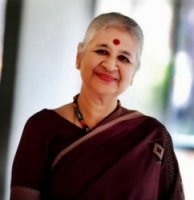 Writing on the dance scene for the last forty years, Leela Venkataraman's incisive comments on performances of all dance forms, participation in dance discussions both in India and abroad, and as a regular contributor to Hindu Friday Review, journals like Sruti and Nartanam, makes her voice respected for its balanced critiquing. She is the author of several books like Indian Classical dance: Tradition in Transition, Classical Dance in India and Indian Classical dance: The Renaissance and Beyond. Post your comments Please provide your name along with your comment. All appropriate comments posted with name in the blog will also be featured in the site. |
