
|     |
|
| |

 e-mail: leelakaverivenkat@gmail.com Reverential homage in Kamalini Samaradhanam spearheaded by Manasa - Art Without FrontiersPhotos: Shibin ChandranMay 24, 2026 Exactly a year after she left this world for her heavenly abode, those who had the opportunity of working with Kamalini Dutt, paid reverential homage to a person who defied being categorized. Guru, mentor, choreographer, Doordarshan producer, aesthetic and spiritual guide, artistic collaborator, most valued friend et al, Kamalini represented above all human qualities of immeasurable value. An unfortunate accident having put paid to an active performing career in dance in the seventies, for one who had mastered the art under renowned Sikkil Ramaswamy Pillai, and had her arangetram when she was a seven year old, with over two years spent on mastering a varnam, without giving in to self-pity, she set about carving an equally, if not more valuable future for herself - transferring her considerable energies to spreading the message of Indian dance to the general public, through her work in Doordarshan. Who can forget the innumerable National Programs of Dance and Music, she presided over? With her mastery over how the camera looked at movement, she released more than a thousand productions. Apart from ushering in new trends, her expertise in being able to control and direct multiplicity of cameras in a program, cut out a great deal of needless work at the editing table. And later as Deputy Director General of Central Doordarshan Archives, the material she collected and left behind, particularly for dissemination, remains unparalleled. All this, while suffering in stoic silence, acute physical pain and discomfort from rheumatoid arthritis. One has to note that it was left to Sharon Lowen, an American citizen, who spent years learning Odissi under Kelucharan Mohapatra, and has made India her home, teaching Odissi, to mount this evening of homage, which no other Indian amongst the many who benefited from Kamalini's instructions, had thought of. The evening, after an emotive introduction by Sharon Lowen of what each person coming into contact with Kamalini had gained, by way of understanding the core principles of our art forms and the enrichment that flowed from interactions with her, from the point of view of artist persona and art comprised a short film which Nitisha Nanda (trained in Odissi and as a Belly dancer) helped string together, a very thoughtfully put together documentary comprising pictures of Kamalini's childhood, of her Arangetram, and other dance postures in later life. 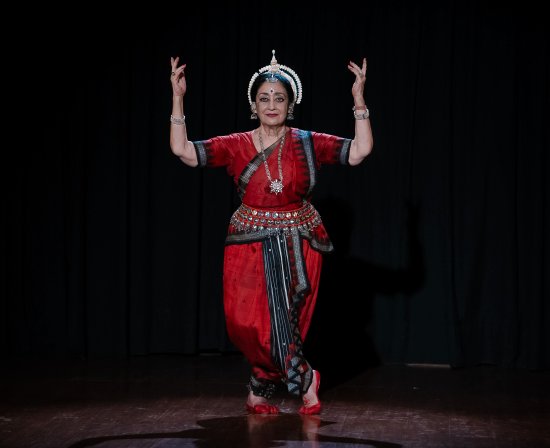 Sharon Lowen Sharon presented her interpretation of late Balamuralikrishna's composition "Omkara Tarini" set to raga Lavangi, a creation of the great singer himself, using only four notes - when music theory prescribes a minimum of five notes to create a raga. Kamalini had explained to her the meaning of spirituality in the metaphysical sense - as against a personal God - Bija Mantras like Om pertaining to the Brahman and Sakti, evoking the higher evocative power of consciousness. "Omkara Tarini" addresses the force that is the form of Om. It ultimately pertains to getting rid of egotism. A large part of her understanding of India's spirituality, Sharon unhesitating admits, stems from interactions with Kamalini. Her understanding of how to direct a program for Doordarshan flowed from one who, apart from having practised dance for years, was also very well versed with how the camera lens looked at movement. Sharon mentioned how skillfully a scene from Kumarasambhavam had been captured - entailing a Parvati confused about showing her dishevelled self to the sakhis after the wedding night with Shiva, alongside the manner in which Shiva himself reacted to the situation. Kamalini it was, who explained to many artistes, the significance of the Nirguna Brahman, and the Nadabrahmaswaroopa and the Dancing Shiva, and the metaphysical concepts behind these terms. 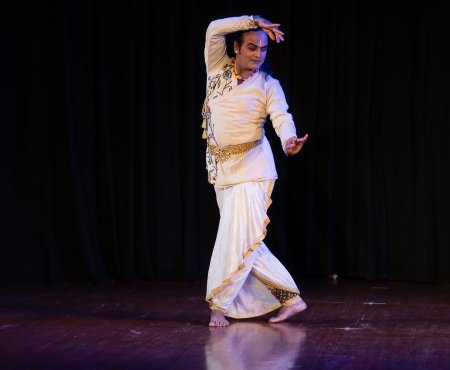 Hemanta Kumar Kalita Working on a program with Kamalini, was Kathak guru and dance exponent belonging to Assam, Hemanta Kumar Kalita (also practices Sattriya, the dance form of his home state and Manipuri) who had his specialization, in his later years, under Late Birju Maharaj. He showed how using Kavits with a soundtrack providing excellent music, the abstract idea of Shivahood was captured. He worked in a production for Kamalini, alongside Divya Goswami, also from Lucknow Gharana Kathak, and showed how the slokam Angikam Bhuvanam along with Kathak mnemonic syllables captured Shiva as Nataraja, representing the five elements of Sky, Water, Earth, Wind and Fire. Divya recollected how Amma spoke of these topics - her eyes dancing in animation. In Chandigarh with Amma as teacher, storyteller and writer, what she derived from her instructions was invaluable. Working with Dhrupad, her three years with Amma, gave her the opportunity to absorb a great deal - just listening to a "Gale bhujanga bhasma anga" of Shiva. She spoke of those years as being filled with bliss, trying to understand the philosophy behind Shiva dancing in bliss in the crematorium - Bliss she said flowed from total non-attachment. Her Chautal presentation "Gale bhujanga bhasma anga" had a feel of deep involvement in portraying Shakti of the unmanifest. The recorded music for the production set to raga Desh in Chautal of 12 beats was rendered by Sudha Raghuraman and Dr. Sridhar Vasudevan. 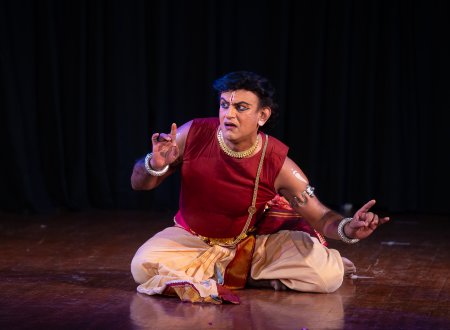 Sridhar Vasudevan Sridhar Vasudevan himself, trained under Vyjayantimala Bali was the last of the solo artistes for the evening. He spoke of late Kamalini Dutt with the deepest appreciation. She made dancers understand, he said, concepts like Antar Yogi, Bahar Bhogi. As teacher of Bharatanatyam, singer and composer, Sridhar's low- key personality, is in the best traditions of an art follower who is in the race because of inner conviction. Leela Shuka's Krishnakarnamritam slokam was followed by presenting "Bhavayami gopala baalam mama sevitham," the composition of Saint Annamacharya which M.S. Subbalakshmi in raga Yamuna Kalyani, made into one of her signature songs, this composition of Krishna as a child, saviour and Paramapurusha, making for a soulful finale. 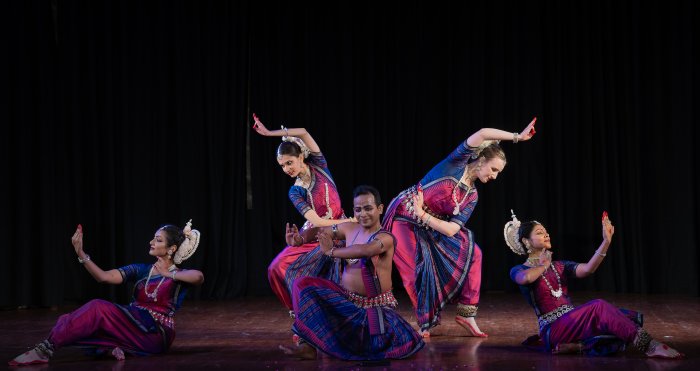 Manasa - Art Without Frontiers ensemble The evening ended with Moksha by students of Manasa - Art Without Frontiers (Nitisha Nanda, Viswanath Mangaraj, Perrine Legoullon, Ishani Bose and Devanshi Das) participating in a composition set to dance by Viswanath, "Deva Deva Krishna dinabandhu pahimaam." 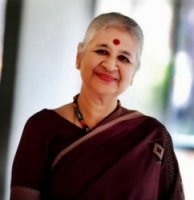 Writing on the dance scene for the last forty years, Leela Venkataraman's incisive comments on performances of all dance forms, participation in dance discussions both in India and abroad, and as a regular contributor to Hindu Friday Review, journals like Sruti and Nartanam, makes her voice respected for its balanced critiquing. She is the author of several books like Indian Classical dance: Tradition in Transition, Classical Dance in India and Indian Classical dance: The Renaissance and Beyond. Post your comments Please provide your name along with your comment. All appropriate comments posted with name in the blog will also be featured in the site. |
