
|     |
|
| |

 e-mail: leelakaverivenkat@gmail.com Allowing a thousand flowers to bloom in a world gone haywireApril 19, 2026 LET A THOUSAND FLOWERS BLOOM Photos courtesy: Sutra Foundation In a world going haywire with dissensions, the exhibition 'Let a thousand flowers bloom' mounted at Delhi's Habitat World by Malaysia's Sutra Foundation, was like a breath of fresh air. Structured round Odissi dance, the event comprising exhibits of drawing, painting and some excellently sensitive photography, featuring 21 artists of India and Malysia, was a tribute to late Dinanath Pathy of Odisha. 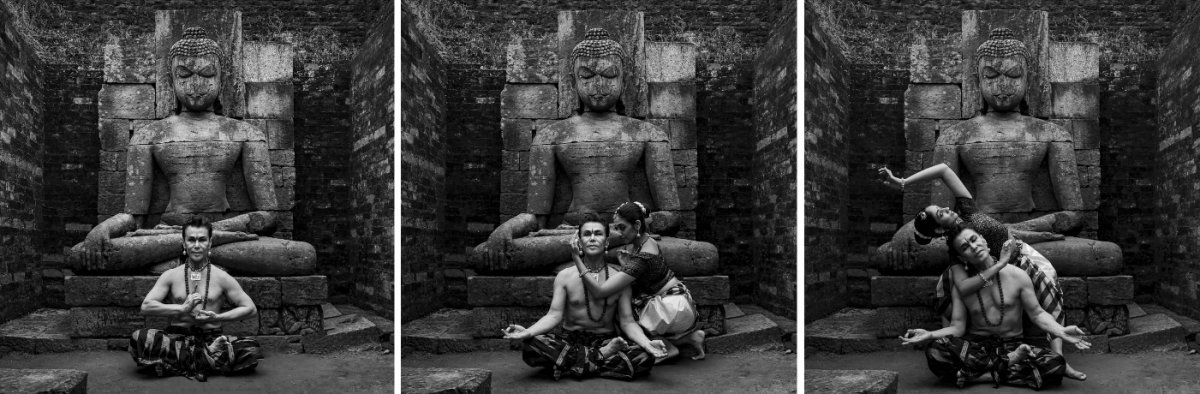 The Temptation I, II, III (Triptych) by A Prathap (Chennai). Print on Canvas. A Renaissance Man in every sense of the term, Dinanath's all- enveloping artistic genius, spanned iconic expressions of painting, with works of authoritative scholarship on myriad expressions of art including dance - both classical and folk. An ardent believer in the cross-pollination of ideas and images in India, among various forms of art, in 2008 he authored a book An interface between Dance and Painting. In a time continuity from past to present, no art for him, notwithstanding its distinctive features, existed and grew in a water tight compartment of a region. Which is why he greatly appreciated Ramli's Odissi Guru, Debaprasad Das, whose strong faith in the spirit and beginnings of any aspect of dance, (notwithstanding its prevailing sophisticated expression), to be existing in the rural interiors of Odisha, made him a great respecter of folk forms. For this Guru, Lokdharmi and Natyadharmi existed together - an understanding reflected in his compositions, where movements comprised a natural / stylized mix. Dinanath's view was in tune with this belief in the continuity and flow of an art form, rather than its existing as a separate monolithic entity. As an art curator, having worked closely with German ethnologists and historians specializing on Odisha, like Eberhard Fisher and Herman Kulke (the latter having researched and authored work on Odisha's history and on the Jagannath Cult), Dinanath Pathy was closely connected with the Central and State Lalit Kala Akademis. A chance meeting with Ramli Ibrahim of Malaysia led to a lifelong friendship, with the two collaborating to produce some of the most ambitious productions, through Ramli's institution in Kuala Lumpur, Sutra. This bond further strengthened Ramli's ties with Orissan culture, resulting in Sutra Foundation's sponsorship of frequent workshops in Malaysia, with hospitality extended to Odissi singers, scholars and dance gurus. 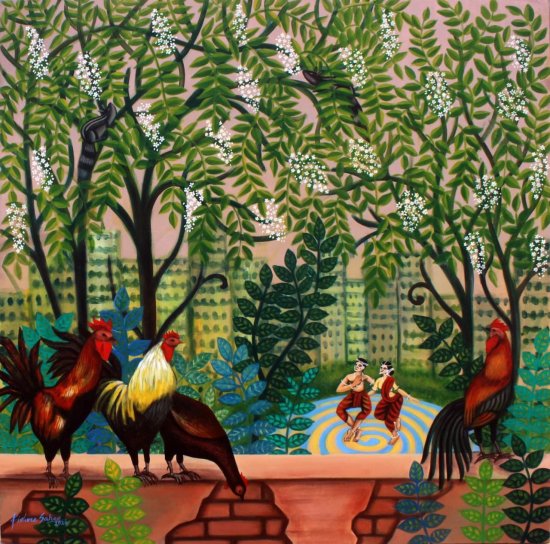 Odissi in Urban Jungle, Acrylic on Canvas by Kishore Sahoo (Odisha) Alongside Odissi colleagues like Gajendra Panda (who shared a deep closeness with Guru Debaprasad Das), these exchanges comprising the rich lived-in experience of Odisha, enabled Ramli's Odissi, notwithstanding its contemporary spirit, to retain a strong connection with the soil which had nurtured the dance form. Ramli organized frequent exhibitions featuring works of painting by artists from Odisha like Dinanath himself, A.V. Ilango, Ramahari Jena, Kishore Sahoo, Helen Brahma, providing for healthy publicity for the painters (whose works this writer has seen adorning many a wall of elegant Malaysian homes. Odisha's stupendous temple monuments, along with the dance form of Odissi, have provided inspiration to innumerable artists. Apart from painters from outside Odisha, including Malaysia painters like A.V.Ilango, Vasanthi Naidu, Bayu Uttomo Radjikin, Syed Thajudeen and Chennai artists Shalini Biswajit, Balasubramaniam, Thejo Menon and V.V. Ramani (the writer on dance in The Hindu), the historic temple remnants along with the Odissi dance have inspired photographers like Diana Lui, Lalit Verma, Eric Peris and S Magendran Subramaniam. For Dinanath himself, who worked at bringing sophistication to ancient arts of Odisha like Patachitra, the close ties with dance choreographer Ramli whose creative imagination is ever open to new ideas, enabled traditions from his home region, languishing due to lack of patronage, inspiring new expressions through a choreographer like Ramli - willing to venture where angels feared to tread! 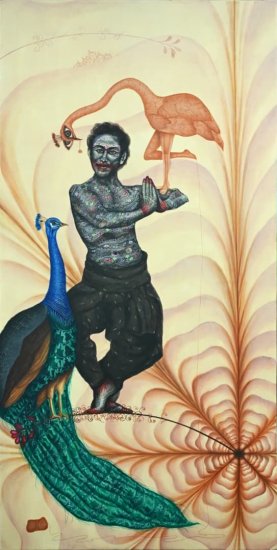 Penari Ulung-III by Helen Brahma (Odisha). Acrylic on Canvas Dinanath's book 'Rethinking Odissi' reflected his disappointment, with the restructuring of Odissi as a classical form, having disregarded, what for him, was the total Orissan perspective of cultural influences from past to present. His belief was that classical Odissi, crystalized in the Jayantika meetings, had been dictated solely by the Puri dominated Jagannath culture, shutting out the rich cultural influences contributed by his own home region of Ganjam. Despite its mixed Oriya/Telugu culture, the reorganization of States in the sixties on the basis of language, had made a major part of this region of Ganjam become part of Andhra Pradesh. After all, historical evidence establishes the Telangana Maharis as having been as much a part of temple worship for Jagannath, as their counterparts in Odisha. And the God himself, before being ensconced as Jagannath in the large Puri temple, had in his earlier avatar, been Neela Madhav, worshipped by the Savaras. And one tends to forget that Anantavarma Choda Ganga who built the Puri temple, was the scion of a wedlock between the Ganga prince, with a Tanjore Chola princess! Hence the term Choda Ganga! South India's influence was evident in the music too with ragas like Shankarabharanam, Bilahari, Arabhi (Odissi's finest Pallavis are set in these ragas by late Bhubaneshwar Misra, who was a shishya of Carnatic violinist Dwaram Venkataswamy Naidu! 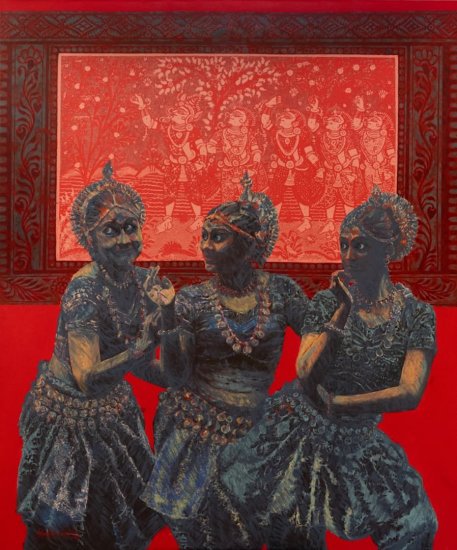 Celebrating Spring by Sivarajah Natarajan (Malaysia). Mix media & Acrylic on Canvas Along with the handsome exhibits, was the background of taped Pallavi music playing on - with an informal but inspired response from Ramli and student dancing round the hall. To think of it - Here was a Malaysian Datuk Ramli Ibrahim, decorated with a Padma Shri from India, a dance choreographer specializing in western Ballet, and Indian forms Bharatanatyam and Odissi, mounting at Delhi's Habitat, an exhibition featuring works of 23 artists from Odisha! Can there be a better medium, which while respecting political boundaries, can conquer by forging friendships between people? THE GITA GOVINDA CAN NEVER GO STALE Photos: The Kahaniwalla What is the alchemy of the 12th century text of Jayadeva's Gita Govinda with its 27 Ashtapadis in 12 prabandhas (which by the year 2002 itself had inspired 57 commentaries in over twenty European languages!) still holding the world of art captive, with its multi layered theatre of bhakti and sringar? Yet another collaborative production 'Gita Govinda where there is Radha, there is Hari,' at the Kamani (New Delhi), before an engrossed audience, proved that this Sanskrit work with its strange sringar twosome comprising a supreme being entangled in a form of his own creation (a rare situation of the macro ultimate also crying out for the micro), with its peaks and depths of emotion, mesmerizes audiences even today. Shivam Sahni, director, script writer and conceptualizer, who also takes on the role of Krishna in this Contemporary Dance/Theatre work, defines his involvement as a 'visceral calling, far greater than perception'! The starting scene of the Gita Govinda, defined by scholars as an allegory, has Radha being asked to accompany Narayana, who has lost his way in the forest, to his home. This is the same Lord who later loses himself in his own mortal creation Radha! Radha too in the depths of sringar described as vilapati, hasati, vishadi, rodati, chencheti, muncheti, has lost herself in her yearning for Krishna. While sringar in its ecstasy and agony in Jayadeva's work covers time omniscient, cosmic, seasonal and linear, this theatre /dance performance based on the entire chronology of the happenings of a day (as given in the text), relates to the plane of fundamental human experience. The enactment while based on the Sanskrit Ashtapadis expressed through movements, not pertaining to any traditional dance form, has the spoken parts set to dialogue in English. Shimran Zaman, Creative Partner, is cast as Radha, while the Sakhi's role is taken by Tenisha Tandwalia. 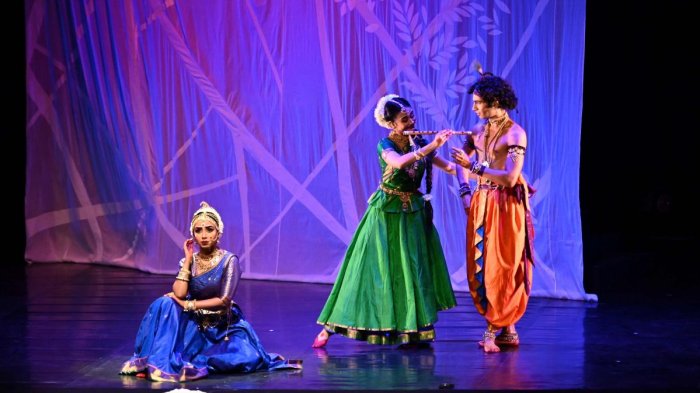 High involvement was a feature of the presentation, with all three actors very convincing in their respective roles. Music forms the bedrock of a Gita Govind presentation, with the Madhura, komala, kanthi padavali of Jayadeva given full respect in enunciation of the Sanskrit terminology and in the ragas chosen for each Ashtapadi, expressive of a definite situation and mood. The choice of Shubha Mudgal, for music composition, with Sai Sravanam's music, direction, production and sound, laid the right musical foundation - comprising Pavithra Chari contributing both singing and dialogue for Radha's role, Aniruddh Aithal's vocal support with dialogues by actor Shivam Sahni himself for the role of Krishna, and for the Sakhi, vocal support rendering the Ashtapadis Mayuri Saha with Isha Bajaj providing the dialogue. With Molina Singh's dramaturgy and mentorship along with Nilava Sen's choreography, the production has invested in Niranjan Gokhale's sensitive light and technical direction. The tasteful set design by Oroon Das, with transparent drapes caught simultaneous action in separate locations - with one main character of Radha, Krishna or Sakhi occupying the front of the stage, while the soft silhouette of another character was often simultaneously visible behind the drape signifying another location. Movements of Shimran and Kenisha as Radha and Sakhi, clearly spoke of dance trained bodies, while Shivam Sahni, the director and script writer with a background of no dance training of any sort (as one later learnt) seemed a natural. Moving with assured elegance, his ability to partner scenes with Radha or the Sakhi, was laudable, his actions and movements, while without palpable foot stomping rhythmic content in the Indian style, having an easy flow. The abhinaya or interpretative part was very convincing with Shimran as Radha, very emotive with her highly expressive face - and acting as a foil for the smouldering emotions of Krishna and Radha, was Kenisha Tandwalia as the vivacious, heart whole, sparkling Sakhi. The Ashtapadis followed in quick succession. 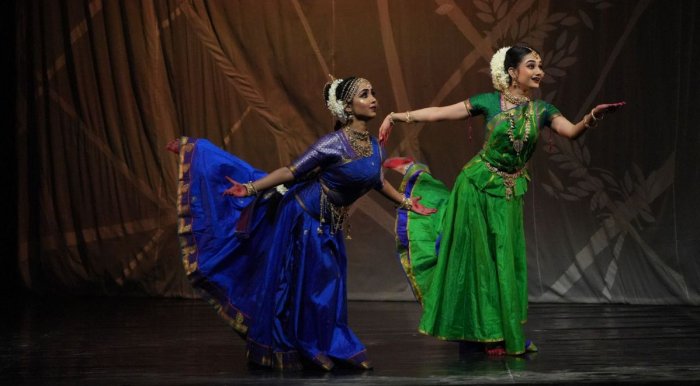 Starting with the abundance of Spring (the ideal time for love) in Lalita Lavangalata, comes the Sakhi drawing Radha's attention to the scene of Krishna frolicking with the Gopis in Chandana charchita, and Sanchara dadhara sudhamadhura dhwani, resulting in forlorn Radha feeling the absence of Krishna in Rase hari miha vilita vilasam. Confiding with the Sakhi in the Ashtapadi Keshi mathanam udaram, Radha shyly recollects the prathama samagam - her initiation into the intimacies of love having Krishna artfully helping her overcome her shyness. In the Ashtapadi, Mamiyam chalita vilokya, it is Krishna in remorse, (having driven Radha away with his constant flirting with other sakhis.) It is left to the Sakhi, the most level headed character to bring two entities deeply in love and pining, together. In the Ashtapadis Nindati Chandana and Pashyati dishi dishi rahasi bhavantam, the state of Radha's tormented condition bordering on losing her sanity, is communicated to Krishna by the Sakhi. The effort leads to a meeting with Krishna going to meet Radha, but with the signs of dalliance with another woman writ large on his body. Radha as the wronged woman, becomes all hurt pain, taking on a highly accusatory tone in the Ashtapadi Rajani janita guru jagara raaga kashayita malasa nivesham, pointing to Krishna's unkempt condition. In a staggered rendition of the text, each telltale point singled out by Radha is met by Krishna's lame explanations in English. As the lovers grieve, Madhave makuru manini manamaya sees the Sakhi giving Radha wise counsel, about not allowing hurt and false pride to stand in the way of love, for Krishna too, after all is entitled to his pride and while every part of her yearned for his love, she had to meet him half way, as he waited for her in his bower. As Krishna rapturously welcomes Radha into his bower, his declaration of love in Priye charusheele, with the Dehi pada pallava mudaram statement, offering his bent head for her to put her feet on, has Radha shying away from the enormity of such a gesture by Krishna. 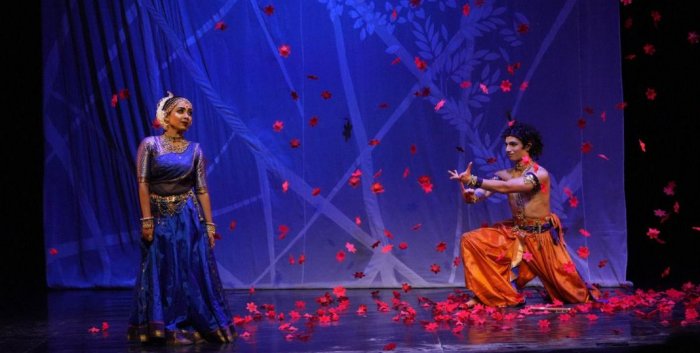 The well-known Ashtapadi Kuru yadu nandana with Radha basking in the intimacy of after love, indolently asking Krishna to repair her deshabille by removing the rumpled state on her person, has been presented as a solo item innumerable times. But rendered as a twosome, the intimate details of Jayadeva's poetry can be daunting. But how the two actors, adopting different angles, related to each other, spoke of imaginative choreography, in interpreting the text. Radha, after becoming one with Krishna in this Ashtapadi, again in an allegory, asks back for her pre-union state - Dualism is after all needed for the lila or play of love to go on. Excellent costumes with Art Carat designed jewellery for each character put the finishing touch on what was a laudable effort. NO HOLDS BARRED FEMALE GAZE OF 'REBEL RANIS' HOLDS AUDIENCE SPELLBOUND Photos: Shibin Chandran Visceral and unapologetic in its blistering tones, of re-contextualizing attitudes defining our epic heroines, through what is referred to as the 'female gaze, placing woman at the center of the performance,' Rebel Rani staged at the Kamani, held a packed auditorium spellbound. Presented by the experimental Keelaka Dance Company founded in 2024 by Jyotsna Shourie and long-standing student Aneesha Grover, its interdisciplinary approach, not dictated by conventional classical performance practices, in a layered, emotive form of its own creation, not excluding the spoken word and music (contributed by MadStarBase, Dr.Himanshu Srivastava, Harini Iyer and O.S. Arun) - makes for highly communicative fare. Rebel Rani, woven round four of our epic heroines Kaikeyi, Sita, Karaikkal Ammaiyar and Draupadi, in that order, begins with an introductory scene, with each heroine seated on a high stool, introducing herself. Aneesha Grover plays the role of Kaikeyi. Though egged on by the cunning Manthara, Kaikeyi universally reviled as the evil stepmother and the main cause for Rama's fourteen year exile, reminiscing on her fate, Kaikeyi is reminded of her days as mother, playing with little son Bharat. With a childhood not spent playing with dolls, and trained in war skills, she had accompanied her husband to battles. Musing, she wonders if it was evil for a mother to nurse ambitions about her son becoming the next ruler of Ayodhya? After all, had not husband King Dasaratha, deeply grateful for his life being saved through her skillful chariot driving when fighting demon Shabare, bestowed on her a boon to ask for anything she wanted, while also making a solemn promise that he would reward her by making her son the King of Ayodhya? 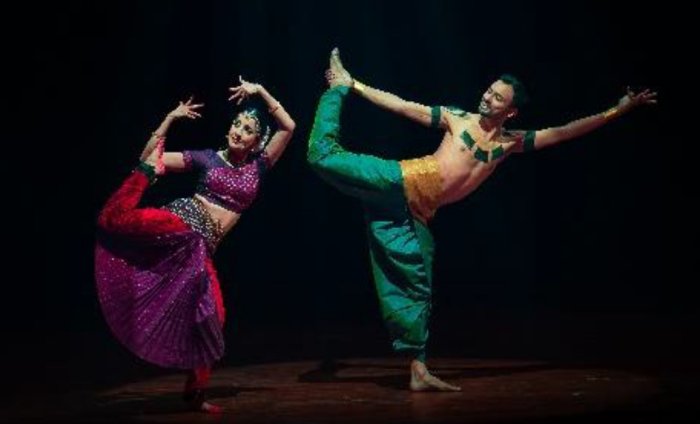 Aneesha Grover & Benjamin Jacob as Kaikeyi & Dasaratha Though deeply loved by her husband, she was not Queen of Ayodhya - a place which belonged by convention, to the first wife Kausalya. Was it wrong to realize her ambitions through the son? Alas! Asking for what was legitimately promised, had cast her as a wickedly ambitious woman causing her husband's death! Not even the son, through whom she hoped to realize her ambitions, and for whom she had gone through all this ignominy, had appreciated what she did, calling her evil, and scurrying to the forest in search of the lost Rama! How many sought to think that without the fourteen-year exile and its travails, how much greatness would this epic hero Rama have earned, sitting securely on the throne of Ayodhya? The scene was punctuated by a brief pas de deux like dance scene, depicting the special love and togetherness bonding Dasaratha and Kaikeyi, with Dasaratha played by dancer D. Benjamin Jacob, trained in Ballet, Contemporary Dance, Jazz and Bharatanatyam). Aneesha's Bharatanatyam teamed with the graceful, long-limbed lines of Benjamin's leg stretches and pirouettes blended elegantly. 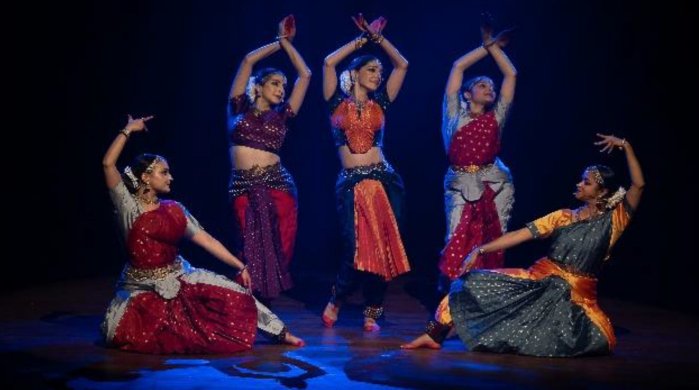 Nandita Kalaan, Aneesha Grover, Khushi Raizada, Aadya Jain, Amrita Sivakumar - Sita the feminine, cosmic energy of mother earth Bharatanatyam dancer Nandita Kalaan was cast as Sita without whom Ramayana is incomplete. Painted Goddess - like, with her beauty, wifely chastity and endurance, symbolizing the best in womanhood, this is a different Sita - as the protagonist of Adbhut Ramayana causing the downfall of the great Ravana with ten heads, who draws his powers from Shiva himself. Ravana conquers everything but cannot overcome Sita, who refuses to fall for either his threats or persuasions. The Kamala, Kanta Mithila princess, and the Queen abandoned in the forest, Sita here is visualized transforming into Maha Kali, against whose fearsome blood thirst, Ravana is helpless. And more than Rama's archery, along with the added strength and wile of the Sena of monkeys, it is the Maha Kali transformation that destroys Ravana. The change over to the possessed Kali, in fast and furious dancing to cries of Anam Taanam -Sita Mahakali Bhaje to the accompaniment of drum syllables on different kinds of percussion, proved very effective and was well executed by the actor. 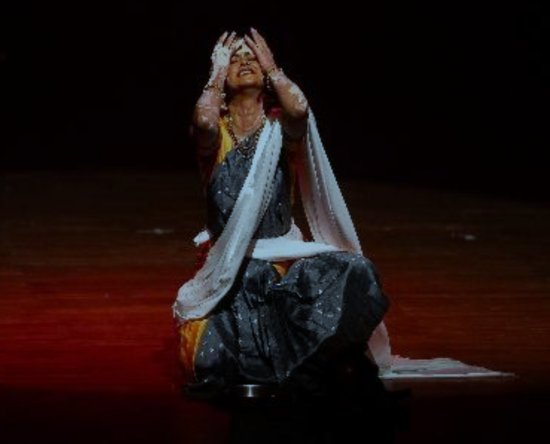 Amrita Sivakumar as Punithavati transforming into Karaikkal Ammaiyar On a different level from Kings and Queens, and pertaining to the Saivite pantheon of Nayanmar saints, was heroine Karaikkal Ammaiyar (ascribed to the 5th century CE), an ardent devotee of Shiva. Played by Amrita Sivakumar, the earlier version shows her as Punithavati, wed to a wealthy merchant Paramadattan, her ardent Siva bhakti earning her a certain power bestowed by the God. When she magically reproduces the second mango her husband asked for (of the two given by the husband earlier, Punithavati had given away one to a hungry man asking for alms), shaken by the wife's power, Paramadattan's attitude to his wife changes with her magical powers making him feel dwarfed, and in course of time he leaves her to marry again. Stung by the husband's reaction, despite all the wifely devotion, Punithavati, discarding all her beauty becomes Karaikkal Ammaiyar, transforming into a ghoul like form (peyi), spending the rest of her life in the Tiruvalangadu crematorium, in fervent prayer to Siva. She is the author of the Tiruvandadi and Tiruvalangadu Tirupadiyam. Apart from the fleeting Punithavati/Paramadattan husband/wife exchanges with Dr.Himanshu Srivastava as husband playing out important points in the story, what for this critic particularly created the right tone for this scene was Nitya Vaishnavi Singh's striking set of pots, pans and kitchen utensils suspended in the air, at various points, fitting in with the ghoul like magical personality. 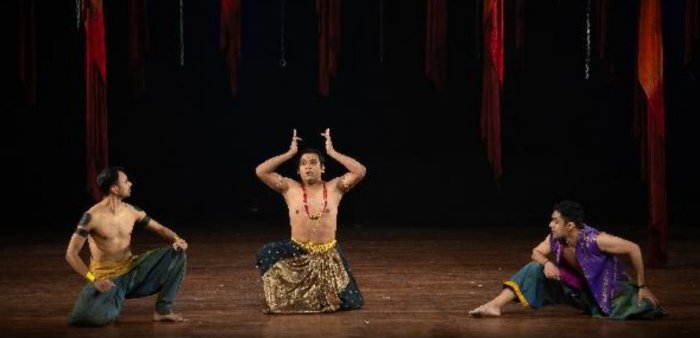 Dr Himanshu Srivastava, Benjamin Jacob and Sagar Vashisht - the game of dice The bitingly sarcastic tone pointing at history's male dominated perspective in passing judgement on these heroines, deliberately ascribes to the male a very lean presence, not worthy of notice. The concluding scene however has heroine Draupadi 'revisiting her assault as a site of re-awakening'. Visualizing the dice play in the Kaurava court, with all that follows, the unavoidable surfeit of male presence, notwithstanding all the shouts and bluster, has them show up as emasculated non-entities. Divine interference defeats the Kaurava resolve to completely disrobe her, while the five 'noble husbands' are unable to raise a finger to rescue her from the indignity heaped on her. 'Did they not realise that as Yagyaseni not conceived the normal way but born out of fire, I would burn these men who insulted me?' Draupadi wonders at Dharmaraja Yudhishtira, so immaculate in adherence to Kshatriya dharma, by giving up everything he has lost in dice, having no qualms about dharma in using the wife as stake in dice play, and in exhibiting such helplessness in fighting the insults heaped on her. This scene rose to a climax of sizzling theatre, given the stentorian voice of Harini Iyer as Draupadi. A global voice, her talents combining singing with song writing, she is famed for her blend of Carnatic music with Jazz. Breathing fire in tone and act, the actress's bristling contempt at the inadequacy of five husbands in protecting her, seemed to envelope the space with its timbre and emotive strength. A truly visceral indictment! 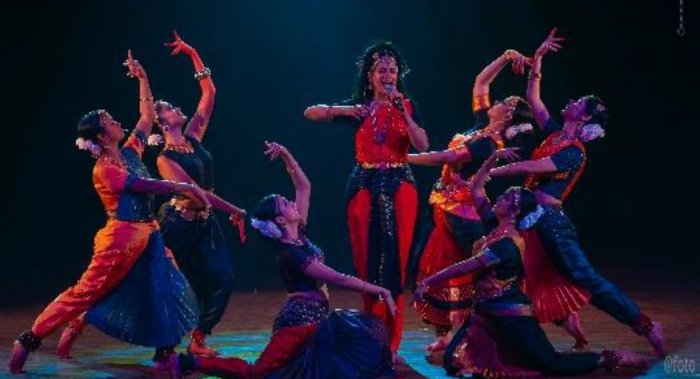 Harini Iyer sings Thillana live And to end was the Jazz Thillana with the entire cast of dancers, which aside from those mentioned included Sagar Vashisht, NSD trained actor and theatre personality trained in Chhau, Yakshagana and Nautanki. Costume designing was by Nandana Venkat. Lighting design was by B. Charles with Khushi Raizada as coordinator. That presentations with a contemporary approach to historical figures, is the need of the day was evident in the huge response to a ticketed show. With not a seat vacant, I looked in vain for the presence of dancers from various genres. There was none! For artistes performing for generally modest monetary compensation, a ticketed event could be out of bounds. But I hope it is not the complete divide between time honoured dance margams and something with a changed perspective. 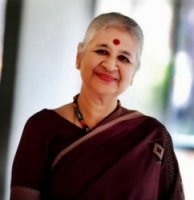 Writing on the dance scene for the last forty years, Leela Venkataraman's incisive comments on performances of all dance forms, participation in dance discussions both in India and abroad, and as a regular contributor to Hindu Friday Review, journals like Sruti and Nartanam, makes her voice respected for its balanced critiquing. She is the author of several books like Indian Classical dance: Tradition in Transition, Classical Dance in India and Indian Classical dance: The Renaissance and Beyond. Post your comments Please provide your name along with your comment. All appropriate comments posted with name in the blog will also be featured in the site. |
