
|     |
|
| |

 e-mail: leelakaverivenkat@gmail.com Solo Expressions in the Music Academy FestivalPhotos courtesy: Madras Music AcademyFebruary 6, 2026 PRITAM DAS: PHENOMENAL BODILY AGILITY It is a career on the ascendant for Pritam Das, with a Masters in dance from Rabindra Bharati University, followed by laurels in Bharatanatyam from Doordarshan, alongside Senior National Scholarships from the Ministry of Culture and the Sahitya Kala Parishad. Currently a disciple of Rama Vaidyanathan, after training under Jayati Ghosh and Samrat Dutta, this dancer combines phenomenal bodily agility, with an uninhibited approach to interpretative dance. 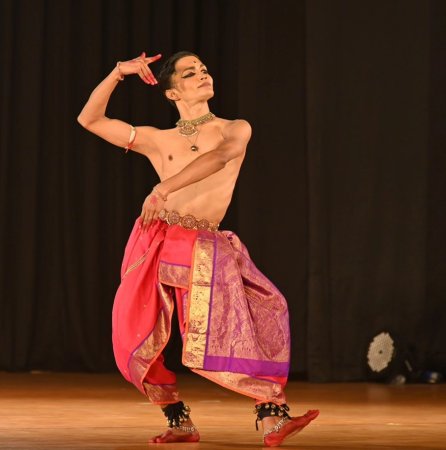 Pritam Das The central part of his recital comprising the Varnam composition of Sivananda of the Tanjore Quartet in raga Kalyani, set to tala rupakam, "Sarasa shikhamani," is in the form of an address to King Shivaji. In fulsome language of hyperbole, the flirtatious Nayika, in the very opening line, following the long Trikala teermanam, announces her total faith only in him - "Shikhamani neevani tsala nammiti." In a pointed reference to his mercy - kripa, she praises his generosity, drawing attention to the gifts of jewellery she is adorned in. Offering herself, she demands his immediate arrival (ee vela raa), to assuage her love pangs. The dancer’s abhinaya embellished with telling gestures, spoke all too clearly of an open invitation to the ruler, to the boudoir. Pritam Das, very fulsome in his enactment of seduction, would do well to temper ideas, very flagrantly expressed, with a degree of aesthetic restraint. A Varnam address in court would seem to call for a certain subtlety. In the teermanams, it was heartening to see that Pritam had tried to curtail his bodily ability to move any which way, by not jumping round too much - though in the charanam he seems to have given in to his natural inclination for leaps and jumps. Mobility, no matter how strong, should be tailored to the needs of the thematic message, without becoming self-indulgent. The dancer had an excellent group of accompanists, with RLV Hemanth Lakshman conducting with his nattuvangam and Bijeesh Krishna providing mellifluous vocal support. Charudutt V.V. for mridangam, with Shyam Kalyan on the violin and Hariprasad Subramaniam on flute completed he team. Bijeesh’s singing of the Gita Govindam ashtapadi "Kshana madhuna naryana manugata manusara" (music composed by Hariprasad) in Dwijavanti was very moving, and Rama Vaidyanathan’s choreography, as presented by Pritam Das, convincingly conveyed passionate Krishna offering his love, inviting Radha to place her feet with the golden anklet on his bed. The finale ringing in the note of pure devotion or bhakti was devoted to Shiva, in a Ragamalika/Talamalika, Shiva Namamrtam comprising compositional snippets of three great devotees -- Sundarar and Thirugnana Sambandar, among the 63 nayanmars who composed Tevaram in praise of Shiva, along with Maha Vaidyanatha Iyer, the 19th century Carnatic legend who composed a 72 melakarta ragamalika as a musical offering to Shiva. ANWESHA DAS: A PLEASANT STAGE PRESENCE 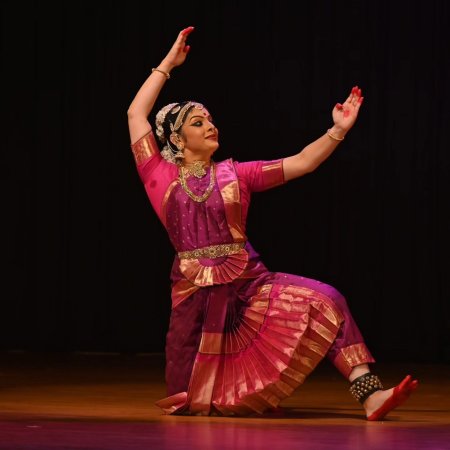 Anwesha Das A more evolved dancer than what one can recollect seeing of her, Seattle based Anwesha Das, with a pleasant stage presence, began with a Misra Alarippu dedicated to Yadagiri Narasimha, with a well mimed, fleeting vision of Narasimha tearing the entrails of Hiranyakashipu. As a student of Urmila Satyanarayana, the choice of the Pada Varnam in ragam Karaharapriya, a composition of Urmila’s Guru K.N. Dandayudapani Pillai, was not surprising. For the smitten Nayika, every facet of nature seems to orchestrate and remind her of her beloved Lord of Ponnambalam - the chirping birds which seem to chant the Lord’s name, and the dark clouds which remind her of her beloved’s throat. Unable to stand the darts of Manmatha, she chides her sakhi to hurry to convey the urgent message of her feelings, "Maane innum yocchanai enadi". (What is making you delay?). Anwesha’s interpretative dance, had a winsome simplicity, as did the nritta aspect, which, sans virtuosity, was correct in line with a neat araimandi. The javali "Sarasamula," a composition of Poochi Srinivasa Iyengar in raga Kapi, portrays the Nayika trying to shake off the Nayaka’s over exuberant advances. It is daylight with the world watching and fully awake, and hardly the time for such intimacy, without the cover of darkness. This was followed by the Balamuralikrishna Tillana in Brindavana Saranga. A feature of the recital was the teacher Urmila herself appearing in between items to announce. HOSKERE - A FAST EVOLVING DANCER 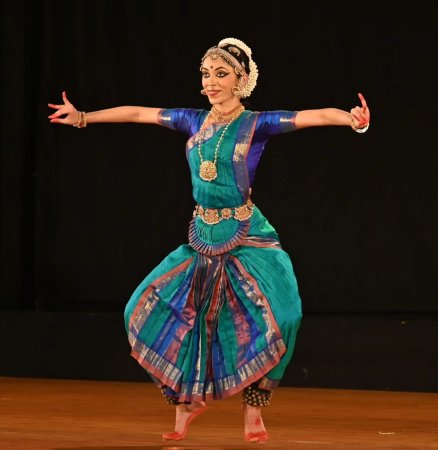 Divya Hoskere Among the examples of both teacher and student meriting a slot in this prestigious festival, was P. Praveen Kumar whose disciple Divya Hoskere, was featured in the morning slot. As a scholarship holder performing in the Dance for Dance festival, just a few days earlier, one had had earlier evidence of this young dancer as a performer visibly evolving. Turned out in a tasteful costume, Divya’s start with a Jatiswaram in Abhogi ragam set to adi talam, demonstrated straight away the excellently balanced body and perfect linear geometry of her dance lines. An unusual item, conceived by her teacher, comprised a pithy Subhashita description of Nandi announcing the impending arrival of Shiva, the Lord of Dance, from his celestial home in the mountains and Nandi wants the right setting with the clouds to behave, the sky cleared of birds and the theatre of dance in nature to be perfect for the celestial dancer! The Pada Varnam set to adi talam in Anandabhairavi ragam, "Panta mela na Sami," showed Divya as one of the dancers who has matured appreciably in her abhinaya. Addressing the exalted Nayaka in words of praise, as the son of Dattaji mantri, the Nayika reminds him of the days when he cherished being close to her, "Sarike ni daya korina nannu," pleading that he shed his present indifference. Praveen Kumar himself conducted with his nattuvangam (a demanding task considering that he was scheduled for his own solo performance the same evening at 6pm). Never overbearing while fully supportive, needing occasional cues, the modest bearing of the accompanists, for this critic, was a noteworthy feature of the recital - with vocal support by Eeshwar Iyer, N Vidyashankar on the mridangam and Vivek V. Krishna on the flute. There were some fine touches in the abhinaya to the Ashtapadi "Natha Hare, Jagantha Hare" set to raga Charukesi, wherein the Sakhi, on an errand, conveys to Krishna, the pitiful condition of pining Radha. On entering the retreat of Krishna, Nature’s scene with the gently flowing waters of the Jamuna, the flying birds and the grazing animals, seem to mock the state Radha is in - crazed with longing for beloved Krishna. "Bhavathi vilambini vigalitalajja, vilapati rodati vasakasajja," the sakhi reports to Krishna the condition of Radha, who in her state of waiting for Krishna seems to have lost her balance. Do not delay, the sakhi begs Krishna. The performance concluded with Lagudi Jayaraman’s Tillana in Thilang. MORE SHARPENING OF KUCHIPUDI NEEDED 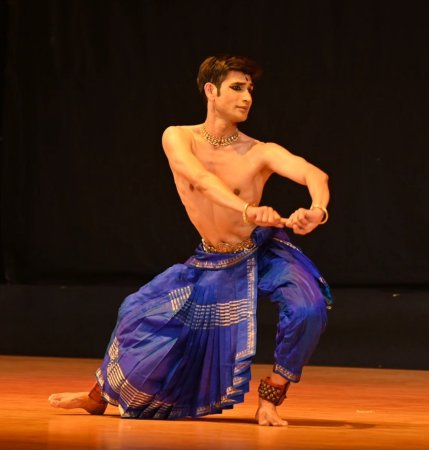 Avijit Das Avijit Das’ Kuchipudi performance opening with Shiva Stuti based on a slokam from Yoga Tantra of Devulapalli Krishna Shastri with the music in Ragamalika by Patrayani Sangeeta Rao, projected a dancer who has undoubted talent. But following a diploma in Bharatanatyam from Kalakshetra Foundation, this dancer, who in career midstream, switched over to Kuchipudi, still has the strong Bharatanatyam imprint on his body. The Tarangam spun round Dr. Rajkmar Bharathi’s Ragamalika score with the words "Kalaya Yashode tava balam," based on nritta with both feet planted on the rim of a brass plate, showed a dancer who had rhythmic control. But for this writer, that typical and very graceful Kuchipudi gait and bearing, while entering and leaving the stage, and the ubukku (dancer’s body bobbing up and down, which Vempati Chinna Satyam’s style curtailed, but used in a unique way) and the torso movements with a shifting of the rib cage, along with the hands while dancing, were missing. Without the defining, stylistic bodily attitudes, which give to Kuchipudi its special place in the scheme of classical dances, this dance becomes a far cousin of Bharatanatyam, losing its identity. And it is here that Avijit Das needs to concentrate, so that his dance does not fall between two stools. It would be unfair not to acknowledge the fact that the dancer performed in the teeth of being ill served by his vocalist D.S. Srivatsa who has had a long singing career behind him, but whose vocal cords, seem of late, to have developed real problems, unable to stay faithful to either sruti (microtonal alignment) or melody. With flute by Raghu Simha and veena by Niveditha Arun having little to do with the singing, music became a cacophony. For abhinaya, the dancer, wisely, as mentioned, sought assistance from Bharatanatyam expert Sudharani Raghupathy for a proper understanding of the Kshetrayya Padam "Etuvanti vade vadu" in Kalyani set to tisratriputa talam. Its layered meaning involves a saamaanya (experienced) Nayika, and not an innocent youngster as often interpreted, expressing her curiosity about the comely young man (Krishna) who has moved into the neighbourhood. According to what she has heard, he is handsome, dark complexioned, a sweet tongued youngster said to be a lover of music, named Muvva Gopala. Even as she expresses the desire to meet and get to know him, an indication of her status emerges in the line "O Yamma ennadu ee veedi raadu" (not one to come to this street). The dancer concluded with Mudikondan Venkatarama Iyer’s Tillana composition in Hamsanandi set to adi talam. The name of a Kuchipudi guru is mentioned in Avijit’s biodata- though I do not know if he is still under the guru’s tutelage. He would be well advised however to diligently work on his movements acquiring the Kuchipudi stamp. WELL CENTERED BHARATANATYAM BY ADITHYA 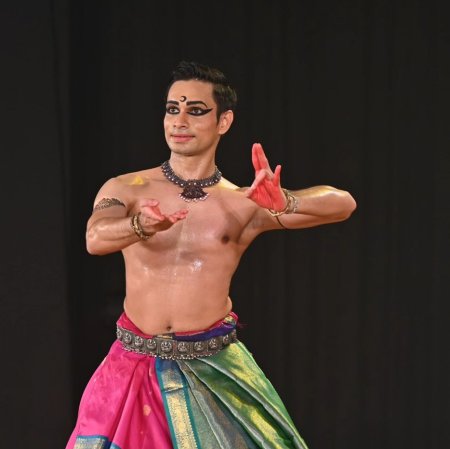 PV Adithya Trained under Latha Edavalath and later the Kirans, P.V. Adithya, now under the guidance of Prof Sudharani Raghupathy, as an experienced performer, apart from the immaculate dance lines, projected a dance persona, with a centered inner serenity. His start was with Agni Sandhi set to raga Nattai in Chatusra Jhampa, one of the Navasandhi Kavutvams composed by the Thanjavur Quartet. In the Varnam, a composition of Papanasam Sivan, in raga Shankarabharanam, "Karunai seididalaagaada" addressed to the God in Chennai’s Mylapore Kapaleeshwarar temple, the Nayika/devotee, beset by pangs of over-whelming love for the Lord, craves his mercy. "I come with full faith in you… Why this indifference to a poor devotee? What is my fault? Manmatha’s arrows hurt me. Will you, Kapaleeshwarar, not cast a sideways glance at me?" The dancer’s involvement was characterized by pin-pointed discipline in elaborating on a statement, with no digressions, not totally relevant to the sahitya, evoking a feel of uncluttered eloquence. Following the varnam, the dancer’s Padam selection in raga Pantuvarali was Ghanam Krishna Iyer’s composition "Nithiraiyil Soppanathil," wherein the nayika unburdens her troubled mind to a friend, regarding the contents of a dream last night - a love scene involving patron/lover (?) Simhendra Bhoopan Ramaraja dorai. Whether her frustration is explained by the absence thereof in real life, or whether the dream sequence pictures him with another young beloved, giving rise to uneasy images of his probable relationship with another young woman, was not clear from the portrayal. Perhaps the indeterminate lack of clarity was meant to be a deliberate part of the abhinaya. The dancer mentioned being guided by abhinaya expert Bragha Bessel for this item. The conclusion was with Lalgudi G. Jayaraman’s Kamas Tillana. The recital had the melodious vocal support of Srikanth Gopalakrishnan, with fellow dancer Parshwanath S. Upadhye ‘s nattuvangam, with Harsha Samaga on mridangam, Viswesh Swaminathan on violin and Hariprasad Subramaniam on flute. VIDHUN KUMAR COVERS THE STAGE WELL 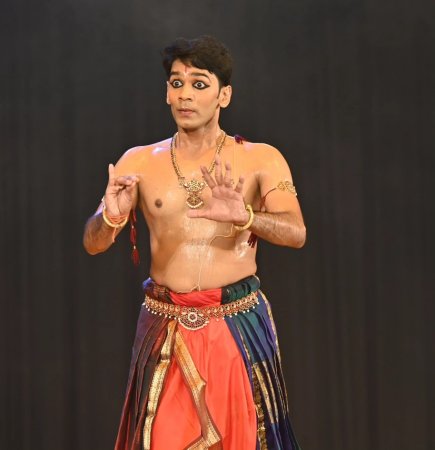 Vidhun Kumar Trained under V. Jayashree, V. Mydhili and Priyadarsini Govind, Vidhun Kumar started off covering the stage with the joyous dance of Lord Shiva, based on Gopalakrishna Bharathi’s Keertanam "Adum Chidambaramo" in raga Behag. The varnam in Kalyani, "Sarasijakshudu," a composition of Sivanandam of the Tanjavur Quartet, as choreographed by Priyadarsini Govind, with Vazhuvoor Jati punctuations between the interpretative thrust of the sahitya statements, is addressed to Saundarya Gopala, the Dwaraka dweller. I have come only to see you, "Sami ninnu jesi vacciti ra", says the Nayika, praising the lord for his Gaana Vidya. The dancer’s neat nritta, was coupled with sensitive abhinaya. The "Appan Talattu" lullaby, again choreographed by Priyadarsini, set to Dr. Rajkumar Bharathi’s music composition in raga Neelambari, in chatusra ekam tala, caressingly addresses the child Rattiname Chittram. The mother here at bedtime, mentioning Rama’s story, goes into a detailed description of the exploits of Hanuman - of his trying to eat the Sun as a child, of flying over the ocean on errands for Rama, of discovering the place of Sita’s confinement in Lanka and consoling her in her distress - ending the tale with how, Hanuman on opening his chest, reveals Rama inside! Sensitivity for interpretative dance, accompanied by sur-filled singing of Murali Sangeeth enhanced the emotive fervour. Nattuvangam by Jayashree Ramanathan, mridangam by Shiva Prasad, violin by Easwar Ramakrishnan and flute by Hariprasad Subramaniam, completed the musical team. The conclusion choreographed by one of the dancer’s gurus Maidhili, was Subramania Bharatiyaar’s Shakti Kootu in ragam Shivasakthi set to adi talam. Starting with the "Thagat, Thagat" opening sounds, this composition is spun around the cosmic dance of the Mother Goddess, representing both creative and destructive energies that govern the Universe. GRACE FILLED BHARATANATYAM BY HARINIE JEEVITHA 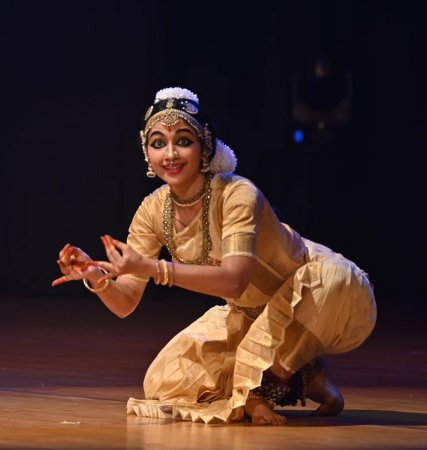 Harinie Jeevitha Turned out in an of white costume, Harinie Jeevitha, a frequent performer in the Chennai Sabhas, began on a devotional note with Kanchi Panchakam, comprising five verse compositions dedicated to the divine spouses of Kanchipuram, a city of temples - presided over by Goddess Kamakshi and her associated forms, in a ragamalika format in tisra nadai Adi, based on Smaran Haridashwa’s lyrics with music composition by Srikanth Gopalakrishnan. Lalgudi Jayaraman’s varnam in Charukesi, "Innum en manam," was announced, as comprising Guru Sheela Unnikrishnan’s original choreography, modified at points to include the dancer’s own improvisations, with jatis composed by Guru Bhardwaj, the mridangist. Starting with a flute overture by Mahesh Swamy, the singing by Srikanth Gopalakrishnan was most evocative. The butter stealer and Krishna with all his naatakam, with the dancer’s mobile expressions, while convincing, tended to be more episodic in treatment than interpretative. The "Kuzhal oodum azhaga Krishna" segment in the charanam refrain with the solfa syllabic passages, met with a highly involved performance. Continuing with her convincing abhinaya, the dancer went on to Marimuthu Pillai’s Padam, a Nindastuti, "Yedhkku ittanai modi endan meedu" in raga Suruti with a charged dancer querying Lord Nataraja on his indifference to her entreaties. She draws attention to her jewellery and all her getup only to attract him, while he is not even looking at her. Elaborating on the deity’s shortcoming of being unfair to his devotees, she mentions as a case in point, Shiva’s winning the dance contest against Kali by devious means - lifting his leg above his head, knowing full well that the Goddess with her adherence to feminine modesty, would refrain from doing so. The recital concluded with Dr.M. Balamuralikrishna’s Tillana in Aahir Bhairav. Apart from the singer and mridangist mentioned above, conducting the recital was Guru Sheela Unnikrishnan with her nattuvangam with Nandini Saigiridhar on the violin and Mahesh Swamy on flute. PAVITRA BHAT OF PAVITRA ART VISUAL INSTITUTE 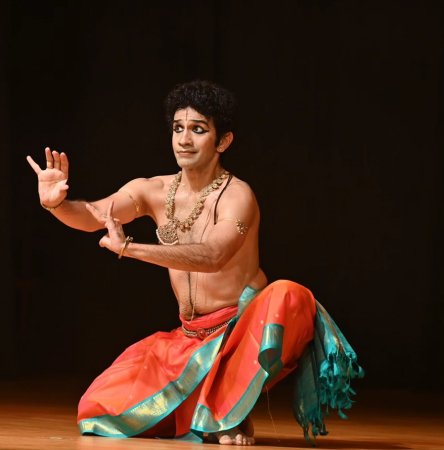 Pavitra Bhat After training under Deepak Mazumdar and Kumari Vasantha, Pavitra Bhat now doing advanced training under Nithyakalyani Vaidyanathan, runs his own Pavitra Art Visual Institute in the suburbs of Mumbai. He would seem to have established himself in the minds of the Chennai public, as the popular hero for several productions of choreographers in the city, whose students are mainly females. His performance for the Music Academy began with a brisk and lively entry on to the stage, to a Ganapati homage, with a Pushpanjali in adi tala based on a Dr. M. Balamuralikrishna composition in raga Arabhi. The Varnam, "Saami ninne kori naanu ra" set to rupaka talam, a composition of the Tanjore Quartet was in Ragamalika form, with each of the statements in a different raga. Set to ragas Shankarabharanam, Todi, Bhairavi, Kamavardhini, Atthana and Kalyani, the varnam, woven round the usual lovelorn Nayika was dedicated to Brihadeeswara - the Tanjapuri Vasa. While the dancer’s nritta was flawless in line and rhythm, and he is well equipped for interpretative dance, one could not avoid the feeling of constant covering of stage space interfering with the inner stillness needed for concentrated abhinaya communication. The exuberant physicality, for this writer, made for a slight restlessness. In the interpretation of the Ghanam Krishna Iyer padam "Unnai thoothu anupinen" in raga Saveri, there was not enough of the anger of betrayal on the part of the nayika questioning the sakhi, (asking ennadi nadandadu) who, sent as a messenger of love, has returned in a rumpled state with the telltale signs of physical intimacy on her person. (With the obvious deception writ large on the sakhi’s dishevelment, the Nayika has no doubts of having been deceived). The recital ended on the sparkling note of a flawlessly rendered Thillana, based on Lalgudi Jayaraman's composition in Mohanakalyani. Conducted by Nithyakalyani Vaidyanathan, the recital pulled off last minute disruptions in accompaniment - with the non- availability of the intended flautist Sujith Nayak, substituted with a totally inexperienced Devaraju. Binu V Gopal's vocal support, B. K. Sivaprasad on mridangam, and Easwar Ramakrishnan on violin made for tuneful musical support. FINISHED RECTAL BY KAVYA MURALIDHARAN 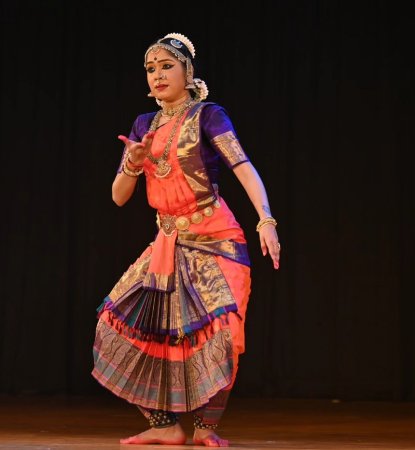 Kavya Muralidharan Kavya Muralidharan, trained under parents R. Muralidharan and Chitra Muralidharan, who run their school Nritya Kshetra Dance Academy, began with Sakthi Kavutvam. Thanks to expertise in both parents, not forgetting father Muralidharan's specialization as a mridangist, with a flair for experimenting with a variety of tala combinations, particularly in Sankeerna Nadai, this dancer does not have to go beyond the home frontiers, in search of new compositions. The Kavutvam with which she commenced was also a composition of her Guru/father Madurai R. Muralidharan - thematically concerning primal energy from which Creation breathes, addressed here as the fierce Protector, the Nurturing Mother and Being, residing in each of us. Set to sankeerna jathi matya talam, the start was on a quiet note of stillness, with singer Srikanth Gopalakrishnan singing raga Vasantha, after which Om Shakti is evoked with rhythmic syllables and the sahityam. The varnam "Mugha vannam" in Sallabam set to adi talam, projected immaculate technique, with very correctly profiled movements rendered in a compact ambit close to the body creating a feel of contained space. With Madurai Muralidharan for nattuvangam, the teermanams had a special zing. The entire choreography was by Mavin Khoo with whom the dancer worked. Addressing the Sakhi, the Nayika who seems to hear whispers of ‘Kanna' from every corner, unburdening her love pangs, speaks of her heartache (deham tudikkudadi, mayavanai kaana). Lovesick and assailed by the agony of sleepless nights, images of the young extraordinary Krishna, with his mischief, also crowd her mind - "I yearn to see that Krishna who as a child revealed the seven worlds contained in his mouth". The charanam shows the throb of the Nayika's body lost to the mellifluous flute music of Krishna. For the popular Muthu Tandavar padam in Kamas, "Teruvil vaaraano ennai chatru tirumbi paaraano", wherein the Nayika expressing her heart's wish imagines Nataraja, in a palanquin or procession presumably, moving down the street, turning and throwing a glance at her, and further stopping at her doorstep to exchange a word with her. The Thillana finale was again based on R.Muralidharan's composition in ragam Maandu set to adi talam with the general accompaniment of Muralidharan's nattuvangam and Srikanth Gopalakrishnan‘s vocal with N.K. Kesavan on mridangam, Suresh Babu on violin and Hariprasad Subramaniam on flute, blended with Durga Prasad's nadhaswaram and Arulanandam on Tavil joining in, giving both sound and rhythm an expansive feel, with the concluding line of homage as in the Kavutvam opening, to divinity in the female aspect "Akhila bhuvanam ellam arulai pozhiyum thaye." GREATER INTERNALIZATION NEEDED 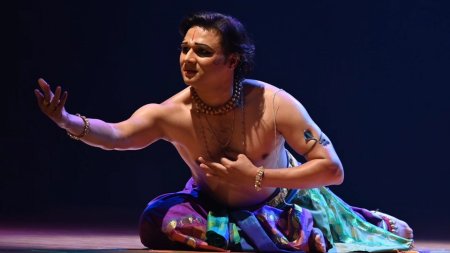 Yogesh Kumar Trained under Sathyanarayana Raju in Bangalore, Yogesh Kumar ushered a start to his performance with a Lalgudi Jayaraman jatiswaram composition in Rasikapriya. One glimpsed concluding moments of movement units, lacking the totally finished feel, with the dancer hurrying on to the next. The lack of impeccability continued in the varnam in Shanmukhapriya, "Devadi Deva," a composition of Veenai Sesha Iyer, choreographed by Guru Narmada, with the dancer's poor body balance while portraying the "Tillaiyil kunchitapadamudan aadum Nataraja" poses. The Nayika yearning for a glimpse of Nataraja (Kaana vendume naan aiyanai) with the dancer's postural instability was coupled by some lack in internalization for abhinaya. The dancer had other unfortunate impediments with singer Srivatsa Debur, who with his obvious vocal cord problems, while better on this occasion than his performance for Avijit Das, was far beyond being able to provide any inspirational mood buildup for the dancer through evocative music. The next item "Hanumantha Deva Nama," a Purandara Dasa composition in Purvikalyani followed by T.V. Gopalakrishnan's Thillana in Rathipathi Priya completed the programme. Perhaps it was one of those days when a dancer was not at his best. 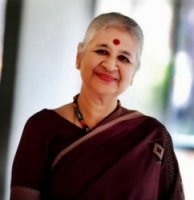 Writing on the dance scene for the last forty years, Leela Venkataraman's incisive comments on performances of all dance forms, participation in dance discussions both in India and abroad, and as a regular contributor to Hindu Friday Review, journals like Sruti and Nartanam, makes her voice respected for its balanced critiquing. She is the author of several books like Indian Classical dance: Tradition in Transition, Classical Dance in India and Indian Classical dance: The Renaissance and Beyond. Post your comments Please provide your name along with your comment. All appropriate comments posted with name in the blog will also be featured in the site. |
