
|     |
|
| |

 e-mail: leelakaverivenkat@gmail.com Classical genres perform to backdrop of dance immortalized on stonePhotos courtesy: Odisha TourismDecember 19, 2025 Come December and it is time for the magnum opus dance celebration at Konark, when the quiet tourist township surrounding the celebrated temple of the Sun God, sees a rush of high profile activity, with visitors of all denominations descending, to witness not just the dance festival but also the activities surrounding it, like the annual Sand Art festival. Alongside is a highly trumpeted, popular late night event, much patronized by the hoi polloi, comprising music, dance and drama. Hosted by the Odisha Tourism Department Corporation in conjunction with the Odisha Sangeet Natak Akademi, the programing of the five day fare (Dec 1 - 5), ensuring understandably, a major share of this dance patronage to its own classical dance of Odissi, has an established convention of one Odissi group recital on one half of every evening of the festival with the other featuring a dance genre from outside the State. Mushrooming Odissi bodies in the State notwithstanding, the five year gap in festival participation insisted upon down the line, poses challenges in ensuring Odissi groups of standard. 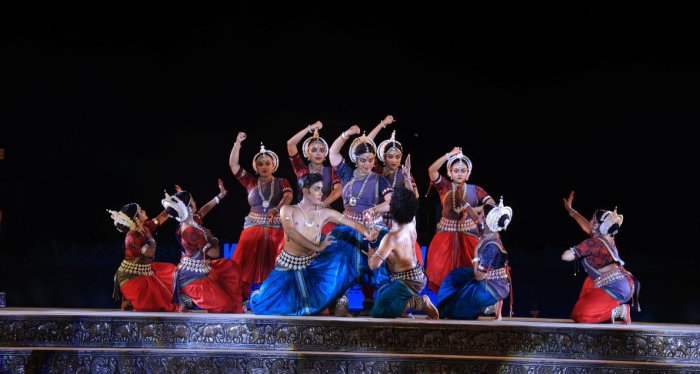 Sonali Mohapatra and group The festival curtain raiser this year was with the Odissi presentation by Sonali Mohapatra and group, from her institution Nrutya Upasana Pitha. Hailed as an example of courage and dedication to dance, given her indomitable fight against the handicap of a major hearing loss as a bare five year old, Sonali, who began training as a four-year-old under Guru Trupteemayee Mohanty, honed her dance skills under Guru Durga Charan Rambir representing the Debaprasad Das Odissi gharana. Her personal struggle in establishing a career in dance has resulted in the laudable initiative of her undertaking to teach differently abled children. Sonali's group choreography for the festival, began with a dance representation of Hanuman Chalisa, a wise choice in that this hymn of Tulsidas, given the wide range of images representing this deity, on walls, in temple sculpture, in paintings et al all over the country, needs little explanation, regarding its celebration of the sterling qualities of this Vanara. Invested with incredible physical prowess, it is Hanuman's unflinching devotion and service to Sri Rama, which are the prime factors enabling the Lord's tiding over the fourteen year period of exile and successfully rescuing abducted Sita - ending with a triumphant return to Ayodhya. Abhiram Nanda's music composition of this action oriented hymn, coupled with Sonali's dance visualization met with a neat rendition. The dancer's choreographic sensibilities when it came to pure rhythm found expression in the Pallavi in raga Saranga strung to Ektali, the music composition being the work of Nirmal Kumar Mohapatra. Based on music by the same composer and strung to energetic cycles of tala Jhampa, was the finale of Chari Yuga Devi with Goddess Durga represented as the vanquisher of evil in each of the four yugas (Yuge Yuge Devi) or time cycles of Satya Yuga, Treta Yuga, Dvapara Yuga and Kali Yuga. Worshipped as benevolent Mother, the lotus eyed (padmalochita) Devi Durga also incarnates as ferocious Kali and as Mahishasuramardhini (killer of demon Mahisha). Both facets of Durga, one soft and the other aggressive, emerged with clarity in the dance formations. 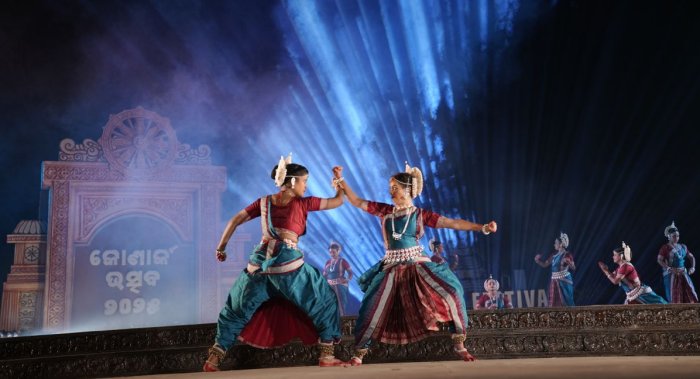 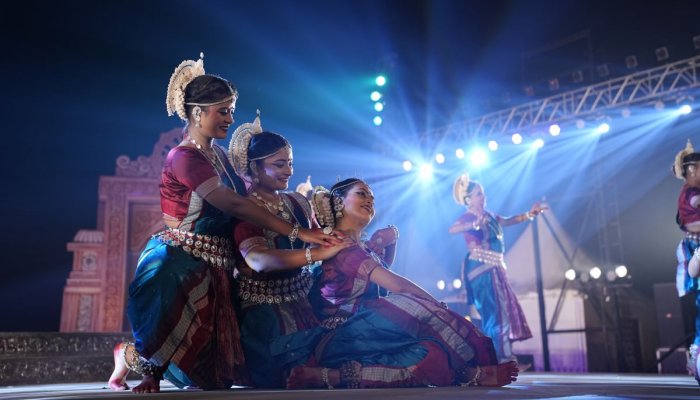 Bharat Charan Giri's ensemble Representing the Debaprasad Das Odissi vintage once again, on the fourth evening of the festival, was Guru Bharat Charan Giri performing with his students from Bharati Nrutya Mandir, an institution founded in 1996 in Bhubaneswar. The group began the recital with pure dance, with a Pallavi in Charukesi set to Jati taal, composed by Bijaya Kumar Jena, with rhythmic inputs by Guru Dhaneswar Swain and Ajay Kumar Choudhury. The dance visualization by Guru Bharat Charan Giri, in the group formations reflected more of the assertive, grounded strength of the Debaprasad school with its prominent chauka position. The sabda/swara/patha style of the Debaprasad gharana, and the togetherness of the dance and mardal patterns recited in a Kavit style, added a special rhythmic energy to nritta. The second half of the recital was an abridged version of a dance drama Gajanana, centered round the origin of Lord Ganesha. The myth behind the elephant faced God concerns Durvasa's curse of Lord Indra who, in the throes of infatuation for celestial nymph Vidhyadhari, had carelessly draped the garland offered to him by Durvasa, round the neck of his elephant Airavata - which in turn, annoyed by the bees in the garland, had flung it to the ground, trampling it. It was for mitigating the constant losses suffered by the Devas against the asuras thanks to Durvasa's curse, that the Samudramanthan - churning of the oceans - for procuring ambrosia, was resorted to. The other myth was of Goddess Parvati acquiring a son, by breathing life into an image made out of the paste made for her bath. Asking the young son to guard her privacy while she went for her bath, she is appalled, on coming out, to find that husband Shiva, returning from his meditation, finding to his annoyance a youngster preventing his entry to the wife's presence, has beheaded the boy. Parvati's anguish forcing Shiva to realize the enormity of his deed, culminates in Shiva's beheading a sleeping Airavata, to place the head on the body of his son- thus bequeathing to Ganesh the form in which he is worshipped to this day. The edited dance narrative, somewhat jerky, lacked flow. 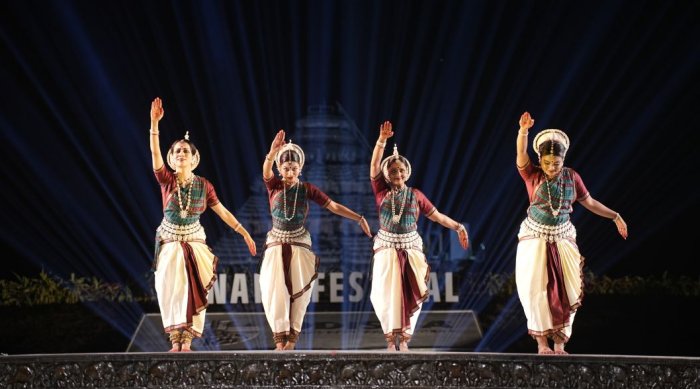 UDRA ensemble On the last evening, what Utkal Dance and Research Academy (UDRA) produced by way of a programme with Arti Kar and group, for this critic, made for a very pleasant surprise, with the quality of choreographic imagination and elan of the young performers, way above expectations. An institution initiated by late Guru Sahadev Padhi in 1994, to keep alive the blended stylistic richness of Odissi contributed by founder Gurus like Kelucharan Mohapatra, Debaprasad Das, Pankaj Charan Das and Dr.Minati Misra, the students have also imbibed dance with the unique 'Devadasi' (Mahari) flavour, contributed by Pankaj Charan Das. Tastefully costumed, the performers displayed enviable group discipline, making it a pleasure to watch. Choreographed by Guru Ramesh Chandra Jena and Guru Arati Kar and based on music composition by Umesh Chandra Das with Dhaneswar Swain's rhythmic contribution, the opening Tri Pathaga, comprised poetic symbolism built round the number 3- the three founder Odissi gurus, subject matter woven round the theme of the three rivers Ganga, Bhagirathi and Janhavi, flowing in the three worlds of Swargaloka, Bhuvaloka and Patalaloka symbolizing three levels of consciousness - namely divine, physical and eternal. The starting homage was to Shiva for bequeathing to mankind the boon of the Ganga lodged in his locks, and the dance captured the feel of people reveling in the flowing waters. If this first offer had movement excelling in grace and impeccable technique, the next part titled Niyati, stressed interpretative subtlety based on music composition by Umesh Chandra Das and Dhaneswar Swain contributing the rhythmic inputs. 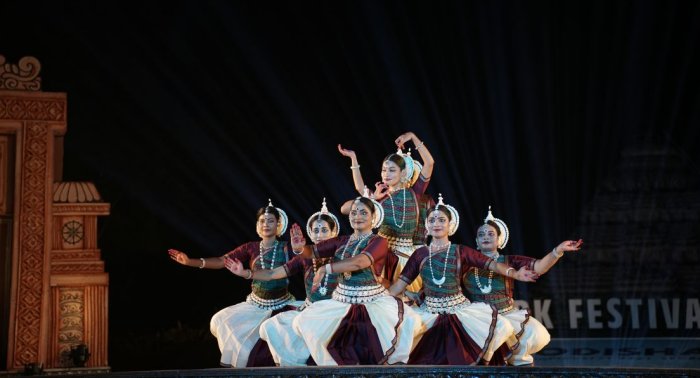 UDRA ensemble Thematically, Niyati was built round the idea that no person can avoid his destiny, also proving that ultimately destiny is shaped with the adage of as you sow, so you shall reap, illustrated through two episodes from the epics - one of King Dasaratha, during his dying moments, without any of his sons by his side due to the curse, while on a hunt during his younger days, when his arrow aimed in the direction of sounds emerging from the gurgling waters nearby (believing it to be the prey that had escaped him), fatally wounded a young lad who had come to the stream to fill his goblet with water, to quench the thirst of his blind parents. An appalled Dasaratha taking the goblet of water to the parents, is forced to inform them of the tragedy, resulting in the anguished father cursing him of being bereft, without any of his sons by his side while breathing his last. The second incident from the Kurukshetra war comprised Bhishma's final moments lying painlessly on his bed of arrows. Granted the boon by Krishna, of choosing his moment of death, Bhisma waiting for the auspicious moment of Uttarayana for leaving this world, uses the time remaining to impart the wisdom of dharma to Yudhisthira. The sensitivity in enactment of both scenes, where mood build up had communicative power without going overboard, showed maturity in group abhinaya, which was impressive. VETERAN ODISSI GROUPS 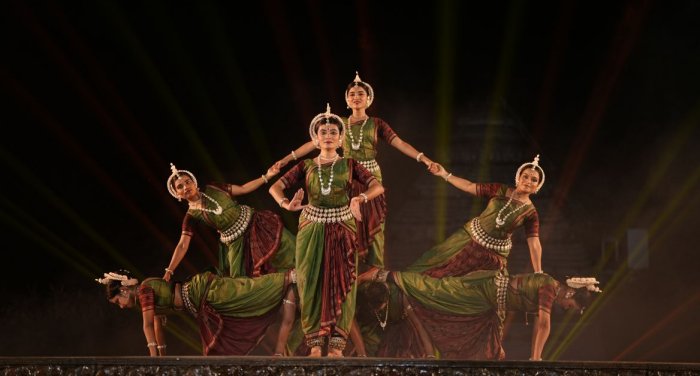 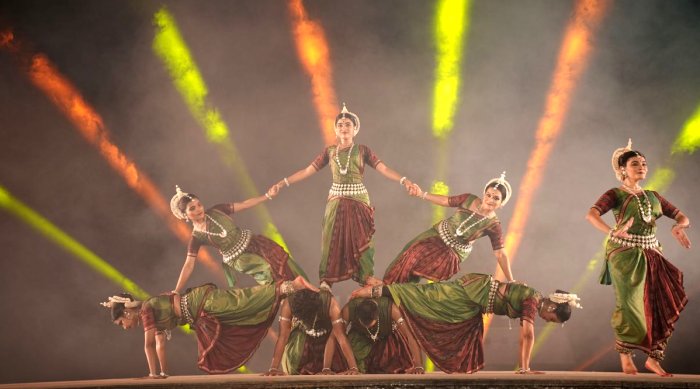 Srjan ensemble The best of Odissi came from established groups. Ratikant Mohapatra's Srjan ensemble's Adviteeyam saw an astonishing display of group aesthetics in what the choreographer calls his neo-classical explorations, where evolution harmonizes tradition with innovation. But is this not the way tradition always moves ahead? Acknowledging fully Ratikant Mohapatra's undoubted ability in visualizing and training groups for such large performance spaces, the question of the copyright of what one inherits from the guru, along with the music being changed, involves an altogether different discussion - which is not the concern in this writeup. Regarding the program itself, the exemplary togetherness in the impeccably turned out dancers and the amazing uniformity in movements and freezes, making the ensemble move almost like automatons, involved artistry of a level rarely seen. Visually, I have never seen anything to compare. The Ardhanariswar concept based on the Champeya gauranga shareera kaya sloka emphasizing the complementarity of opposites, with Shiva and Parvati enshrined in one entity, saw some of the most striking formations by the exquisitely trained group, with attitudes and facial expressions, even in the constantly changing images, conveying the requisite mood. Banda nritta group formations in some places were flawless in line. The recital comprised originally choreographed productions by Guru Kelucharan Mohapatra to Raghunath Panigrahi's music, now re-choreographed by Ratikant - like the 'jawab-sawal' of rhythm in Yugmagdhwanda set to raga Bageshri., which was the original masterpiece of Sanjukta Panigrahi performing to music by Raghunath Panigrahi. Then came the Oriya composition set to music by Bhubaneswar Misra, in Arabhi set to Ektali, Nachante Range Sri Hari, to the stunning finale Vande Soorya with Nityananda Mishra's poetry set to music by Agnimitra Behera. wherein the performance imaging the Sun God riding the chariot, given the lighting by Debiprasad Mishra, created a magical effect. Ratikant could hone his incredible ability for visualizing ensemble dancing by concentrating on a new set of compositions with original music. CREATIVE IMAGINATION 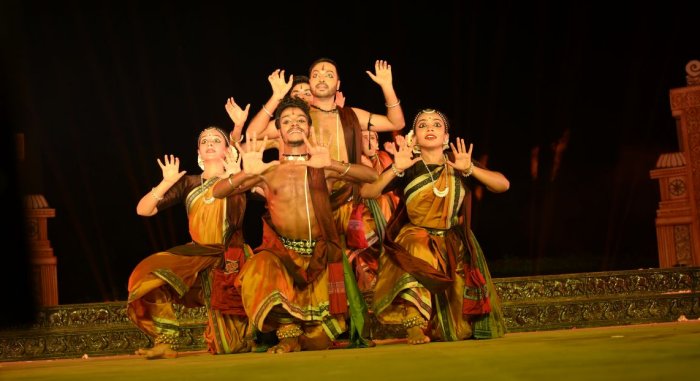 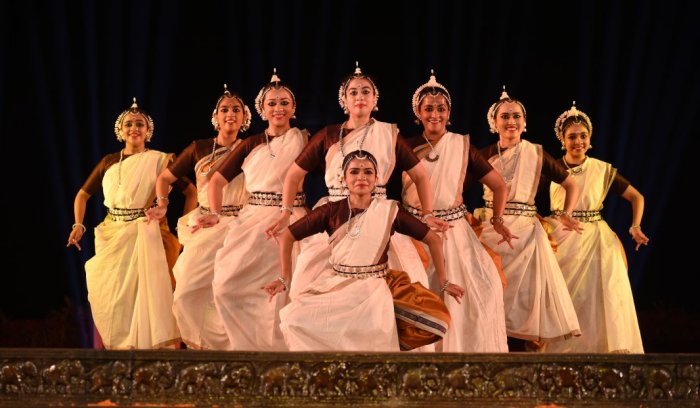 Sharmila Biswas group Known for her Odissi work evolving out of deep conviction and research, Sharmila Biswas as Artistic Director of Odissi Vision and Movement Centre, has never hesitated venturing into new areas, where most would fear to tread. The whole performance was built round the idea of how a system of movement evolves, to acquire a definitive character, to in course of time, get recognized as a separate dance form. The recital started with a visually powerful production Mahalakshmi Stotram, wherein the dance imagery of the Goddess holding Shankha, Chakra, Gada, Padma, was inspired by Patachitra paintings, shadow puppetry and sculptures, proving how ideas in various art forms feed one another. The accompaniment comprised muted musical chanting by Srijan Chatterjee set to Bijaya Kumar Barik's rhythmic inputs. The next item of Abartan-Bibartan, for this critic was the most challenging in terms of having a production exploring the idea of how rhythm is a natural part of every activity in life, with chhand and laya as a part of all action, even pounding rice. This rhythm, over a period of time, acquires a language of measurement comprising what has been called often 'nonsense syllables'. (dheidhi nakadhini dhei) or a simple takadhini nakadhini. Imagine youngsters playing gulli danda and along with the rhythm are movements of different parts of the body of torso, hands, types of jumps, and an entire body gait, which evolves as part of the rhythm of a language of a region and also its music. This accumulated specific characteristic of rhythm and movement with the grammar of stylization get codified as a separate dance genre. Sharmila's choreography based on music by Ramahari Das (again not in the full-throated Pallavi raga style) with Dhaneswar Swain's rhythmic inputs, was a fun loving display of how a distinct style of movement evolves to form a classical dance. Simple but elegantly turned out, the well-trained students gave of their best. (It was interesting when a couple of persons, not particularly well versed on what Odissi is, accosted me at the Yatri Nivas asking, “Was it not wrong to have stick play in Odissi? We don't use sticks as far as I know!”). The conclusion of the recital with Shrishti-Tatva illustrated how ancient wisdom and modern thought meet, when it comes to interpreting evolution. Jayadeva's celebration of evolution in the Gita Govinda, is surprisingly similar to Darwin's theory - of life first emerging in water, and then land in animal form, graduating to a form, half man and half animal, before proceeding to emerge as a stunted dwarf like human being- more savage at first like Parasurama to the final stage of thinking Man - an elevated being in the form of Buddha and Rama - the choreography by Sharmila based on Srjan Chatterjee's recitation base in matra/ chhanda style - with its own sonorous musical quality. Altogether, the production was a grace and fun filled unique display of how a dance form gets established! ELECTRIC BHARATANATYAM BY SHANKARANANDA KALAKSHETRA 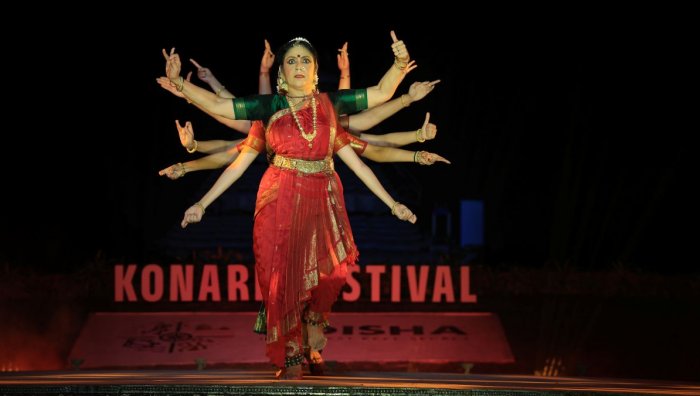 Ananda Shankar Jayant and ensemble The non Odissi half of the festival had a rousing start in the Nrityopahara Bharatanatyam recital by a group of impeccable dancers from Shankarananda Kalakshetra, the institution founded in 1979 in Hyderabad by Dr. Ananda Shankar Jayant, herself a versatile artiste groomed at Chennai's Kalakshetra. The programme began with a Telugu composition based on the Dashavataram -Takkuvemi Manaku by 17th century poet Bhakta Ramadas. If Jayadeva's Gita Govinda on the ten incarnations of Vishnu has Krishna (Keshava) as the central God, Ramadas' Bhagavan is Sri Rama. Sweta Prasad made for a melodious singer. Nattuvangam by Renuka Prasad with mridangam support by Balasubramaniam combined with excellent group coordination in the dancers, made the teermanams electrifying punctuation points between incarnations. With Sai Kumar on violin, Uma Venkateswarulu on flute and V. Sridharacharya on rhythms, the accompanying music was of a high standard. The next item Devi Upasakam based on Muthiah Bhagavatar's Daru Varnam in Kamas, Mathe Malayadhwaja Pandya Samjathe in praise of Goddess Meenakshi, was strung round the quintessential warrior princess who loses her heart to Lord Shiva. Embodiment of the primordial Omkara, she is extolled in the song as Shatodari, Chandrakaladari, Chamundeswari, Shankari and Gowri - repository of all the art. Seated in the esoteric Sri Chakra, Adi Shankara's Soundaryalahari, describes her as the eternal Shakti presiding over the energy centres. Ending this homage to the embodiment of female divinity, presiding over literally all facets of life on the right note, was the Aigiri Nandini hymn. The group visualization held audience attention right through. What better way to end this recital than with music and poetry expressed through the timeless beauty of Bharatanatyam rhythm in Shivoham dedicated to the Natana Sabhapathy himself - namely Nataraja, the king of dance. Worshipped as Gangadhara, Mahadeva, Mrityunjaya, Nilakantha, Parameswar, et al, he represents primal rhythmic energy as Nataraj- for whom the theatre of dance is the cosmos itself, set in motion through his dance. Led by Guru Ananda Shankar Jayant's choreographic imagination, the work successfully evoked the esoteric feel of the rhythm and life breath of the universe being set in motion by Har Har Mahadeva. KUCHIPUDI BY VYJAYANTHI KASHI'S SHAMBHAVI SCHOOL OF DANCE 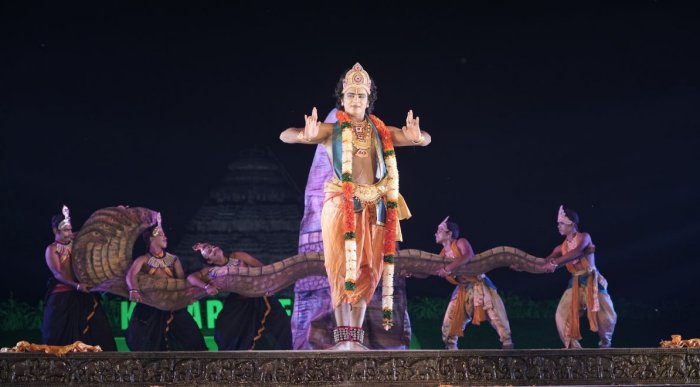 Shambhavi ensemble Vyjayanthi Kashi with her Shambhavi School of Dance in Bangalore, founded in 1993, has been a force to reckon with in Kuchipudi, though in recent years, one has seen less of her work. The recital of the group Dharmayana, based on a script by Dr.Shatavadhani R.Ganesh, with music composed by D.V.S Sastry and concept, choreography and direction by Vyjayanthi Kashi, concerned the manifestations of Lord Vishnu (Dashavatar) to preserve the principles of Dharma or Justice restoring the supremacy of right conduct and thinking. The constant churning of the ocean in Koormavataram for ambrosia to enable the Gods to regain their ability to overcome the demons, is seen as a metaphor for the churning which goes on eternally in the human mind, in the never ending good and evil struggle - between wrong and righteousness. Starting with the prayer song in Kuchipudi Amba Paraku Devi Paraku followed by the ritual cleansing of the performance arena with a sprinkling of water, the ragamalika composition Ksheerasagarashayana (Vishnu lying on his serpent bed in the ocean) the accent was on the Koormavataram with apsara Mohini rising from the ocean bed, succeeding in artfully deceiving the Asuras by distributing the churned ambrosia solely among the devas. Below par music made for a performance below expectations. Live music, a feature of the festival, in the open air setting, can pose challenges in sound management, apart from the fact of musicians of quality with busy schedules insisting on air travel. It is keeping this fact in view that monetary compensation for each group, in this festival is far above what other States offer. One male and one female singer, with a percussionist and one instrumentalist are a must, at any given time for a group performance. Vyjayanthi Kashi's music ensemble, barring one male singer with her conducting, doing the nattuvangam, seemed to have musicians, who were all from Odisha. A single practice session for the group from outside Odisha, after the day's performance is over, to enable familiarizing the artistes with the spacious stage, cannot accommodate the luxury of local singers, being put through their paces to fully grasp their part in the entire music arrangement. Music forms a distinctive aspect of every dance. While musicians of the calibre of violinist Agnimitra Behera and flautist Srinibas Satpathy are certainly well versed in classical raga music, the style / character of Odissi music is very different from that of Carnatic Kuchipudi music. Taking a female singer from Odisha with below par singing in a false voice to boot, made the changeover from the male Kuchipudi singer to the female voice, a disaster. Even the dancing would have benefited it seemed with more rehearsals, for despite trained dancers, it needed more of ensemble understanding, to enhance group aesthetics. KATHAKALI UNDER OPEN SKIES SANS ELABORATION 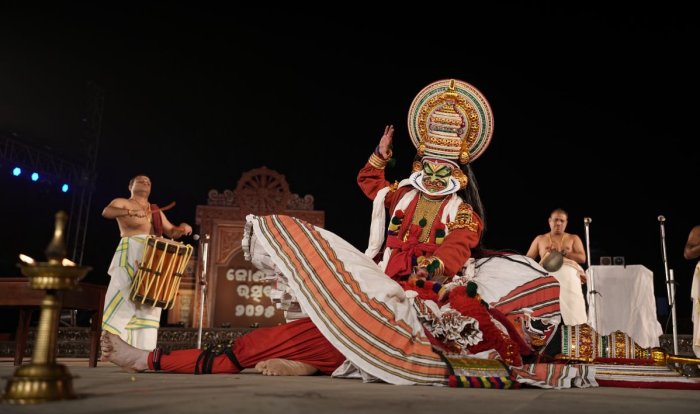 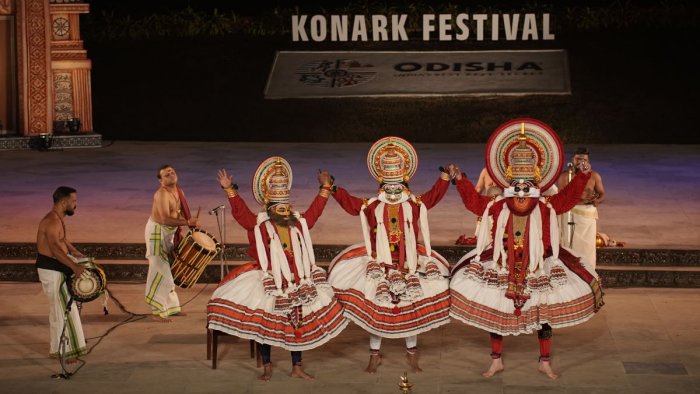 Kerala Kalamandalam Regarded as a dance drama form more suited to viewing in a closed auditorium space, with its accent at any point in a performance resting on emotion conveyed through the minutest of facial expressions, with every part of the face speaking, Kathakali, by none other than Kerala's Kalamandalam, this year made an appearance on the large Konark stage. Given three levels of stage space open to the skies, and the wide spread of a mixed audience seated in a gradient in front, Kalamandalam's choice was an action oriented play Duryodhana Vadha by Vayaskara Aryan Narayanan Moosad (1841-1902), built round pivotal moments in the Mahabharata. Duryodhana's ambition, arrogance and jealousy of the Pandavas, the dice play in the Kaurava court plotted by Shakuni to dispossess the Pandavas of their kingdom, Dushasana's unspeakable attempt at shaming Draupadi, dragging her by the hair and attempting to disrobe her, and Bhima's oath to avenge the act by killing Dushasana and anointing Draupadi's loose hair with his blood before she again put it up into a knot were all acts of high profile. But within the allotted time slot of a few minutes over an hour, the essence of Kathakali acting which lies in elaboration, suffered. The magnificent costumes made the characters stand out though - actor Dr.Sudeep Mohan in the pacha of Dharmaputra, Kalamandalam Ravi Kumar as Duryodhana (as a Kathi character with the bulbous nose as also Kalamandalam Sooraj as the cunning Shakuni, Kalamandalam Hari R.Nair, a Chuvanna Tadi character as Dushasana with his red beard, and Kalamandalam Anil Kumar as Draupadi in the only minukku role, and Shanmukhadas as Raudra Bhima in the final scene, there was plenty of variety to engage audience attention. But the dice play scene had to be hurried and Padams like Draupadi's appeal to Sri Krishna, Paripahimaam hare... sung with deep feeling by Kalamandalam Vinod Kumar and Kalamandalam Viswas, in the typical sopanam type of slow singing of Kathakali, asking how long her hair will remain untied with the Kauravas remaining unpunished, which forms the crème de la creme of abhinaya in Kathakali, did not have the indulgence of time - to expand on the sancharis. The finale was with the awesome sight of Raudra Bhima tugging at the entrails of the grounded Dushasana he has overpowered, with Krishna finally appearing to appease his rage and savage spirit, restoring him to his original state. In the time space available, and quite different from percussion instruments of other dance forms, the chenda by Kalamandalam Venumohan and maddalam by Kalamandalam Haridasan attracted audience curiosity. LYRICISM AND GRACE OF MANIPURI NARTANALAYA 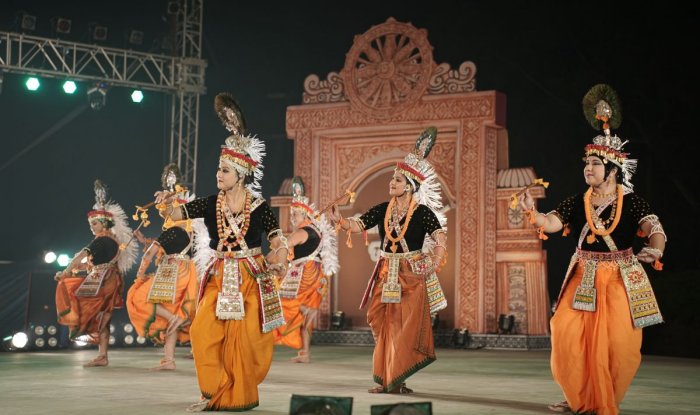 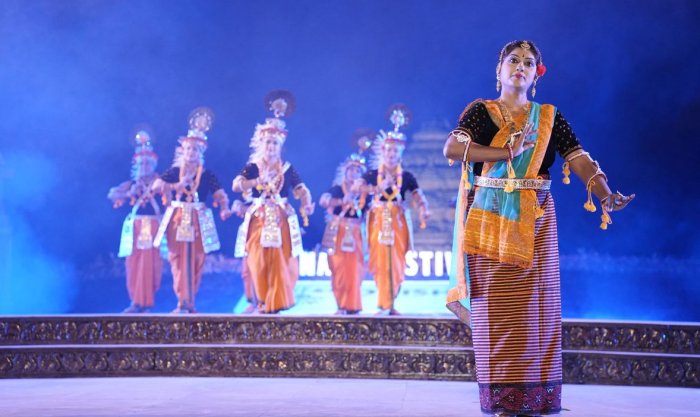 Manipuri Nartanalaya Trained under her parents late Guru Bipin Singh and Kalavati Devi, talented Bimbavati Devi, with her initiation into Pung playing, and training in the basics of Manipur's martial art Thang Ta, has been equipped with all that it takes to be a complete Manipuri dancer. What impressed in the presentation by her institution Manipur Nartanalaya was how quietude and lyrical softness in movement could arrest and hold audience attention on such a vast performance space. Traditionally performed in the temples of Manipur during the month of Kartik when Krishna and the sakhas are believed to go to the meadows to tame cattle, an essential part of Vaishnavite worship in Manipur, comprising its ritualistic dance and music is Goshtaleela (Sensenbei in Meitei), built round young Krishna's fight against evil forces like Bakasura, Pootana. While late Guru Bipin Singh's choreography of Goshtaleela was meant for, and is performed by youngsters, Bimbavati Devi's choreography of leelakamal with the adult performer in mind, is inspired by traditional songs and ritual of Goshtaleela, and excerpts of songs (to quote Bimbavati Devi herself) from Natasankirtana and a variety of Vaishnavite texts like Achintyashakti Samparnna sa Krishna Karunamaya. All the episodes attacking boy Krishna were dealt with in quick bites, with that of Bakasura (brother of Pootana, disguised as a giant crane attacked Krishna, only to be destroyed) depicted with four large Emu like birds represented by masked dancers, pitting their forces against Krishna, only to be overpowered, the accent being more on Bakasur Moksh than Bakasur Vadh, with the demon meeting his end through the hands of the Almighty himself. It was Manipuri with a refined aesthetic sense even in the depiction of malefic forces. The melodious singers S. Promila Devi and Romila Devi with that distinctive use of microtones, so distinctive to Manipuri music with yodels and trills, added so much to the emotive content of action along with Sanat Adhikary and Partha Sil on violin and flute respectively and to end the entire presentation was a short and crisp Pung playing by drummers S. Tomba Singh and K. Kendra Singh. TAME KATHAK FINALE 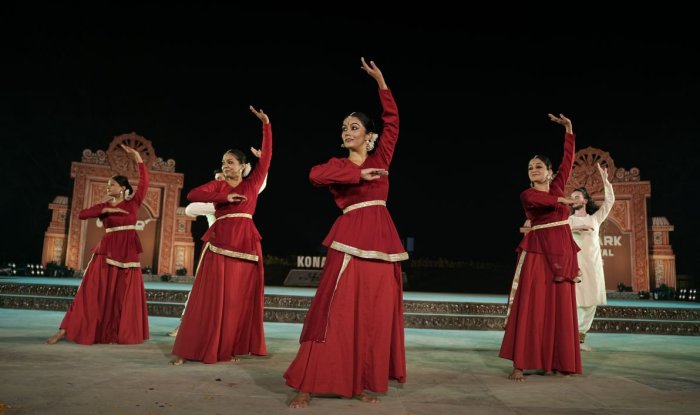 Sanjukta Sinha Dance Company Much was expected of the Sanjukta Sinha Dance Company, which only a month earlier had presented a delightful programme at Delhi's Kamani auditorium. Caught in the Indigo imbroglio they faced the inconvenience of their travel plans getting disturbed - with members travelling by air arriving in singles and twos from different places. The return also, for those booked for air travel had to be changed to travel by Vande Bharat train. As an example of Diversion in Unison, their program Adi Anant sought to highlight contrasting characters of cosmic energies of Shiva and Krishna, differences in the character of stylistic accents of the Lucknow and the Jaipur gharanas of Kathak, along with the two faces of solo and group Kathak aesthetics, in one program. Kathak dancers in particular, seem to find it difficult to stick to a group performance, which is what the Konark stage is designed for. A solo dancer at the mike, reciting a tukra, and exhibiting the virtuosity of peir ka kaam and chakkars is fine in a closed auditorium. There was nothing sub-standard about the two male soloists representing Jaipur gharana, except that presenting a dialogue between rhythm and grace, power and poise, tradition and innovation (to quote their own description in the brochure) through group aesthetics, should have formed the main production challenge, for an artiste creating a program for the Konark festival. With only a little over an hour allotted to each group, the percussion of Mohit and Ashish Gangani on tabla and pakhawaj, was over drawn. With the two tall male dancers representing two gharanas, and Sanjukta in the center chiming in with her own nritta punctuation, much over half the program comprised solo representation. Thaat, Amad are fine for the closed auditorium. The vast empty stage space came alive only in the representational part with Krishnaleela, the group participation showing Radhika and the gopis. While there was little of exceptional quality about the dancers in the group, the singing too lacked emotive involvement. Sanjukta's costume with footwork not showing adequately, has been commented upon on earlier occasions. To no avail. Sadly, the standards of performance witnessed in Kamani by the group were missing and it was a tame finish for the festival. 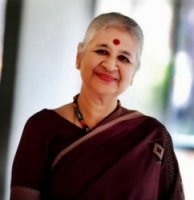 Writing on the dance scene for the last forty years, Leela Venkataraman's incisive comments on performances of all dance forms, participation in dance discussions both in India and abroad, and as a regular contributor to Hindu Friday Review, journals like Sruti and Nartanam, makes her voice respected for its balanced critiquing. She is the author of several books like Indian Classical dance: Tradition in Transition, Classical Dance in India and Indian Classical dance: The Renaissance and Beyond. Post your comments Please provide your name along with your comment. All appropriate comments posted with name in the blog will also be featured in the site. |
