
|     |
|
| |

 e-mail: leelakaverivenkat@gmail.com Impressive dance recitals across DelhiDecember 3, 2025 WINSOME ODISSI AND KATHAK FEATURED IN BHARATIYA VIDYA BHAVAN'S 17TH SANGEET SAMAROH Photos courtesy: BVB It was the sensuous grace of Odissi and the sparkle and vivacity of Kathak for regaling the audience at the Kamani during the evening hosted by the Bharatiya Vidya Bhavan for its 17th Sangeet Samaroh. Titled Bhava and Bhakti, Madhulita Mohapatra, with her thriving school Nrityantar in Bangalore, has proven over the years that her Odissi, imbibed under several teachers, the seniormost being late Guru Gangadhar Pradhan followed by Guru Aruna Mohanty, Pabitra Kumar Pradhan and Guru Krishnachandra Sahoo, has not been in vain. 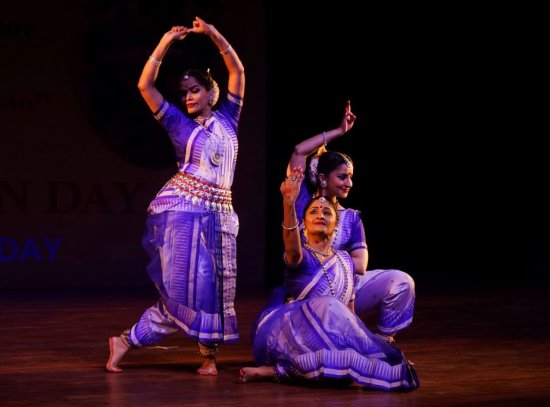 Madhulita Mohapatra, Sahana R Maiya & Paridhi Joshi The finished presentation, abounding in the sensual grace of movements rendered by a trim-bodied, supremely graceful trio of performers, comprising Madhulita accompanied by her students Sahana R. Maiya and Paridhi Joshi, had the onlookers engrossed in the involved presentation. The dancers turned out in the tastefully simple costume in Orissan fabric with its eye-catching purple motifs on a white base, made for a striking image every time they entered the stage from the wings. Watching the impeccably held chauka, and the delightful tribhanga, along with the complete control over rhythm and taal, what also held the audience enthralled were the frozen moments with the dancers grouped in elegant cameos. Madhulita entered the stage solo, in a prayer to Jagannath, after which came the Pallavi in Malhar with its Tarita jena start set to Ektali, the ensemble discipline of the trio was highly commendable. The abhinaya part with the Ashtapadi Ramate pulinavane vijayiradhuna, in raga Piloo, musically set by late Subhas Pani, and choreographed by Madhulita's guru Aruna Mohanty, portrays Radha, in the haunted loneliness of unrequited love, reliving in her mind's eye Krishna making love to different nayika. The presentation with the very next Ashtapadi "Radha vadana viloka," showing Radha blossoming like the fully open Lotus, under Krishna's love depicted a total mood change. What one appreciated in the performance was the manner in which Madhulita as Radha with Sahana R. Maiya as Krishna, dealt with the heavily erotic imagery of the two Ashtapadis, through an aesthetically restrained interpretation, using suggestion through the language of mudras to communicate. 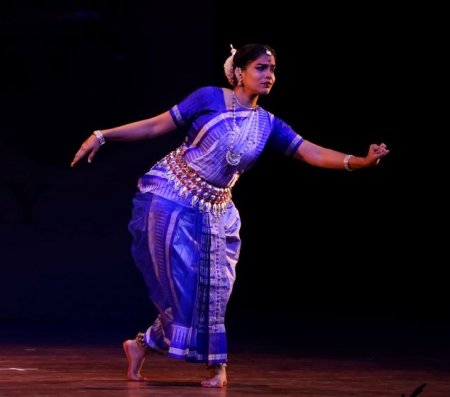 Madhulita Mohapatra Finally in the typical reaching out to audiences of Bangalore where Madhulita is based, came a Kannada composition by Purandhara Dasa, "Hari smarana mado." Set in a Ragamalika by Vijay Kumar Jena, with rhythmic interludes by Bijay Kumar Barik, the dance interpretation by Madhulita - in the dance theatre mode - comprised the dramatic episodes of Vishnu as Narasimha appearing from within the pillar to tear the entrails of Hiranyakashipu to save young devotee Bhakta Prahalad, of Indra's elephant Gajendra being saved from the Jaws of the crocodile and of Draupadi, in the Kaurava palace saved from the indignity of being disrobed, by Krishna blessing her with an endless saree. The dancers clearly enjoyed the more in-the-face dance drama like presentation in performance tone. SPIRITED KATHAK 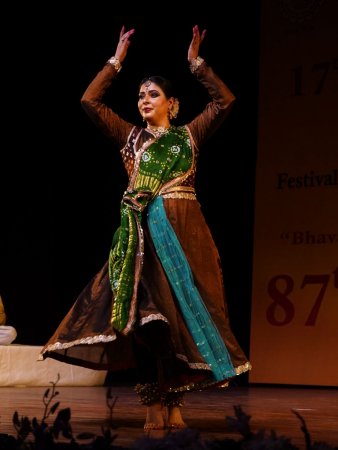 Vidha Lal (Photo courtesy: BVB) Dancing with supreme confidence, Kathak dancer Vidha Lal has matured considerably during the last five years. One of Geetanjali Lal's most acclaimed students of the day, she was accompanied by competent musical support in vocalist Suheb Hassan, and Amir Khan on the sarangi, with the special fillip in the percussive support provided by Hiren Chate on the tabla and Ashish Gangani on the pakhawaj. Starting with a special word of thanks to the Guru as the Moksha Moolam Guru Prabho, the dancer's invocatory item was devoted to cosmic dancer Shiva, representing cosmic activity of Shristi, Sthiti and Samhara with his specific accoutrements like Ganga in his locks, snake garlanding his neck, damaru in hand etc. Images of Raas during Sharad Poornima, with Krishna dancing with the Gopis (Mohan raas rachave), pranks of the heart stealer (hriday churayo) of the Rasika Bihari, who deftly stones pots carried by the Gopis to watch in merriment as the pot breaks. Comprising Toda, Gat Nikas, Kavits Gat bhav, Uthan, Gopuch, Chalan, it was all vintage Jaipur gharana which the dancer represents, flowing in a smooth fashion. Vidha Lal's presentation, comprising foot sure rhythm, flawless ang and chakkars executed with ease, in complete balance, combined with an interpretative ability which communicates effectively, add up to a rounded ability. With maturity her dress sense too has gained an aesthetic feel, different from the originally over ornate appearance. Altogether a creditable performance! Very fittingly, in a festival dedicated to the memory of late tabla maestro Zakir Hussain, with performances by two accomplished dancers, the choice of Dr. A Kanyakumari, the Carnatic violinist, for the Bhavan's Sangita award for this year, was a fine choice. A Padmashri, A. Kanyakumari, trained under Ivaturi Vijeswara, M. Chandrasekharan and M.L. Vasanthakumari, is the first woman Sangita Kalanidhi. Perhaps a short biodata in the Bhavan brochure, would have helped even the dignitaries who did not have enough information on her - and a predominantly North Indian audience with very little knowledge on the real achievements of A. Kanyakumari, would have accorded a more hearty applause than the polite claps, greeting her awards ceremony. Finally in humble support of performance/auchittya, may one suggest that the tea/coffee and refreshment hospitality, (undoubtedly an important part of the hosting) for the dignitaries seated in the first row, be conducted in one corner of the spacious Kamani foyer, set apart for this, before their being escorted to the auditorium? While the show is on, tall standing figures moving back and forth, in front serving the guests, hiding parts of the stage while the performance is on, makes viewing inconvenient for the audience seated beyond the second row. DOUBLE DELIGHT IN DOUBLE BILL CONCERT It was a rewarding experience to watch two deserving dancers in IIC's Double Bill Concert, at Deshmukh auditorium, representing Odissi and Mohiniattam respectively. After quite some time, one was treated to an Odissi performer belonging to the style of late Guru Debaprasad Das, whose unique vision of Odissi combined the sanctity of the temple traditions in Odisha, with the vibrancy of the folk - the latter representing for the Guru, the life force and emotive throb of a dance culture. Debaprasad's loyal student Guru Shrinath Raut was the first teacher to propagate his Guru's style in Delhi - his unfortunate, accidental death at a young age, leaving students rudderless. Continuing in the Debaprasad style, students continued training under Debaprasad's disciples like Durga Charan Ranbir. Among the most worthy of Shrinath Raut's disciples was Dr. Jyoti Shrivastava, in whose school, Vaishali Kendra, the dancer of the evening at the IIC, Khyati Rawat, has been groomed. 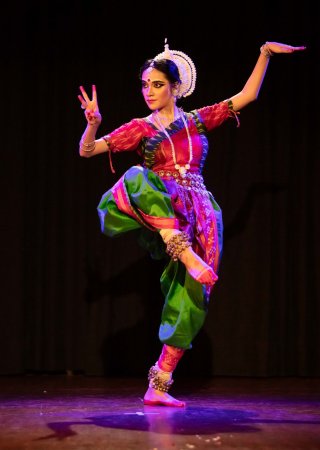 Khyati Rawat (Photo: Sanjit Debroy) The impression of a graceful presence began as soon as Khyati entered the stage, with the traditional Mangalacharan wherein the Stuti part, after Bhumi Pranaam, was based on Adi Shankara's Krishnashtakam - paying homage to the cowherd, in headdress with the peacock feather, the Protector and dissolver of darkness and usherer of light. As the dancer moved into Sabhinaya Pallavi set to raga Kalavati in Ektali, the faithfully preserved Debaprasad lineage was obvious. Knitted into the Pallavi is the interpretative segment based on the composition "Sanginire chaha" by Banamali Das, the delightful arasa, in this composition long with the Sakhi's mesmerized delight, drawing the attention of her friends to the beauty of what she is seeing -'Feast your eyes' she says on that wondrous spectacle - pointing to what appears to her to be none other than Krishna in all his finery and the garland of flowers like the Bakula. In a contrasting mood of unrequited love was the Ashtapadi "Rase Harimiha vilita vilasam" for which the music composition was by Balakrushna Das. A forlorn Radha reliving in her mind's eyes, the image of Krishna dancing with several gopis "Sanchara dhadhara sudhamadhura dhwani," wherein Radha describes the picture of dancing Krishna's arms twirled like creepers round waists of several damsels (Vipula pulaka bhuja pallava valayita ballav yuvati sahasram). In a contrasting mood of high energy was the next item (marking the finale) Ashta Shambho, Guru Debaprasad's acclaimed dance creation visualizing Shiva in contrasting moods - serene and benevolent on the one hand and highly charged and fiery on the other. These eight divine aspects culminating in the aspect of Shiva as Ardhanariswara, set in Ektali and triputa taal, are set to a Ragamalika musical composition in raag Malkauns, Chandrakos, Darbari and Bhopal, the original choreography of Guru Debaprasad Das done to music by Bankim Sethi, reconstructed by late Guru Shrinath Raut with Saroj Mahanti's vocal support and percussion on mardala provided by Pradeep Maharana. While scenes of Shiva, disturbed in his penance, reducing Kamadev to ashes, show one aspect of the God, one has a glimpse of the lord, almost insane with grief and anger, strutting around with the body of his wife Sati who has consigned herself to flames in the Yagna presided over by her father Daksha, for his insult in not inviting her husband Shiva. As one who swallows the halahal poison spewing from the breath of Vasuki while the ocean is being churned by the Gods and the demons, the God is the embodiment of calm. He is also the Lord of Dance, whose movements set the Universe in action. From what one could glean from Khayati's first solo Odissi recital, given her serene and graceful presence, and quietly communicative expressions, this dancer is a credit to her teacher Jyoti Shrivastava, with a promising future. DELIGHTFUL MOHINIATTAM 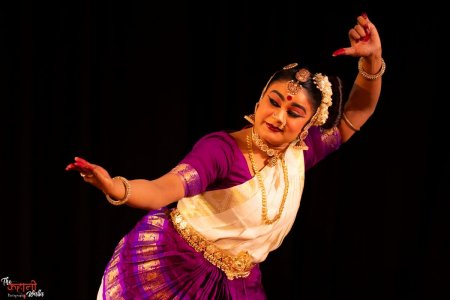 Vishnupriya Marar (Photo: The Kahani Walla) The second dancer of the evening, Vishnupriya Marar, delighted the audience with her proficiency, the chaste and flawless quality of her Mohiniattam acquired with training connected with two reputed sources - Kerala Kalamandalam and now specialist Dr. Neena Prasad. The start with the cholkettu set to ragam Kedaragowla and adi talam, straight away established the micro perfections of the savoured, leisurely pace and grace characterized by clarity in every eye glance, andolika, torso and hand movement. The varnam "Kamita Varadayaka" in raga Sri, a composition of Thrissur Janardhanan, is one of the less known varnams performed in Mohiniattam, whose traditionally unalloyed allegiance to a totally lasya oriented form, has been very wary of the Shiva theme, more attributed in mind to masculine vigour negating the very ethos of the feminine dance form. Just like Neena Prasad, known for her penchant for injecting new ideas into Mohiniattam without hurting its feminine allure, to have convinced even her own Guru Leelamma, about not shying away from a bolder, open-minded approach to the dance. This varnam takes an episodic form in extolling Shiva - through narratives associated with Shiva - starting with the Pallavi wherein Arjuna in deep penance for Shiva is tested by the Lord, who appears in the form of demon Mura and Arjuna during the bow and arrow battle against, recognizing it is Shiva in the form of Mura, lays down arms, and is granted the Pashupata Astra by the pleased God. In the Anupallavi, Parvati in deep worship of the Lord, is tested by Shiva, disguised as an old man dissuading her from enslaving herself to such an idiosyncratic entity. But when Parvati, refuses to be put off by these unflattering words, Shiva accepts her true love and accepts her for wife. In the final charanam part is Shiva as Garulakantha, swallowing the halahal poison spewing from the breath of Vasuki, used as the coiled rope for churning the ocean for ambrosia. The dancer concluded with a Tillana in raag Revati. KAMADAHANAM KOODIYATTAM BY MARGI MADHU An active IIC programs calendar in quick succession presented Margi Madhu in a Koodiyattam performance Kamadahanam. Imagine my surprise, when the audience, not exceeding modest numbers, even for reputed dance programs, had more than three quarters of the seats occupied, even before the show had started - and for a highly esoteric form like Koodiyattam, part of 'India's oral and intangible heritage'! That Margi Madhu's performance had cast a spell even on the ignoramus was seen from a group of persons asking, post performance, as to what that percussion instrument 'made of copper with a strangely different sound' was called! The play Kamadahanam (Immolation of Kama), a segment taken from the full-length play Mattavilasam by Mahendravarman, starts with the Sutradhar's summary in the manner of old Sanskrit theatre, about how angry Shiva, disturbed in his penance, burns Manmatha, the love God, to ashes with the fire emanating from his open third eye. The verses used in the performance are taken from Kalidasa's Kumarasambhava. Demoness Taraka's violence prompts Indra to seek the help of Brahma who, in turn, advises that love God Kama's help be procured in persuading Shiva to marry Parvati, the daughter of Himavan. Kamadev arriving at Shiva's home in Kailash, where Nandikeswara with golden cane in hand, guarding Shiva doing penance at the base of a devadaru tree in his abode, is seen admonishing Siva's 'bhuta ganas' to behave. Kama's love arrows, meanwhile, having awakened the world to the romance of love, all creatures on Earth are expressing their desire in various ways. But to facilitate the Lord's penance, Nandikeswara orders the forest to come to a standstill. On informing Shiva of Parvati's arrival at the ashram with offerings of prayer, the Lord with flicker of eyebrow gives permission. Sensing his best chance, Kamadeva cowed in the presence of Shiva, aims his love arrow at Shiva, who, disturbed in deep penance, opens his third eye, and in one look reduces Kamadev to ashes. 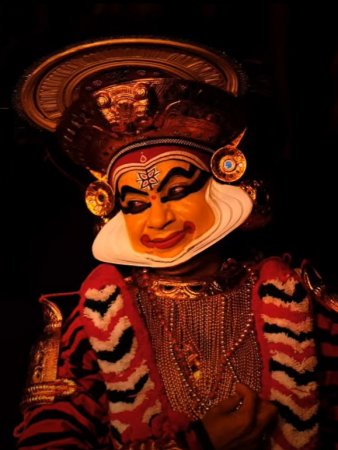 Margi Madhu Sole actor Margi Madhu Chakyar, in the seated position right through, communicating the ideas of a swaying tree, humming bees, cooing birds and animals, held the audience in awe with the manner in which his facial muscles worked, the quivering cheek muscles depicting the bees sucking honey from the flower, or showing the deer stroking the doe, and the manner in which the accompanying percussion on the copper kettle drum the mizhavu, wielded by Kalamandalam Manikandan and Nepathya's Jinesh suggested these acts through the language of rhythm, nothing short of a miracle. Edakka was played by Kalamandalam Rajan and wielding the cymbals (thalam) was Dr. Indu G, who also recited the slokas in the typical raga of Koodiyattam. Not a person (a child of about three was also seen) stirred - and the standing ovation at the end, saw applause that seemed almost endless. The sole remnant of old Sanskrit Theatre, Koodiyattam accorded a special status as masterpiece of oral and intangible heritage by UNESCO, is existing under difficult circumstances. Sheer commitment of the followers has kept the art alive. YOUNGSTERS PERFORM TO THE MAGICAL SHEEN OF NEW IDEAS Tucked away in the interiors of Chatrapur near Delhi, one wanders through cobbled sidewalks to the interiors of a shopping plaza of fashion boutiques, to a modest, inner, intimate space - the OddBird Theatre - being used now for a lot of experimental work - which in the larger auditorium spaces finds crucial performer/audience communication difficult. It is this performance space with galleried seating for a small number of watchers, that Aditi Mangaldas is utilizing more and more for rehearsing new work, and to facilitate artist/audience dialogue. As part of the Living Legacy Project by Aditi Mangaldas, the Zeroing in series of performances, staged in OddBird Theatre with the laudable aim of inviting, presenting and commissioning the work of exceptionally talented youngsters, has been attracting a small, steadily swelling, well-informed audience for witnessing and discussing these works. SOMA CATCHES THE MAGIC OF A MOONLIT NIGHT 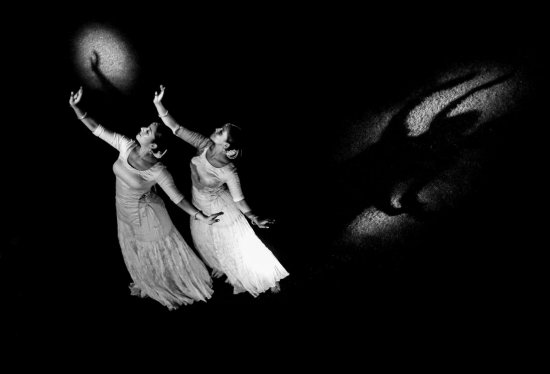 Aamrapali Bhandari & Deepannita Sarkar (Photo: Vivek Sagar) Aamrapali Bhandari, a much travelled, highly creative Kathak performer, trained under Rajendra Gangani, Aditi Mangaldas and the Drishtikon Company and selected in 2019 for the Akram Khan Company Classical Intensive in London, teamed up with another Kathak colleague, Deepannita Sarkar, who after training under Guru Suman Chowdhary, Shikha Khare, Ram Mohan Maharaj, Anukriti Viswakarma and Pt Jaikishan Maharaj is now under Aditi Mangaldas of Drishtikon Dance Company, to create Soma, woven round the magic of a moonlit night. If the pure dance zest of the dancers had an appreciable quality of excellence, the shared emotion, with the words of poet Faiz Ahmad Faiz, "Yoon, sadaa chaand ke jhalke tere andaz ka rang," providing the poetic backdrop for interpretative excellence, saw the twosome equally skilled. What is the quality of that enchantment, when romance acquires that special edge, when every glance, a touch, the complexion of the skin of one's lover, a kiss, acquires an added quality of emotional intensity with the simplest of sounds acquiring a musical lilt. Two dancers under the moonlit sky, drunk not with alcohol, but with the rapture of the romance spelt by the shining silver orb in the sky, share a closeness, not just physical but emotional. Musicians like Faraz Ahmed's vocal and harmonium, Ashish Gangani on pakhawaj, Anurag Jha on the tabla and Harendra Bhushan for padhant, were completely in tune with the dancers. While the two dancers had worked out the choreography between themselves, the creative direction by Meher Bhandari and creative input by Gaurav Shridhar must have helped the punctuating of the performance in a way where the crescendos followed by the calmer phases ensured a balancing of moods - very important in a performance. Tastefully attired in white, very romantic under the lighting catching the mood of a moonlit sky, it was from all accounts a creditable performance. 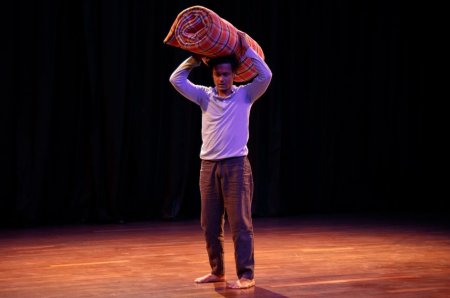 Prashant More (Photo: Vivek Sagar) The second half of the evening, in a Contemporary Dance performance, presented dancer Prashant More based in Goa, who, graduating from Bangalore's Attakkalari Centre, has participated in festivals in U.K., Hong Kong, South Africa etc. It made an interesting contrast, going from stylized movement of a classical form to a work built on everyday movements of life as lived. The work 3 A.M., projected an insomniac character. With sleep totally deserting him, even as an exhausted mind and body are struggling in a space between dreams and wakefulness, the dancer's moves, with wry humour, catch the sleeping mattress and man in a droll relationship - with the bedding more often carried or wrapped round his body than providing the resting place for the weary man. The wall clock is almost an irony for its beat of time makes little sense. The creative effort with music by Nikhil Nagaraj and Deepak Kurki Shivaswamy as dramaturg, saw movement in spurts of restlessness, shifting to various parts of space on the stage. OBEISANCE TO THE GURU 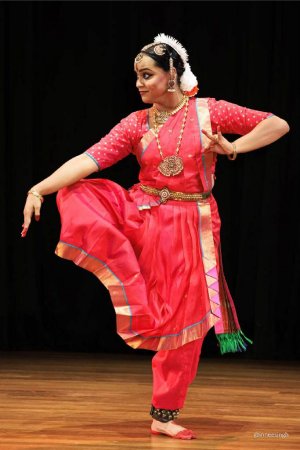 Devikaa Rajaraman (Photo: Innee Singh) Once again, it was a student of Geeta Chandran, Devikaa Rajaraman taking the stage in a Bharatanatyam performance, this time in the Chinmaya Mission Auditorium, with the excellent team of musicians Natya Vriksha is known to work with - viz Venkateshwaran Kuppuswamy (vocals), Manohar Balatchandirane (mridangam), G. Raghavendra Prasad (violin,) led by Guru Geeta Chandran's choreography and assertive nattuvangam. The specialty of the program lay in the thematic package conceived by the dancer's husband Balakrishnan - with the Margam items assembled - as a salute to the Guru, who in life can take the form of various manifestations. Knitting the items together with his fine compering, Balakrishnan began with the shloka to the Guru, recited across the board by all students of classical dance - "Gurur Brahma, gurur Vishnu, Guru Devo Maheswaraha, Gurur saakshat parar Brahma tasmai Sri Gurave Namah" - wherein Godhead is vested in the Guru who is equal to the Trimurti. Many among us have also heard the saying from the Guru Geeta, "Dhyana moolam gurur moorti, Poojamoolam Guroha Padam, Mantramoolam Gururvakyam, Moksha moolam gururkripa," wherein the Guru is regarded as the very form of meditation or object upon which to meditate, as a path to special enlightenment and liberation from ignorance. The guru's directions begin in Bharatanatyam with the Alarippu, wherein the body is taught to become aware of disciplined movements, opening out, like consciousness - in this case set to the rhythmic gait of two dritams plus 1 guru, as composed by mridangist Manohar Balatchandirane. The child's first Guru are the parents - particularly the mother who has given birth and feeds the child. The thoughtful Varnam selection, fitting in with the title of the program, "Annaiye maravenadi anudinamum," is a creation of Guru Dandayudapani Pillai, who was most conscious of the need for a repertoire meant for the young learner, unable to experience or cope with adult emotions, who is made to struggle in the Margam repertoire with the interpretation of Bhakti or Sringar in a varnam. Another sentence in the sahitya says, "tandhai sol mikka mandiramillai yadi" (there is no religious diktat going beyond a father's words). Apart from the clean technique, the dancer's footwork, particularly in executing the teermanams, contained the right accenting of certain syllables, thereby providing the right emphasis to the nritta sequence. The next item showed how Lord Rama himself had to follow the command of the Guru, overcoming hesitation in killing a female, which went against his code of conduct, by killing Thataka the demoness - as ordered by his Guru Viswamitra. The music for this was composed by Sikkil Gurucharan in the form of a ragamalika. In the Gita Govinda, Radha's sakhi becomes the Guru, advising her companion to give up nursing feelings of betrayal at Krishna failing to keep his word. In the Ashtapadi "Madhave ma kuru manini manamaye" she advises her friend, "Don't turn wounded pride on Madhava waiting for you in passion - Remember he is proud too, sullen Radha" persuading Radha to shed her sense of betrayal by meeting Krishna half way in the place where he waits for her to join him. The music for this was composed by Sudha Raghunathan. To conclude the thanksgiving to the Guru, was the Pallavi in Dwijavanti, wherein the final salutation is to Kartikeya, who became the teacher instructing his mighty father Shiva, on the secret of the Pranava Mantra 'Om'. 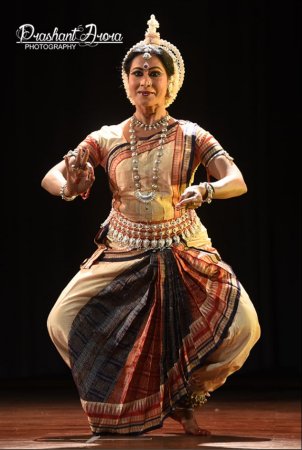 Sujata Mohapatra On a concluding note, watching Odissi rendered by a surprisingly unchanged Sujatha Mohapatra, after the gap of quite a few years at Gurgaon's Epicenter, from Mangalachran with homage to Jagannatha swamy, to Yugmagdwanda Pallavi in Bageshri, to the Ashtapadi "Keshi Mathanam Udaram" to the famous Salabeg composition "Ahe neela sailo," with not a punctuation changed from what her father-in-law late Kelucharan Mohapatra had taught her, drawing huge applause from the audience, one wondered what all the talk about needing change was! Does one appreciate the guru whose works even today have remained as popular, or a dancer who over the years dances with complete conviction that what she imbibed from him (which she is faithfully passing on to all her students) stands for eternity! 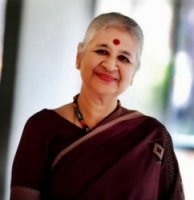 Writing on the dance scene for the last forty years, Leela Venkataraman's incisive comments on performances of all dance forms, participation in dance discussions both in India and abroad, and as a regular contributor to Hindu Friday Review, journals like Sruti and Nartanam, makes her voice respected for its balanced critiquing. She is the author of several books like Indian Classical dance: Tradition in Transition, Classical Dance in India and Indian Classical dance: The Renaissance and Beyond. Response * Namaste. This refers to the review of Odissi at Bhavans Sangeet Samaroh, Delhi, featuring Madhulita. The Fest was dedicated as homage to Ust Zakir Hussain. The observations about inadequate publicity to the BVB Shikhar Samman Awardee and the inappropriateness of serving coffee to front row dignitaries inside the auditorium is spot on. - CS Panchamakesan (Dec 3, 2025) Post your comments Please provide your name along with your comment. All appropriate comments posted with name in the blog will also be featured in the site. |
