
|     |
|
| |

 e-mail: leelakaverivenkat@gmail.com Bhagyam Arts and Ideas recalls pages of Gandhi's Satyagraha and righteous strugglePhoto credit: Prateek SharmaOctober 9, 2025 Come Gandhi Jayanti and it is time for Bhagyam Arts and Ideas led by founder Suranya Aiyar's script, concept, design, curating and direction, to pay homage to the Father of the Nation through the medium of various art expressions. This year's calendar comprised two presentations, built round his life episodes, highlighting his philosophy. The first titled Satya Agraha (on Sept 27) based on events in India, was largely portrayed through Indian art forms while the next In Righteous Struggle was fashioned round the moral fibre of Gandhiji's philosophy influencing leaders of enslaved peoples in foreign countries like America's Civil Rights Movement led by Martin Luther King Jr and Nelson Mandela's fight against Apartheid. Apart from episodic encounters enacted by the core group of actors - Joy Sengupta, Rajesh Kumar, Suranya Aiyar and Sandeep Gautam, common to both presentations, the second program comprised music Hymns, Jazz Fusion, Blues, etc with the danced part contributed by Ballet and Jazz Dancers, including pantomime artists. Much discussed and deliberated upon, Satyagraha (Satya is truth and agraha is to seize or hold on to) for Gandhiji, was an active struggle and not passive retreat - calling for moral courage, patience and tolerance involving mental strength. It prescribed involved engagement without physical force, thus winning over the oppressor by appealing to his conscience. Based on unfailing optimism regarding human nature, Gandhi's philosophy founded on Ahimsa paramo dharma, did not however, lack its Doubting Thomases - who wondered if oppressors indeed did have a conscience that troubled them - a premise, which would be tantamount to reducing Satyagraha to self-suffering. Gandhiji's own son rebelled against the father, accusing him of a narcissistic desire to protect his Mahatma title, which had put the family, particularly his mother, through so much suffering. 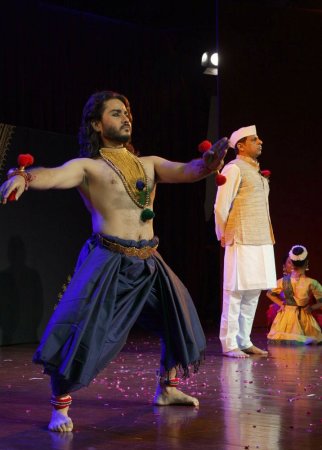
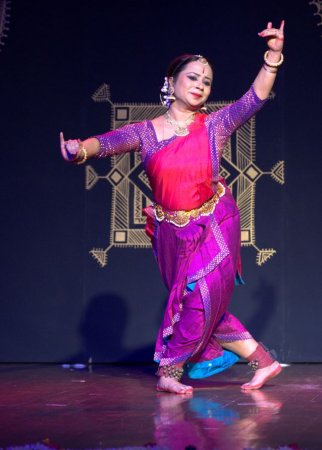
For such a sensitive human being as Gandhi, Partition was a rude shock - the terrible killings almost de-legitimizing his political approach, making him wonder if he had erred. The prelude to the first part shows a lonely, remorseful Gandhi full of self-doubt, wondering if he has compromised with evil. Favourite hymns associated with Gandhiji like "Raghupathy Raghava Raja Ram" and "Vaishnava Janato" rendered by the music ensemble with Ustad Arif Ali Khan on the harmonium, Vignesh on the midangam and Areeb Ali Khan on the tabla, had Arshul Ameen as vocalist - the last unfortunately having to grapple with sound balancing which played spoilsport on the first evening, with humming and echoes drowning out certain parts of the spoken or sung word, while making the decibel level too high for certain others. Not surprising perhaps that Ameen who sounded off-key in places, on the second evening more than proved his worth - his brief Durbari Kanada alaap along with the guitar play, very evocative. 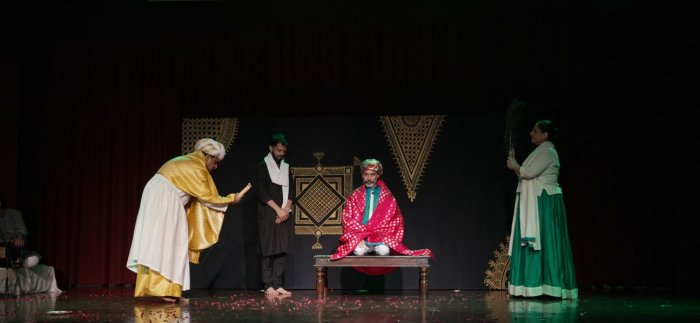 Performing to Gandhiji's favourite Bhajan "Vaishnava Janato," Bharatanatyam dancer Swarnali Kundu's interpretation was to the point and highly communicative. Equally impressive was Akash Mallick's Kathakali and Marga Natya, the latter category applied to contemporary dance fashioned by research scholar Piyal Bhattacharya, on the basis of his research and deep study into what is prescribed in the Natya Sastra - a holistic art combining dance, music, Instrumentation and acting. The compositions were chosen with care, starting with the sloka Akrodhen jayat krodham, asadham sadhana jayet, jayet kadaryam danenajayet satiate Janrutam from the Mahabharata appropriately defining Gandhiji's philosophy - of defeating negative attitudes in the oppressor by the force of the victim's positive attitudes - crushing anger with placidity, bad conduct with good conduct, mean nature with generosity and lies with the truth. The next sloka extolling the virtues of Ahimsa as the highest duty, the greatest endeavour, the best gift and Tapasya and the highest offering to God, applies equally to Gandhi's approach. In some scenes while dialogue between participants went on in episodes, the dancers in the hinterland, through movements, provided a soft backdrop. Actors who donned several roles, without any makeup, brought out the characters, each portrayed through mannerisms ascribed to the person, aided by typical cosmetic features like a shawl draped round the shoulder, spectacles hanging low on the nose bridge, the walking stick for Gandhi, the long cloak for Tagore etc. Joy Sengupta with his placid and measured delivery came across as a convincing Gandhi the first evening. The light hearted, almost amused expression submitting to being so wrongfully arrested after the Dandee March, after having already being subjected to all the police battering, again seemed very typical of Gandhi's impish sense of humour. The man was too intelligent not to have realized that the war was being won. With all the male leaders being arrested, the struggle continued with women volunteers like Sarojini Naidu and Kamaladevi Chattopadhyay taking up the cause. Bengal Congress in due course of time announced Astra Samarpan, in unity with Gandhi's non-violent struggle. Rajesh Kumar in Gandhi's role in the next presentation The Righteous Struggle was also impressive. The episodes in Satyagraha included Gandhi's speech during the inauguration of the Benares Hindu University in 1916, on the invitation of Annie Besant one of the main trustees. Short of becoming an embarrassment, Gandhi's speech, in his forthright manner, addressing the elite audience, pointed to the stark difference between the grand celebration there against the total disregard of the same elite for the impoverished labourers. Annie Besant's tact had to mollify the mood. 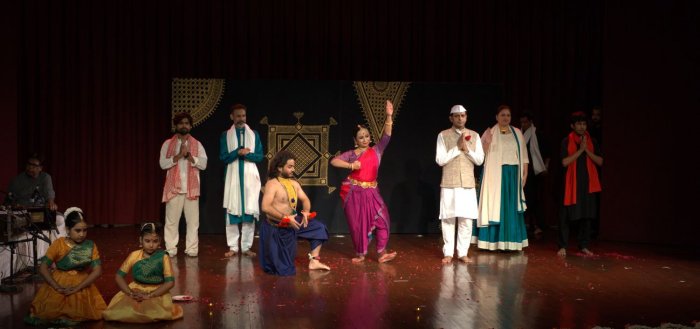 Tagore's songs like Ekla Chalo Re rent the air. Gandhi as Karma Yogi and Tagore as a patriot who however believed in modern methods of educating and equipping the Indian for a bright future, while friends with a lot of respect for each other, had their differences. "You compromise too much," said Tagore to Gandhi. "Swaraj cannot be won without the full participation of the people. Non-violence cannot be the only answer." But he cared for this unusual human being and when Gandhi was in Yerda Jail, Tagore composed the song Jiban jakan shukai ejai. Nehru's speech Tryst with India when Azad Hindustan was born ended the first part. For In Righteous Struggle, the packed auditorium at the Triveni (Oct 1, Delhi) was treated to some really inspiring music as well as dance passages interpreting various incidents. The translation into Urdu and Hindi was the work of Mahmood Farooqui, Dastangoi Collective Sibtain Shahidi and Rajesh Kumar with Vaibhav Ahunja, director, arranger and composer of original music items for the show. The music ensemble comprised lead vocalist Shirin David, Rishad Puri on Saxophone, Antonio Cardozo on double bass, Ascanius Cordozo on the piano, Arshul Ameen providing vocal alaap and guitar and Suranya Aiyar providing additional vocals. Soft Mindedness (Buddhiheenata) rendered by Lisa Richards, Jazz instrumental (track) heralds the start. Troll (music Richard Ames on clarinet and strings, Frederic Chopin, Waltz Op 69), based on the track for Eminem's Lose Yourself was Think with Me, written by Suranya and performed live. 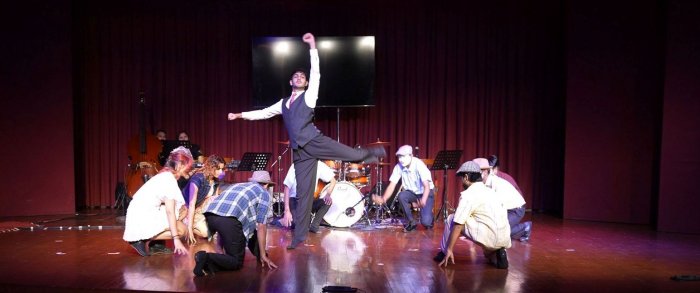 The Africa/American spiritual music saw many songs - I've been buked and I've been scorned, and the Prison Songs of the African American provided very moving moments. A figure like Booker T. Washington born as a slave in the cotton fields, was, after the Civil War and abolition of slavery, to become a great African American leader. William Edward Burghardt Du Bois, the great black writer became in his writings the voice of the disenfranchised African American in the South, where despite Lincoln's War, the African American was not independent. He described Gandhiji as the greatest coloured man in the world, and perhaps the greatest man in the world. One who gave Martin Luther King advice, Rev Howard Thurman was another important figure who came all the way to India to meet Gandhiji Frank Wilson, Juliette Derricote, Rev Mays, and many others like Mordecai Johnson travelled to India to meet with Gandhi. Gandhi's passive resistance with sit-ins like the one after the Bus Boycott incident were inspired by Gandhi's Civil Disobedience Movement. In Montgomery, AL, of 1955, 'Bus Boyakat' (boycott) had parallels with the Gandhian experience in Johannesburg, with Mrs Rosa Parks, despite her ticket, being told several times to vacate her seat for a white passenger. The Pietermaritzburg incident was depicted showing South Africa in 1893, when Gandhi with a first class ticket, was thrown out of his compartment onto the platform merely because he was not white. And how imaginatively the Ballet dancers Soumidepa Mandal and Deepanshu Tyagi along with the Jazz dancers Sumirna Kaoul, Sandeep Gautam, Prerna Verma with Vikrant Samrat as choreographer portrayed this incident, with half squatting passenger bodies with the slightest of movements side to side, showing they were passengers in a moving vehicle, with intervening characters of bus conductor, ticket inspector, police, Governor and various side roles. The pantomime artists were equally resourceful. But the image one carried home was Suranya's singing, belting out a song in full throated glory! 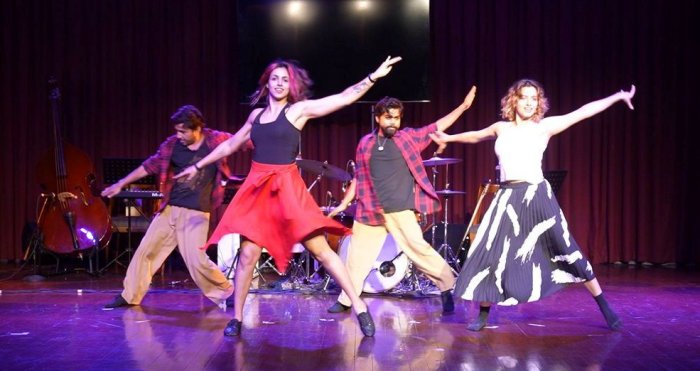 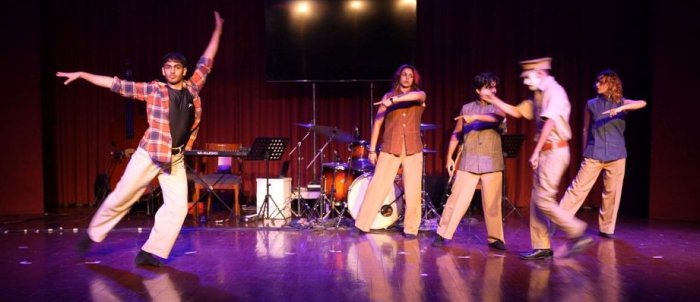 Video clippings underlined the famous speech of Martin Luther King. Another interesting event pertained to video clips of the 1936 Olympics in Germany, with every event won by a black, becoming an embarrassment for Hitler! There was impassioned reference to the idea of Vasudeiva Kutumbakam, to Nizamuddlin Aulia, to the Odes to Krishna written by a Sultan, but where is Gandhi today, was the question posed. In the prevailing world in which we live, asserting one's rights and ensuring them through aggression if need be being the norm, one wonders if this cuts into the very basis of Gandhi's philosophy. The conclusion was that ultimately Gandhi was a man of the times, when many people thought in terms of shedding materialistic power for the greater good of mankind as important. It would be well-nigh impossible today for example, to come across a mighty King like Ashoka, who after seeing the horrors and bloodshed of war that he had won so decisively, made up his mind, once and for all, to abolish war and preach peace through Buddhism to the world at large. This is a world where might is right and Gandhi's idea of truth seems misplaced. But can his idea of Vasudaiva Kutumbakam as an ideal ever be irrelevant? 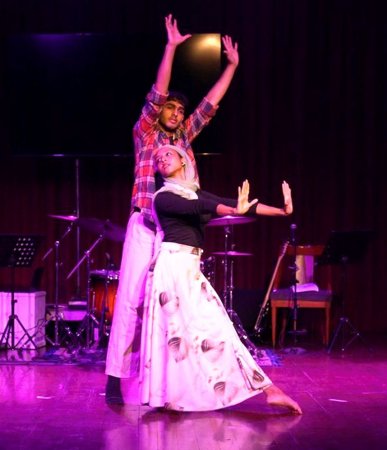 That Bhagyam Arts and Ideas has single handedly held these events every year, speaks of high commitment.  Writing on the dance scene for the last forty years, Leela Venkataraman's incisive comments on performances of all dance forms, participation in dance discussions both in India and abroad, and as a regular contributor to Hindu Friday Review, journals like Sruti and Nartanam, makes her voice respected for its balanced critiquing. She is the author of several books like Indian Classical dance: Tradition in Transition, Classical Dance in India and Indian Classical dance: The Renaissance and Beyond. Post your comments Please provide your name and email id along with your comment. All appropriate comments posted with name and email id in the blog will also be featured in the site. |
