
|     |
|
| |

 e-mail: leelakaverivenkat@gmail.com A fortnight of programs off the beaten trackSeptember 25, 2025 Coincidentally, it has been a fortnight for programs off the beaten track for Delhiites! BEEJA - SEED: MALAVIKA'S COMPULSIVE WAKE-UP CALL TO HUMANITY THROUGH BHARATANATYAM Photos courtesy: Kalavaahini Malavika Sarukkai's latest work, Beeja-seed, marking the tenth anniversary of Kalavaahini Arts Trust, founded with its multi-dimensional vision of 'fostering excellence in classical dance as a critical heritage of India', is designed as a clarion call to humanity to wake up and guard their planet Earth - the only home man has. The presentation at Delhi's Kamani auditorium on September 10 evoked appreciation and criticism (from the dancer group in particular), in equal proportions. The plot, as a blend of three Time zones, comprises the weight of remembrance from a hoary past with the experiences of a mixed present leading to the lurking fears of what the future may hold for mankind. While a packed Kamani auditorium in Delhi, at the end, acknowledged the performance with a standing ovation, the views in the foyer post recital, were very mixed. 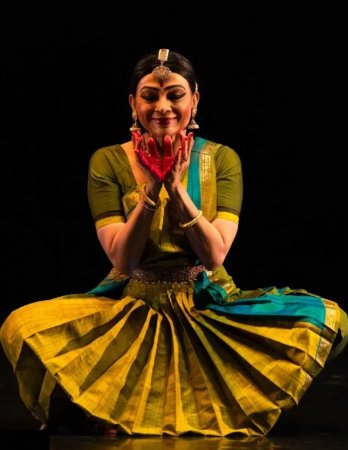 Malavika Sarukkai The message, imparted through a combination of immaculate angasudhhi, a hallmark of the dancer, was spurred by a burning inner fire for the cause - encased in a frame totally different from the margam version one is used to, with the dancer's search for a language within the classical parameters, aiming for the audience gut, rather than applause. A collaborative effort, Malavika's concept, as mentioned, involved hours of churning out ideas through exchanges with the main participants - comprising Creative collaborator Sumantra Ghosal, associated with the dancer's productions for some time now, helping convert the dancer's concepts into poetic word imagery, Rajkumar Bharati's musicscape in a range of octaves, inclusive of rhythmic interspersions, arrived at, after several exchanges and contributing ideas, from Sai Shravanam, whose ambisonic soundscape, was a blend of sounds classical and contemporary. Light designer Niranjan Gokhale's oh so subtle light designing, springing from a conviction of lighting design having to carry the mood forward, without becoming a 'barrier or disconnect' (which in the elegantly got up booklet as brochure, has been described as 'hinting and concealing,' perhaps erring on the side of too much restraint, elicited across-the-board criticism on 'totally missing out on mood building'. The production was ushered in with the sonorous chanting of the Hiranya Suktam in Sanskrit from the Vedas on the myth of the expanding Universe born from the golden womb and the cosmic seed. As the seasons roll on, Earth portrayed in her bounty - replete with the joys of Nature, has danced Images of birds engaging and delighting in love play, with dancing swans in the water- filled lakes during Varsha. There was mention of the swan's ability to separate milk from water, perhaps as a figure of speech only - for it did not seem to have anything to do with the danced version. Fleeting images of an elephant bathing, its raised trunk dousing it with water, of lioness sheltering cubs from other predators followed, with the most moving part portraying graceful leaps of fleet footed deer in the brightly lit plains, showing the doe preoccupied with her fawn. 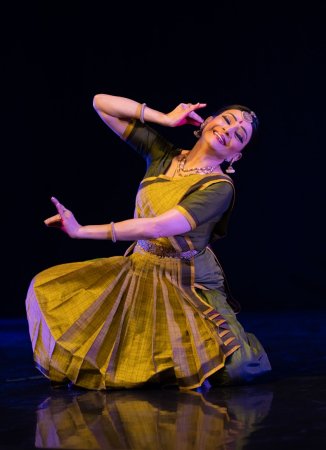 Malavika Sarukkai Since the work was aimed at corroded human sensitivity, the plaint, a dirge, about the state of the suffering planet, was from the hapless, less powerful of Nature's inhabitants. The final note of caution (the most sensitive part of the production, for this critic), of what avaricious Man is doing to his home, is sounded by the Tree (for which Malavika has always had a special reverence, as seen in her earlier works like Thimakka on the resourceful Karnataka tree planter). Spread like a canopy against the sky, born from the Beeja, it is one sentinel still holding on to its ground. The Tree it is, that has been witness to generations of Moving Time, in all her vicissitudes, and moods - through several histories with tales of wars and 'of Kings and Queens, of moving mountains' and of generations erased through Man's greed and war. But, wonders the Tree, 'If the ground is being cut from under my feet, where do I stand?' The dramatic impact in the end comes with a shatteringly loud blast, with the sad spectacle of the felled innocent deer. Some facts stood out for this writer. In a presentation spread a little over an hour, to have a solo dancer of Malavika's seniority, hold the stage from start to finish without a stop, speaks of rare commitment to the dance with undying dedication to maintaining fitness levels. I was amazed that with a choreography of constantly changing body levels, the dancer's execution, without a loss of fluidity, with the total adherence to stylized classicism and no trace of mongrelized movement were achievements in themselves, and there were some very evocative and powerful moments in the work. The sustaining power stems from the dancer's commitment to the cause of awakening the slumbering disregard for Man's Harakiri. The hard road and challenge of carving out new ways of presentation, underlining strong contemporary messages through Bharatanatyam, will not be an easy task. But conviction which has always been Malavika's strength will provide the way. KEELAKA DANCE COMPANY'S RIB TICKLING TAKE OFF FROM INDIAN MYTH Photos courtesy: Keelaka Dance Company Involving more than one group, the evening of Kalatra was sponsored by The Natya Ballet Centre under Radhika Hoon. Termed as a 'mélange of Bharatanatyam, Contemporary dance, poetry, drama and humour, based on Lord Murugan and his two charming consorts, Devayani (Devanai) and Valli', Kalatra staged at the Shri Ram Centre, Delhi, had the audience in giggles punctuated by peals of laughter. Scripted by Aneesha Grover of Keelaka Dance Company with the dance choreography involving Aneesha's Guru Jyotsna Shourie of Jyotsna Shourie Company, the female Bharatanatyam dancers, all trained under Jyotsna Shourie, belong to the Keelaka Dance Company while the main Modern dancer Benjamin as Muruga runs his own Modern Dance Company. In the role of the peacock was Joe Mathew, working as a school teacher. 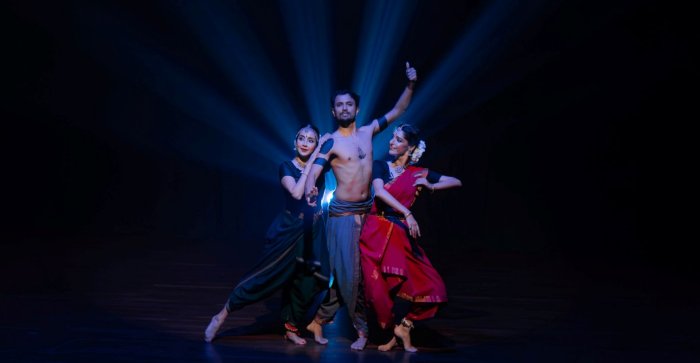 Aneesha Grover, Benjamin Jacob, Nandita Kalaan As a take-off from the Muruga myth, the plot is built round the two wives of Shiva's son Muruga, who in birth and upbringing represent two opposite ends of a spectrum. Born to the Gods, and the daughter of Lord Indra, Devayani (also called Devanai) who has been traditionally married to Murugan at Tiruparamkunram, symbolizes knowledge, aristocratic wealth and wisdom. Quite the opposite is Valli who, following a very involved birth, is discovered as a baby, by a childless Tondainadu hunter, who brings her up with joy. Full of rustic charm and playfulness, Valli catches the eye of Lord Muruga on a hunt and he falls for her unpretentious charm. The attraction the two feel for each other results in Narada, with his usual cunning, helping bring about the marriage. Playing Cupid with his flowered darts is Manmatha, ever willing to stir even calm waters, telling Devayani, "You are a classical celestial beauty, while Valli has celestial charm." To further complicate the situation, is the peacock, the vahana of Muruga, who arrives flapping his colourful wings. Dravidian myth in particular delights in the Valli / Devayani imbroglio, and in the south several humorous compositions, have been built round Muruga caught in the tug-of-war between the two women married to him. In the long run, husband of two women so far removed from each other's hemispheres, has Muruga enjoying the best of both worlds. 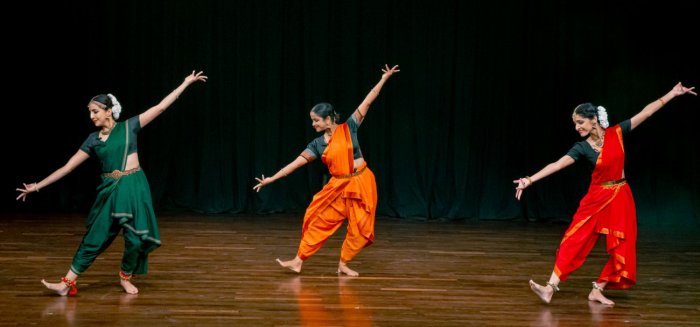 Aneesha Grover, Amrita Shivakumar, Nandita Kalaan The English script by Aneesha Grover, makes full use of the situation of both wives wanting to be the really coveted one of the husband. The play in many places resembles a long Ninda Stuti, peculiar to Hinduism with classical music having a lot of such compositions, wherein one praises the Lord (Stuti) through blame or abuse (Ninda) - an act carrying veneration. "He (Muruga) is the commander-in-chief of the army of the Gods!" boasts Devanai. "He is the one who taught even Shiva the secret of the mantra 'Om'!" boasts Valli. "Knowledge is nothing without power," says the other. There is a scene when Devanai like the typical khandita nayika, in a Padam suspiciously questions Muruga about the telltale marks on his body of intimacy with another woman. Where is your peacock? And she questions him about the wilted jasmine, the cheap sandalwood scent, and the long hair sticking to his upper body. But the punch line which led to guffaws from the audience was the statement "Devanai has major first wife energy, and she enjoys priority parking rights!" 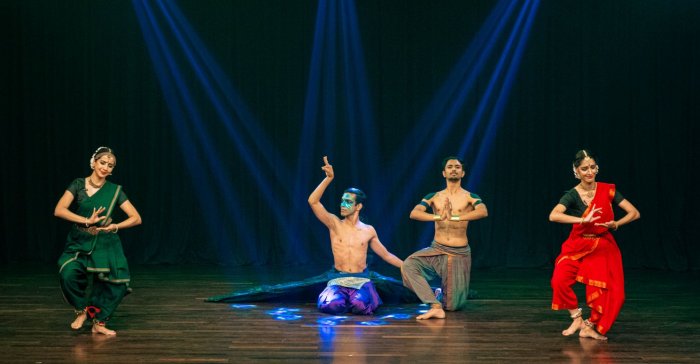 Aneesha Grover, Benjamin Jacob, Joe Mathew, Nandita Kalaan Shourie's choreography of the Modern Dance/ Bharatanatyam combine worked very well, the ease in the combination showing that the two groups had worked together in productions earlier. Leg stretches, geometry of profiled movements, were cleanly etched, and all the dancers were proficient, carrying a dialogue with spoken words, along with the dancing, with ease. Nandita Kalaan and Aneesha Grover were Valli and Devayani respectively. Amrita Shivakumar was Kamadev. The mixed western/Carnatic music was composed by Daniel George the Bollywood composer, and O.S. Arun, with Neal Sekri and Anant Ahuja providing Madstarbase adding electronic music and sounds. SRIDHAR VASUDEVAN'S SAPARYA MESMERISES AUDIENCE Photos: Vinay Tiwari The crowning event of the fortnight, judged by the most exacting standards of excellence, was Saparya by Dr. Sridhar Vasudevan, the most undervalued of artistes among classical dancers. Transcending mere entertainment, the performance Saparya as an offering on his birthday at the Stein auditorium, Delhi, was a weaving together of esoteric concepts in Hinduism prescribed in Shastra - wherein the subtle cosmic energies imbedded in Yantra, Tantra, Nada, Mantra, awakened through a methodology, wherein form, sound, gesture, devotion of the spoken sound, are all woven into a deeply devotional exercise, aimed at awakening a higher state of consciousness. That the compositions of the Carnatic Musical Trinity of Muthuswamy Dikshitar, Tyagaraja and Syama Sastri, representing a wellspring of bhakti are regarded as constituting a significant starting point to this deeply spiritual exercise of Saparya, where every note, word or musical movement is meant to be a sacred offering, is not surprising. 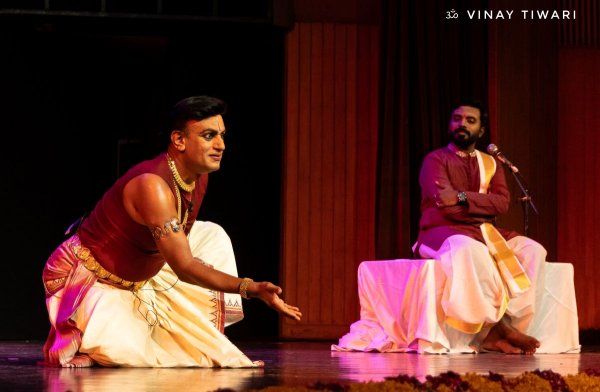 Dr.Sridhar Vasudevan The journey in Yantra - Saparya, representing the start of the process "of unearthing the mystic energies into accessible forms" begins with the form of the Triangle, the three-cornered form with a focal point for energies to converge. The starting point of an exercise is with homage offered to Ganapati, who is the deity representing the Mooladhara Chakra, the starting point of energy centres located at the base of the spine - to be awakened first on a road to the final point of Moksha right at the top. Muthuswamy Dikshitar who is said to have believed in the Sri Vidya Tantric traditions with deep belief in these esoteric concepts, has composed sixteen Ganapati compositions, for each type of Upacharam of Ganesha. His composition in Bilahari on 'Ekadanta Ganapati' (Ganesha with a lone broken tusk) made into a danced exercise by Vasudevan, wherein from formlessness gradually emerges the outline of a definitive form through gesture and rhythm, called for above all, knowledge combined with total belief, to visualize the concept. The Mantra part was illustrated through Tyagaraja's composition and this composer's single-minded devotion, using form and the sound with which he evoked this state, was worship of Rama. The saint poet's composition "Tulasi talamulase santoshamuga poojindu" in the raga Mayamalavagowla comprised, chanting his name offering puja through different types of flowers. In the Anupallavi "Palamaru chirakalamu paramatmuni pada mulanu," when the composer mentions worshipping the feet of the Lord with leaves of Tulasi, Vasudevan sang while dancing. A measure of his expertise was the fact that neither the dance lines nor the rhythmic exactitude seemed affected by the full-throated, melodious singing. Trained as a Bharatanatyam artiste under Dr. Vyjayantimala Bali, with a doctorate in Carnatic Music from Delhi University, trained under Dr.Radha Venkatachalam along with deep research under Late Kamalini Nagarajan Dutt, Vasudevan is a dancer whose art is based on and backed by shastric knowledge. 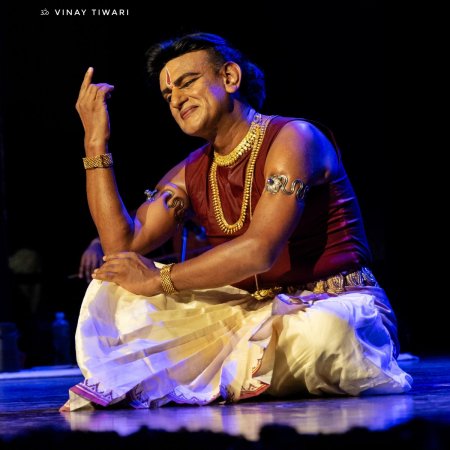 Dr.Sridhar Vasudevan The manner in which he presented the finale of Tantra, suggesting the unified strength linking matter and spirit was through the Syama Sastri composition "Rave Himagiri Kumari Kanchi Kamakshi" in raga Todi. A Devi upasaka, the composer calls out to the daughter of the snow-clad mountains to come down to bless him with her darshan. A blend of tala, laya and gamaka, the composition in its detailed description of the Devi and her power, brings out the slow spun soporific dignity and power of the melodic mode of Todi. Fully matching in quality was the accompanying music for Saparya, with an excellent singer in Sweta Prasad. Providing equally evocative rhythmic support on the mridangam was Manohar Balatchandirane, with tuneful violin by G. Raghavendra Prasath. And what a revelation Sridhar's student Ananyaa Shankararaman was with her nattuvangam! Ever helpful in providing vocal support for programs and assisting in ideas laying out the blueprint for programs by fellow dancers, this all-pervading talent sits lightly on Vasudevan's shoulders. While Padma Bhushans and Padma Shris abound, this excellent artiste, modest to a fault, has not even merited an SNA award! Such are the ironies of the art world! 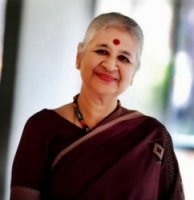 Writing on the dance scene for the last forty years, Leela Venkataraman's incisive comments on performances of all dance forms, participation in dance discussions both in India and abroad, and as a regular contributor to Hindu Friday Review, journals like Sruti and Nartanam, makes her voice respected for its balanced critiquing. She is the author of several books like Indian Classical dance: Tradition in Transition, Classical Dance in India and Indian Classical dance: The Renaissance and Beyond. Post your comments Please provide your name and email id along with your comment. All appropriate comments posted with name and email id in the blog will also be featured in the site. |
