
|     |
|
| |

 e-mail: leelakaverivenkat@gmail.com Tradition in TransitionAugust 12, 2025 Attracting a small, interested gathering was the evening of lecture/demonstration at Srinivasa Gandhi Nilayam in Chennai's Ambujammal Street, Alwarpet, by Bharatanatyam performer and teacher Sunanda Narayanan, settled in Boston. A long-time student of Guru Rhadha, Sunanda's teaching pertains to the Vazhuvoor Bani of Bharatanatyam. Her lucid lecture threw some light on the challenges of teaching an Indian dance tradition to students in the United States. 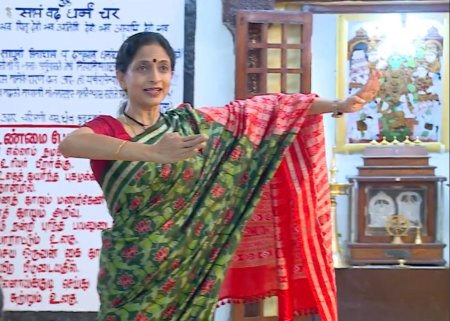 Sunanda Narayanan Substantiating the lecture with demonstrations was student Divya Rajan, whose performance, with long-limbed grace and poise, was characterized by impeccable technique. As the years go by, increasing internalization is bound to make the interpretative part acquire greater depth. It is in the abhinaya items, wherein the challenges of passing on the tradition to students living outside the cultural frontiers within which a form of dance has evolved, are greater. Even in Divya's case, given the basic cultural affinity as an Indian belonging to Tamilnadu, in a Tamil padam like "Etthanai sonnalum ariyadavar pol" depicting a mother chiding the daughter to go back to the husband, instead of constantly indulging in arguments, disagreeing with him and escaping to the parents' house, the moral in the composition (of the wife having to be the inferior partner ever subduing to the husband), is at variance with ideas shaped, growing up in the United States. Sunanda is right in allowing Divya the freedom of interpreting the padam in her own way. As for dancing to "Marangalai paduvane" (selected parts of Vairamuthu's modern Tamil poetry, set to music in Reetigowla by Sujatha Vijayaraghavan in 1992) addressing Nature, in the ecological message which is in tune with modern thinking, one saw a fully animated dancer. 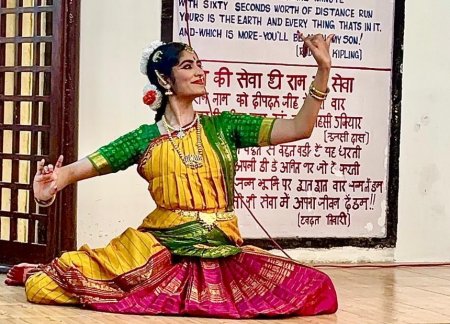 Divya Rajan The evening for me brought home the larger aspect of what happens to traditional dance forms in transition. I recollect Guru Kelucharan expressing to me a feeling of Odissi not being presented the right way by some dancers living abroad. But when Gurus themselves have travelled all over the world, eagerly teaching foreigners, helping expand the dance they represent with such pride, how could they now grumble about what is happening to the form they worked hard to spread? Having taught foreigners your language, one cannot be unhappy about the way the language is used, and what is said in that language. Ramli Ibrahim, a top student of late Guru Debaprasad Das, who has even merited the Padma Shri for his work in Odissi, is often criticized for some of his work as being against the 'spiritual content' of Odissi. He gets less praise, it would seem, for his efforts in finding lebensraum as permanent space for Odissi (which has evolved round Jagannath worship) in a Muslim country. Along with global spread, will come changes - some enriching and others which some may feel are not so desirable. One cannot own or claim a proprietorial right over an Indian art form evolving in its own way on foreign soil. When within India, historical changes from Sadir to Bharatanatyam are questioned, how can one expect the art form as practiced in foreign countries, not to have changes in approach and themes they present through the art form? Art traditions not restricted to a Robinson Crusoe existence on an isolated island, with spread cannot remain unchanged. Traditions born and nurtured for years in a certain cultural soil, have a form and content. In dance, the form involving the physicality of the body, also has a memory passed on from generation to generation - which is also conditioned by years in a particular cultural environment. Dances in the stylized technique, when passed on through travel to interested clientele brought up in foreign cultural environments, can be, and are being continually mastered in grammar. But here too, the conditioned body with its body memory, can be a giveaway, when it presents a form foreign to it - in the way the body is held for example or also in a movement like a leap. Going from an Indian dance form, where the body with its feet firmly planted on the floor, is completely in tune with gravitational forces with body weight downwards, to a western form like Ballet, where the upward body thrust, with leaps, calls for making the body lighter to take off into air space, involves a change which could be challenging. It is in the dance content however, spurred by the cultural soil in which it lives and evolves, that one is bound to find greater changes. The use of Kathak, brilliant in technique, that one sees in an Akram Khan production for example, is very different from the classical Kathak presentation seen in India. Late Pandit Birju Maharaj, credited with putting Kathak on the international stage, said to me in a conversation, that teaching foreigners a 'ta thai thai tat' is not as difficult as making them understand a concept like 'lajja,' which is so much more than just shyness, as an essential part of sringar. A veteran Bharatanatyam performer, settled in America's Orange County, with a large student clientele, once spoke about naivety of students asking her, "Why this constant cry for the Nayak? Don't they have dating in India?" Bharatanatyam dancers from India going abroad on short teaching assignments, have mentioned how one needs to tread carefully while dealing with interpretative items. I am reminded of Ratan Thiyam, the theatre luminary, who recently took his last bow, working with Chorus Repertory Theatre he created, and his understanding of modernity, while dealing totally with his theatre language which came from Manipur's tradition of body languages like Manipuri and Thang-Ta. The script is the same, he said, but with different interpretations. What he had to say, in his own language, communicated with the contemporary theatre goer, in the most mesmerizing way, in all his theatre productions. This same challenge of being able to speak and communicate with contemporary audiences in an old language, without losing essential character, is part of all traditional dance languages, as they travel through the corridor of time. 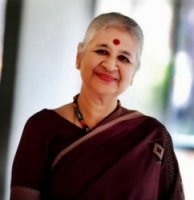 Writing on the dance scene for the last forty years, Leela Venkataraman's incisive comments on performances of all dance forms, participation in dance discussions both in India and abroad, and as a regular contributor to Hindu Friday Review, journals like Sruti and Nartanam, makes her voice respected for its balanced critiquing. She is the author of several books like Indian Classical dance: Tradition in Transition, Classical Dance in India and Indian Classical dance: The Renaissance and Beyond. Post your comments Please provide your name and email id along with your comment. All appropriate comments posted with name and email id in the blog will also be featured in the site. |
