
e-mail: leelakaverivenkat@gmail.com
Sougandhika Centre's Lasya Lahari showcases
new vitality of Mohiniattam
Photos: Haree
August 8, 2025
It was at Tagore Hall of Trivandrum, that Sougandhika Centre for
Mohiniattam, established in 2003 by Mohiniattam veteran Dr. Neena
Prasad, observed its Lasya Lahari 2025 on July 27, 2025. The programme
featured, apart from established senior dancers of the institution,
fifteen youngsters celebrating their Margapravesam (formal arangetram
like stage initiation). The ambit of the performance in its variety
showcased the expansive thrust flowing from a dancer, who combines
performance with deep scholarship, with her dance studies including a
Doctorate. The understanding of the why of movement, coupled with
performance excellence, makes for a dancer whose creativity can open the
art form to new vistas, without damaging its stylistic
characteristics. And in Neena Prasad's case, the art journey has
included artistic support from musician Changanasseri Madhavan
Namboothiri, whose Carnatic music compositions, along with his vocal
support, make for an excellent take-off point for all her work. This
fruitful, unbroken artistic collaboration has had the full support of
Neena's Guru, dancer and choreographer Kalamandalam Sugandhi.
Contrary to Kavalam Narayana Panicker's prescription that music for
Mohiniattam should pertain to the Sopanam tradition alone, Kalamandalam
trained dancers, have always based their Mohiniattam on Carnatic music,
which, with its long history, certainly provides a larger musical
framework and base for dance work.
While the altar on the side of the stage carried a Nataraja image in the
Bharatanatyam mode, what was presented, in the Kerala mode, was in
praise of Padmanabha and Rama, with sequences from Vishnu Puranam.
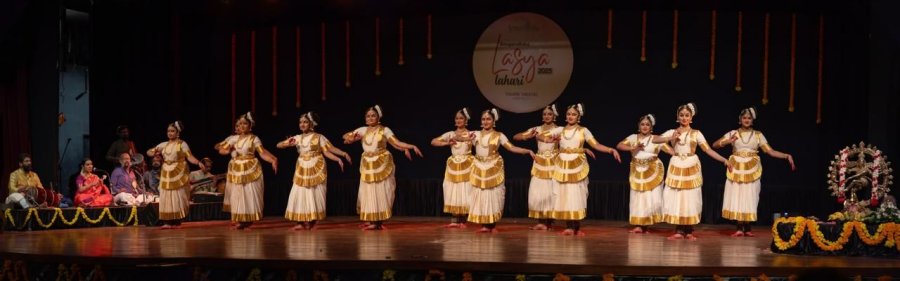
The programme began with a Cholkettu in Kedaragowla, a composition of
Madhavan Namboothiri, which was followed by the Krithi in Reetigowla set
to roopakam. The praiseworthy group discipline with such a large
group performing was visible right from the start - as in a "Shantakaram
Bhujagashayanam" slokam, with eye catching ensemble images, involving
several dancers. Neena intelligently grouped the performers, with the
young Margapravesam group in one cluster, with seniors on two sides and
in the brief episodic treatments, dancers in assigned roles momentarily
stepped centre stage before merging with the group - with both young and
experienced very expressive. Episodes like Gajendra Moksham, or the
saving of drowning Bhumi Devi held aloft by Vishnu as the boar in Varaha
avataram, were all deftly projected in fleeting tableau like images.
Going beyond the much- rendered items, what came through pointed to
meticulous training with good grasp over technique and dance line. And
more than anything else what struck this critic was that each dancer
while maintaining immaculate dance profile, remained an individual,
without becoming a carbon copy of Neena (an ailing which so often
confronts a lot of youngsters training under very famous dancer /
teachers).
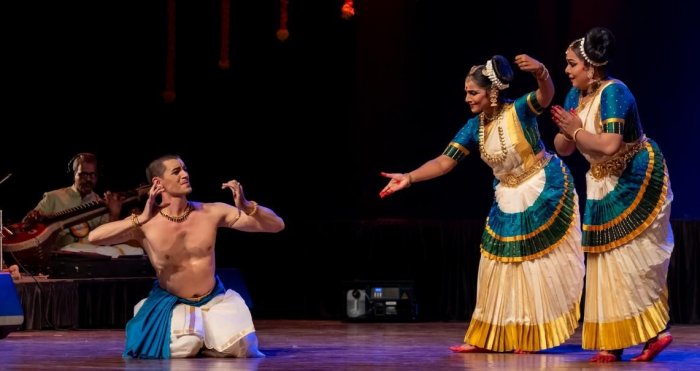
After a fine presentation of the traditional Swarajathi in
Ragamalika in misrachapu talam, set to Kalyani, Begada, Athana, Thodi
and Suruti, came the centre piece Sthava Varnam, "Rama ava akhila ripu
vairaama," which as an old Swati Tirunal composition set to a raga
at a
pace not suiting the slow spun grace of Mohiniattam, was reset by
Madhavan Namboothiri in Shankarabharanam. The item underlines how Rama's
love for Hanuman is the cause of jealousy. 'What was, after all so
difficult about the bridge that Hanuman built, to cross over to Lanka?
Surely Rama with all his physical prowess could have managed to have the
bridge built without involving Hanuman who acquired all the credit.'
Arjuna, the tallest among the Pandava warriors, is approached and
challenged to build the bridge. The instant, the by then aged Hanuman,
sets foot on it, the bridge collapses. Realization sets in that there
was more to the endeavour than realized - for the act entailed, along
with the high physical achievement, power and confidence flowing from
Hanuman's steadfast loyalty and faith in Rama.
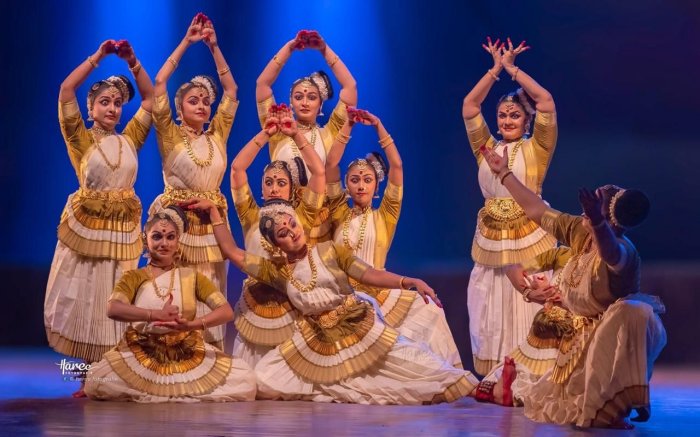
And here the turnout for the
entire group with hair in a side topknot, decorated with jasmine, draped
in the all-white costume, with just a dash of colour as counterpoint
contributed by the blouse and matching frills below waist - along with
minimal jewellery of typical Keralite vintage, made for soothing
aesthetics. In the Varnam, the way the only male dancer Thomas Vo Van
Tao, in an all Nayika group, was turned out, in the elegant off-white
dhoti, with a short green matching frill falling from one side of the
body, spoke of aesthetic costume sense (kudos to the costume designer) -
without resorting to any stree vesham.
That the body as a vehicle of communication is not gender-bound, was
underlined, with the dancer, in one varnam sequence, becoming the
momentary stonelike Ahalya cursed by her husband, rishi Gautama - till
redeemed by divine contact with Rama's feet. Further establishing that
the dance body could be trained to evoke both femininity and maleness,
was Thomas' solo presentation of the Irayimman Thampi padam in Asaveri
ragam, "Entaho Vallabha," wherein the Nayika addressing the Nayak,
wondering about his indifference to her in spite of her deep love for
him, entreats and persuades him to accept her love. The internalized
depth of the dancer's abhinaya, with woven sancharis of persuasion -
like leading the Nayaka to the bed, made with such loving care, spoke of
both commitment and understanding of the mood of the sahitya.
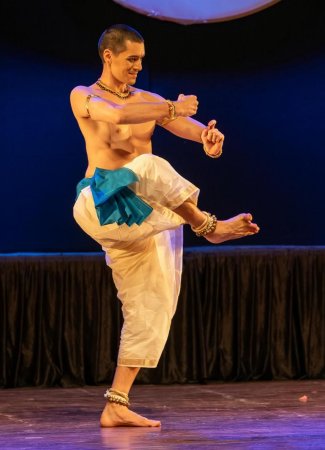
Thomas Vo Van Tao
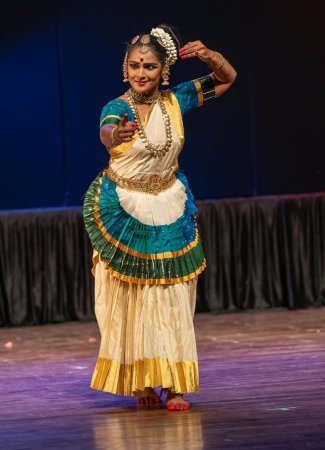
Vidya Pradeep
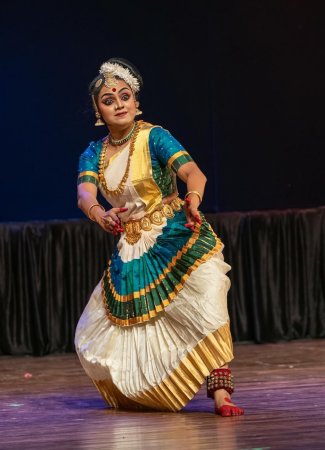 Juni Menon
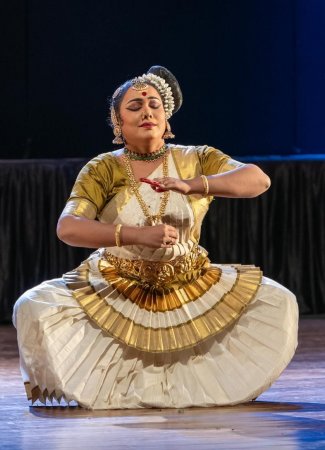 Aswathy Krishna
Going beyond the much-rendered items in Mohiniattam were additions out of the usual, like Jnanapana,
the composition again a creation of Madhavan Namboothiri, in a
Ragamalika incorporating ragas Bilahari, Chalanattaa, Vijayanagari,
Chenchurutti set to Talamalika khandachapu and adi.
Striking a nationalistic mode was the group performing to 'Vande
Mataram.', set to ragam Kuntalavarali. Tillana in Hameer Kalyani saw a
slightly faster tempo than associated normally with Mohiniattam, without
mangling its aesthetics. Finale of Mangalam was set to music in
Yadukula Kamboji and Madhyamavati.
The real success of Neena's efforts, for this critic, lay in the smiles
and praise of her Guru Kalamandalam Sugandhi, who feels that the seeds
sown in her student, of looking beyond the traditional format to
revitalize a form, had borne fruit. With its slender, oft-rendered
repertoire, Mohniattam, which was not finding a larger space in the
performance scenario of the country, is now on a level, with other dance
forms. Neena has shown the way.
Writing on the dance scene for the last forty years, Leela
Venkataraman's incisive comments on performances of all
dance forms, participation in dance discussions both in
India and abroad, and as a regular contributor to Hindu
Friday Review, journals like Sruti and Nartanam, makes her
voice respected for its balanced critiquing. She is the
author of several books like Indian Classical dance:
Tradition in Transition, Classical Dance in India and Indian Classical dance: The Renaissance and Beyond.
Post your comments
Please provide your name and email id along with your comment. All appropriate comments posted with
name and email id in the blog will also be featured in the
site.
|